

A strong ethical framework provides the foundation for a trusted and respected financial advice profession.
This article, proudly sponsored by GSFM, examines standards seven to twelve of the Code of Ethics. Standards one to six were examined in a previous article you can read here.
The Financial Planners and Advisers Code of Ethics 2019 (Code) is principles based. It applies to a wide range of situations that require advisers to exercise their professional judgement. Professionalism is a frequent topic of discussion in the industry, and for good reason: it’s essential to the future success of financial advice.
What is professionalism?


Professionalism covers a lot of ground. It means delivering on your promises, putting your client first and providing services to the best of your ability. It means keeping your knowledge and training current, understanding the laws and principles that define your role and operating within them. Professionalism helps you inspire others, both within and outside the industry, and gives you a sense of satisfaction at having delivered real value to your clients through your guidance and advice.
A guiding principle of professional financial advice is to always act in the best interests of your clients, in the same way any reasonable person would expect their doctor, dentist, accountant or other service provider to act: professionally, with your interests front and centre.
A focus on professionalism benefits you, your practice, the financial advice industry and, crucially, your clients. As the industry becomes increasingly professional, those who lack the appropriate professionalism stand out and, over time, will be filtered out. Professionalism builds trust, and trust builds long term relationships. Both are essential to both a successful advice practice and a successful, growing industry.
The Code of Ethics
The Code is comprised of twelve standards which, in turn, are based on five values. These were detailed in part one of this article.
The standards are not intended to provide a compliance checklist; the intent is for you to make active decisions that result in ethical behaviour and the prioritisation of every client’s best interests. Section 961B of the Corporations Act 2001 (the Act) lists the steps an adviser must take to satisfy the ‘best interests’ standard, which is central to the Code.
In brief, these steps are:
- To identify the client’s financial situation, objectives and needs
- To identify the subject matter of the advice sought by the client (whether explicitly or implicitly)
- To identify the client’s relevant circumstances – the objectives, financial situation and needs that would reasonably be considered as relevant to advice sought on that subject matter
- To ensure this information is complete and correct; enquiries should be made if gaps or inconsistencies are apparent
- To identify whether you have the relevant expertise to provide the client with advice on the subject matter sought and, if not, decline to provide the advice
- When considering the advice sought, whether it would be reasonable to consider recommending a financial product; if it is deemed relevant, they should only recommend a product after thoroughly investigating the most appropriate products relevant to the client’s circumstances
- When advising the client, the financial adviser must base all judgements on the client’s relevant circumstances
- Take any other step that, at the time the advice is provided, would reasonably be regarded as being in the best interests of the client, given the client’s relevant circumstances
This final point is designed as a ‘catch all’, a statement that encapsulates the spirit of the legislation. Irrespective of the client’s requirements, the advice must be underpinned by knowledge of the client and their circumstances.
While the best interest duty applies to retail clients, a similar fiduciary duty is required for dealings with wholesale clients. To meet the obligations imposed by section 961B of the Act is the basis of ethical behaviour in dealing with clients.
Relevant providers
The legislation identifies ‘relevant providers’ as those who must abide by the Code. Relevant providers are defined as an individual who is:
- A financial services licensee
- An authorised representative, an employee or director of a financial services licensee
- An employee or director of a related body corporate of a financial services licensee
Any individual listed on ASIC’s Financial Advisers Register as authorised to provide personal financial advice to retail clients – as the licensee or on behalf of the licensee – in relation to relevant financial products is considered to be a relevant provider.
The Code is compulsory for all relevant providers and responsibility for applying the principles of the Code falls on individuals. In the event of a review by a licensee or regulatory bodies, advisers must be prepared to provide details of their interpretation and application of the Code in relation to specific clients and situations.
Financial services licensees also have a role under the Act to monitor and enforce compliance with the Code. Licensees are required to structure their business operations in a way that facilitates their authorised representatives being able to operate ethically and comply with each of the twelve standards that comprise the Code.
Ethical competencies
The Code contains twelve standards grouped under four ethical competencies:
- Ethical Behaviour (standards one to three)
- Client Care (standards four to six)
- Quality Process (standards seven to nine)
- Professional Commitment (standards ten to twelve)
Each of these ethical competencies contains three standards, which, in turn, contain ethical principles. In applying these principles, advisers are expected to exercise professional judgement according to the specific circumstances of each individual client. As stated earlier, the standards are not a compliance checklist. Rather, they are a set of guidelines to ensure your advice is in the best interests of each client, steered by the values that underpin the Code.
While ethics is defined in many different ways, it can be broadly distilled as a system of moral principles that is concerned with what is good for individuals and society. In the world of financial advice, it means treating your clients fairly, acting in their best interests always and acting with honesty, integrity and competence. In short, embodying the values upon which the Code is based.
Quality process
Quality processes encompass standards seven to nine and while these standards encapsulate all the values upon which the standards are based, those of honesty, integrity and competence are highlighted.
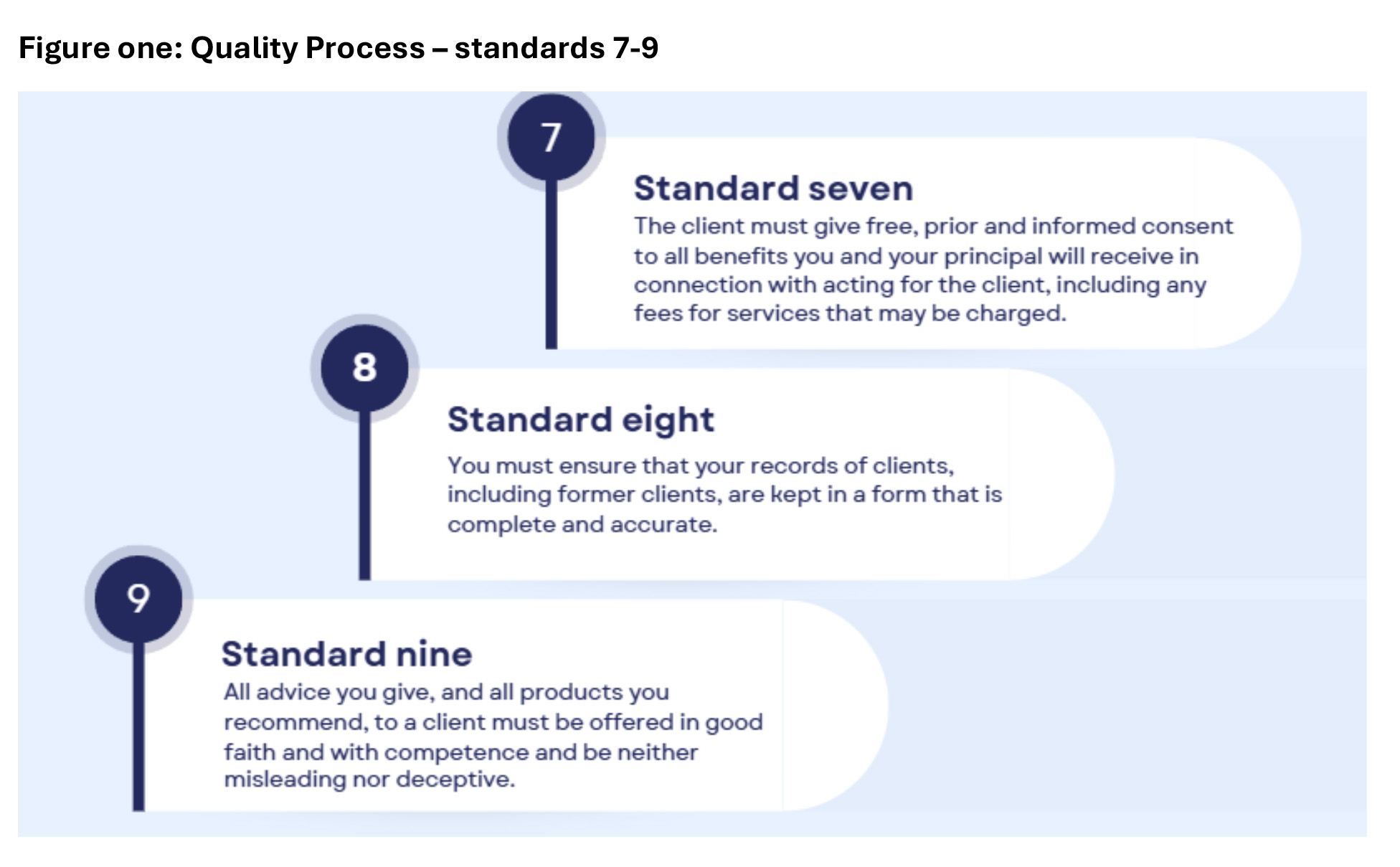
Figure one highlights each of the standards that fall under the competency ‘Quality Process’.

Standard seven
The purpose of standard seven is to ensure clients freely give ‘informed consent’ to benefits the adviser (or licensee) will receive, and that this consent is obtained before the client receives advice. It is important to note that benefits are not limited to fees and charges.
As well as disclosing – and receiving consent for – the charges to the client and benefits to the adviser or licensee, standard seven requires that:
- Unless expressly permitted by the Act, advisers may not receive any benefits, in connection with acting for a client, that derive from a third party other than that adviser’s principal
- Fees should reflect the benefit to clients over the long term balanced by the costs in providing the advice
- Advisers must be satisfied that any benefits received in connection with acting for the client are fair and reasonable and represent value for money.
The requirement to limit the benefits an adviser may derive from a third party is intended to reduce the likelihood of third party influence on the advice given. Many of the recent cases involving advisers and licensees with respect to the First Guardian and Shield Master Funds would likely have breached standard seven.
As regularly highlighted by the trade media, breaches of standard seven continue to blight the financial advice industry, which reflects poorly on all participants. That itself is a breach of an ethical standard, as you will read later in this article.
Case study – Undisclosed third-party benefits
Adviser Craig operated as an authorised representative of ACME Advice, a mid-sized licensee. Over an 18-month period, Craig received referrals from a lead generation firm that cold-called consumers about their superannuation. Clients referred through this channel were consistently advised to roll their existing super into a choice fund on a specific platform, then invest a large share of that balance into two unlisted managed investment schemes marketed as offering strong, stable returns.
Craig did not disclose to these clients that the lead generation firm received a fee for each successful referral, structured as a percentage of funds invested, paid indirectly through arrangements with the platform and fund promoters. Statements of Advice referenced ‘adviser service fees’ but gave no detail on the source, size or structure of these third-party payments. Clients signed consent forms bundled into the broader advice paperwork, without a clear or separate explanation of what they were consenting to.
Standard seven requires that a client give free, prior and informed consent to all benefits an adviser or their principal receives in connection with acting for that client, and that any fees charged are fair, reasonable and represent value for money. Advisers may not receive benefits from a third party outside their principal unless expressly permitted under the Act.
Craig’s conduct breached standard seven in several ways:
- Clients were not given a clear, separate explanation of the referral payment arrangement before receiving advice, so consent was not properly informed
- The benefits flowing from the lead generator to the platform and fund promoters, and indirectly connected to Craig’s advice, were not disclosed at all
- The fees charged bore no clear relationship to the scope or complexity of the advice given, undermining the ‘fair and reasonable’ requirement.
When the underlying schemes – the Shield Master Fund and First Guardian Master Fund – experienced severe liquidity issues and investor losses mounted, ASIC’s review of adviser conduct in this space identified referral-linked recommendation patterns as a recurring red flag. Advisers found to have failed proper disclosure and consent obligations connected to these schemes have faced banning orders, some for periods of five to ten years, along with referrals to AFCA and the Compensation Scheme of Last Resort for affected clients. ACME Advice faced its own scrutiny for failing to monitor referral arrangements and adviser conduct across its authorised representative network.
Standard eight
Standard eight requires financial advisers keep complete and accurate records of advice and services provided to clients. It also requires that:
- Advisers meet legislative requirements relating to the secure storage of client records
- Client records must be complete and accurate for both current and former clients
- Records should include file notes of discussions
- Client records must be easily accessible.
Whether using a paper or online record system, client records should be kept in one place, with appropriate security measures in place. Because of the increasing propensity to use cloud services to store records, mitigating cybersecurity risk is increasingly important.
Case study – Good record-keeping
Kaye is a financial adviser at ACME Financial Advice. Her clients, Mary and Alex, engaged her to manage their investments with the goal of long-term capital growth. During their initial consultations, Kaye completed a thorough risk profiling process and documented that both Mary and Alex identified as growth-oriented investors, comfortable with short-term market fluctuations in exchange for higher long-term returns. Based on this profile and their stated objectives, Kaye recommended a portfolio weighted towards growth assets.
Sometime later, Mary and Alex decided they wanted to access their investment capital earlier than originally planned. At that point, due to broader market volatility, their portfolio was showing a capital loss. Believing Kaye’s advice had caused the loss, Mary and Alex lodged a complaint with AFCA.
Mary and Alex’s position was that the growth investments Kaye recommended were unsuitable and had directly caused a financial loss. Their complaint centred on two claims: that the advice hadn’t matched their risk tolerance, and that Kaye hadn’t adequately explained the possibility of short-term losses when they first agreed to the investment strategy.
Because Kaye maintained detailed and contemporaneous file notes throughout her relationship with Mary and Alex, she was able to provide AFCA with clear evidence of the advice process, including:
- The original risk profiling documentation, showing Mary and Alex’s own responses indicating a growth risk tolerance and a long-term investment timeframe
- File notes from the advice meeting, recording that Kaye had explained the nature of growth assets, including the likelihood of short-term volatility and the possibility of capital loss over shorter periods
- The Statement of Advice, which set out the recommended strategy, the reasons it was appropriate for their stated objectives, and the risks associated with it in plain language
- Ongoing review notes, showing that Kaye had checked in with Mary and Alex at agreed intervals and confirmed their objectives and risk tolerance hadn’t changed
- A record of the conversation in which Mary and Alex first raised the idea of accessing their capital early, including Kaye’s explanation of the impact this timing would have given current market conditions.
Taken together, these records gave AFCA a complete picture of the advice process from beginning to end. They showed that Kaye’s recommendation had been based on Mary and Alex’s own stated objectives and risk tolerance at the time, that she had clearly explained the risks involved, and that the capital loss they experienced was a result of choosing to withdraw funds earlier than planned during a period of market volatility, not a result of unsuitable advice.
AFCA found in Kaye’s favour. The determination centred on the fact that Kaye could clearly demonstrate the basis for her original recommendation and show that it aligned with what Mary and Alex had communicated about their goals and risk tolerance. Her records also showed that the risk of short-term loss had been explained at the outset, which meant Mary and Alex’s decision to withdraw early, rather than the original advice, was the more direct cause of the loss they experienced.
This case illustrates the practical value of standard eight. Kaye’s advice itself may well have been appropriate and well-reasoned, but without documentation to demonstrate that at the time it was given, she would have had little to rely on beyond her own recollection of events that occurred months or years earlier. Her file notes, risk profiling records and Statement of Advice gave AFCA an objective, contemporaneous account of the advice process, which is what standard eight is designed to support.
Standard nine
Standard nine requires that any financial product advice, and all financial products covered by that advice, are offered to each client in good faith and with competence. This covers the following broad requirements:
- Advisers offering financial product advice and recommendations must have the knowledge and competence to provide the advice
- The advice and product recommendations must be in the best interests of each client
- The advice and product recommendations must be delivered in a way the client can easily understand and take at ‘face value’
- The advice and product recommendations consider the broad effects arising from the client acting on the advice and the broader, long-term interests and likely circumstances of the client
- Advisers identify any risks to the client and discuss them openly and honestly.
Advisers are expected to investigate each financial product they recommend. This means having enough knowledge and understanding of the product, including its benefits, risks and costs, to recommend it with confidence.
The legislation also makes clear that advisers are not acting in good faith if they’re aware, or should be aware, of something that would suggest their advice isn’t in the client’s best interests, once the broader and long-term effects on the client’s circumstances are considered.
Standard nine also reflects existing law: financial product advice and recommendations must not be misleading or deceptive.
Case study – Failure to act in good faith
Hannah, 58, held around $340,000 in a large industry super fund. She was contacted by a lead generation firm offering a ‘free superannuation health check’ and referred to Martin, an authorised representative of ACME Financial Advisers. Martin recommended Hannah roll her entire balance into a new platform and invest a significant portion into an unlisted managed investment scheme, presenting it as offering strong, stable returns with modest risk.
Martin had not reviewed the scheme’s product disclosure statement in detail, was unaware of its underlying asset composition and had not checked whether the scheme held the licences and registrations it claimed. He was unaware of the mounting concerns already circulating among other advisers and researchers about the scheme’s liquidity and governance. His Statement of Advice described the scheme in general, favourable terms lifted largely from the promoter’s marketing material and did not address these red flags because he hadn’t gone looking for them.
Hannah, trusting Martin’s professional judgement, proceeded with the switch.
Standard nine requires that financial product advice, and the products recommended, must not be misleading or deceptive. It also requires advisers to act in good faith, meaning they must not ignore matters they were aware of, or ought reasonably to have been aware of, that would suggest the advice wasn’t in the client’s best interests once her broader and long-term circumstances were properly considered.
Martin breached standard nine in two ways:
- His advice was misleading, not necessarily through deliberate deception, but because it presented a picture of the scheme’s risk and stability that he had no proper basis to support. He hadn’t done the work needed to know whether that picture was accurate.
- He failed to act in good faith. A reasonably diligent adviser researching this scheme would have come across the warning signs circulating at the time. Martin’s failure to investigate doesn’t excuse the advice; the standard covers what he ought to have known, not just what he actually knew.
When the scheme collapsed, Hannah lost a substantial portion of her retirement savings, with limited near-term prospect of recovery. ASIC’s broader review of adviser conduct connected to schemes of this kind has identified inadequate due diligence and advice built on promoter material rather than independent analysis as a recurring pattern. Advisers found to have failed these obligations have faced banning orders, and their clients have needed to pursue claims through AFCA and the Compensation Scheme of Last Resort.
Standard nine puts the onus on the adviser to investigate, not just to relay. Good faith isn’t measured only by intent. It’s measured by whether the adviser did what a reasonable, informed professional would do before putting a client’s retirement savings on the line. Martin’s failure wasn’t that he set out to mislead Hannah. It was that he recommended something he didn’t properly understand and passed along claims he hadn’t tested.
Professional commitment
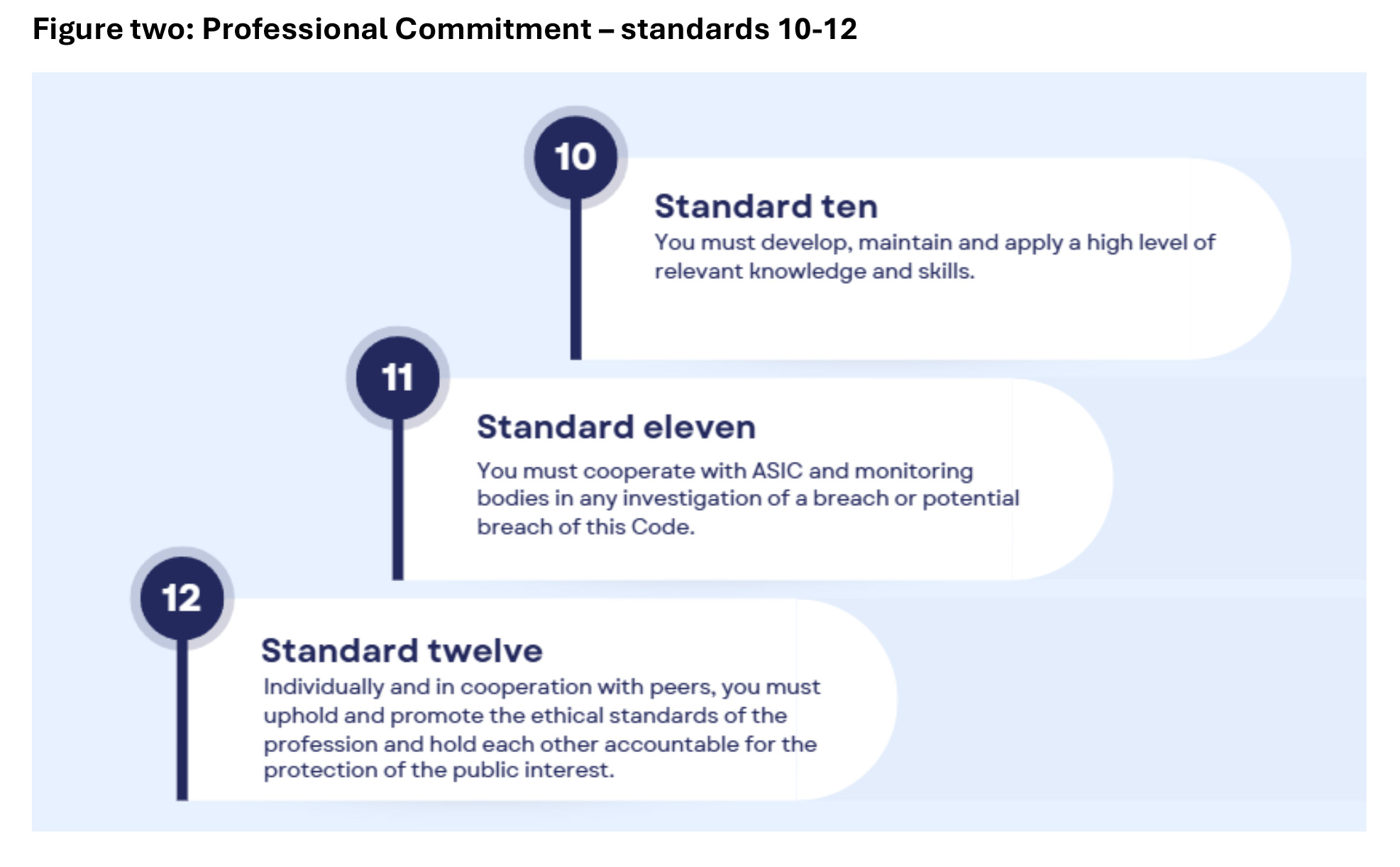
Figure two highlights each of the standards that fall under the competency ‘Professional Commitment’.

Standard ten
The focus of standard ten is to ensure that financial advisers have and maintain an appropriate level of relevant knowledge and skill to provide competent financial advice that is in the best interests of their clients.
Section 921B of the Act sets out the education and training standards for a person who is, or is to be, a relevant provider. It, in turn, is made up of four standards:
- Qualifications standard – the person has completed a bachelor’s or higher degree, or equivalent qualification, approved by the Minister (or holds an approved foreign qualification or an approval under section 921GA(3))
- Exam standard – the person has passed an exam administered by ASIC in accordance with principles approved by the Minister
- Professional year standard – the person has undertaken at least one year of work and training that meets the requirements set by the Minister
- Continuing professional development standard – the person meets the CPD requirements set by the Minister.
Standard ten also requires that:
- Financial advisers provide advice only in areas where they have the necessary skills and competencies to do so in a professional way
- Advisers undertake sufficient continuing professional training to maintain competence at an appropriate level for the professional services, including financial product advice, provided
- Advisers keep up to date with industry, regulatory and product developments relevant to their practice
- Where an adviser specialises in a particular area, they don’t provide advice outside that area unless they have the necessary skills and competencies to do so in a professional way
- Where an adviser doesn’t have the skills and competencies to provide advice sought by a client, that client should be referred to an adviser with relevant skills and knowledge.
Continuing professional development
Financial advisers are required to complete 40 hours of continuing professional development each continuing professional development year[1]. Licensees are responsible for approving at least 70 percent of CPD activities.
The minimum hours for continuing professional development across the mandatory categories are:
- Technical Competence – five hours
- Client Care and Practice – five hours
- Regulatory Compliance and Consumer Protection – five hours
- Professionalism and Ethics – nine hours
The balance up to 40 hours must consist of qualifying continuing professional development.
Case study – A failure of competence
Melanie, an adviser at ACME Advice, had built her practice over more than a decade, largely on traditional risk insurance and retirement income advice. When several long-standing clients began asking about self-managed super funds and direct property investment through their super, including gearing arrangements and the tax implications, Melanie agreed to advise on these strategies rather than referring clients to a specialist.
Melanie had not completed any structured training in SMSF establishment or limited recourse borrowing arrangements. She relied on product provider webinars and general reading to piece together her understanding and had not kept pace with recent changes to contribution caps, in-house asset rules or borrowing restrictions. When advising a client, Robert, on setting up an SMSF to purchase an investment property, Melanie miscalculated the fund’s borrowing capacity and failed to account for a recent change to non-arm’s length income provisions, exposing Robert to a higher tax outcome than she had advised. Robert discovered the error when his accountant reviewed the fund’s tax position at year end.
Standard ten requires advisers to develop, maintain and apply a high level of relevant knowledge and skill. This standard exists because competent advice depends on the adviser genuinely understanding the strategy, product or structure they’re recommending, not just being broadly familiar with it.
Melanie’s conduct breached standard ten because:
- She advised on a complex strategy (SMSF borrowing) outside her core area of expertise, without completing adequate training or accreditation in that area first.
- She did not keep her knowledge current about relevant regulatory changes that directly affected the advice she gave.
- Her CPD activity, largely informal and product-provider led, did not build the depth of technical knowledge the strategy required.
Robert incurred additional tax liability and administrative costs correcting the fund’s structure. He lodged a complaint with AFCA, which found in his favour, and ACME Advice was required to compensate him for the financial loss. ASIC’s review of the complaint also raised concerns about ACME Advice’s oversight of advisers providing advice outside their demonstrated areas of competence, prompting a broader review of the licensee’s authorisation and training framework.
Standard eleven
Standard eleven requires financial advisers to cooperate with ASIC and other monitoring bodies in any investigation. This includes a requirement to respond to requests in a timely and open manner and provide requested documentation or records that may assist the investigation.
This duty applies in addition to the offences outlined in sections 921M and 921P of the Act.
Case study – Attempt to mislead ASIC
Financial adviser Duncan was an authorised representative of several licensees over a fifteen-year period, most recently at ACME Financial Planning. He was permanently banned from providing financial services after an ASIC investigation found that he had persistently engaged in dishonest conduct.
In banning him, ASIC noted their belief that Duncan was likely to contravene a financial services law for reasons including that he had engaged in dishonest conduct while an authorised representative of one licensee and continued to do so at ACME Financial Planning. Additionally, Duncan acted dishonestly in the course of responding to an ASIC statutory notice.
ASIC’s investigation found that Duncan had:
- Dishonestly backdated advice documents to clients
- Incorrectly witnessed binding nomination of beneficiary forms
- Allowed the incorrectly witnessed binding nomination forms to be submitted to insurers on behalf of clients
- Inserted signatures and dates into documents to look like he was compliant with his obligations as an authorised representative
- Falsified company books while carrying out his financial planning and advice business
- Implemented financial advice to clients before they were provided with a statement of advice
- Created or modified documents on client files produced to ASIC and attempted to induce a client to mislead ASIC.
As well as being banned from providing financial services, Duncan was placed on a good behaviour bond for two years. Commenting on the falsification of records, the sentencing judge noted this action to be “A breach of trust of those who you’re engaged to act for.”
Duncan’s actions were unethical on several levels. However, he specifically contravened standard eleven by attempting to mislead ASIC through modified or ‘created’ records, as well as actively inducing a client to mislead the regulator on his behalf.
Standard twelve
For financial advisers to be perceived as a professional group, they need to embody the values that underpin the Code: trustworthiness, competence, honesty, fairness and diligence.
Standard twelve deals with relevant providers’ professional relationships with each other and emphasises that each needs to be supportive and aligned to the profession as a whole. To build trust among consumers, being – and being seen to be – a profession that acts ethically and professionally is critical for the long-term success of the industry.
If you’re supervising a provisional relevant provider through their professional year, this duty has a personal dimension too. It means genuinely supporting them, not just ticking off requirements; they need to get real value from their professional year and should be properly set up for the work ahead.
Case study – Failure to uphold the ethical standards of the profession
Ian ran a small financial services business, initially operating as a licensed authorised representative. From mid-2019, Ian’s licence was revoked, but he continued operating as though nothing had changed. Between 2017 and 2021, he recommended that several clients invest funds from their SMSFs into products he personally controlled, promising fixed returns of 8-12 percent per annum, with some arrangements promising up to 100 percent return upon maturity (stated as three years).
The promised investments were not implemented. Instead, Ian directed a significant portion of investor funds into his own bank account for personal purchases. These included property held in his own name, educational expenses for his three children and expensive cars.
Standard twelve requires advisers, individually and together with their peers, to uphold and promote the ethical standards of the profession and hold each other accountable for protecting the public interest. Ian’s conduct struck directly at the heart of this standard. Continuing to operate as an adviser after losing his licence, and using client funds for personal benefit, wasn’t a technical or process failure. It actively undermined public trust in the profession as a whole.
Ian’s conduct resulted in significant financial harm to his clients, many of whom had entrusted their retirement savings to him in good faith. The matter was investigated and referred for prosecution, resulting in imprisonment. Beyond the personal consequences for Ian, cases like this attract public and regulatory attention that affects perceptions of the entire advice profession. This reinforces the importance of individual accountability and the willingness of the profession to call out and report misconduct when it’s identified.
Standards seven to twelve of the Code move the focus from what advice looks like on paper to how it plays out in practice. None of these standards exist in isolation. A breach of one often signals a breakdown in several others. For better or worse, disclosure, competence and accountability tend to move together. For advisers, the practical takeaway is straightforward: understand what you’re recommending, be upfront about what you and your business stand to gain, keep your knowledge current and be prepared to explain your decisions if asked. These aren’t high bars. They’re the basic expectations of a trusted profession, and the cases where things go wrong are often those cases where one or more of these basics was missed.
Take the FAAA accredited quiz to earn 0.75 CPD hour:
CPD Quiz
The following CPD quiz is accredited by the FAAA at 0.75 hour.
Legislated CPD Area: Profesionalism and Ethics (0.75 hrs)
ASIC Knowledge Requirements: Ethics (0.75 hrs)
please log in to start this quiz

Read CPD: A review of the Code of Ethics (part one)
———–
Notes:
[1] ASIC, Continuing Professional Development
CPD Quiz
The following CPD quiz is accredited by the FAAA at 0.75 hour.
Legislated CPD Area: Profesionalism and Ethics (0.75 hrs)
ASIC Knowledge Requirements: Ethics (0.75 hrs)
please log in to start this quiz

Read CPD: A review of the Code of Ethics (part one)
———–