
CPD: A review of the Code of Ethics (part one)

A strong ethical framework provides the foundation for a trusted and respected financial advice profession.
The Financial Planners and Advisers Code of Ethics (Code) has sat at the centre of adviser conduct in Australia since it became mandatory on 1 January 2020. This article, proudly sponsored by GSFM, examines the values and standards (one to six) that underpin the Code.
The Code sets out standards and core values designed to lift professionalism and behaviour among relevant providers. It establishes twelve standards covering everything from client best interests through to professional judgement and competence, and every relevant provider under the Corporations Act must comply with it.
Speaking at the National Press Club on 19 August 2026, Financial Services Minister the Hon Dr Daniel Mulino MP said the government has firmly turned its attention to the next phase of the DBFO returns. He noted the government’s intention to “also progress a review of the Adviser Code of Ethics to ensure it is fit for purpose.”[1]
However, the Code you are bound by today is the one written in 2019 by a body that no longer exists. While a review is on the government’s agenda, no public consultation or exposure draft has yet dealt with the standards directly. Until that changes, understanding each standard, as it stands, remains a useful exercise.[2]
A values-based Code
The Code addresses five core values, and its twelve standards reflect these in practice. As highlighted in the legislation, these values are paramount, and all provisions of the Code must be read and applied in a way that promotes these five core values. It is, according to the explanatory statement that accompanies the legislation, an ethical duty under the Code to demonstrate, realise and promote these values[1].
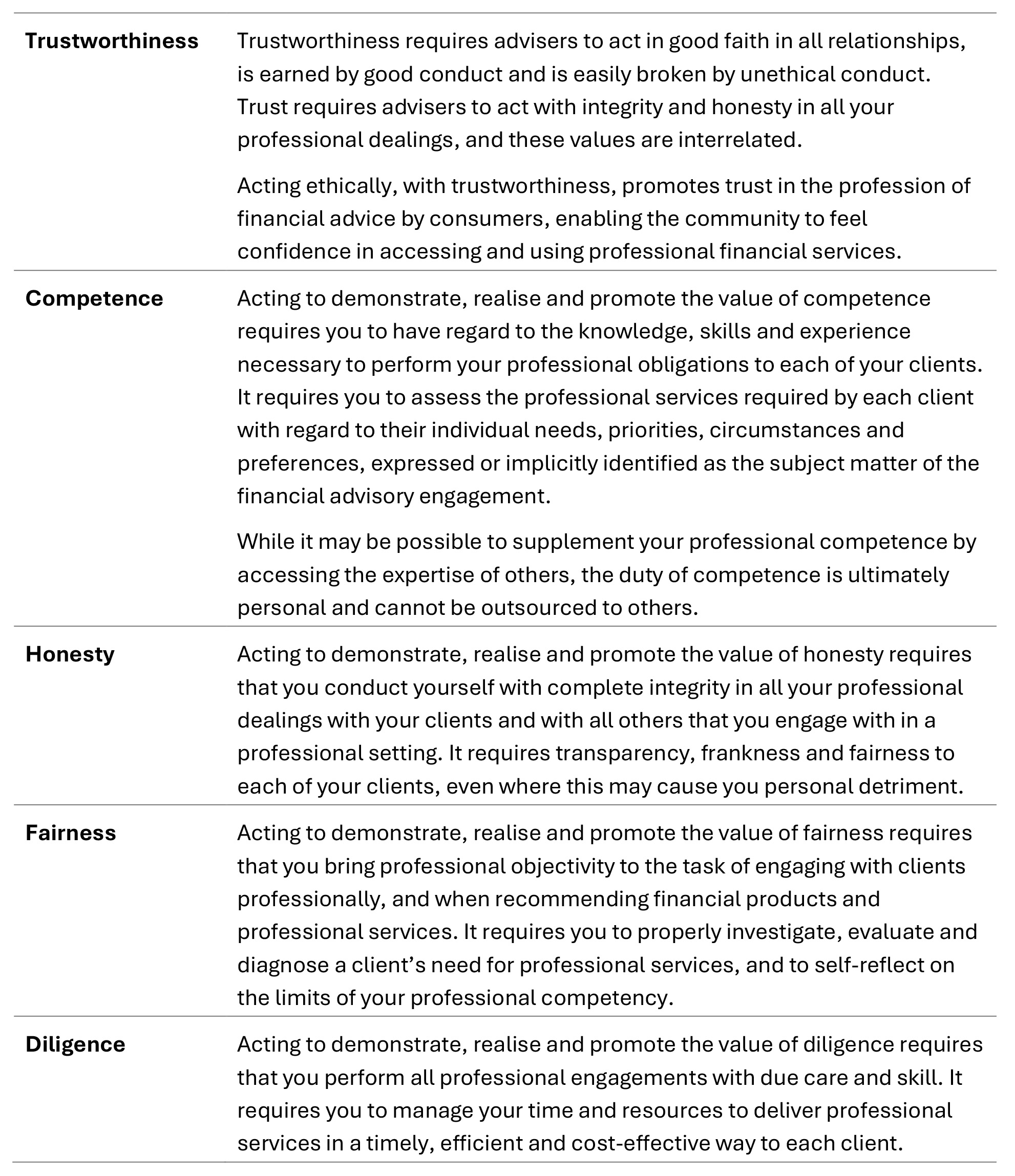
Code of Ethics
The Financial Planners and Advisers Code of Ethics 2019 is comprised of twelve standards, which are grouped under four ethical competencies:
- Ethical Behaviour (standards one to three)
- Client Care (standards four to six)
- Quality Process (standards seven to nine)
- Professional Commitment (standards ten to twelve)
Advisers and licensees are expected to weigh each standard’s ethical principles against their own professional judgement and the circumstances at hand. The standards are not a compliance checklist.
This article examines standards one to six and provides a case study to illustrate each. The case studies are based on real events; however, the names of people and organisations have been changed, and some details altered. The case studies have been drawn from ASIC, AFCA and the FSCP.
Ethical Behaviour
Ethical behaviour in financial advice is much more than simply following rules. It means acting with honesty, competence and genuine care for each of your client’s interests, even when no one is checking the file. The Code was built on this idea. Rather than listing every scenario an adviser might face, it sets out core values and standards that require judgement, reflection and a willingness to put the client first when interests conflict.
This is what separates a profession from an industry that simply complies with the letter of the law. The standards that follow give shape to that expectation, translating broad ethical principles into specific obligations advisers can apply day to day.
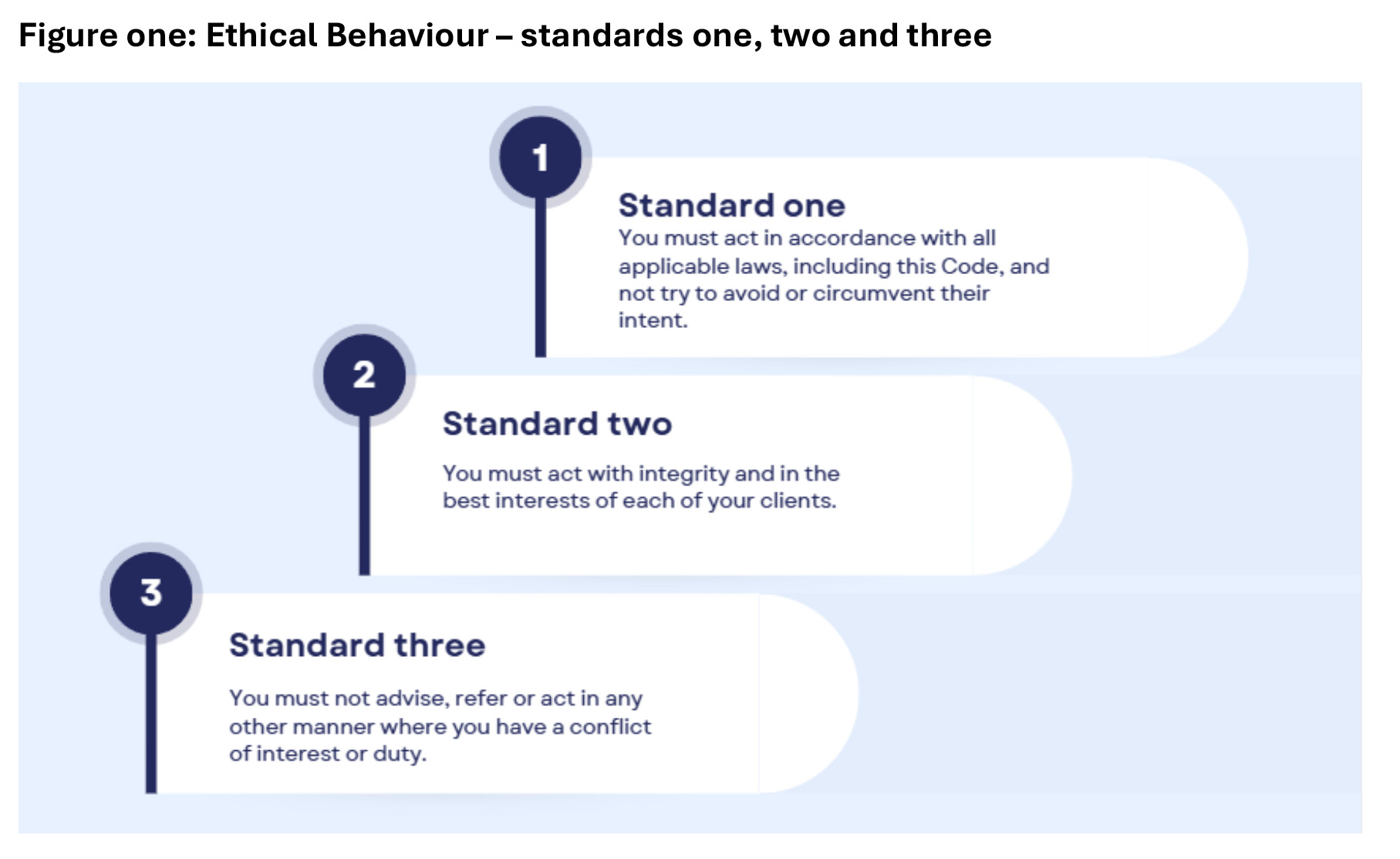
Figure one highlights each of the standards that fall under the competency ‘Ethical Behaviour’.
Standard one
Since the Corporations Act first came into being, financial advisers have had to abide by the laws that guide their profession. While the majority operate within the prescribed legal boundaries and within the spirit of the law, there’s a small number of advisers who avoid or circumvent the intent of the Act, skirt those laws that exist to protect consumers from unprincipled operators.
Standard one – acting in accordance with applicable laws and the Code of Ethics, is highlighted as the minimum ethical obligation financial advisers must meet.
This standard requires that:
- Advisers will take steps to understand their legal obligations, under both the law and the adviser Code of Ethics
- Advisers will ensure the advice they provide is not intended to circumvent the intent of financial services laws or the Code of Ethics
- Advisers must not establish business structures to circumvent their ethical obligations
- Advisers must always act in the best interests of their clients.
Importantly, standard one encourages advisers to consider both the legalities and ethics of each course of action they take. Because the Code is enshrined in legislation, a breach of the Code will result in a breach of the law (and by default, the Code).
Case study – failure to comply with financial service laws
ACME Advice operated two Gold Coast-based financial advisory practices between 2018 and 2024. This included running a managed discretionary account service and a superannuation rollover business. ASIC cancelled the firm’s AFSL in May 2025 following concerns it had breached a number of its legal obligations.
A hearing before the Administrative Appeals Tribunal (AAT) in 2025, found that ACME’s contraventions included:
- engaging in unconscionable conduct
- prohibited hawking
- misleading or deceptive conduct
- false or misleading statements
- failing to provide appropriate advice
- failing to act in the best interests of clients
While ACME Advice and its advisers are likely to have breached several of the Code’s standards, the fact that it breached the Corporations Act 2001 (unconscionable conduct, hawking, failing to act in client best interests among others), as well as the Code, is an evident breach of standard one.
The AAT upheld ASIC’s decision to cancel ACME Advice’s AFS licence.
Standard two
Standard two requires that financial advisers act with integrity and in the best interests of their clients. Although encapsulated in a range of laws, the Code makes clients – and their best interests – front and centre.
Integrity underpins trust, the first of the values the Code is built on. A professional without integrity cannot build trust with clients. Integrity is also tied closely to the third value, honesty, since acting honestly is difficult to sustain without it.
Acting in the best interests of clients underpins each of the five values and is the pivotal requirement that supports each of the twelve standards.
This standard requires that:
- Advisers consider each client, and their needs, individually
- Advisers are honest, open and frank in all dealings with clients
- Advisers prioritise their clients’ interests over their own or their licensees’ interests
- Advisers must honour commitments made to their clients.
Putting each and every client’s interests first requires that advisers ensure the advice, products and services recommended are appropriate to meet the client’s objectives, financial situation and needs. This needs to include consideration of the client’s longer-term interests and expected future circumstances.
Importantly, the explanatory notes that accompany the legislation specifically state that you are not relieved of this ethical duty merely because the client does not provide enough information – even when asked.
Case study – a failure of integrity
The FSCP cancelled the registration of adviser Joe, barring him from re-registering until after a date in September 2027 and prohibiting him from providing personal advice to retail clients on relevant financial products during that period.
The FSCP found Joe breached the best interests duty, the appropriate advice obligation and SOA timing requirements in relation to three clients and failed to provide an SOA at all for three others.
For two clients, Joe did not properly identify their objectives, financial situation and needs, and did not assess suitable alternatives before making recommendations. The advice itself exposed clients to risk inconsistent with their circumstances. Across three clients, the FSCP found breaches of the Code of Ethics.
This case illustrates how a handful of process gaps compound into serious regulatory findings. Skipping proper fact-finding, failing to test alternatives and overstating likely outcomes don’t just breach individual standards. Together they undermine the best interests duty at its core: advice that fits the client, not the product.
Standard three
Standard three is the Code’s conflicts provision and has been the most contentious of the Code’s standards; it frequently appeared in discussions about the Code of Ethics and its standards during the Quality of Advice Review. There is a good chance that this standard may be up for some amendments when the Treasury formally reviews the Code as part of its DBFO reform program.
The primary ethical duty in this Standard is that, if you have a conflict of interest or duty, you must disclose the conflict to the client and you must not act. If the client wishes, you may refer the client to another relevant provider if neither you nor your principal will receive any benefits from the referral.
You will not breach standard three merely because you recommend a financial product offered by your employer or principal to a client. However, you will breach standard three if a variable component of your remuneration depends on the amount or volume you recommend of those products, because your interests will or may conflict with your duty to act in the client’s best interests.
This standard requires that:
- Advisers make an assessment as to whether their personal interests are compatible with the best interests of their client
- Advisers must ensure the advice they provide is not in conflict with personal interests or those of their licensee
- Advisers must remain aware of changing circumstances and whether that can result in conflicts of interest with some or all clients.
Disclosing to a client any advantages you would receive, and obtaining that client’s consent for those advantages, does not relieve you of the duty to comply with this standard.
Case study – a conflict of interest
Angela was an authorised representative of Brisbane-based ACME Financial Services. She recommended that numerous clients invest in the ACME Property Opportunity Fund, a managed investment scheme operated by her licensee.
An ASIC investigation found that over a three-year period, Angela recommended that the majority of her clients invest in the ACME Property Opportunity Fund, which invested in speculative property developments in the Gold and Sunshine Coasts. Angela was incentivised by her licensee to recommend the product to her clients and received bonuses based on the value of her clients’ assets held in the fund.
ASIC found that she failed to prioritise her clients’ interests above her own when recommending they invest in the fund. Further, the high-risk nature of the investment did not match her clients’ risk profiles or experience, and Angela was found to have failed to conduct a reasonable investigation into alternative financial products that could have met her clients’ needs.
Consequently, Angela was banned from providing financial services for three years.
Client care
Client Care is the second area of ethical competence and encompasses standards four to six. As with Ethical Behaviour, this area of ethical competence encapsulates the spirit of the values that underpin each of the twelve standards.
While honesty and trustworthiness continue to be crucial, the values of competence, diligence and fairness are particularly pertinent when it comes to client care; for without these, the standard of care for your clients may not comply with the best interests duty.
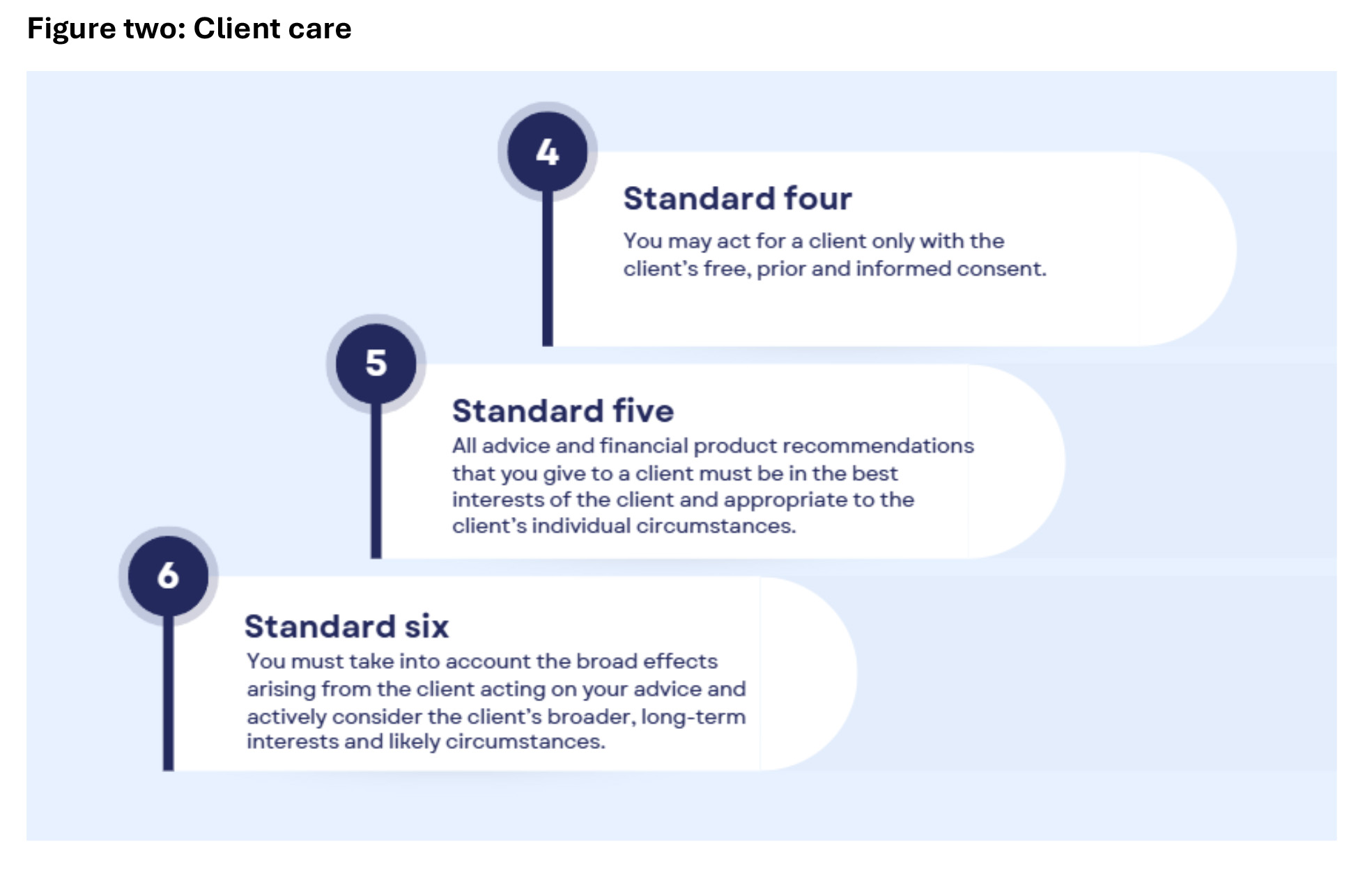
Figure two highlights each of the standards that fall under the competency ‘Client Care’.
Standard four
Standard four requires that financial advisers may act for a client only with that client’s free, prior and informed consent. The fundamental concept encapsulated in this standard is to ensure clients are well informed and freely consent to personal financial advice before they act.
This means that, before you start to act, you must have explained to your client, clearly and simply:
- The services that will be provided
- The terms on which those services will be provided
- The records that will be made of the services, and the privacy and confidentiality arrangements applicable to them.
‘Informed’ consent requires that the client understands and agrees to the arrangements. You will need to be satisfied of this and should have reasonable grounds to be satisfied. This agreement between adviser and client should be free from any form of coercion or pressure, from the adviser or another party.
Case study – informed consent
Nikki and Anthony sought investment advice after receiving an inheritance from Nikki’s parents. The couple had paid off their home and wanted to invest $500,000 of the remaining money. The advice was provided by Brendon at ACME Financial Advice, who had been recommended by the couple’s accountant.
One of the investments Brendon recommended was a structured product that obtained exposure to high yield fixed income through derivatives. During a period of sustained market volatility, the product experienced a significant loss; it was ultimately deemed to be unviable, and the product was wound up. This crystallised a substantial loss for the couple.
Nikki and Anthony claim they were not advised of the high-risk nature of the investment. Further, they stated they would not have consented to investing in this product had they been properly informed about the associated risks.
Brendon disputed this claim and said he was supported by the SOA he provided, one that the clients had signed. This, he believed, had adequately disclosed the risks associated with the investment.
AFCA’s case manager found that Nikki and Anthony didn’t have enough time to read and understand the SOA, since they signed it at the same meeting it was given to them.
Brendon also provided his file notes from the meeting where the investment was discussed. The notes didn’t mention any discussion of the investment’s high-risk nature. AFCA found this didn’t support Brendon’s claim that he’d verbally explained the risks and the risk/return profile of the structured product.
AFCA found in favour of the complainants. The licensee was ordered to cover the couple’s losses, plus interest at 4.5% pa, compounding annually from the determination date to the payment date.
Advisers can only act for a client with their free, prior and informed consent. By giving his clients incomplete information, Brendon’s argument that he obtained informed consent from them fell flat.
Standard five
This standard elaborates on the ‘best interest of the client’ duty in standard two and also ensures that you satisfy yourself that the client understands your advice and the products and services you recommend. This requires detailed engagement with and assistance to the client and is an essential element when it comes to providing ‘Client Care’.
This standard also emphasises the importance of the client properly understanding the advice and recommendations you give, and their implications. It requires you to be satisfied that the client understands:
- The advice and recommendations you give
- the benefits of the recommended products
- The costs involved in acquiring, holding and disposing of the recommended products
- The risks involved in acquiring, holding and disposing of the products, and how you recommend they be managed.
Advice must be clear and simple, and you must have reasonable grounds for being satisfied your client understands it.
Case study – failing to act in clients’ best interests
Bill is an adviser at ACME Financial Planning. Ray contacted Bill after receiving a call from a lead generation firm about boosting his retirement savings. Ray had $280,000 in an industry super fund and was five years from retirement.
Bill recommended that Ray roll his entire super balance into a new platform and invest the bulk of it in the Shield Master Fund, a scheme promising high, stable returns. Bill’s advice focused narrowly on the projected returns of the fund and didn’t test the recommendation against Ray’s actual objectives, financial situation or needs.
Eighteen months later Shield is frozen. Ray can’t access his super, retirement is delayed indefinitely and he has no other savings to fall back on.
Standard five requires advisers to only give advice or recommend a product if they’re satisfied it’s appropriate to the client’s likely objectives, financial situation and needs. Bill’s advice failed this test in several ways:
- He recommended an illiquid, unlisted scheme without establishing whether it suited Ray’s need for capital stability and access as he approached retirement.
- He didn’t assess the recommendation against Ray’s actual financial situation, including his reliance on this balance as his primary retirement asset and his limited timeframe to rebuild savings if the investment underperformed.
- He based the recommendation on projected returns rather than on evidence that the product matched Ray’s objectives and risk capacity.
Standard five doesn’t ask whether a product might perform well. It asks the adviser to establish, and be able to demonstrate, that the advice actually fits the client in front of them.
The Shield and First Guardian collapses show what happens when advice is built around a product’s promised return rather than a genuine assessment of suitability. An adviser can point to a plausible strategy and still fail standard five if they haven’t tested it against the client’s real objectives, financial situation and needs.
Standard six
This standard expressly requires you to consider the broad effects of the client acting on your advice and the broader, long-term interests and likely circumstances of your client.
These effects are not limited to effects on the client. For example, your advice may have implications for other family members of the client. These will need to be considered, although you will not have a duty to act in the best interest of the family members if they are not clients of you or your principal.
By way of example, any potential need for the client or one of the client’s family members to move into aged care accommodation in the near future would need to be factored into any financial advice you give the client.
Case study – failure to consider long term implications of advice
Diane is 58 and works part time. She has $340,000 in superannuation and owns her home outright with her husband Steve, who retired early due to ill health. Diane sees an adviser, Mark, after her employer offered a redundancy package and she wants advice with respect to the payout.
Mark recommends Diane contribute the full redundancy amount into super as a non-concessional contribution and invest it in a high-growth option alongside her existing balance. His advice focuses on maximising Diane’s super balance and long-term investment returns.
Unfortunately, Mark doesn’t ask about Diane’s short-term needs. Diane and her husband have been planning to renovate their bathroom and kitchen to make the house safer as they age and were counting on part of the redundancy payout to fund this. He also doesn’t consider that locking the money away in super limits Diane’s access to funds if she needs to stop working earlier than planned due to her husband’s health.
A year later, Steve has a fall and the couple need to make home modifications sooner than expected. They have no accessible savings outside super, and Diane can’t withdraw the funds without meeting a condition of release.
Standard six requires advisers to consider the broad effects of a client acting on their advice, and to take into account the client’s broader, long-term interests and likely circumstances. Mark’s advice failed this test in several ways:
- He recommended locking away funds without asking about Diane’s short-term plans or her husband’s health, both of which had a direct bearing on how accessible those funds needed to be.
- He didn’t consider what reduced flexibility would mean for a couple approaching an age where health needs can change quickly.
- He treated the advice as a standalone super strategy rather than weighing it against Diane’s whole financial picture and life circumstances.
Standard six asks advisers to step back and consider what the advice means for a client’s broader life, not just their account balance.
Ethics can be defined as the moral principles that govern a person’s behaviour or the manner in which they conduct an activity. In financial planning, this comes down to acting in the client’s best interests at all times, and acting with competence, honesty, integrity and fairness. Standards one to six, covering Ethical Behaviour and Client Care, capture what Australian consumers reasonably expect from financial advice professionals.
Financial advisers are required to act ethically and in the best interests of their clients at all times. The Code of Ethics has made ethical practice a binding requirement for financial advisers for six years. Continued support for the Code and the behaviour it demands will build trust in the profession and help cement financial advice as a respected profession, one that plays a genuine role in the financial security of all Australians.
Take the FAAA accredited quiz to earn 0.75 CPD hour:
CPD Quiz
The following CPD quiz is accredited by the FAAA at 0.75 hour.
Legislated CPD Area: Professionalism & Ethics (0.75 hrs)
ASIC Knowledge Requirements: Ethics (0.75 hrs)
please log in to start this quiz

———–
Notes:
[1] Explanatory statement, 11 February 2019
[2] The Hon Dr Daniel Mulino MP, National Press Club Address, 19 August 2026
CPD Quiz
The following CPD quiz is accredited by the FAAA at 0.75 hour.
Legislated CPD Area: Professionalism & Ethics (0.75 hrs)
ASIC Knowledge Requirements: Ethics (0.75 hrs)
please log in to start this quiz
———–
Notes:
[1] Explanatory statement, 11 February 2019
[2] The Hon Dr Daniel Mulino MP, National Press Club Address, 19 August 2026


Have feedback on this article? Contact Us
Earn CPD Points
 CPD: Currency risk – friend or foe?
In today’s interconnected world, global companies play a significant role in our daily lives. However, when Australian investors allocate their capital to global markets, they are exposed not only to [...]
 CPD: Ethics and moral dilemmas
When it comes to financial advice, the numbers may be black and white, but the ethical decisions often aren’t. This article, proudly sponsored by GSFM, examines moral dilemmas and the [...]
 CPD: Jump in my CAR. Client Advice Records – why, what, how
Introduction The forthcoming replacement of Statements of Advice (SOAs) with Client Advice Records (CARs) has once again shone a spotlight on the vexed issue of client communication within financial advice. [...]
 CPD: Investor Behaviour – Retirement
To best understand how and why clients make financial decisions – particularly during retirement – advisers must look beyond technical strategies and consider investor behaviour. Before addressing product selection or [...]
 CPD: A star is (re)born – Investment Bonds are the new headline act of tax-smart investing
Introduction Tax-smart investing is one of the central pillars of quality, effective, financial advice. The capacity for tax to drag on investment returns, stifle compounding, and eat away at gains [...]