
Weekly market update – week ending 13 February, 2015
Investment markets and key developments over the past week
Shares generally saw good gains over the last week thanks to a combination of optimism regarding Greece, a new Ukraine ceasefire deal, more global monetary easing (the latest being Sweden) and good earnings results including in Australia. The strong start to the earnings reporting season in Australia combined with expectations for more interest rates cuts have helped push Australian shares up 8.5% year to date to a new post GFC high. Reflecting the risk on tone bond yields were generally flat to up a little bit, but commodity prices including oil were a little softer. The $A fell slightly partly in response to a weak Australian jobs report.
There are some signs of a compromise regarding Greece. Sure Wednesday’s Eurogroup meeting did not resolve the standoff, but I can’t see why anyone ever really expected that it would as it will take time. However, it is worth noting that on being asked whether a Grexit from the Euro is on the table the Greek finance minister replied “of course not” and German Chancellor Merkel has indicated a willingness to compromise. Our base case remains that a deal will be reached and that even if Greece doesn’t agree and heads for a Grexit, the risk to the rest of the Eurozone is manageable as the peripheral countries are now in better shape and defence mechanisms are stronger. In terms of the latter it’s noteworthy that Italian and Spanish bond yields remain around record lows.
Time will tell whether the latest Ukraine ceasefire deal sticks or not. But Russian shares are looking interesting. While the Russian recession is still deepening the 60% plunge in the value of Russian share shares since 2011 has left them trading on a PE of just 4.4 times. Meanwhile they look to have been building a base since a collapse into mid December last year and a near 50% fall in the value of the Ruble will help make the Russian economy more competitive and has almost completely offset the fall in the oil price over the same period.
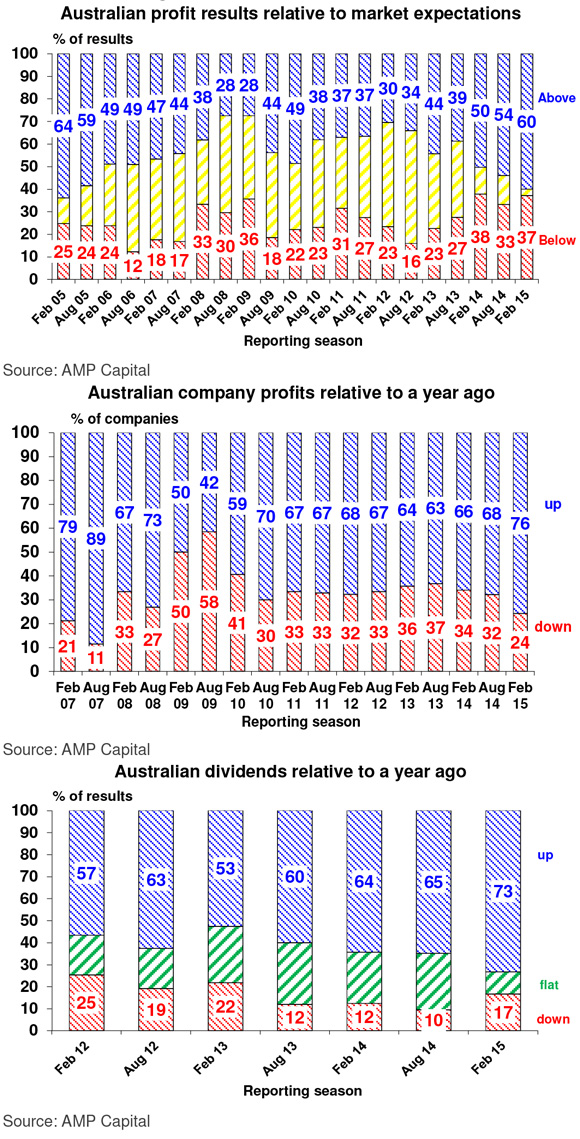
Its early days in the Australian December half profit reporting season with just less than 20% of companies reporting to date and there is also a tendency for the good results to come out early, but so far so good. 60% of results to date have beaten expectations against a norm of 45%, 76% have seen profits rise from a year ago, 54% have seen their share price outperform the day results were released and 73% have increased their dividends. Key themes have been weakness amongst resources shares (on falling commodity prices) and mining services companies (on falling mining investment), continued strength for the banks, ongoing cost control and solid growth in dividends.
Major global economic events and implications
US data was a bit messy. Job openings rose to a new high in December, but small business optimism dipped and January retail sales were soft. Given the high levels of consumer confidence, low gasoline prices and the strength in employment and real income growth it’s hard to see the softness in retail sales being sustained. Nevertheless, it is another indicator pointing to a delay in the Fed’s first rate hike.
The tone to US December quarter earnings results has remained solid over the last week. We are now 80% done and 77% of companies have beaten on earnings, 56% have beaten on sales but earnings growth for the quarter is still running at a relatively subdued 5%.
Japanese data was generally good with stronger readings for consumer confidence, the Eco Watchers’ outlook survey and machinery orders and a sharp fall in bankruptcies.
Chinese data reinforced the impression of a soft start to the year with falls in January exports and imports, a sharp fall in inflation and deeper producer price deflation. While the export and import weakness may owe to distortions caused by the variable timing of the Chinese New Year, the collapse in inflation highlights the need for more monetary easing in China. We see the PBOC’s one year benchmark lending rate falling to around 4.5% this year (from 5.6%).
Indian inflation was less than expected in January and December GDP growth was reported at a stronger than expected 7.5% year on year, which was stronger than China’s. However, there is some uncertainty about the latest GDP data as it’s based on a new data approach.
Australian economic events and implications
Australian economic data was a mixed bag, with rising unemployment and subdued business conditions and confidence but strength in housing finance and house prices and a welcome rise in consumer confidence but only to levels well below last year’s highs. While the rise in consumer confidence indicates that rate cuts will get traction the ongoing rising trend in unemployment is consistent with more interest rate cuts ahead.
RBA Governor Glenn Steven’s Parliamentary Committee testimony left the impression that the RBA has a clear easing bias: inflation is likely to remain low; growth is likely to remain sub trend for longer even assuming another cut in interest rates; home price strength is no barrier to rate cuts as it is concentrated in Sydney and APRA is adopting a tougher regulatory approach; and the $A is expected to fall further. Our view remains that the RBA will cut rates by another 0.25% in the next month or so. However, since the RBA’s downwardly revised growth forecasts already allow for one more rate cut, there is a high chance the RBA will end up going further and cut the cash rate below 2% to provide confidence that growth will get back above trend next year.
What to watch over the next week?
The week ahead is PMI week with preliminary business conditions indexes or PMIs released for the US, Europe and Japan on Friday. The US PMI is likely to remain solid around 53.9 and a further improvement is expected in Europe and Japan.
In the US, the minutes from the last Fed meeting are likely to confirm that it remains comfortable in the way the economy is progressing but for now it can be patient in moving to raise interest rates. Meanwhile, the home builders conditions index (Tuesday) is likely to show a small gain, permits to build to new homes (Wednesday) are likely to rise but housing starts (also Wednesday) are likely to have fallen slightly after a very strong gain in December. Expect the New York and Philadelphia regional manufacturing conditions indices (Tuesday and Thursday respectively) and industrial production (Wednesday) to remain solid and January producer prices (Wednesday) to show a further fall. The December quarter earnings reporting season will start to wrap up.
Japanese December quarter GDP data (Monday) is likely to show a return to modest growth after two quarters of recession inspired by the April sales tax hike.
In Australia, the Minutes from the last RBA Board meeting (Tuesday) are likely to confirm that the door is open to another interest rate cut, but are unlikely to say anything new given the Statement on Monetary Policy and Governor Steven’s Parliamentary testimony that post-date the last meeting.
The December half profit reporting season will really ramp up with 80 major companies due to report including Amcor, Fortescue, IAG and AMP. Consensus earnings growth expectations for this financial year are near zero, driven by an expected 25% drop in resource profits on the back of the slump in commodity prices. However, the rest of the market is much stronger with industrials expected to see growth of around 10% and banks to see about 8% growth. Expect ongoing cost cutting, help from the lower $A and strong dividend growth to be key themes.
Outlook for markets
Notwithstanding the risk of a correction – potentially as the Fed eventually moves to raise interest rates – the broad trend in shares is likely to remain up as: valuations, particularly against bonds, are good; economic growth is continuing; and monetary policy is set to remain easy with further easing in Europe, Japan, China and Australia and only a gradual tightening in the US. As such share markets are likely to see another year of reasonable returns.
Commodity prices have been seeing a bounce from very oversold conditions, with oil in particular looking like it may have built a short term base around $US45/barrel. However, excess supply for many commodities is expected to see them remain in a long term downtrend.
Low bond yields point to soft medium term returns from sovereign bonds, but it’s hard to get too bearish in a world of too much saving, spare capacity and deflation risk.
Short term gyrations aside, the downtrend in the $A is likely to continue as the $US trends up and reflecting the long term downtrend in commodity prices and Australia’s relatively high cost base. We now expect a fall to around $US0.70, with the risk of an overshoot. However, the $A is likely to be little changed against the Yen and Euro.
Shane Oliver, AMP Capital
——


