Our tax system is holding us back: FSC submission to the Tax White Paper

Andrew Bragg
Australia must change its mix of taxes to build a tax regime which is sustainable, efficient and globally competitive, the Financial Services Council (FSC) said last Friday.
Andrew Bragg, FSC director of policy said: “Our 1950s tax system is in need of reform.”
“Australia is already a relatively high-taxing nation; therefore increasing the overall tax burden is not the answer. We need to fix the tax mix,” he said.
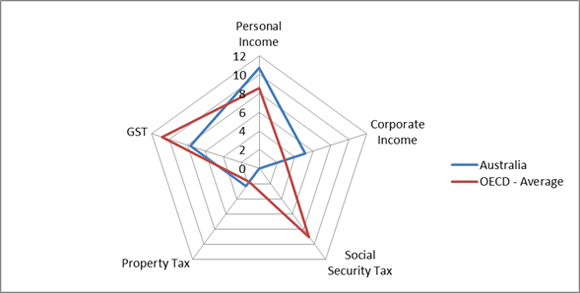
“Australia has the second highest reliance on company and personal taxes in the OECD and one of the lowest and narrowest consumption taxes. Our tax mix is the converse of the OECD average – it is heavily reliant on personal and company taxes, whereas the average OECD nation has a higher reliance on consumption taxes.”[1]
“The existing mix of taxation will be unsustainable for Australia as our population continues to age and Baby-Boomers move out of the workforce,” Mr Bragg said.
The FSC’s submission to the Tax White Paper has proposed a package of changes to bring Australia’s tax system into the 21st Century.
These include:
- 22 per cent company tax rate by 2020
- lower personal income taxes
- abolition of state stamp duties / transaction taxes, and
- a higher and broader GST increased towards the OECD average.
The FSC has also called for the 1999 Intergovernmental Agreement for the establishment of a GST to be renegotiated to enable Australian states and territories to abolish inefficient taxes so the GST can be broadened and increased. This should happen at the Prime Minister’s impending leader’s retreat with state premiers.
“Australia’s heavy reliance on company and personal taxation must come to an end,” Mr Bragg said. “GST must be part of the tax mix switch.”
“Including compensation for low income earners, a 15 per cent GST with a broader base would deliver $42 billion in additional revenue in 2015-16,” Mr Bragg said.
“The states are increasingly relying on inefficient, growth-destroying taxes to meet their expenditure needs. This has created a grossly inefficient and unwieldy tax base.”
“Victoria and the Northern Territory have increased stamp duties on insurance in the past year” he said. “Discouraging people from taking out insurance adds further pressure to Commonwealth budgets.”
Mr Bragg also said: “As we reorient our focus to services exports, our tax system will need to promote Australia’s competitiveness.”
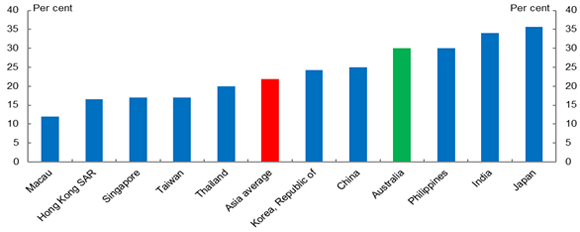
“Unlike mining and resources competitor nations, our competitors in services exports, such as Singapore and Hong Kong, have a long head start. The average Asian company tax rate is 22 per cent whereas our 30 per cent tax rate is forcing opportunities and jobs offshore.”[2]
“Japan and New Zealand are already reducing company taxes, and we are being left behind.”
Mr Bragg said tax reform is essential but it cannot be achieved without the states.
“The Prime Minister’s leader’s retreat this month will provide a unique opportunity to reform the tax mix. Continuing leadership on tax reform shown by the premiers of NSW and South Australian will be essential,” he said.
[1] Figure 14: Australia v OECD dependence on taxes
[2] Figure 8: Corporate tax rates – selected Asian economies
Figure 8: Corporate tax rates – selected Asian economies
Source: KPMG (2015)
Figure 14: Australia v OECD dependence on taxes