
Investment markets and key developments over the past week
Britain votes to Leave the European Union. The past week has been dominated by first the anticipation that Britain would vote to Remain within the EU that saw “risk on” in financial markets and shares rally followed by an abrupt move to “risk off” as the referendum saw the Leave vote win by 52% to 48%.
The vote to Leave poses risks: to the UK economy which will also face a period of political instability with PM Cameron to step down by October and pro-EU Scotland pushing for another independence referendum; to Eurozone stability over fears that some Eurozone countries may seek to follow the UK; and hence to global growth. It also threatens to add momentum to a move away from economic rationalist policies in favour of populism and a reversal of globalisation which would be a negative for long term global growth.
Reflecting the worries about the impact on the UK and more significantly Europe financial markets reacted sharply in “risk off” fashion on Friday with the British pound (-8.1%), British shares (-3.1%), the Euro (-2.4%) and Eurozone shares (-8.6%) down sharply and this seeing global share markets down generally along with the Australian dollar. Safe haven assets such as bonds, the $US, Yen and gold have all benefitted. This could have further to go in the short term until some of the dust settles. A concern is that a rising $US in response to safe haven demand will weigh on the Renminbi (sparking new fears of capital outflows from China), commodity prices and emerging countries taking us back to the global growth fears we saw earlier this year.
However, it’s worth putting all of this in perspective. First the moves in some markets seen on Friday were exaggerated because the moves that occurred during the first four days of the last week when markets thought Remain would win had to be reversed. So, for example, while Eurozone shares fell 8.6% on Friday they only fell 2.6% over the last week. Over the week as a whole US shares lost 1.6%, Japanese shares lost 4.2%, Chinese shares fell 1.1% and Australian shares fell 1%. Bad but not monumental. Believe it or not the British share market actually rose 2% over the last week. While the British pound fell 8.1% on Friday it only fell 4.7% over the week as a whole and the $A actually rose 1% last week. It was similar with bonds and oil – big moves on Friday but only modest moves over the week
Second, Britain has only started down a process to exit and has a long way to go yet. It will first need a new PM then later this year formally notify its intent to exit which will then kick off a negotiation process that will then take up to two years to complete. This will determine the ultimate impact on the UK economy – either it will retain free trade access to the EU but have to continue to allow the free movement of people, agree to EU rules and regulations and contribute to its budget or forgo free trade altogether. At this stage its hard to see which way this will go. But the point is that for some time the UK will still be in the EU.
Third, while the Brexit vote will likely trigger a guessing game as to which Eurozone country will try and follow its lead and ask for a similar referendum it’s doubtful that Eurozone countries will actually seek to leave because the hurdle to leave the Eurozone is higher than Britain leaving the EU as it will mean adopting a new currency, paying higher interest rates, etc. Just think of Greece despite its woes over the last few years consistently deciding to stay in the Eurozone. Countries to watch though are Italy following the recent success in municipal elections of the Eurosceptic Five Star Movement and maybe Spain given the success of Podemos.
Fourth, the Brexit vote is unlikely to be akin to a Lehman moment because conditions are radically different. Lehman came after a long period of global strength and a credit boom where liabilities and exposures were opaque. That is not the case now and Brexit has been talked about endlessly so is not the surprise Lehman was.
Finally, central banks have quickly adopted a “whatever is necessary” stance to provide liquidity to markets and support their economies, notably the Bank of England which is already providing £250bn. The ECB is monitoring the situation but its liquidity measures (eg TLTRO) are probably more than enough at present. The more important point is that global monetary policy will remain easier for longer. The Fed certainly will be slowed further in raising rates because it won’t want to put more upwards pressure on the $US which is being boosted by safe haven demand. A G7 Statement decrying excessive currency volatility has arguably given Japan close to a green light to intervene to stop the Yen rising much further. Expect more BoJ easing soon which should help Japanese shares.
I am not so confident about British assets given the long period of uncertainty the UK will now face both economically and politically. However, the global bout of “risk off” underway is likely to provide a buying opportunity as Europe is likely to hang together, global monetary policy is likely to be even easier than previously thought and the global economy is likely to continue to see modest growth.
Given that only 2.7% of Australian exports go to the UK and that the Leave victory is unlikely to plunge Europe into an immediate recession the main impact on Australia will be on financial markets. This could affect short term confidence and may add to the case for the RBA to cut interest rates again particularly if banks increase their mortgage rates out of cycle due to higher funding costs flowing from an increase in lender caution. That said we expect the RBA to cut rates again anyway and a falling $A will continue to provide a shock absorber for the Australian economy. Overall, Brexit barely changes the risk of recession in Australia which remains low.
The key for investors is to either look through the short term noise caused by the Brexit decision or look for investment opportunities that it throws up as investment markets become oversold.
Just finally on Europe, the last week saw the German constitutional court approve the validity of the ECB’s Outright Monetary Transaction (OMT) program, which partly underpins Draghi’s 2012 commitment to do “whatever it takes” to preserve the Euro. This is a big relief because its rejection would have put a cloud over the ECB’s ability to respond to any turmoil in peripheral bond markets that may flow from the Brexit vote.
Now on to other things!
In Australia, the big event in the week ahead will be the Federal election (Saturday). Each side of politics is offering very different visions for the size of government:
- Labor is focussed on spending more on health and education and in the process allowing the size of the public sector to increase, funded by tax increases on higher income earners (retention of the budget deficit levy and cutbacks in access to negative gearing, the capital gains tax discount and superannuation). The ALP would also undertake a royal commission into banking and intervention in the economy is likely to be higher than under a Coalition government.
- By contrast the Coalition is focussed more on containing spending, and encouraging economic growth via company tax cuts and mild reforms. Despite the Coalition’s tilt to “fairness” with its super reforms it’s committed to keeping taxes down. It does plan to reinstate the Australian Building & Construction Commission but even with the double dissolution election it’s unclear whether it will get enough votes to do this.
At this stage the polls suggest the Australian election is too close to call. But it’s a big ask to see the ALP become the first opposition in 85 years to regain government after just one term as it will need to win 19 seats. As such betting agencies have the Coalition as favourite. However, the big issue may be what happens in the Senate with there being a good chance that the Greens and minority “parties” control the balance of power again acting as a huge constraint on the government, which would mean another de facto minority government, ie more of the same. Which in turn mean poor prospects for getting government spending under control over the next three years and for implementing serious productivity enhancing economic reforms.
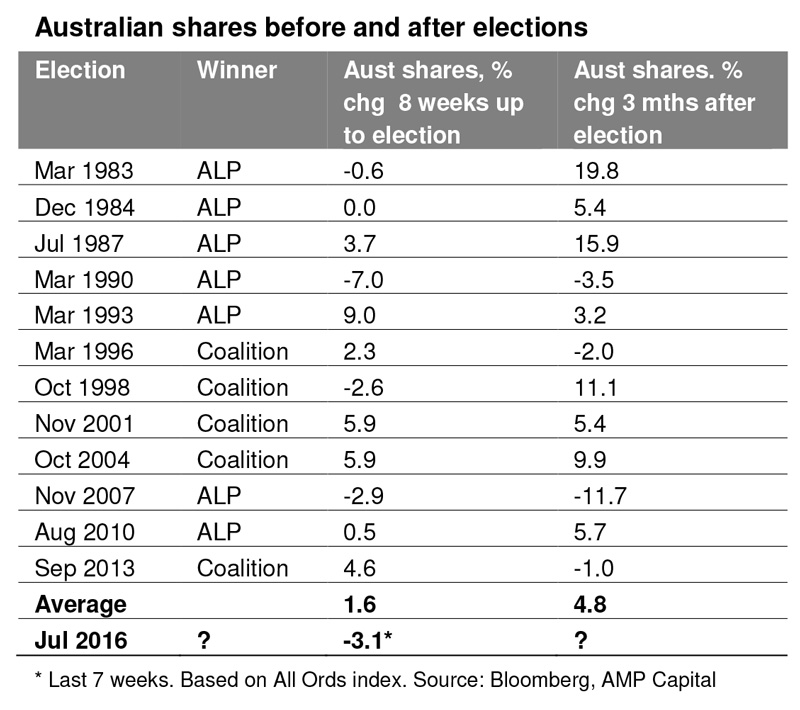
Over the 7 weeks since the election was called the Australian share market has fallen 3.1%. The next table shows that 8 out of 12 elections since 1983 saw shares up 3 months later with an average gain of 4.8%. This may partly reflect relief at getting the election out of the way.
Major global economic events and implications
Fed Chair Janet Yellen’s congressional testimony didn’t really add much. The key is that the Fed is “proceeding cautiously” to give it time to assess whether the US economy and inflation is on track with its expectations and given global uncertainties. Uncertainty and market turmoil flowing from the Brexit outcome is likely to further delay the Fed in terms of raising rates again.
US economic data was mostly good. While durable goods orders were weak, the June manufacturing PMI rose, home prices rose, home sales were strong, jobless claims fell sharply and home prices continue to rise. And the US’s top 33 banks passed a Fed stress test indicating that they have enough capital to withstand a severe economic shock (involving unemployment doubling to 10%.) In other words they are in good shape to withstand any shock flowing from Brexit.
The Eurozone composite business conditions PMI fell slightly in June with a decline in services (on Brexit fears?) offsetting a gain in manufacturing. It remains at a level consistent with moderate growth though.
Japan’s manufacturing conditions PMI rose just 0.1pt to a still weak 47.8 in June indicating that growth in June quarter is still struggling.
A couple of Chinese business conditions surveys moved in opposite directions for June with one up solidly and a small business PMI weakening. So bit of a wash there.
Australian economic events and implications
In Australia, the minutes from the last RBA Board meeting added little that was new with the RBA neutral and on the sidelines for now. However, our view remains that lower inflation and a too high $A on ongoing Fed delays will still see more easing ahead with the next cut likely in August.
By Shane Oliver, AMP Capital
——–


