
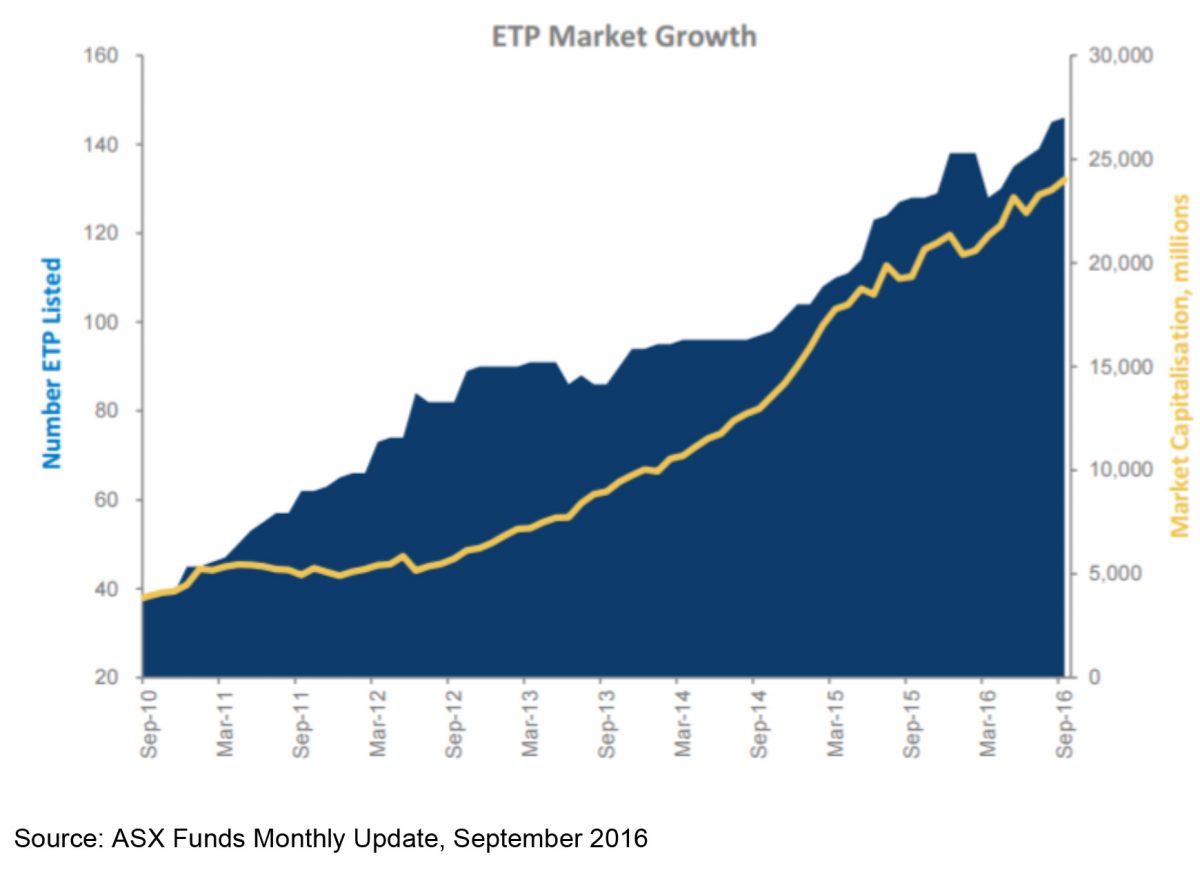
Exchange Traded Products (ETPs) have proliferated in the Australian (and global markets). They became more prevalent in the Australian market following the Global Financial Crisis (GFC) and today have more than $24 billion assets under management, up 24% over the year ended 30 September 2016[1].
In this article, OpenMarkets examines the stellar rise of ETPs, particularly Exchange Traded Funds (ETFs) and the more recent phenomena of Exchange Traded Managed Funds (ETMFs).
The rising trajectory of ETFs
ETFs aim to track the returns from a given market index, rather than seeking to generate outperformance through active stock or asset class decisions. By replicating an index, investors retain a diversified exposure to a specific asset class, and managers can keep fees low. Funds are transparent, with investors able to see bid and offer prices, as well as portfolio composition at any time.
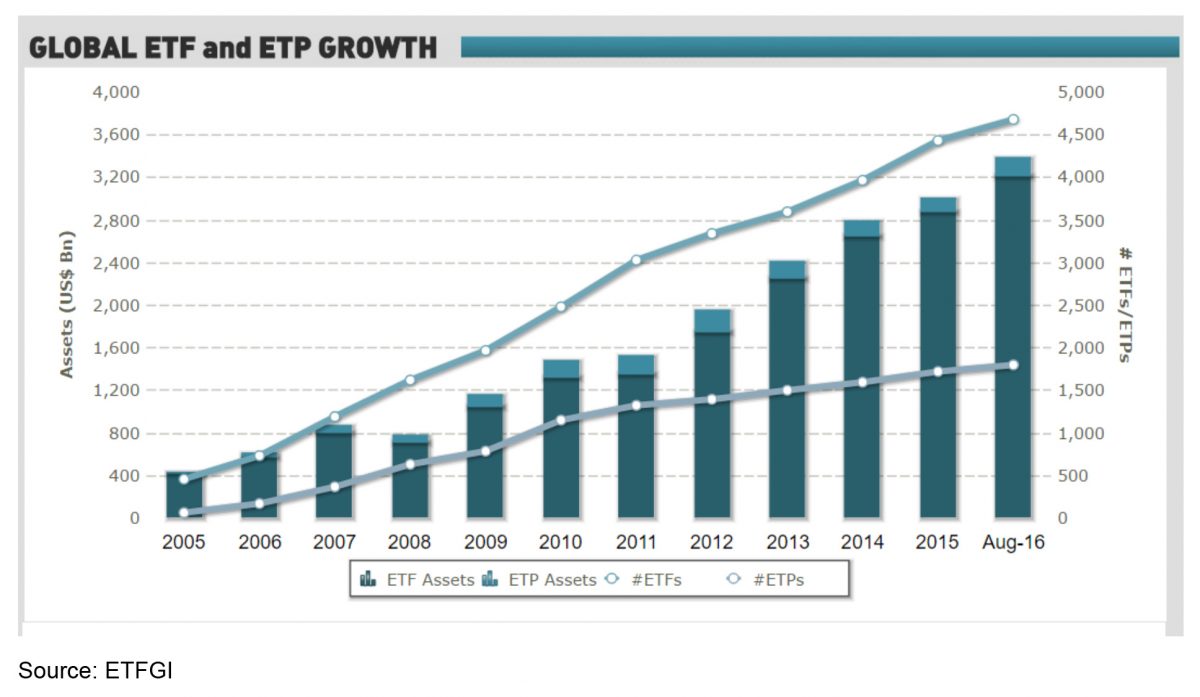
ETFs have been around in the US since 1993 and according to researcher ETFGI, ETF assets globally have nearly reached US$3.75trillion (to put that in perspective, Australia’s total superannuation pool was A$2.1 trillion at 30 June 2016). According to a recent report from Credit Suisse, ETFs account for approximately 30 per cent of the value of all US shares traded.
Since the first ETF was launched into the Australian market in 2010, investors have embraced the trend. The ASX publishes ETP market growth statistics; the growth of ETPs in number and funds under management has been remarkable.
According to a report by BetaShares/Investment Trends released earlier this year, Australian investors continue to switch out of managed funds and direct shares into ETFs; the number of Australians invested in ETFs grew 37% over the past year to 202,000, with 41% of investors holding an ETF through an SMSF. Globally, 2015 was the biggest year on record for money leaving actively managed funds for index funds and ETFs.
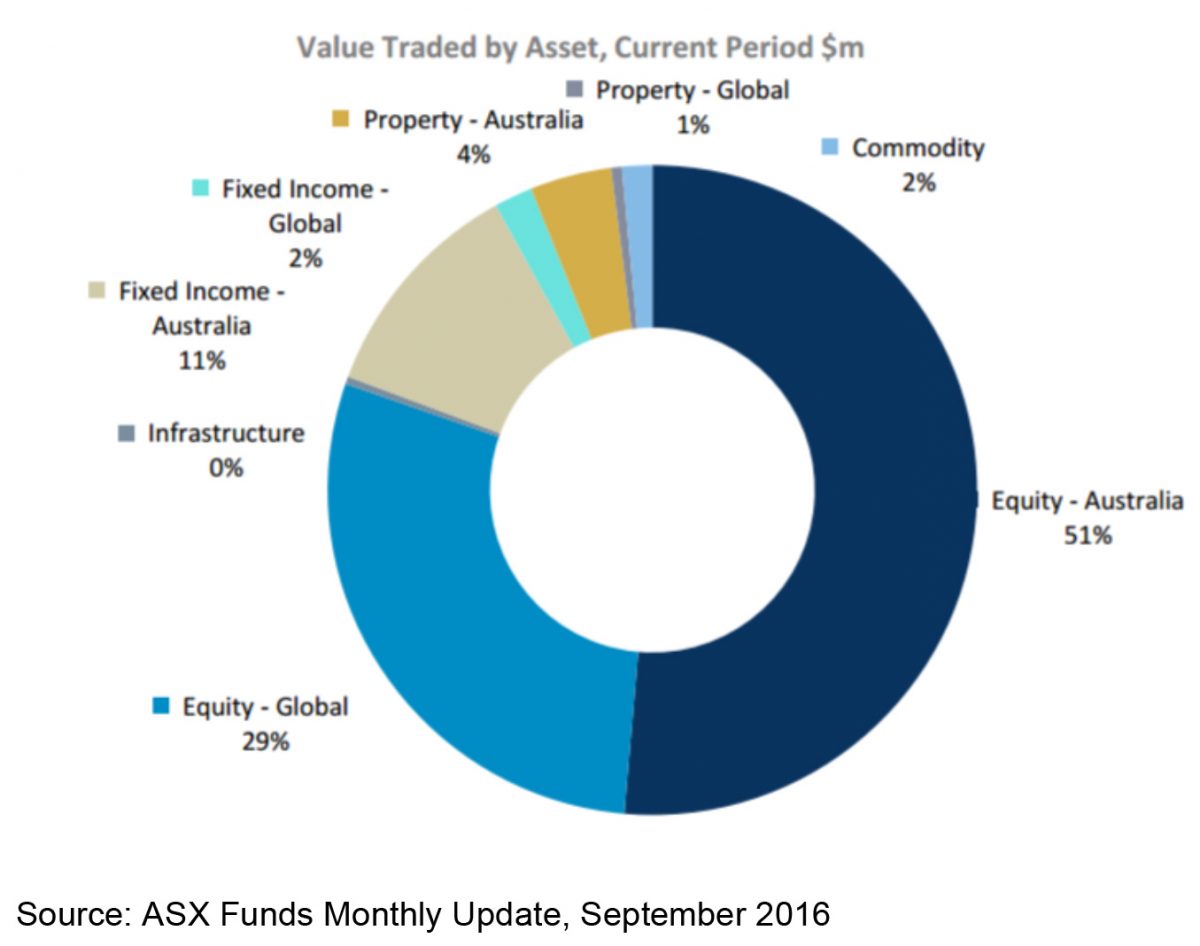
Australian and global equity ETPs remain the chief recipients of inflows, although fixed income has experienced significant growth since the first ETF in the sector was cleared by the ASX in 2012.
Unlike some investment vehicles, ETFs have been embraced by all parties in the advice chain – financial planners, stockbrokers, self-managed superannuation funds and investors. They are reviewed by research houses and available via investment platform and managed account menus.
The attraction of ETFs
While a knee jerk response to the GFC might explain the initial take up of ETFs, there are a number of benefits that support this continued growth:
- Diversification – ETFs provide low cost, diversified market exposure to an underlying index or asset class
- Transparency – most ETF issuers publish holdings on a daily basis
- Flexibility – ETFs trade on an exchange and can be bought and sold like shares, with investors able to place limit and stop orders
- Breadth – ETFs are available for traditional asset classes, as well as a range of sector and niche investments
- Tax efficiency – ETFs generally have lower levels of portfolio turnover and investors aren’t subject to capital gains tax triggered by the action of other investors, as is the case with most unit trust structures
- Cost efficiency – ETFs can be a cost effective way to gain exposure to a diversified portfolio of securities. The direct costs associated with ETFs are generally lower than those associated with investment in an equivalent actively managed fund or from trading multiple securities
- Liquidity – with primary and secondary markets available to investors, ETFs can be bought and sold easily.
As with all investments, there are risks. ETFs generally mirror a specific index and the same rules apply to ETFs as all other investments – a decline in value requires a significant gain to get back to square one.
It’s important to remember that with an ETF, there is no careful stock selection, hedging strategies or other tactics that an active fund manager might apply to mitigate against loss of value in down markets.
The future – Exchange Traded Managed Funds (ETMFs)
The BetaShares/Investment Trends research highlights continued growth for the ETF sector, measured by stated intentions of both investors and financial advisers. In the latter group, 44% of financial advisers regularly recommend ETFs, representing 79% of all financial advisers that directed new client money into direct equities in 2015. The research suggests this will continue to grow.
The new generation of ETPs – the Exchange Traded Managed Funds (ETMFs) – are gaining traction. Sometimes referred to as ‘exchange quoted managed funds’, the Investment Trends/BetaShares research indicated that 61 percent of financial advisers are interested in using ETMFs in the future; interestingly, those advisers not currently recommending ETFs show a greater propensity to recommend ETMFs.
How do ETMFs work?
An ETMF provides:
- The ability to buy and sell units on the ASX and settle via CHESS – no lengthy application forms
- Live and transparent market pricing rather than having to wait for that day’s unit price to become available
- Access to a fund manager’s investment strategy, research and expertise
- Active management, unlike ETFs that are generally passively managed around an index
- A tight price range around the Fund’s net asset value, unlike a Listed Investment Company (LIC) that can trade at a discount or premium to net asset value, depending on what investors are willing to pay.
Fundamentally, an ETMF is a listed, actively managed portfolio with access to live market pricing and the ability to buy and sell the Fund’s units in the secondary market as easily as any other ASX-listed security. ETMFs are generally comparable to their unlisted counterparts, with the same investment strategy, investment portfolio and management costs.
Since Magellan launched its popular Global Equities Fund as an exchange traded product in March 2015, the landscape has shifted. The opportunity to benefit from an exchange traded product that is actively managed has captured the imagination of many and a number of investment managers are bringing their funds to market in the same way, potentially grabbing back market share lost to ETFs over the past six years. The ETMFs currently available via the ASX are:
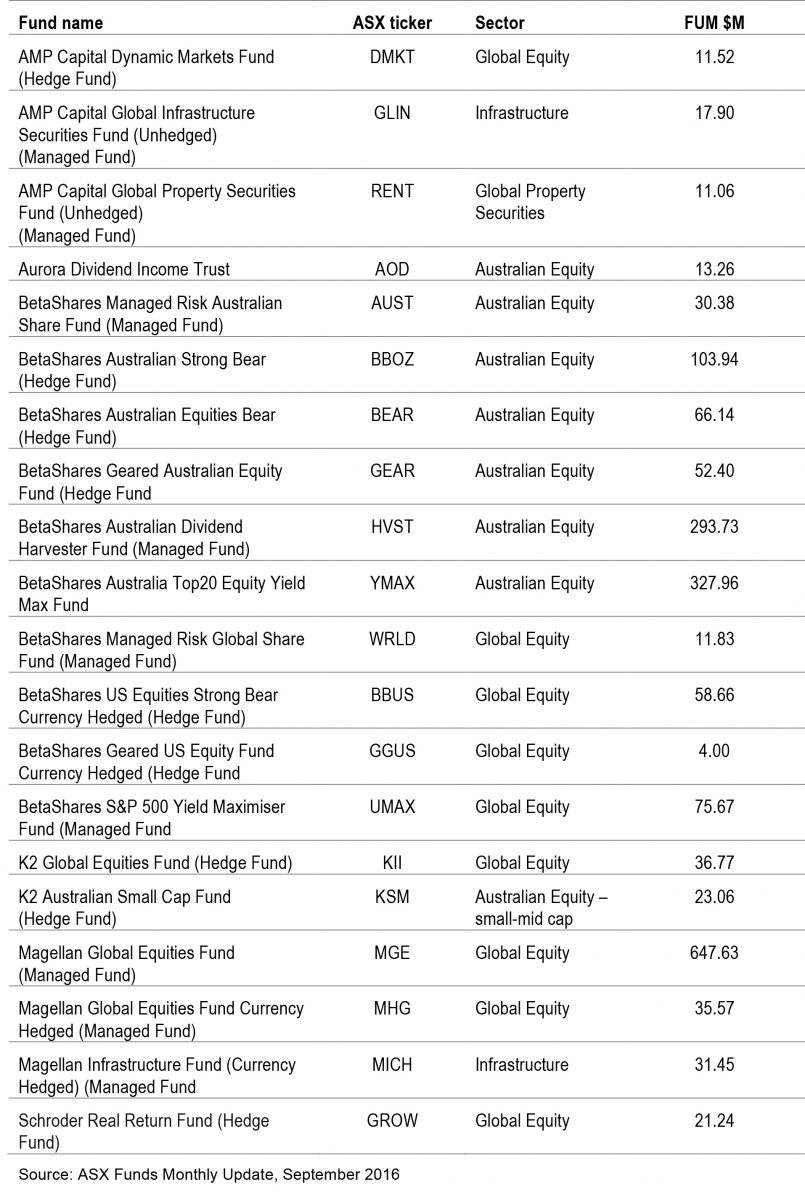
While the sector is still relatively immature, ETMFs could have the power to cannibalise both traditional managed funds and ETFs…is this the future of managed investments?
[1] Source: ASX Funds Monthly Update, September 2016
———


