
The dominoes keep falling- market reaction to Italian referendum
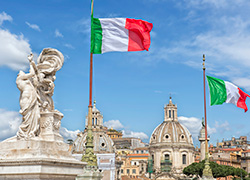
The Italian referendum can be viewed as another victory for populism.
The results from yesterday’s Italian referendum to reform the legislative process has failed with the “No” side taking almost 60% of the vote. The referendum has claimed another victim, Prime Minister Matteo Renzi who staked his political future on a “Yes” vote. Renzi is set to offer his resignation Monday morning.
Another Brexit?
In one sense, the Italian referendum can be viewed as another victory for populism, which has been gaining strength across Europe. Euro-skepticism won its first major battle with Brexit in June while global populist sentiment received a major shot in the in arm from the election of Donald Trump in the U.S.
However, unlike both Brexit and the election of Trump, a “no” vote in Italy wasn’t a major surprise. While undecideds ran close to 20%, the “No” vote was leading in most polls by about 2-3% going into Sunday’s referendum. As a result, the markets have had a much more muted response to the referendum. As of this writing, major Asian equity indexes are down only fractionally while bond yields are down 3-5 bps across Asia.
In a mild flight-to-quality, the euro is off modestly while the broad U.S. dollar is up 0.6%. It should be noted that even this muted reaction may only be partially the result of the Italian vote. The markets, particularly across the Asian open, may also be discounting the surprise resignation of New Zealand’s prime minister John Key as well as heightened tensions around U.S./China relations as president-elect Trump spoke with Taiwan’s president.
This was a mild faux pas since the U.S. doesn’t recognize Taiwan as sovereign under the “One China” doctrine. Regardless of the specific attribution to the Italian vote, markets have gone mildly risk-off.
More cracks in the foundation
So the market response thus far has been muted. But what of the larger implications? No, the structures supporting the EU and Eurozone system are not collapsing, but today’s vote is another discernable crack in the foundation. It is unclear as of this writing whether Italy will form a new, caretaker government or push for new elections in the next few weeks.
In the bigger picture, it may not matter. Italy’s growth has been failing, its deficits growing, and the solvency of its banks are in question. The Italian banking system is laboring under massive non-performing loans (NPLs) which is hardly a recipe for reviving credit-driven growth.
Ineffective, fractious, and divided government holds little hope of addressing these problems anytime soon. Moreover,
Renzi’s fall opens the door further for other Euro-skeptic parties like Italy’s Five Star Movement. Predicting European
political paths is surely a fool’s game, but Renzi’s defeat is another headwind to keeping “the European experiment”
together.
Another brick on the load
While somewhat expected, today’s vote in Italy is moving markets at the margin. However, it does little to change,
other than perhaps extend, many of our current views. We expect 2017 to be a year of increased volatility and dispersion.
It would be naïve to think geopolitical risk has passed post-Brexit and the U.S. election. We believe it’s just getting more interesting. The UK’s withdrawal under Article 50 may prove sloppy at best and downright painful at worst. While markets have reacted favorably towards Trump’s growth agenda in the U.S., this weekend’s dust-up with Taiwan/China certainly won’t be the last, as his inexperience and bombastic style should provide plenty of thrills and spills for global investors.
Combined with elevated valuations across stocks globally, a Fed on the verge of hiking rates, and interest rate fears spreading across bond markets, it’s difficult to forecast a reduction in asset volatility. After 7+ years of solid returns across both stocks and bonds (post-Great Financial Crisis), we expect investor emotions to be tested more severely in 2017.
Yesterday’s Italian referendum is just another brick on the load that investors will have to bear.
By David F. Lafferty, CFA®, Senior Vice President – Chief Market Strategist


