
Legg Mason on ‘’ Legg Mason, a leading global fund manager, presents a global bond update. They comment: Global bond markets suffered a sharp turnaround, mostly driven by expectations that US president Donald Trump will unveil next week a tax plan aimed easing businesses’ costs, thereby accelerating growth.
The benchmark US Treasury 10-year yield jumped to 2.44%, the highest since March, while sovereign bond yields in other developed markets also rose sharply. The abrupt change was also triggered by positive US durable goods orders data, as well as strong existing home sales in September. In addition, speculation mounted about president Trump appointing a new chair for the Federal Reserve, who could be perceived as slightly hawkish. In the meantime, current chair Janet Yellen reiterated that recent soft inflation data might be temporary. The US dollar rallied on the expectations of higher rates, hitting Emerging Markets (EMs) and their currencies. The Brazilian real and the Mexican peso sank 2.3% and 2%, respectively. Inflation expectations rose in both Europe and the US.
Globally, and underpinning an overall better economic outlook, China maintained its 6.8% growth rate in the third quarter, while Britain posted an above-expectations 0.4% economic acceleration between July and September, fuelling speculation that the Bank of England could lift interest rates for the first time in a decade. Germany’s leading IFO index of business confidence also came in above estimates. In Japan, president Abe won another mandate to continue his ultra-expansionary monetary policy, while in Argentina, the central bank unexpectedly hiked rates to stem rising inflation. Oil and commodities mostly rose on the improved global outlook, at the same time that US equities reached yet another record on the back of strong earnings.
On the rise
Euro & growth – together at last?
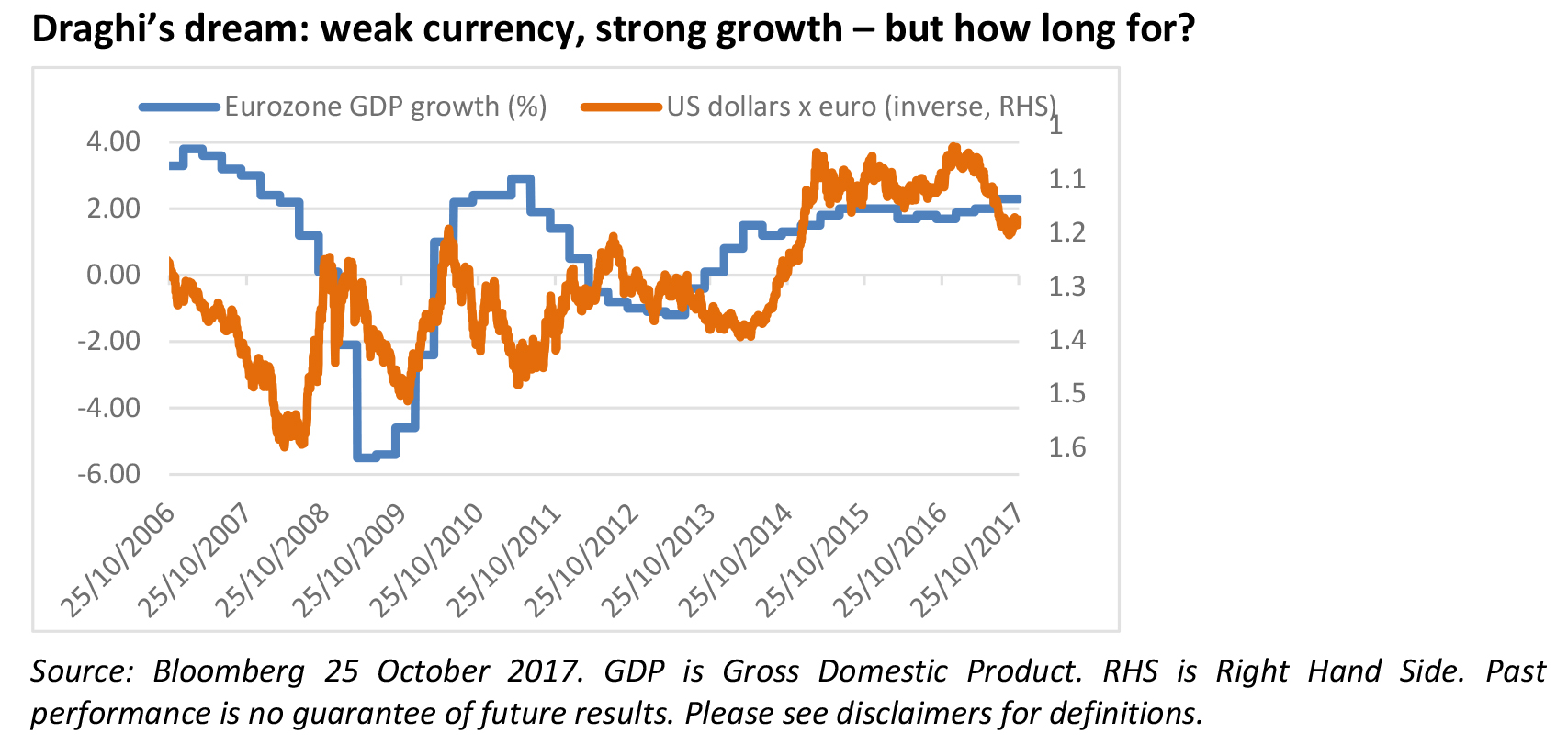
The euro was one of the few currencies to strengthen against a rising US dollar over the past five trading days, supported by strong growth in the region. Speculation also rose about European Central Bank’s (ECB) president Mario Draghi announcing a potential scaling down of the bank’s monetary stimulus this week. Years after the US and British central banks unveiled monetary easing policies to minimise the effects of the 2007-08 financial crisis, the ECB finally announced a similar programme in January 2015. Almost 2 years later, and with annualised growth at 2.3% (blue line in the chart), speculation is mounting that the programme could be coming to an end. However, Draghi has reassured markets that any tapering would be gradual – comments which have contained the euro from sharp increases, a welcome move for European exporters. As seen on the chart, European growth has benefited from a weaker currency over the past two years – but how long will Draghi be able to foster growth while keeping a lid on the currency?
High Yield and bank loans – week survivors
High Yield (HY) bonds and leveraged bank loans were two of the few fixed income asset classes to deliver positive returns over the past five trading days. Hopes of faster growth, lower taxes and, consequentially, lower defaults in the US pushed the country’s HY leading index up 0.6%, taking its year-to-date return to 7.64%. Top-performing sectors include those sensitive to economic cycles, such as Transport and Banks. Other top leading sectors include Metals & Mining companies, especially those that have deleveraged and improved their balance sheets. US bank loans, closely correlated the health of the economy, also gained.
On the slide
Gilts – ready for a hike
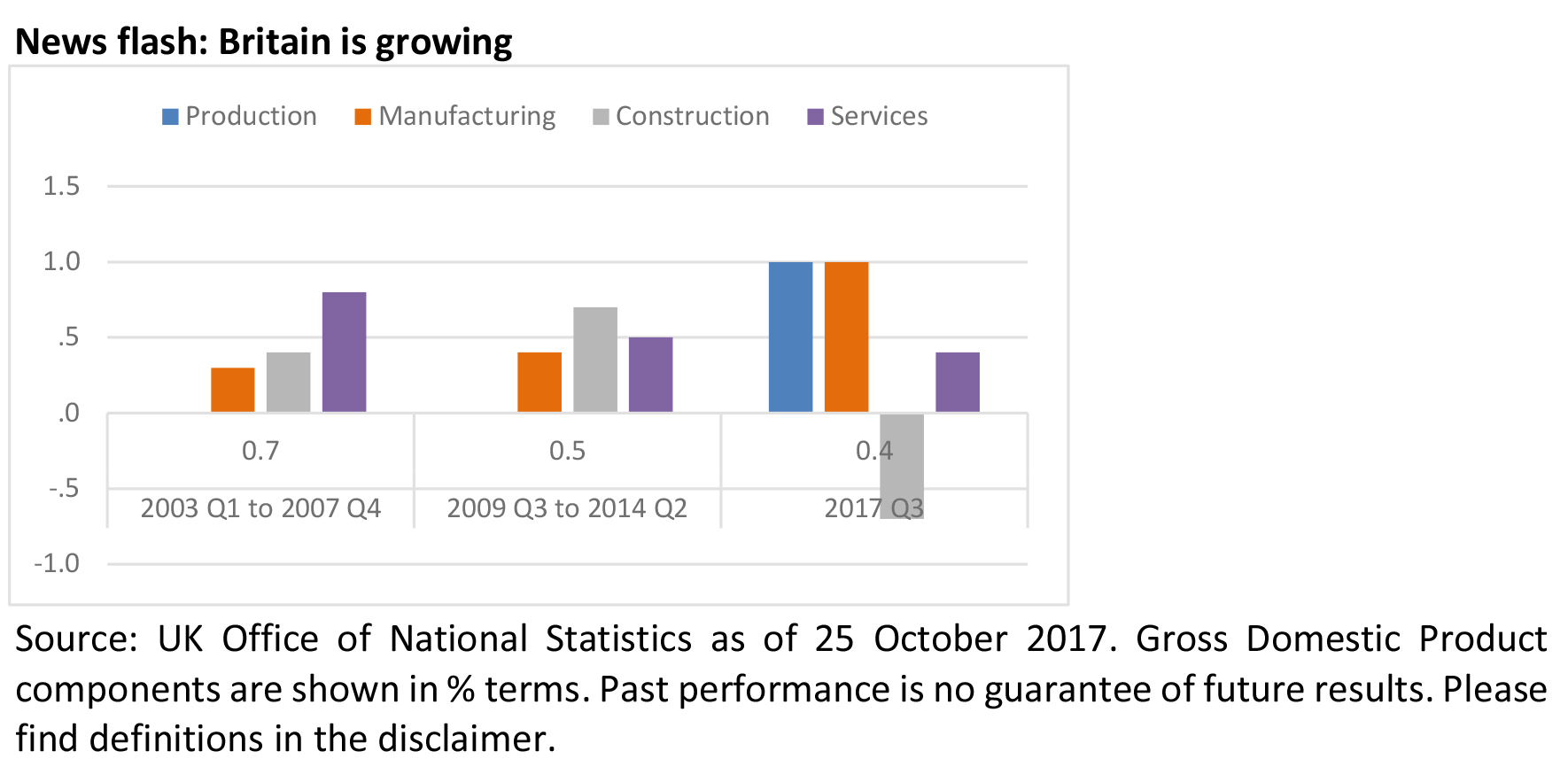
UK sovereign bonds, popularly known as gilts, were among the worst performing European sovereigns over the past five trading days, dragged down by unexpectedly positive growth data. Despite the uncertainty around the negotiations between Britain and the European Union (EU) about the terms of the country’s planned departure from the bloc, growth has been more resilient than many expected: the UK economy grew at 0.4% in the third quarter, above expectations of 0.3%, and despite a contraction in the construction sector, as seen on the chart. On this occasion, it was Manufacturing that led growth, especially in areas such as Transport Equipment and Machinery. The overall growth, and inflation running an annualised 3%, have lifted market-implied chances that the Bank of England will raise rates at its November meeting to as high as 89%, up from only 20% only 2 months ago – it would be the first rate hike in a decade.
South African rant
The rand plunged almost 5% against the US dollar over the past five trading days, the worst EM currency performance. The country’s sovereign bond yields also jumped as finance minister Gigaba signalled that debt could rise to as much as 60% of GDP in order to reduce an increasing budget deficit. The move might trigger credit rating downgrades. Gigaba’s predecessor, Pravin Gordhan, showed commitment to limit debt at around 50% of GDP – until he was sacked by president Zuma in March. The country’s ruling African National Congress is expected to review the party’s leadership at its next meeting in December. Source for all data: Bloomberg and Barclays Capital as of 25 October 2017, unless indicated.


