

Victor Verberk
In light of the massive gap between markets and fundamentals, we approached this Credit Quarterly Outlook with the question: do fundamentals still matter?
Sander Bus, Co-head of the Robeco Credit team, says, “Longer term, we have no doubt that fundamentals still matter for markets but, for the last several months, the central bank put has overwhelmed everything else. Quick and decisive action by governments and central banks helped to restore a large part of the initial losses, by removing the systemic risk in the market. The risk of a banking crisis or even a Eurozone sovereign crisis is now arguably lower than before Covid-19, due to the easing of banking regulation, the introduction of quasi Eurobonds, relaxed rules for state support and several other supportive actions by authorities”.
We recognise this dynamic and feel comfortable that at least senior bank and Eurozone sovereign spreads are under policy control and unlikely to move dramatically wider. The same holds for higher-quality corporate bonds that are eligible for ECB buying and that can benefit from fiscal support in the form of guaranteed lending, furlough schemes and other measures.
According to Bus, “one of the few segments of the market where fundamentals still matter today, is the weaker end of the high yield market. Here you find many vulnerable companies that will not survive an extended period of weak demand”.
Limited inflationary impact
Victor Verberk, Co-head of the Robeco Credit team, sees limited inflationary consequences from the policy response. “We do not expect much inflationary impact from the massive increase in money supply engineered by fiscal authorities and central banks, at least in the next few years. The disinflationary forces stemming from the disruption to demand will simply be too strong. Secular forces such as aging and technological developments do not point to galloping inflation, either. Moreover, academic research suggests that the inflationary impact of deglobalization should not be overestimated”.
The odds of an inflationary uptick on a horizon beyond the coming years do seem more pronounced, though. Nevertheless, this would require the increase in money supply to be sustained and eventually associated with much stronger consumer and business spending, as ‘more money starts to chase fewer goods’.
Inflation will probably follow the rules of the ‘ketchup theory’, says Verberk: “At first, nothing comes out of the bottle, but as you keep on shaking and the ketchup starts to flow, you end up with more than you wanted.”
Fading recovery momentum
So, where are we now? After the initial shock, macro data in Q3 surprised to the upside compared to very downbeat expectations. This has helped risk markets. But the momentum of the recovery is clearly fading now and the positive surprises have ended. With winter approaching in the northern hemisphere, we are already seeing more infections across much of Europe and local lockdowns that will hurt the economic recovery.
For many corporates, the economic downturn means weaker balance sheets and negative cashflow. “Let’s not forget that Covid arrived after the longest US economic expansion ever recorded by the NBER,” says Robeco Credit Strategist Jamie Stuttard. “We were already warning of an economic downturn in the Outlook a year ago, not knowing that Covid-19 would be the trigger.”
“Weaknesses were already prevalent in corporate credit, such as stretched balance sheets, debt-funded M&A and poor documentation. Massive government intervention in the private sector and liquidity injections helped to extend the cycle but it is likely (and healthy!) that we go through a proper bear market. A bear market is the best medicine to clean up the house; it gets rid of the zombie firms, repairs balance sheets and strengthens documentation. Only when that process is finalized are the markets ready for a brand new multi-year credit bull market,” says Stuttard.
Stretched valuations
“For the market as a whole we judge valuations as being stretched,” according to Verberk. “Spread levels are at or below the long-term average for all segments of the market. The tight spreads can be explained by the strong technicals but do not compensate for the current fundamental environment.”
He adds that the market looks even more expensive if adjusted for quality. “The weight of BBB in the US investment grade market has steadily gone up from 35% in 2008 to over 50% today, within 0.5% of its all-time record.”
Market cycle | Mapping our view on market segments
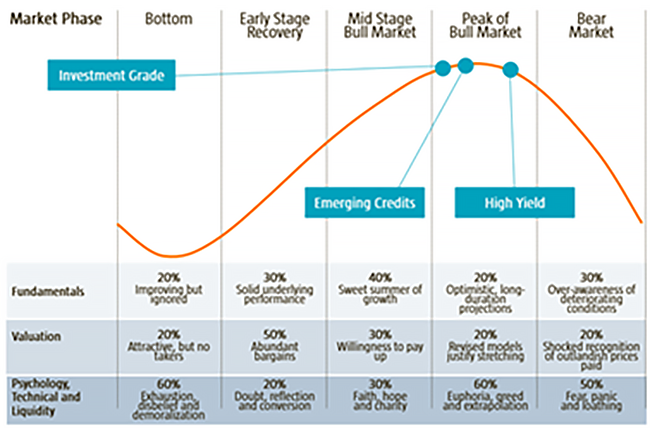
Source: Robeco, September 2020
For high yield, it is easier to see spreads going wider from here, explains Bus, since this market only benefits indirectly from the central bank put. “The Fed limits individual high yield bond buying to companies that were investment grade before late March 2020, a sum total of just 8 tickers.”
The rally may have run its course
“We now have the view that the rally has run its course,” says Bus. “It is difficult to see further material spread tightening from here. We lower our beta for investment grade to 1. For high yield, where we were already below 1, we keep it there.”
We are convinced that there will be opportunities to add or reduce risk in the coming months, not only from a top-down perspective but also in individual issuers or sectors. There is still a lot of volatility in Covid-sensitive sectors, which from time to time offer good value.


