
CFA Institute report says investment organisations need to better manage culture

Lisa Carroll
A new report from the CFA Institute, The Future of Work in Investment Management: Changing Organisational Cultures, has found that the culture of investment organisations often constrains innovation; for stronger cultures to develop, leaders must promote more adaptive, agile and inclusive organisations.
Although most investment leaders recognise culture as extremely important, the culture of investment management organisations has, to date, been one of the least understood and least managed areas in the industry, the report found. More proactive leadership of culture is therefore needed.
Lisa Carroll, CEO of CFA Societies Australia, said while a cultural reset will be difficult for some organisations, it is important that employers focus on employees’ performance, promote inclusive work practices and adopt a strong focus on values including trustworthiness.
“Culture is shaped by top-down organisational messages and bottom-up team experiences. The investment industry has an opportunity to build more effective teams through the power of inclusion that values the benefits of diversity,” Carroll said.
“Culture has moved forward in the COVID period and will no doubt continue to evolve. As a guide to investment leaders, organisations should do the practical things well, such as setting out precise work parameters, interpret metrics thoughtfully and fairly, and give feedback on how things are working. The Future of Work report also recommends building and maintaining a people-centric cultural identity. Organisational values should include fairness and trustworthiness, which will help to underpin trust in the investment management industry as a whole,” she said.
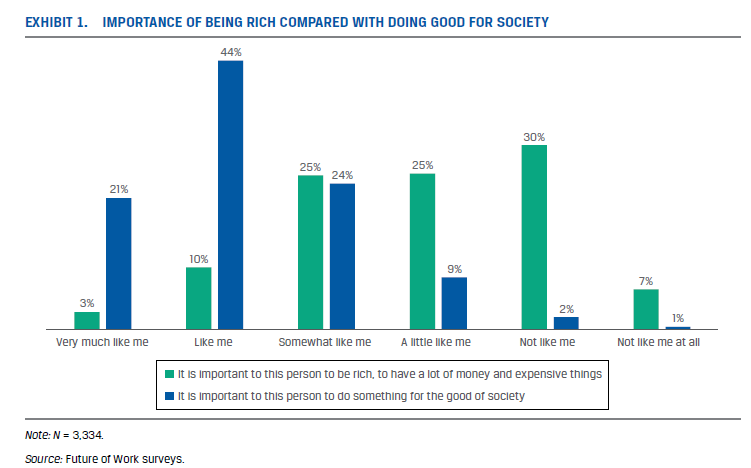
Surprisingly, the report found that investment professionals value being rich less than the general population and value doing good for the benefit of society more, when compared with responses from the World Values Survey.[1] The Future of Work report includes data from a combined 9,000 investment professionals surveyed globally across two Future of Work surveys between March and May 2021.
“The fact that investment professionals prioritise impact and purpose over wealth may be a surprise to many, given they manage a huge amount of wealth on behalf of society. But the trend was clear, as shown by the graph below,” Carroll said. “There are strong trends in the appetite for meaningful work amongst investment professionals. Organisations can capitalise on this opportunity to align organisational impact with the desire of their employees.”
Other key fundings from the report include:
- Leaders must ask the tough questions; they should review why their organisations exist and the shape and texture of its identity, including its purpose and vision, history and legacy, and artifacts and stories.
- The new sustainability paradigm makes cultural adaptation more urgent. The challenge of blending risk, return, and real-world impact requires a cultural commitment to sustainability through the lens of professional excellence and organisational values.
- Investment organisations should build a robust talent strategy; acquiring, developing, and retaining talent are important. The cultural value of investing in employees builds better talent, and it improves an organisation’s ability to retain staff.
- Investment organisations should take a balanced approach to compensation to strike the right balance that is not unduly geared to commercial success and has more stakeholder components.
- Investment organisations should work together for impact and leaders should build a wide network of cooperative relationships that allow the real-world impacts from sustainable investment initiatives to be scaled up.
- No greenwashing. Organisations need to apply the very highest standards of accuracy and ethics in all sustainability reporting and ensure that the benefits and costs of sustainability practice are communicated without undue bias and with appropriate context.
———


