
Super changes from 1 July 2022

How do the changes to superannuation that came into effect on 1 July 2022 impact your clients?
Superannuation is a tax effective and important retirement savings tool. The new financial year heralded a raft of changes to existing superannuation rules. This article, proudly sponsored by Russell Investments, outlines these changes and how they can impact advisers’ clients.
It’s estimated that there’s five million Australian baby boomers approaching – or having recently entered – their retirement years. As these baby boomers celebrate their increased longevity and plan what they want to do over 25 plus years in retirement, there’s something important that underpins their ability to achieve this – a sound financial plan. Superannuation forms a key part of this plan.
Although for many baby boomers, compulsory superannuation was introduced partway through their working lives, it remains a tax effective savings vehicle for their retirement and should be maximised. As is often the case, superannuation rules change over time. This year is no different, and a number of changes were made to superannuation rules, effective from 1 July 2022, impacting contribution caps, the work test, the annual minimum pension drawdown and more. From this date, superannuation guarantee contributions rose to 10.5% and the minimum monthly income threshold was removed.
Let’s explore some of these changes in greater detail.
Contributions limits
There are two types of contributions – concessional and non-concessional.
Concessional contributions
These are pre-tax contributions and include super guarantee (SG) contributions made by employers – now at 10.5% – as well as personal contributions for which your client can claim a tax deduction and salary sacrifice contributions.
Concessional contributions are taxed at a lower ‘concessional’ rate of 15%. If a client’s employer subsidises administration costs or pays insurance premiums on the client’s behalf, these amounts also count towards their concessional contribution limit.
From 1 July 2022, the concessional contributions cap has increased from to $25,000 to $27,500.
Carry-forward concessional contributions allows clients to carry forward their unused contributions caps from prior years, commencing 1 July 2018. This allows eligible members who do not use all of their concessional cap in a particular financial year, to carry forward their unused concessional cap amounts to future years.
The first year in which a client can increase their concessional contributions cap by the amount of unused cap is 2019/20, but only if their total superannuation balance is less than $500,000 on 30 June in the previous year. Unused amounts are available for a maximum of five years.
Case study – carry forward contributions caps
In the 2019 financial year, Anna held a full time job at Events R Us. Her concessional contributions – SGC payments from Events R Us plus her own salary sacrifice contributions – totalled $25,000, thereby reaching the maximum concessional contributions cap. In this scenario, Anna had no unused cap to carry forward into future years.
During the 2020 financial year, Events R Us had to close due to the Covid-19 pandemic and Anna found herself unemployed. Her employer had made $5,000 in SG contributions during that financial year before the business had to close its doors. Anna had seen the writing on the wall and had cancelled her salary sacrifice contributions as soon as the pandemic reached Australia’s shores. At the end of the 2020 financial year, Anna had an unused cap amount of $20,000 – the annual concessional contributions cap of $25,000 less the $5,000 super guarantee contributions she’d received from her employer.
It was a terrible period for events and Anna remained unemployed throughout the 2021 financial year; she was unable to make personal contributions. The concessional contributions cap for that year was again $25,000, so Anna had this total amount count towards her unused cap.
Over the nearly two years she was unemployed, Anna’s total unused cap totalled $45,000, which was then carried forward to the 2022 financial year.
Anna had undertaken some study during the period of unemployment and was able to find a new role in a new industry during the 2022 financial year.
Anna receives $15,500 in SG contributions to her super fund during the 2022 financial year. Her total super balance on 30 June 2021 is $247,000 and, because it is below the $500,000 threshold, Anna is eligible to use the unused cap of $45,000 from the previous two financial years.
Anna also has a 2022 financial year cap of $12,000 remaining, which is the 2022 cap limit of $27,500, minus the $15,500 employer super guarantee contributions made by her employer.
Anna could make a total concessional contribution of $57,000 in the 2022 financial year. This would reduce her taxable income and allow her to add to her super balance.
Non-concessional contributions
These contributions are those made by your client from their after tax earnings. The age limit to make non-concessional contributions to super has been extended to 75 years from 1 July 2022; in line with this, the age limit for a client to use the bring forward provisions to make up to three years of contributions in one year has also been lifted.
From 1 July 2022, the non-concessional contributions cap is $110,000. Those clients who wish to make non-concessional contributions above this cap may be eligible to automatically gain access to future year caps and ‘bring forward’ two years of contributions, giving them a total non-concessional cap of $330,000 for the three years.
A client would now meet the age based criteria to trigger a bring forward contribution if they are aged less than 75 at any time in that financial year. However, while the bring forward contribution is available in the financial year the client turns 75, it needs to be made before they turn 75, because non-concessional contributions cannot be made after that time.
The bring-forward rule allows eligible clients to make extra non-concessional contributions without having to pay extra tax. The maximum amount that can be contributed under the bring forward rule for the 2022-2023 financial year is illustrated in figure one.
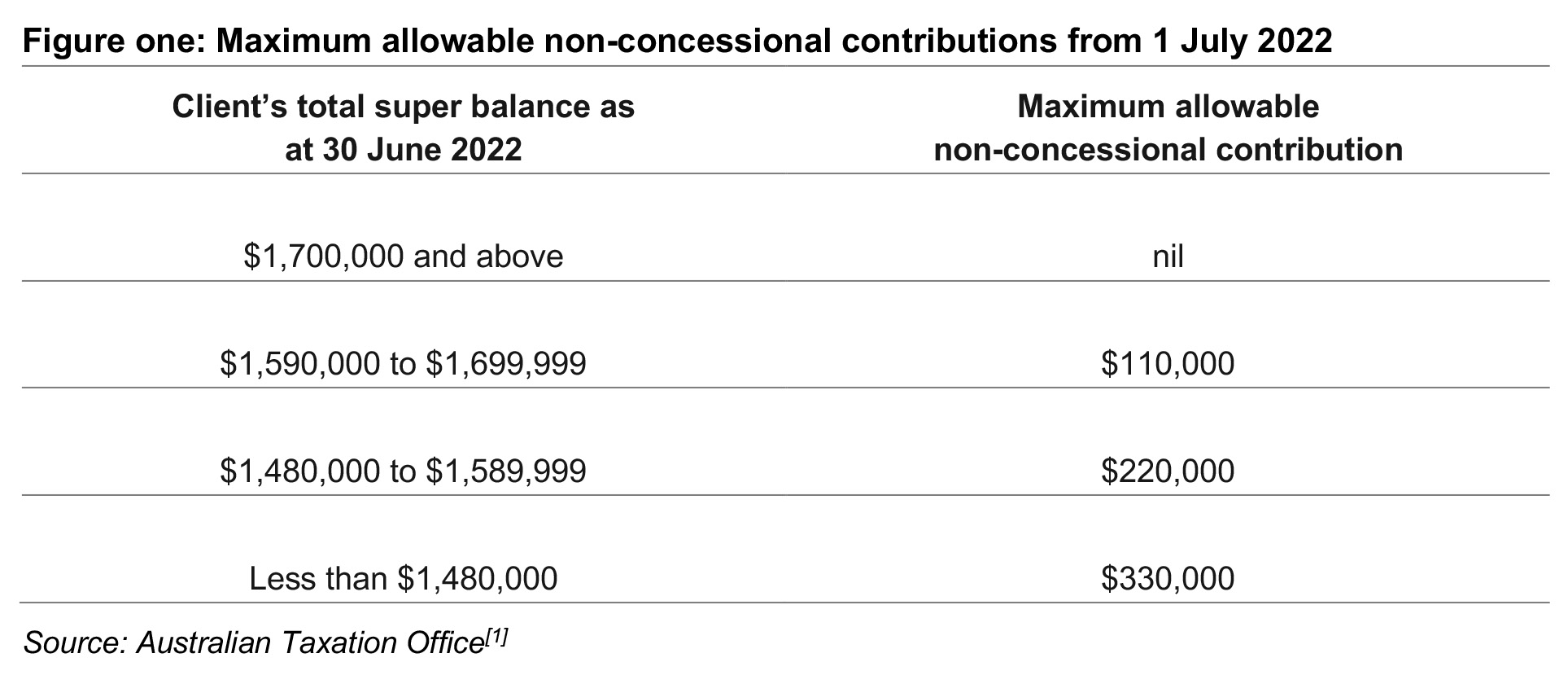
Any contributions made in excess of the bring-forward rule limit will be taxed at 47% (including the Medicare Levy). If your client is over the limit, they can elect to have their excess non-concessional contributions (along with associated earnings) returned.
From 1 July 2022, the work test has been removed for non-concessional contributions, meaning eligible clients can make such contributions until they turn 75. However, the work test must still be met for personal deductible contributions. So, if a client aged 67 and above wants to claim a tax deduction for a personal contribution made to their super from 1 July 2022, work test requirements remain.
This means the client needs to have been gainfully employed (which can include being self-employed) for at least 40 hours within any consecutive 30-day period during the financial year.
Whether there is a work test requirement or not, existing contribution cap arrangements will continue to apply; a client’s total superannuation balance will need to be below the $1.7 million threshold at the previous 30 June to be eligible to make a non-concessional contribution.
Finally, those clients with $1.7 million or more in the super system as of 30 June in the previous financial year will not be eligible to make non-concessional contributions. This is an increase of $100,000 from the previous maximum.
It’s important to remind clients that if they are contributing to more than one super account, the contribution limit is a total combined limit.
Case study – a non-concessional contribution
Joe is aged 74, soon to turn 75. He and his wife recently sold a share in an industrial property and Joe wants to make a non-concessional contribution to his super account. If he does this prior to turning 75, he is eligible to take advantage of the ‘bring forward’ cap and contribute more than $110,000 without incurring a tax liability.
Joe’s super balance at 30 June 2022 was $1,490,000. So, in the financial year commencing 1 July 2022, he can make a non-concessional contribution of $220,000 because this won’t result in him exceeding the $1.7 million threshold.
Prior to 1 July 2022, Joe would have needed to meet the work test to make this non-concessional contribution and he would not have been able to take advantage of the bring forward cap.
Minimum super pension limits
Each tax year, super fund members in retirement phase are required to be paid at least the minimum legislated pension from their pension account. This annual minimum amount (figure one) is based on your client’s age and expressed as a percentage of the balance of their pension account as at 1 July or when they commence their pension (whichever occurs later).
The federal government has now extended the measure first introduced in March 2020, which allowed retirees to withdraw half the normal minimum amount from their super without having to pay additional tax on their earnings. This extension applies until 30 June 2023.

Changes to the downsizer contribution
Introduced on 1 July 2018, the federal government’s downsizer contribution allows older Australians to top up their super with some of the proceeds of selling their main residence. The contribution does not count toward their annual non-concessional cap.
While the current age for downsizer eligibility is 60 upward, tax amendments passed Parliament to lower the age to 55. It’s expected the revised rule could apply from October 2022, once it receives royal assent. Sale proceeds from the main residence can be contributed to super – up to $300,000 for singles or $600,000 for couples. No work test or upper age limits apply to downsizer contributions.
By lowering the qualification age, the government aims to enable more pre-retirees to use the downsizer contribution to get a greater amount of savings into super earlier, thereby benefiting from investing in the tax effective environment offered by super.
There’s a number of eligibility requirements to be met when making a downsizer contribution, including:
- your client/s are 60 years old or older at the time they make a downsizer contribution
- the amount being contributed is from the proceeds of selling a home where the contract of sale exchanged on or after 1 July 2018
- the home was owned by your client and/or their spouse for 10 years or more prior to the sale
- the home is in Australia and is not a caravan, houseboat or other mobile home
- the proceeds (capital gain or loss) from the sale of the home are either exempt or partially exempt from capital gains tax (CGT) under the main residence exemption, or would be entitled to such an exemption if the home was a CGT rather than a pre-CGT (acquired before 20 September 1985) asset
- the client has provided their super fund with the ‘downsizer contribution into super’ form either before or at the time of making their downsizer contribution
- the downsizer contribution is made within 90 days of receiving the proceeds of sale, which is usually at the date of settlement
- your client has not previously made a downsizer contribution from the sale of another home.
(Source: Australian Taxation Office[2])
Re-contribution of COVID-19 early release super amounts
A number of your clients may have dipped into their super during the Covid-19 pandemic, taking advantage of the government’s two windows in which they could withdraw up to a total of $20,000. In all, $36.4 billion was withdrawn from super as part of this early release scheme.
Any client who did need to use this scheme can now re-contribute that money back into their super account to rebuild their balance. Re-contributions of Covid-19 early release of superannuation can be made up to 30 June 2030.
According to the ATO, before choosing to treat a contribution to super as a re-contribution of Covid-19 early release amounts, your client should:
- check their non-concessional contributions cap to see if they’re likely to go over it in the year they make the contribution – if the contribution will not cause them to exceed their cap, they do not need to complete a form
- check eligibility
- confirm their super fund will accept contributions.
If a client elects to make a COVID-19 re-contribution, they need to complete the Notice of re-contribution of COVID-19 early release amounts (NAT 75394) form[3] and provide it to their super fund before or at the time they make your contribution. The fund will report this re-contribution information to the ATO.
One form can be used to cover multiple re-contribution amounts to a single fund in one financial year. If your client makes Covid-19 re-contributions to multiple funds, or in more than one financial year, a separate form must be lodged with each fund for each financial year.
Eligible Covid-19 re-contributions are excluded from the non-concessional contributions cap. However, your client needs to tell their super fund that the contribution is a Covid-19 re-contribution at the time of (or before) making the contribution. If this is not done, it will be regarded as a non-concessional contribution and assessed to the non-concessional contribution cap.
Superannuation continues to be the most tax effective savings vehicle for retirement. There are a range of opportunities for clients to add to their super balance, which will help them enjoy a comfortable retirement and be better positioned to meet their retirement goals.

——–


