
Four signs that a client will benefit from setting up a family foundation

When does a client benefit from setting up a family foundation?
Financial security is the first goal, but then what? For some, there can be a lingering and overarching need to give back. Setting up a family foundation is a great way for a family to consciously, intentionally and regularly give to charity and feel the great personal satisfaction of making a difference.
In this article, we outline the landscape for family foundations in Australia, and highlight when a client will benefit from setting up a family foundation.
What is a family foundation?
Family foundations, officially known as Private Ancillary Funds (PAFs) in Australia, are private charitable trusts that families can make tax deductible donations to. By law, 5% of the value of the fund must be distributed each year to charities with Deductible Recipient Status 1[1](DGR 1) tax status.
PAFs are usually invested in a portfolio of investments that reflect the financial objectives of the family. Some families also choose to ensure their PAF investments are aligned ethically with social/environmental objectives.
Family foundations in Australia
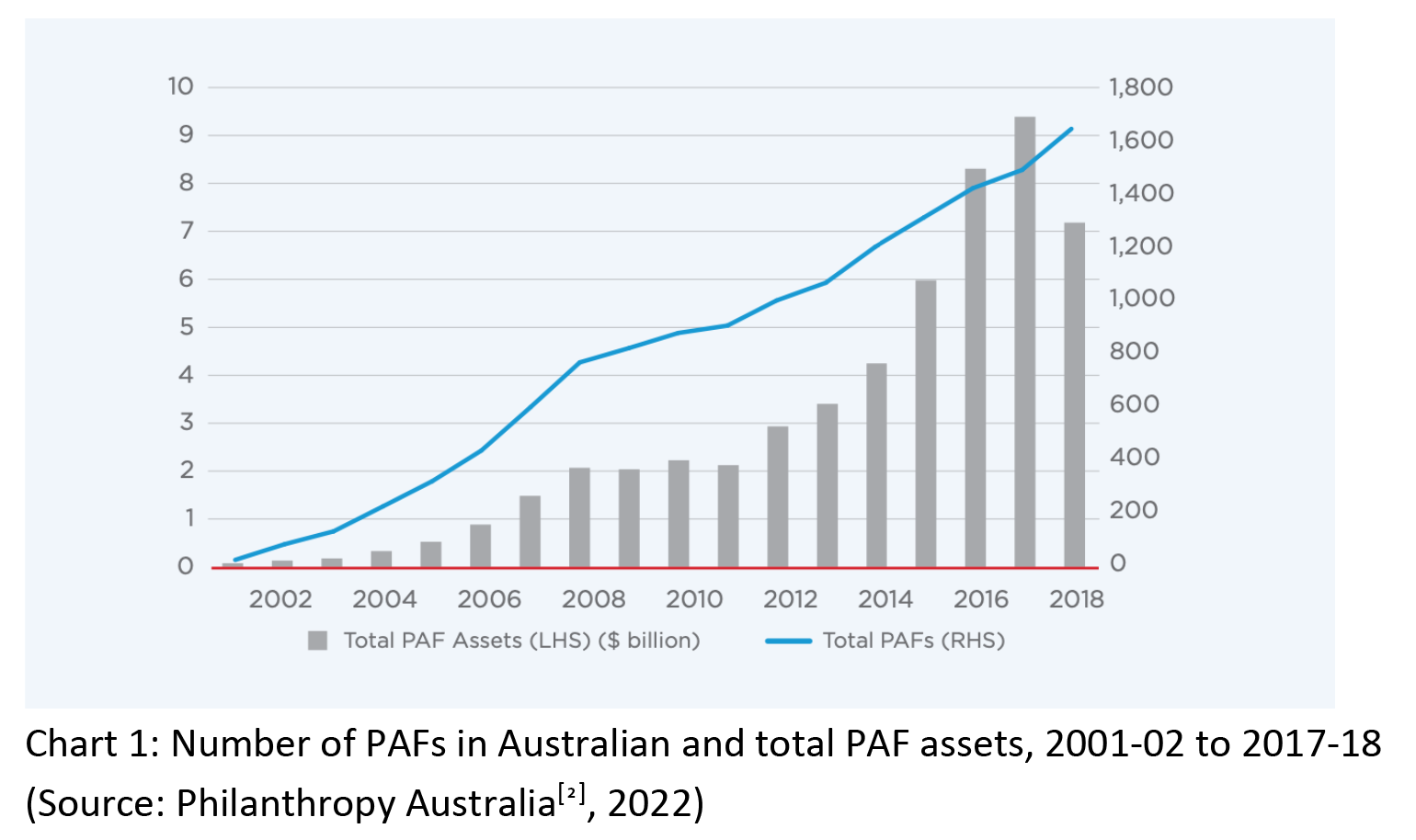
There are over 1,600 PAFs in Australia, with an average value of $4.4 million each. The number of PAFs are steadily growing and with several hundred new PAFs registered each year (Chart 1, below).
Foundations are not just for the ultra-rich
PAFs can be established for any portfolio size, but are usually only cost-effective with an initial outlay of $500,000. For those with a smaller starting asset-base, there are other options that achieve similar outcomes. With a deposit of just $20,000, your client set up a sub-fund with a Public Ancillary Funds (PuAFs). Sub-funds have the same function as a PAF, but with some small differences. They allow your client to choose the charities they distribute donations to, but require a distribution of only 3% of the value of the fund per annum. However, your client will have limited control over the funds’ administration and investment decisions as this is the responsibility of the PuAFs’ trustees.
4 signs that your client will benefit from a family foundation
There are 4 clear signs that a client will benefit from establishing a family foundation. Those that aspire to leave a legacy, that take an active interest in helping others (or the environment or animals) and that are financially comfortable or have come into wealth usually receive the most joy and fulfillment from a family foundation.
Sign 1: Aspire to leave a legacy
Setting up a family foundation can be an extremely effective tool in embedding values within a family. Family foundations can exist into perpetuity and can be managed by the family descendants long after the founders are gone. They require an annual distribution which forces the family to continually reflect on their position in society and the critical role they can take in improving the lives of others. For these reasons, clients that see themselves as leaders and that want to leave a legacy are naturally attracted to setting up a family foundation.
Sign 2: Takes an interest in helping others, the environment or animals?
Does your client take an active interest in helping others? Are they of the nature that they take their role in giving back seriously? Deciding on where to place an annual donation takes thought and research. Too often we see clients disappointed by their charitable experiences because they haven’t given the giving process time and attention. Giving and making a real difference is not as easy as it first may seem. The more passionate your client is about making a difference, the more personal satisfaction they will get from their foundation.
Sign 3: Financially comfortable
Is your client financially comfortable? Once the funds are in the foundation, they cannot be withdrawn. Family foundations are therefore only recommended for clients that are financially secure and that have the ability to permanently lock away part of their portfolio without it affecting their lifestyle. Foundations are suitable for clients that have investment portfolios robust enough to withstand financial shocks after the foundation has been established.
Sign 4: Unexpected wealth
In many instances, a strong trigger for setting up a foundation is when a family comes into a large sum of money (e.g. from a business sale or inheritance). Their lifestyle doesn’t require increased wealth. Often, they have an overwhelming urge to give some of it away as they feel like they don’t need it. Having said that, these clients may also be reluctant to give it immediately to charity due to a lack of experience with the charity sector. Setting up a foundation for these clients allows them to make a commitment to charity, but give back slowly and carefully as they become more familiar with philanthropy.
What next?
If you have a client that fits the family foundation profile, get them started today. Setting up a foundation will help their whole family establish an annual donation ritual. Your client will then have something that cannot be purchased: a legacy and the overwhelming feeling of fulfillment that comes from giving back.
By Jessica Bowman, Co-Founder
———


