
Super facts to support your client conversations

Know the rules and regulations around superannuation caps, tax, contributions and other related facts pertinent to the current financial year.
By the end of 2022, Australians had amassed $3.4 trillion in superannuation assets[1]. As a greater number of Australians join funds, the rules that govern contributions, tax, super caps and access to those retirement savings continue to evolve. This article, sponsored by Russell Investments, provides a snapshot of superannuation in 2023.
Mark Twain is often credited with the pithy declaration “The only two certainties in life are death and taxes”; while numerous luminaries used these words before and after Mark Twain, a modern wordsmith could add “and change to Australia’s superannuation system” as a third certainty. We know that advisers – and your clients – are besieged with changes to the system: changes to contributions, both the quantum and how they are taxed, at what thresholds different taxes are applied, how and when super can be accessed, changing caps…the list is long and onerous.
However, the importance of superannuation as a retirement savings vehicle remains undiminished. There are tax advantages to saving inside superannuation, as well as a range of strategies to help your clients amass retirement savings, make the most of tax efficient savings and eventually enjoy a comfortable retirement.
Contributions
There are limits applied to both concessional and non-concessional contributions that restrict the amount your clients can contribute to superannuation each year before incurring additional tax.
Concessional contributions are those made before tax and include super guarantee (SG) contributions made by employers, personal contributions for which your client can claim a tax deduction and salary sacrifice contributions.
If your client’s employer subsidises any administration costs or pays insurance premiums on their behalf, these amounts also count towards the concessional contribution limit. There are special rules to calculate concessional contributions for Defined Benefit (DB) members. The tax rate for concessional contributions remains at 15%.
Non-concessional contributions are after tax contributions. To make a non-concessional contributions, your client must be less than 75. If your client is between 67 and 74 and wishes to claim a deduction from their personal super contribution, they will need to meet a ‘work test’ of 40 hours gainful employment within a 30-day period in the financial year in which they contribute.
Clients over the age of 75 may not make voluntary contributions to their super.
Importantly, if your client has $1.7 million or more in the super system on 30 June in the previous financial year, they can no longer make non-concessional contributions. This limit will increase to $1.9 million from 1 July 2023.
What happens if a client exceeds their contributions limit?
If your client’s contributions pushes them over their limit, they’ll be liable to pay more tax. However, only the amount above the relevant limit is subject to this additional tax. For example, if your client contributed $5,000 over their limit, extra tax would be charged only on this $5,000.
Any concessional contributions that exceed the limit will be taxed at the client’s marginal tax rate (including the Medicare Levy).
Excess concessional contributions count towards the client’s non-concessional contribution limit. Any non-concessional contributions that exceed the limit will be taxed at 47% (including the Medicare Levy).
Importantly, for those clients contributing to more than one super account, the contribution limit is a total combined limit.
Limits for the 2022/23 financial year
Concessional contributions are limited to $27,500 for the year.
Clients have been able to carry forward any unused concessional contributions cap amounts from 1 July 2018. If they have not used all of their concessional cap in a particular financial year, they’re able to carry forward their unused concessional cap amounts to future years.
This is only available where the client’s total superannuation balance less is than $500,000 on 30 June in the previous year. Unused amounts are available for a maximum of five years.
Non-concessional contributions are limited to $110,000 for the year.
Depending on your client’s total superannuation balance, those aged under 75 may be able to bring forward two years of contributions, providing a total non-concessional cap of $330,000 for the three years. Where a bring-forward has been triggered, the two future years’ entitlement are not indexed.
Since 1 July 2017, the bring-forward amount and period has been dependent on the client’s total superannuation balance and the financial year in which the bring-forward was triggered.
Any contributions made in excess of this limit will be taxed at 47% (including the Medicare Levy). If a client is over their limit, they can choose to have the excess non-concessional contributions (along with associated earnings) returned. These can be invested outside of the super environment.
Importantly, those clients with $1.7 million or more in the super system on 30 June in the previous financial year cannot make non-concessional contributions. This limit will increase to $1.9 million from 1 July 2023.
Salary sacrifice v after tax contributions
There are two benefits that arise from clients making salary sacrifice contributions. One, it can help grow your client’s super savings to meet their retirement goals and two, it can reduce their taxable income. Only 15% tax is deducted from a salary sacrifice contribution, small when compared to the client’s generally much higher marginal tax rate.
The tax rate on the investment growth inside super is also a maximum of 15%, again which is typically lower than tax paid on investments returns outside superannuation. The Federal Government is proposing that from 1 July 2025, earnings on super balances over $3 million will be taxed at 30% instead of 15%.
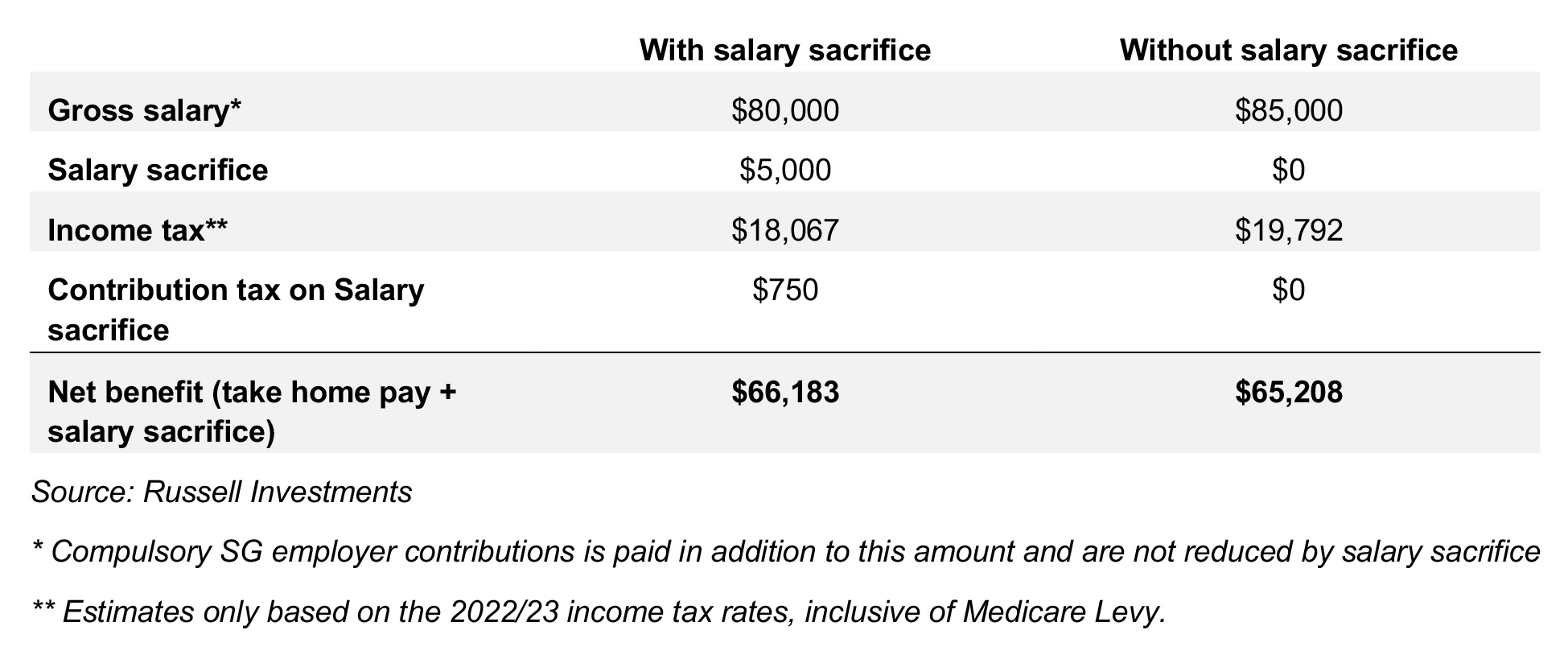
Sally’s salary is $85,000. If she sacrifices $5,000 to super, she will pay $750 in contributions tax instead of $1,725 in income tax, giving her $975 more to invest.
In the case of after tax contributions, if a client’s total assessable income is lower than the relevant income threshold, making after-tax contributions may qualify them for a co-contribution from the government of up to $500.
No contributions tax is deducted from after-tax contributions, provided the contribution limits are not exceeded. For those with a low income or who receive franked dividends from share investments, their income tax rate may be lower than the 15% contributions tax deducted for salary sacrifice. In such cases, the client could pay less tax by making after tax contributions rather than through salary sacrifice.
Spousal contribution splitting
In the case where one partner of a couple is a low-income earner, works part-time, or is unemployed, the higher income earner could add to their partner’s super, something that can benefit both parties.
Clients can transfer contributions to their spouse’s account once per financial year and these must be concessional (before tax) contributions. These are generally the client’s salary sacrifice, personal tax deductible contributions and employer’s contributions.
The client can then transfer up to 85% of the gross concessional contributions made to their account to their spouse. This is the same as the net contribution after 15% contribution tax has been deducted. If the client has a Defined Benefit account, they generally can only split the voluntary contributions they have made.
There are two possible benefits of splitting contributions with a spouse. It may allow earlier access to their super and can save on tax.
Earlier access
If the spouse receiving the contribution is older, they will reach their ‘preservation age’ (figure two) sooner. The non-working spouse will then be able to start a super income stream or, if they have retired from the workforce, take a lump sum payment.
If the contributions had remained in your client’s account, they would not have been able to access them until they reached preservation age.

It’s important to note that the spouse receiving the contributions must be under age 65, and if aged between 55 and 65, must not be retired to be eligible to receive split contributions.
Tax savings
If your client or their spouse intend to access a lump sum from super before reaching age 60, contribution splitting could save on tax. When a lump sum is taken, a tax-free threshold (‘low rate cap’) is applied to the taxable component.
The threshold is $230,000 for 2022/23. This means an individual may access up to $230,000 from their taxable super without paying tax between their preservation age and age 60. Splitting contributions could allow your client to access two full tax-free thresholds.
Case study – Spousal contribution splitting
Jody and Mark were both born between 1 July 1963 and 30 June 1964, so they both have a preservation age of 59. Mark intends to retire at 59 and take some of his super as a lump sum.
Jody’s super balance is $40,000 and Mark’s is $350,000. Jody has not accumulated much super, because she has primarily worked part time and left work to take care of their children.
Scenario 1
Mark does nothing and the couple access $390,000 as a lump sum when they reach age 59. The tax situation is as follows:
Jody’s balance is $40,000, and she takes the whole balance tax-free.
Mark accesses $350,000 from his account to make up the total of $390,000 and pays $20,400 tax.
This is based on tax of 17% including the Medicare Levy on the amount above the tax free threshold of $230,000 and assumes the total balance is made up of the taxable component.
Scenario 2
Mark transfers some of his super contributions to Jody’s account each year, and as a result when they reach age 59, Jody has a balance of $195,000.
Mark and Jody each access $195,000 from $390,000 and pay no tax, because of the tax-free threshold.
This strategy is only applicable when accessing super before age 60. After 60, all payments from super are tax-free, regardless of the amount. From 1 July 2023, everyone will have a preservation age of 60 and so this strategy will not be able to be used to save tax.
Transfer balance caps
The transfer balance cap (TBC) limits the total amount of superannuation that can be transferred into a tax-free super pension account. First introduced on 1 July 2016 at $1.6 million, from 1 July 2021 the transfer balance cap increased to $1.7 million, and will increase again to $1.9 million from 1 July 2023.
The ATO will create a transfer balance account for clients who commence a pension account. For those clients with a transfer balance account before 1 July 2023, the ATO will calculate their TBC, which will be between $1.6 million and $1.9 million.
The transfer balance account:
- includes the total amount transferred from super to one or more pension accounts and includes any death benefits taken as a pension
- does not include transition to retirement accounts
- assuming the TBC is not exceeded, does not apply to investment earnings made in the retirement phase.. so if your client’s pension account balance grows over $1.9 million, no action is required. If the TBC is exceeded the investment earnings on the excess amount is included in the transfer balance account.
Clients can leave any amount over $1.7 million ($1.9 million from 1 July 2023) in their superannuation account.
If a client transfers more than $1.7 million ($1.9 million from 1 July 2023) into their retirement phase account, they will be liable to pay 15% tax – or in the event they have previously gone over their TBC, 30% tax. This is calculated from the day they exceed the TBC.
Super and tax
Super contributions made before tax are taxed within your client’s super fund at a concessional rate of 15% up to the concessional contribution limit. An additional 15% tax – known as Division 293 tax – was introduced in 2012. It reduces the tax concessions on superannuation contributions for individuals with income greater than $250,000[2] a year. The Division 293 tax is payable in addition to the standard 15% contributions tax.
If your client is a high income earner with an income in excess of $250,000 a year, the total tax on their before-tax contributions below the concessional contribution limit is 30%.
Concessional contributions in excess of the concessional contribution limit will be taxed at the client’s marginal tax rate, therefore Division 293 tax does not apply on this portion.
The concessional contributions limit is currently $27,500 per annum, indexed to increases in Average Weekly Ordinary Time Earnings (AWOTE) in increments of $2,500. If your client has carry-forward concessional contributions and their total superannuation balance was less than $500,000 at the end of the previous year, then their concessional contributions limit is increased by the amount of these carry-forward contributions.
If the client’s income is less than $250,000 a year, but by including before tax contributions (that are below the concessional contribution limit) the total is more than $250,000, the 30% tax rate will apply to the part of the before-tax contributions that are over the $250,000 total (but below the concessional contribution limit).
For example, if your client’s income is $230,000 and their before-tax contributions are $25,000, they only pay the 30% tax rate on $5,000.
Income for surcharge purposes (also known as adjusted taxable income)
The ‘income’ that is used to calculate the Division 293 tax is similar to the income used for determining whether a client is liable to pay the Medicare levy surcharge. It excludes reportable superannuation contributions (that are instead included in the low tax contributions).
This income includes the following amounts, if applicable:
- taxable income (assessable income less deductions)
- reportable fringe benefits
- net financial investment loss
- net rental property loss
- the net amount on which family trust distribution tax has been paid.
It excludes the taxed element of a superannuation lump sum benefit (other than a death benefit) up to the low rate cap amount, relevant only to those aged between 55 and 59.
Low tax contributions
If your client is an accumulation member, low tax contributions are generally the concessional contributions made in a financial year, excluding any excess concessional contributions. For most individuals, this will be employer contributions, salary sacrifice contributions and any deductible personal contributions.
For those clients in a defined benefit scheme, their low tax contributions will be the total of any concessional contributions (by the employer or as salary sacrifice) to an accumulation account plus the defined benefit contributions, calculated in accordance with a formula specified by the government, less any excess concessional contributions.
In the case of defined benefits, those contributions are regarded as the ‘notional taxed contributions’. This is the same formula that is used to determine concessional contributions for the purposes of the excess contributions tax. For some defined benefit members ‘notional taxed contributions’ are capped at the prevailing concessional contribution limit.
The defined benefit contributions for the purpose of calculating the low tax contributions are equal to the client’s ‘notional taxed contributions’, but without any cap applying. For example, if the defined benefit notional taxed contributions calculated without the concessional contribution cap applying are $40,000, and the concessional contribution limit is $27,500 and a cap applies, then the defined benefit concessional contributions are $27,500, but the defined benefit low tax contributions are $40,000.
Does Division 293 tax apply?
If the total of your client’s income for surcharge purposes and low tax contributions is above $250,000, the Division 293 tax will apply to the lesser of the following two amounts:
- the amount by which the client’s total income for surcharge purposes and low tax contributions exceeds $250,000; or
- the total of their low tax contributions.
The additional 15% tax is applied to the lesser of these two amounts.
Case study – Accumulation member
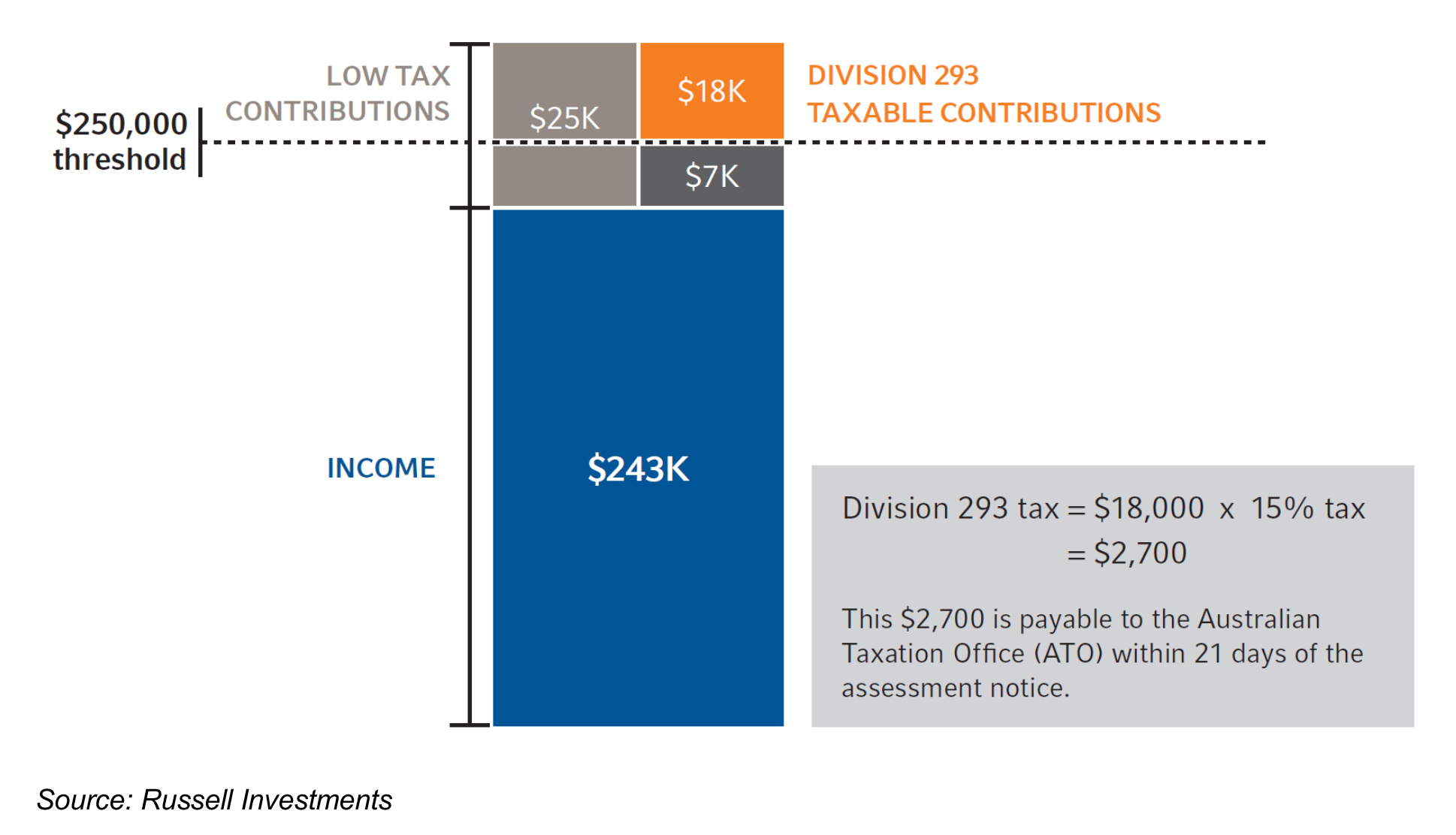
Will has an income of $243,000 and low tax contributions of $25,000.
The sum of these two amounts is $268,000. He exceeded the $250,000 threshold by $18,000. This means the Division 293 tax will be applied to $18,000, as it is lower than his low tax contributions of $25,000. He will pay Division 293 tax of 15% x $18,000 = $2,700.
Case study – Defined benefits member
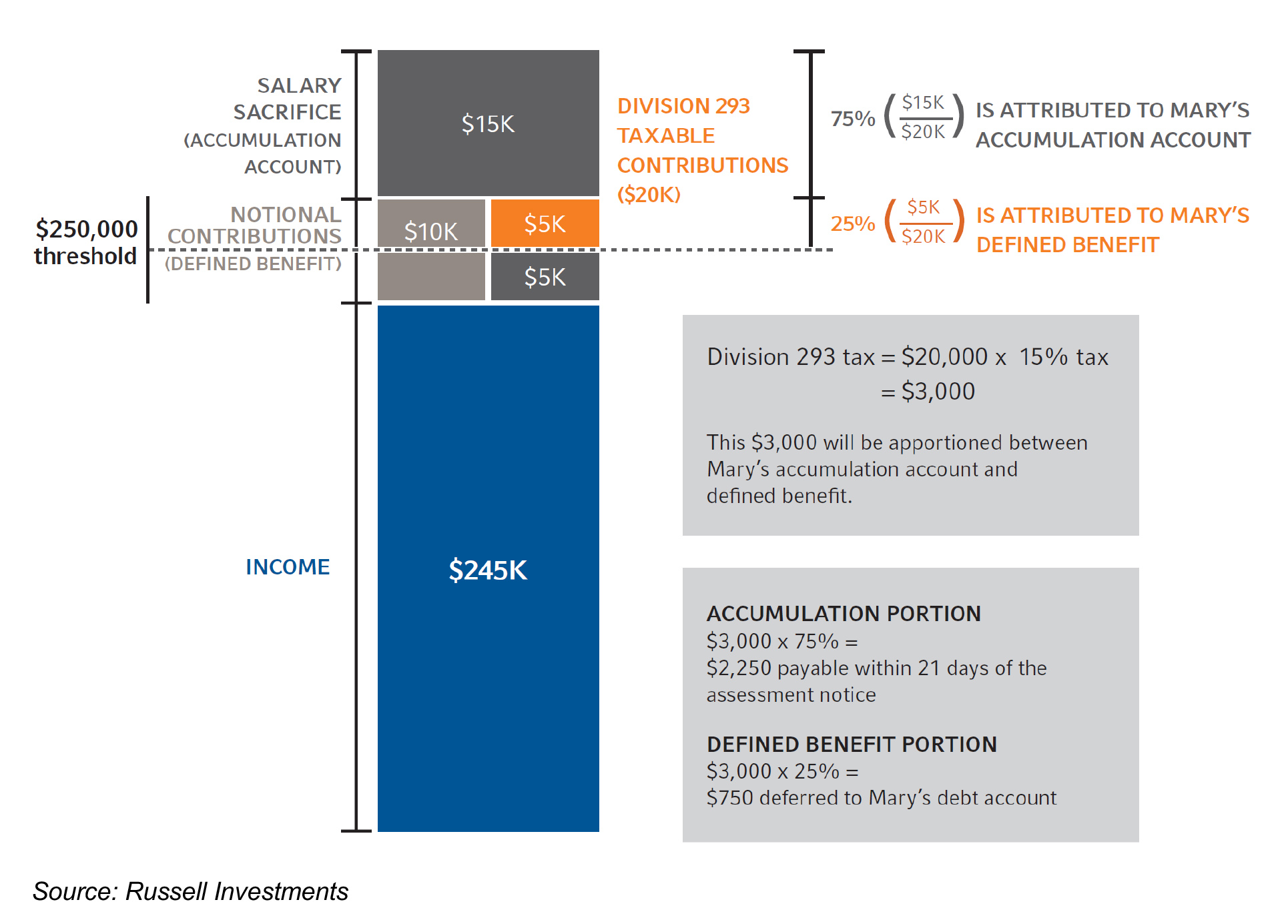
Anna is a defined benefit member. Her income is $245,000. She makes voluntary salary sacrifice contributions of $15,000 to an accumulation account. Anna’s notional taxed contributions for her defined benefit are $10,000 and her low tax contributions are $25,000 ($10,000 + $15,000).
Anna’s combined income and low tax contributions is $270,000 ($245,000 +$25,000). She has exceeded the $250,000 threshold by $20,000. This means she will pay Division 293 tax of $20,000 x 15% = $3,000.
In this example, the tax is apportioned between her accumulation account and defined benefit; meaning she will need to pay $2,250 attributed to her accumulation account within 21 days of the notice of assessment from the ATO and the remaining $750 may be deferred to a debt account.
Financial advice plays a pivotal role in navigating the complex superannuation landscape. With retirement planning becoming increasingly important in an uncertain economic climate, providing your clients with the knowledge and tools necessary to maximise their superannuation benefits is critical. Your invaluable advice empowers clients to make informed decisions, enabling clients to optimise their superannuation outcomes, confidently plan for retirement, and enjoy a comfortable and prosperous post-work life.

———


