
Key takeaways
- Europe is experiencing challenges typical of emerging markets, including energy insecurity and increased government intervention, which threaten its long-term industrial and technological competitiveness
- European nationalisations, windfall taxes, and fiscal deficits resemble emerging market conditions and may deter investment, exacerbating energy supply issues and economic instability
- In contrast to Europe’s regressive policies, countries like India and Brazil are adopting reforms that promote economic growth and create a more favourable business climate
A place plagued by energy insecurity, nationalisation of power infrastructure, windfall taxes, price controls, and large fiscal deficits. No, we are not referring to a small, politically unstable country in Latin America, but rather these events describe what has transpired in most of Europe over the last few years.
We have written much about the reforms in many emerging markets like India and Brazil, which have led to resilient economic growth after a decade of stagnation. In contrast, we have witnessed the opposite in Europe, where politicians are trading structural growth for quick political wins. This behaviour will likely undermine European competitiveness in industry and technology over the longer run. We find it challenging for even the best management teams to succeed against global competition if they are hamstrung by energy insecurity, windfall taxes, and regulatory interventions.
Energy insecurity
Europe’s overdependence on imported natural gas and renewable energy sources that are only intermittently reliable has led to significant spikes in power prices over the last few years and associated demand destruction. Natural gas is a critical feedstock into many industrial processes as well as electricity generation. Prior to the invasion of Ukraine, Europe imported ~40% of its natural gas requirements from Russia. Ironically, if Germany had not decided to shut down most of its nuclear capacity a decade ago, they would likely not be in the current scenario where their manufacturing base is so dependent on imported natural gas.
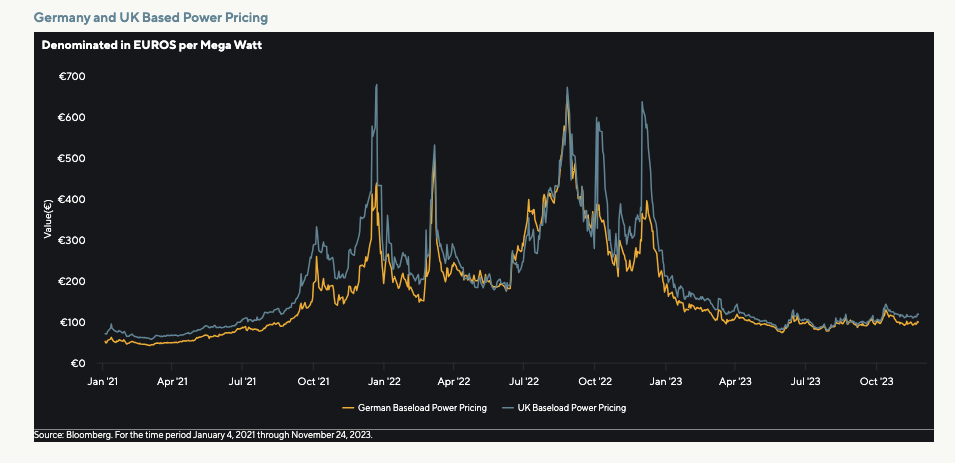
Power prices began to spike in early 2022 due to the supply shock, driven largely by the reduced imports of Russia natural gas (~10% of European gas supply). Although prices have significantly declined in 2023, this is not necessarily good news as lower power prices have largely been caused by demand destruction. In the first half of 2023, European (EU) electricity demand fell roughly 3% to 1,261 Terawatt hour (TWh), the lowest since at least 2008 for current EU member states (S&P and IEA).[1,2]
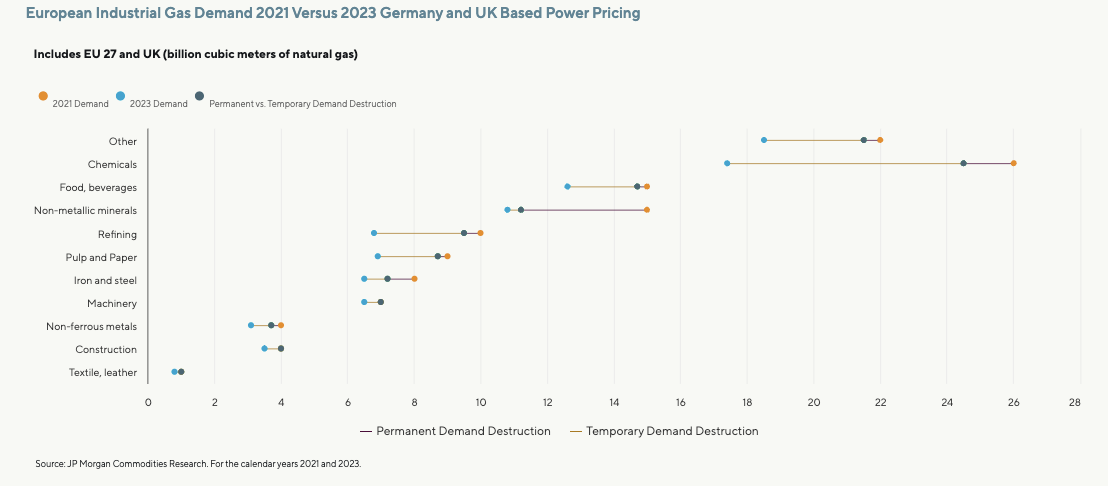
A variety of heavy industry businesses have been most impacted by the higher energy costs. Depending on the subsegment, most industrial supply chains have seen a 10-20% decrease in industrial gas demand including industries like chemicals, refining, food and beverage, as well as pulp and paper which are at the heart of most industrial economies. We believe that signs of such significant basic industrial demand destruction are a major cause for concern. In our view, it is not an exaggeration to say that Europe is de-industrialising.
Nationalisation of energy infrastructure
The issues around energy security have led to heavy-handed government interventions. The rapid rise of natural gas prices led to the German gas utility Uniper becoming insolvent, requiring a 15 billion EUR bailout by the German government. Despite the nationalization, the core issue around the lack of natural gas availability has not been solved. In a similar scenario, France also decided to nationalise its nuclear utility EDF, trampling on minority shareholders in what was effectively a “takeunder.” While these countries have been prioritizing a green agenda, we believe these policies need to be based on rational thinking and not utopian visions. Many of these European countries have neglected baseload power, which cannot be solved easily by green technology, and have put their longer term industrial base at risk, leaving an overdependence on imports from Russia.
Broadly, these nationalisations remind us of the re-nationalisation of YPF in Argentina in 2012, which was then the largest energy company in the country. To this day, Argentina remains in an energy trade deficit which has caused major current account issues over the last decade. The Vaca Muerta shale basin was once talked of in the same vein as the Permian basin in the US. However, politics have relegated the latent energy resource potential to just that, failed potential. Nationalisation has not solved the fundamental issue of energy security in cases like Argentina, and we doubt that nationalisations in Europe this time around will solve the crux of the issue: energy supply.
In contrast, Brazil recently privatised their biggest utility (Eletrobras) and India is looking to open up its electricity distribution to private players for the first time.
Windfall taxes and price controls
Coupled with energy insecurity, politicians have felt a need to enact the classic playbook of both arbitrary taxation as well as price controls. We know that both tools, while popular politically, tend to reduce supply. We think these actions will produce short-term political gain but may result in longer term pain. The table below shows a few examples of the windfall taxes we have seen over the last few years. Of note, this is not a comprehensive list and excludes many of the smaller European countries. While there are certain instances of tax-friendly policies (France recently reducing corporate income tax from 33% to 25% as an example), we are struck by the breadth of unfriendly windfall taxes over the last two years.
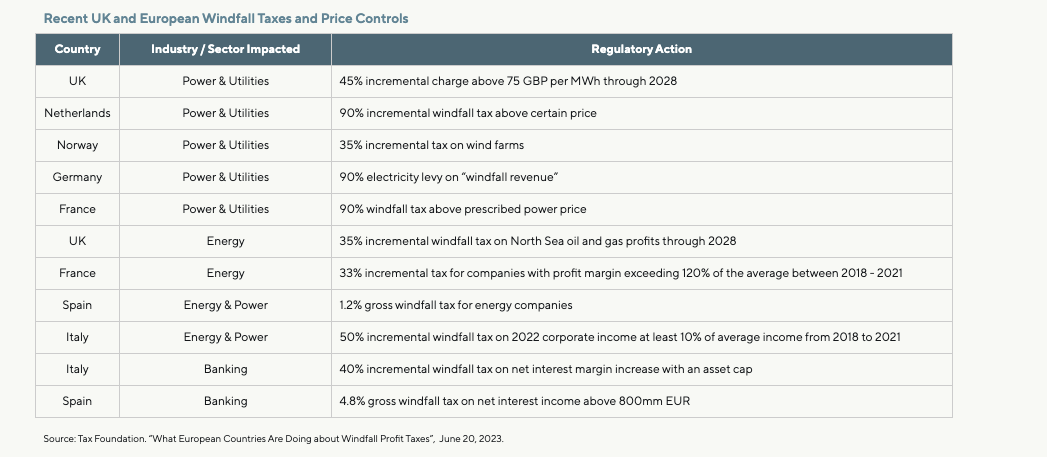
We find it ironic that many of the power and utilities taxes will directly apply to renewable energy generation. While Norway has been the most explicit in directly taxing wind farms an incremental 35%, the UK is effectively placing an incremental 45% tax on any future renewables development. In this context, we are not surprised by the complete failure of a UK offshore wind auction in September 2023, given the heavy-handed treatment, coupled with rising construction costs in the renewables space. In other countries such as Germany, auctions are still proceeding, but the most recent August 2023 auction saw capacity awards decrease sequentially even though Germany needs to triple its renewable capacity by 2030 to meet their internal targets. Already, we are seeing the negative impacts of heavy-handed government policy.
This behavior is, again, in contrast to what we see in India and Brazil. Over the past decade, Brazil and India have moved towards opening up their respective energy and utility sectors. Brazil’s government now compensates its state-owned oil company (Petrobras) for taking non-economic decisions. For example, in 2018, the government responded to a trucker’s strike by cutting diesel prices but paying Petrobras the difference. Similarly, India has been slowly linking domestic energy prices to global prices. Earlier this year, the government approved a new natural gas pricing policy allowing domestic prices to be reset on a monthly basis rather than every six months. These two countries have some of the best energy and power supply growth globally. We are not surprised.
Fiscal deficits amidst an inflationary environment
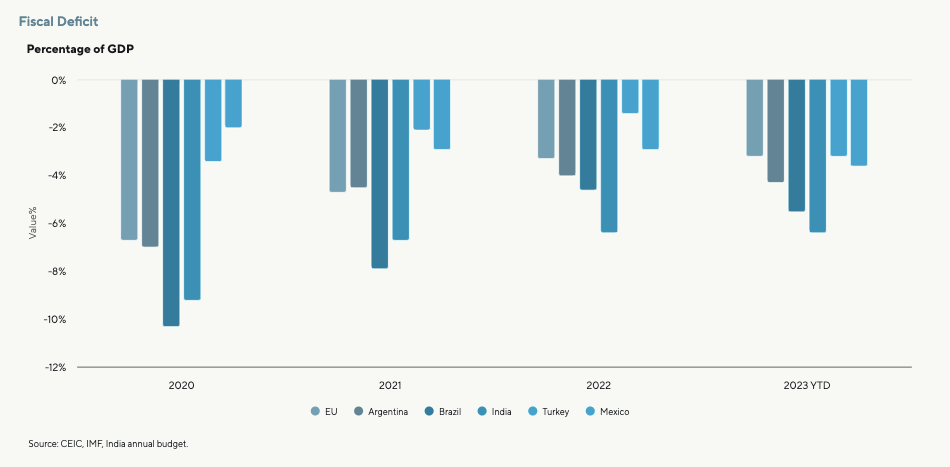
Amidst the chaos of COVID and the Russia-Ukraine war, the EU has adopted aggressive fiscal measures. Since 2020, the fiscal deficit across the EU has ranged from 3% to 7% depending on the quarter. Unfortunately, these levels of fiscal deficits look uncomfortably close to many oft-criticized emerging market economies. We don’t see any natural ‘brakes’ on such reckless spending.
Fiscal Deficit
While we are not explicitly predicting a crisis (although some macro investors would remark that this appears to be a setup for a balance of payment crisis), we believe the risk of an external shock increases in these circumstances with high fiscal deficits, energy imbalances in the current account, and a weakening of the industrial economy. With large fiscal deficits today, there is also less future capacity to weather potential future shocks.
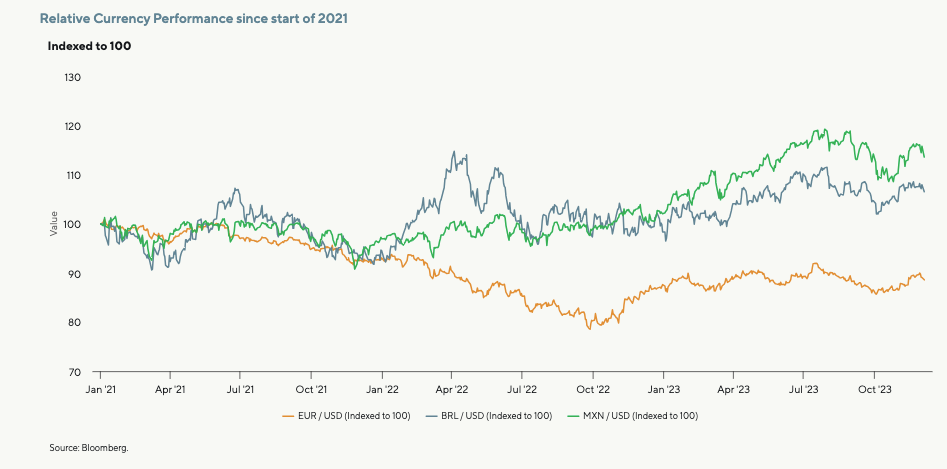
Already, currency markets have sniffed out the relative differences in fiscal discipline, as the EUR has performed much worse versus the USD than currencies like the Brazilian Real and Mexican Peso since the start of 2021.
Why does this matter
It will likely take many years for the full impacts of recent policy to show up. We do not expect that politicians will be punished for their behavior in the near-term, and in fact, they may end up winning more votes. Unfortunately, as we have seen in so many markets, these sort of policies that revolve around arbitrary taxation and price controls end up reducing investments in critical industries which end up exacerbating structural issues over the longer run.
We are reminded of the heavy-handed digital and internet regulation from the EU since the mid 2010’s, and how such bureaucracy essentially killed any hope for creating technology giants that could rival the US. There really have not been many new large-cap technology companies worth investing in within Europe that have come up in the last 10-20 years. In our opinion, much of this could be traced to the bureaucracy smothering any risk taking.
In contrast, our current excitement around India, Brazil, and Indonesia has been because of changes in government policy leading to more favourable corporate earnings potential.
Companies in these emerging markets seem to face a more favourable regulatory regime coupled with healthy country-level growth. Meanwhile European companies increasingly have to navigate a tough operating environment in the face of slowing economic growth and difficult regulatory regimes. While we still invest in certain businesses with European headquarters, these tend to be global businesses that service global markets rather than those servicing domestic markets.
In many ways, the lines between emerging economies and developed economies have begun to blur. Developed markets have increasingly adopted classic emerging market playbooks – price controls, windfall taxes, and nationalisations. In contrast, so many emerging markets seem to have adopted developed market playbooks – price liberalisation, tax incentives, and privatisations. While we are apt to change our minds especially in the face of new data, it really does seem like certain emerging markets are trending in the right direction and European countries in the wrong direction.
——–


