

Using investment bonds can assist in facilitating intergenerational wealth transfer.
Australia’s great wealth transfer
Australia’s largest intergenerational wealth transfer in history is underway, with an estimated $5.4 trillion expected to be passed on in inheritances over about the next 20 years[1]. This transition will redefine how advisers approach estate planning.
While 80% of Australians intend to leave a legacy, only one in five have a structured plan to do so[2]. For many families, particularly blended or complex ones, the question isn’t if wealth will be transferred, but how it can be done efficiently, fairly, and tax-effectively.
The modern challenge of transferring wealth
Estate planning can be emotionally and financially complex. Common challenges include:
- Family conflict: 74% of contested family provision estate claims in Australia had a likelihood of success, rising to 88% for larger estates ($1-3 million)[3]
- Taxation concerns: Australia’s tax system can be complex and improper wealth transfer planning can lead to significant tax liabilities[4].
- Cost-of-living pressures: Rising property prices, mortgages and everyday expenses have made it harder for younger Australians, seeing more parents and grandparents stepping in to ease financial strains.[5]
The cost of supporting the next generation is growing. Research shows it takes 12 years to save for the average unit deposit and 16 years for the average house.[6]
These realities appear to be shifting intergenerational wealth transfers from a mostly posthumous event to an increasingly living process. More parents and grandparents are seeking to help children during their lifetimes, supporting education, property purchases, or business ventures, without compromising tax outcomes or family harmony.
One of the most flexible and tax-efficient structures enabling all this, is the investment bond.
Investment bonds: A powerful estate planning tool
An investment bond is a tax-paid investment product. Investors contribute an initial investment and can make additional contributions, ad-hoc or through a regular savings plan. The investment can grow within the investment bond based on the investment strategies selected, with earnings taxed within the product at a rate of up to 30%.
After 10 years, all withdrawal proceeds are received tax-free. If a withdrawal is made within 10 years, top up tax may be payable by the investor. This represents the difference between the 30% tax paid within the investment bond and the investor’s marginal tax rate.
Beneficiaries can be nominated so that, in the event of the owner’s death, they can receive the value of the investment directly and tax-free, they may be appropriately structured and the investment can bypass the estate and probate process and potentially avoid will disputes.
Alternatively, investment bonds can provide for the transfer of the investment to a nominated person on death or a future date, without triggering any tax consequences for the recipient.
Key estate planning benefits
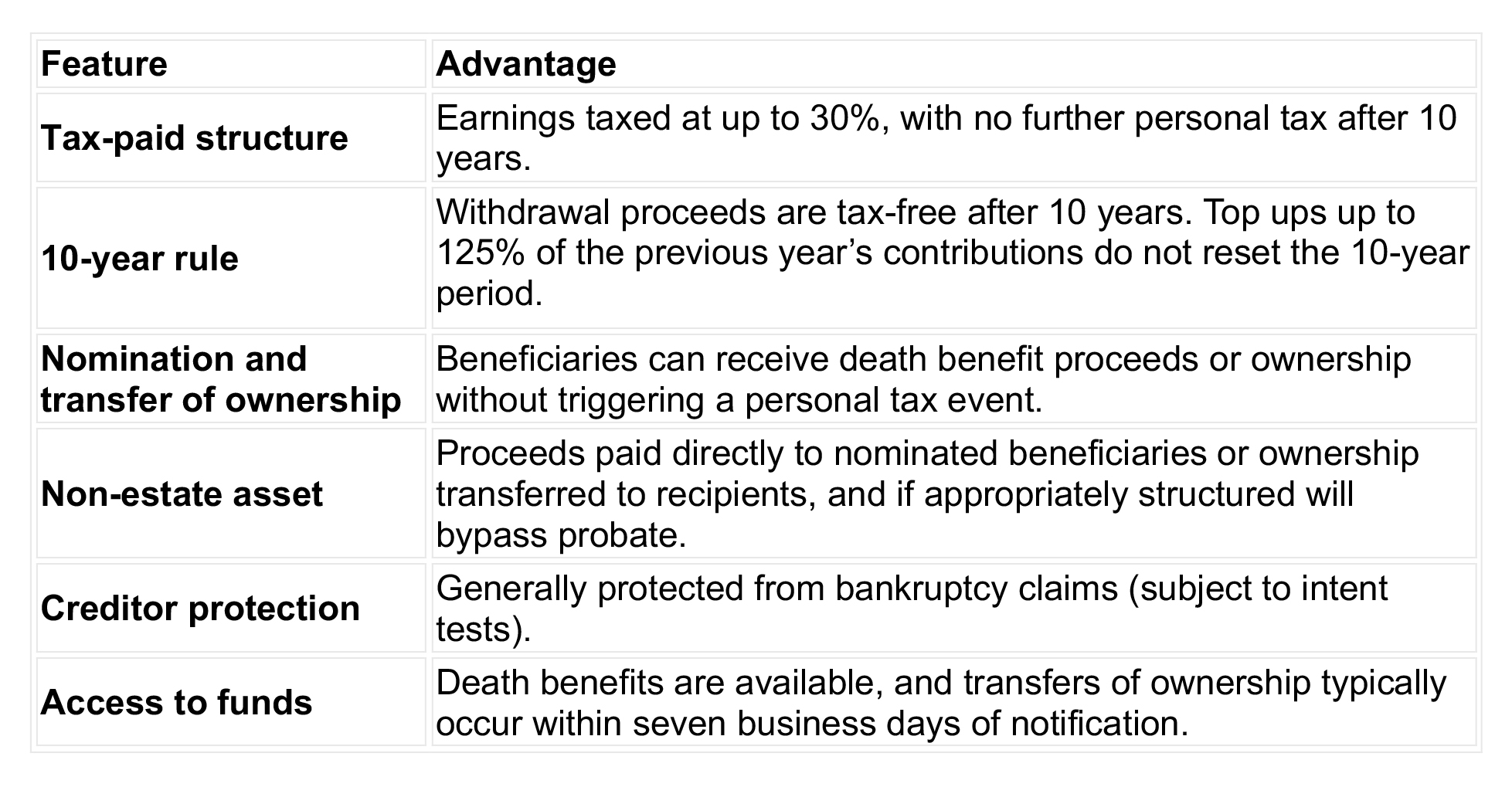
Investment bonds therefore sit neatly between the tax efficiency of superannuation and the control of discretionary trusts, offering advisers a balanced estate planning solution.
Comparing wealth transfer structures

Why investment bonds can excel in today’s tax environment
Although Australia doesn’t have an inheritance tax, many wealth transfers are subject to other taxes. For example, the taxable component of a superannuation death benefit payment to a nominated non-dependant beneficiary is taxed at 15% plus Medicare levy, and any untaxed element can attract tax at 30% plus Medicare levy.
Additionally, the proposed Division 296 tax will apply to earnings on total super balances exceeding $3 million, making superannuation less attractive for larger intergenerational wealth transfers.
By contrast, investment bonds offer:
- A tax-paid environment (up to 30%) independent of personal marginal tax rates
- Tax-free death benefits to nominated beneficiaries
- No potential Division 296 exposure as they sit outside the superannuation system
- No CGT events on transfer of ownership either before or on death.
Future event transfer: planning for precision
Some investment bonds allow investors to schedule the transfer of ownership to nominated recipients on a chosen future date or death of the owner, through a transfer arrangement.
How it works
- Nominate a transfer trigger – for e.g. death of the owner or last surviving joint owner, or a future date (like a grandchild’s 25th birthday).
- Automatic ownership transfer occurs, without capital gains or income tax consequences to either the owner or future recipient.
- 10-year period continuity – the original start date upon transfer is retained for tax-free status.
- Future access restrictions can be built in – delaying access to funds, establishing periodic income payments, or requiring third-party approval for withdrawals.
This structure gives investors control from beyond the grave, ensuring nominated recipients receive wealth in a controlled and tax-efficient manner.
Case studies in generational wealth planning[8]
1. Avoiding superannuation death benefit tax
Dianne, aged 79, has two adult children and three grandchildren. She has reached her Superannuation Transfer Balance Cap and has $600,000 superannuation in accumulation phase. Dianne wants to steer clear of the death benefit tax while ensuring fairness and control.
Her financial adviser recommends she establish five investment bonds with her super balance in accumulation phase:
- Two $150,000 investment bonds for her adult children, transferring ownership upon her death.
- Three $100,000 investment bonds for her grandchildren, transferring ownership upon each grandchild turning 25.
- The children are nominated as account guardians to hold the investment on behalf of the grandchildren until they reach 16.
Result: If Dianne passed away at age 93 her children and grandchildren would in total have an additional $60,449 in proceeds and eliminating the death benefit tax, transfers wealth tax-free, and bypasses probate. The investment bonds allow for controlled, direct inheritance transfer.
2. Helping the next generation with housing
Gordon and Mel, both 41, are high-income professionals concerned about their children’s ability to buy a home amid rising property prices.
Their financial adviser recommends establishing two investment bonds with $5,000 each upfront and a Regular Savings Plan of $1,000 per month for ten years. Using a future event transfer feature:
- Each investment bond’s ownership transfers when a child turns 30.
- Access to funds by the child is restricted for an additional 10 years after transfer.
- Gordon and Mel act as withdrawal co-signatories to authorise one-off withdrawals (eg a home deposit) that may be needed during the restriction period.
Result: The couple can provide a meaningful financial head start for their children, while maintaining control and ensuring funds are appropriately used. The tax-paid investment bond structure can provide a tax-effective investment outcome compared to investing personally subject to the top marginal tax rates.
3. Managing complex family dynamics
Margo, aged 77, has three adult children with very different financial situations:
- Sarah (51): financially secure but is taxed at the highest personal marginal tax rate .
- Sam (46): financially unstable and poor with money.
- Jane (42): a single mother with two young children.
Her financial adviser recommends establishing three investment bonds using $1.3 million from superannuation withdrawal proceeds and $200,000 from the sale of her shares and direct investments, each tailored to her children’s needs.
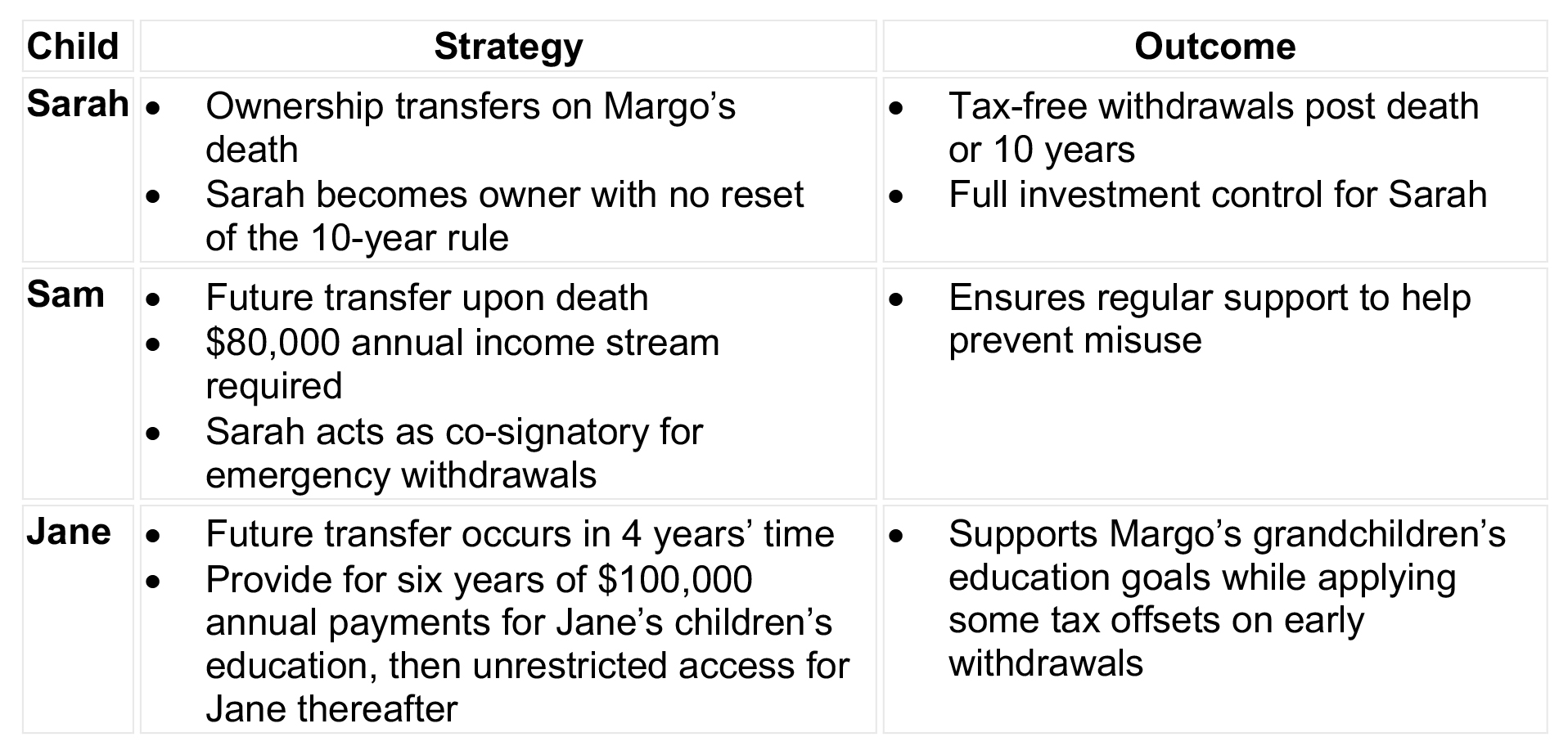
Result: Margo achieves the required outcome for her children without conflict, ensures responsible timing of delivery of proceeds, and eliminates superannuation death tax exposure.
Early wealth transfer: living legacies
Increasingly, investors don’t want their wealth to make a difference after they die, they want to see it make an impact now.
Investment bonds enable living legacy strategies, allowing financial advisers to:
- Help clients support children earlier for housing, education, or business.
- Provide tax-effective gifts while maintaining oversight.
- Reduce the risk of estate disputes, as wealth can be transferred outside the will.
With flexibility to structure future event transfers, future regular income payments, and access controls, investment bonds align perfectly with modern family and tax realities.
Best practice tips for financial advisers
- Assess suitability and objectives
Should ensure the investment bond aligns with the client’s estate and intergenerational goals, not just their investment profile. - Complement with other structures
Investment bonds can complement other structures like superannuation and discretionary trusts. - Use future event transfers strategically
Can consider structuring conditional access to funds, especially for younger or financially inexperienced beneficiaries. - Monitor and review regularly
Could review nominations and access conditions after major life events (eg marriages, births, divorces). - Communicate clearly with clients and beneficiaries
Provide education about how the investment bond operates, its tax treatment, and how it fits within the broader estate plan.
Conclusion: Building a legacy that lasts
As Australia undergoes a seismic intergenerational wealth shift, investment bonds offer a uniquely flexible and tax-efficient structure for financial advisers helping clients pass on their wealth.
They combine the control of discretionary trusts, tax advantages, and the simplicity of direct investments, without the same limitations of any single other vehicle.
For financial advisers, mastering the strategic use of investment bonds isn’t just about managing money, it’s about shaping legacies that can endure.
Take the FAAA accredited quiz to earn 0.5 CPD hour:
CPD Quiz
The following CPD quiz is accredited by the FAAA at 0.5 hour.
Legislated CPD Area: Technical Competence (0.5 hrs)
ASIC Knowledge Requirements: Estate Planning (0.5 hrs)
please log in to start this quiz
———–
Notes:
[1] JB Were (2024) The Bequest Report
[2] Generation Life (2023) Reimagining Legacy Report
[3] NSW Wills and Estate Helpline (2025) What is the Success Rate of Contesting a Will?
[4] Moiler Wealth (2025), The Hidden Risk of Intergenerational wealth transfer and how to avoid them
[5] ABC News (2025), Cost of Living Sting Lessened by Bank of Mum and Dad
[6] Blackburn, T. (2023). A Marathon to Mortgage: First Home Buyers Need More Than a Decade to Save for a Home, Finder, July 2023
[7] Adapted from Generation Life’s “Generational Wealth” guide, 2024
[8] Ibid
Disclaimer: Generation Life Limited (Generation Life) AFSL 225408 is the product issuer and provides general financial product advice and other services related to investment life insurance products and life risk insurance products. Any superannuation general financial product advice provided is by Generation Development Services Pty Limited ABN 14 093 660 523 (GDS) as Corporate Authorised Representative, No. 001317211 of Evidentia Financial Services Pty Ltd AFSL 546217 ABN 97 664 546 525 (Evidentia). The information provided is general in nature and does not consider the investment objectives, financial situation or needs of any person and is not intended to constitute personal financial advice. The product’s Product Disclosure Statement (PDS) and Target Market Determination (TMD) are available at www.genlife.com.au and should be considered in deciding whether to acquire, hold or dispose of the product. Superannuation products’ PDSs, offer documents and TMDs are available from the websites of their product issuers. Professional financial advice is recommended. Past performance is not a reliable indicator of future performance. Generation Life, GDS and Evidentia do not make any guarantee or representation as to any particular level of investment returns. Generation Life does not accept any responsibility or liability for superannuation general financial product advice provided by GDS. Generation Life’s investment bonds can provide certainty as they are governed by legislation that has changed infrequently and can be appropriately structured to bypass an estate and be protected in case of bankruptcy of the life insured. Investments carry risks.
Assumptions for Dianne’s case study: Compares investment in a conservative portfolio through both a superannuation fund and investment bond with total return of 4.2% pa before tax. The superannuation fund balance assumes a taxable component value equal to 80% of the total super balance. No drawdowns. Past performance is not an indication of future performance.
CPD Quiz
The following CPD quiz is accredited by the FAAA at 0.5 hour.
Legislated CPD Area: Technical Competence (0.5 hrs)
ASIC Knowledge Requirements: Estate Planning (0.5 hrs)
please log in to start this quiz———–
Notes:
[1] JB Were (2024) The Bequest Report
[2] Generation Life (2023) Reimagining Legacy Report
[3] NSW Wills and Estate Helpline (2025) What is the Success Rate of Contesting a Will?
[4] Moiler Wealth (2025), The Hidden Risk of Intergenerational wealth transfer and how to avoid them
[5] ABC News (2025), Cost of Living Sting Lessened by Bank of Mum and Dad
[6] Blackburn, T. (2023). A Marathon to Mortgage: First Home Buyers Need More Than a Decade to Save for a Home, Finder, July 2023
[7] Adapted from Generation Life’s “Generational Wealth” guide, 2024
[8] Ibid
Disclaimer: Generation Life Limited (Generation Life) AFSL 225408 is the product issuer and provides general financial product advice and other services related to investment life insurance products and life risk insurance products. Any superannuation general financial product advice provided is by Generation Development Services Pty Limited ABN 14 093 660 523 (GDS) as Corporate Authorised Representative, No. 001317211 of Evidentia Financial Services Pty Ltd AFSL 546217 ABN 97 664 546 525 (Evidentia). The information provided is general in nature and does not consider the investment objectives, financial situation or needs of any person and is not intended to constitute personal financial advice. The product’s Product Disclosure Statement (PDS) and Target Market Determination (TMD) are available at www.genlife.com.au and should be considered in deciding whether to acquire, hold or dispose of the product. Superannuation products’ PDSs, offer documents and TMDs are available from the websites of their product issuers. Professional financial advice is recommended. Past performance is not a reliable indicator of future performance. Generation Life, GDS and Evidentia do not make any guarantee or representation as to any particular level of investment returns. Generation Life does not accept any responsibility or liability for superannuation general financial product advice provided by GDS. Generation Life’s investment bonds can provide certainty as they are governed by legislation that has changed infrequently and can be appropriately structured to bypass an estate and be protected in case of bankruptcy of the life insured. Investments carry risks.
Assumptions for Dianne’s case study: Compares investment in a conservative portfolio through both a superannuation fund and investment bond with total return of 4.2% pa before tax. The superannuation fund balance assumes a taxable component value equal to 80% of the total super balance. No drawdowns. Past performance is not an indication of future performance.


Have feedback on this article? Contact Us
Earn CPD Points
 CPD: US middle market private credit – the investment case
In today’s rapidly shifting investment landscape, traditional sources of fixed income are struggling to meet the yield and diversification needs of investors. They are also becoming more closely correlated with [...]
 CPD: A new global order and implications for investors
The new global order differs from its predecessor in four ways, as outlined in the following article from GSFM’s investment partner TD Epoch. For decades, the US has been unrivalled [...]
 CPD: Is your approach to client risk profiling putting you at risk?
Introduction The shockwaves that followed the announcement of ‘Liberation Day’ tariffs by Donald Trump brought an abrupt and unsettling end to a three-year bull market. Major global indices plummeted by [...]
 CPD: Ethics and the advice practice
When last published, the FAAA’s Value of Advice Index[1] saw trust in financial advice at an all-time high, which reinforces the importance of ethical practice. This article, proudly sponsored by [...]
 CPD: Retirement income strategy choices
There’s a wide variety of income strategies used across the market, with an equally wide variety of labels attached to these strategies. Each varies in complexity, its ability to mitigate [...]