
CPD: Thinking outside the box – providing a loved one a paycheque for life

Investment-linked lifetime annuities challenge the idea that retirees must choose between enjoying their retirement and leaving a legacy.
Australia’s great wealth transfer is well underway. An estimated $5.4 trillion is expected to pass from those aged 60 and over to younger generations within the next two decades.[1]
In 2024, around $150 billion was transferred and this is forecast to rise to $500 billion per annum by 2044,[2] with more than 80% of inheritances going to individuals aged 50 and over.[3]
With such a significant intergenerational shift in wealth, the role of financial advice has never been more critical. It’s no longer just about how to accumulate, it’s about ensuring the right assets go to the right people, at the right time, without unnecessary tax, legal disputes or financial mismanagement.
Importantly, wealth transfer is not a single event. It is the outcome of a well-structured financial strategy. The real question is not “How do you prepare for a wealth transfer?”, but rather “How do you build a financial plan that delivers the right outcomes?”
Modern families, modern challenges
Family structures are becoming increasingly complex, and estate planning must evolve accordingly.
Divorce rates are rising, with nearly 200,000 Australians filing for divorce between 2020 and 2022 – the highest level in over a decade.[4]
These dynamics are reshaping how advisers need to think about wealth transfers.
In fact, the complexities of blended families have been linked to an 80% increase in family disputes over wills and estates over the past decade.[5] Adding to this, a 2022 ruling by the Victorian Supreme Court reinforced that parents may have a “moral duty” to consider children from previous relationships, even if those children can later contest the estate.[6]
Supporting loved ones with additional needs
The challenge becomes even more pronounced when clients have children or other loved ones with additional needs.
The traditional cycle of ageing where adult children support their parents, does not apply in these scenarios. Instead, your clients may be responsible for ongoing care of others well into their own retirements, while also wanting to plan for what happens when they are no longer here.
Guiding clients through this process is complex and deeply emotional. You are not only structuring financial outcomes – you are helping clients secure the long-term wellbeing and dignity of someone they care about.
Looking ahead, the scale of this issue is growing. By 2099, an estimated four million Australians will have a severe or profound disability. This is more than triple the number in 2009.[7]
While improvements in care and accessibility are positive, they also introduce additional planning complexities. At the same time, many traditional financial solutions designed for non-dependant adult children particularly those with nevertheless, special needs or financial vulnerabilities, are becoming less effective.
In Australia[8]:
- Nearly one in five people live with a disability
- One in three of those individuals has a severe or profound limitation
For many parents, one of the greatest concerns is simple – will my loved one be financially secure when I’m gone?
Why traditional structures may fall short
As family dynamics and client needs evolve, so too must the tools used to support them. Challenges financial advisers are facing include:
- Traditional estate planning approaches increasingly being tested; both legally and emotionally
- Increased complexity when planning for modern day family dynamics, complex family structures and blended family scenarios
- Providing some certainty to clients needing to support children or loved ones with additional needs
Wills and trusts remain important, but they can fall short in delivering certainty. They are frequently contested, misinterpreted, or reliant on third-party actions.
For clients, particularly those with vulnerable beneficiaries and complex family structures, the overall depleted certainty can leave them harbouring ongoing anxieties.
Expanding the estate planning toolkit
This is where alternative structures come into focus.
Investment bonds, for example, are increasingly being used as estate planning tools due to their flexibility and tax advantages.
They can be appropriately structured as non-estate assets that bypass probate, likely to reduce the risk of disputes. They also provide greater control over how and when wealth is transferred, without the administrative complexity of a trust.
But there is another, less commonly considered approach emerging in advice strategies.
A different lens: Providing a loved one a paycheque for life
Investment-linked lifetime annuities are typically used to provide retirees with a regular income stream for life, complementing superannuation and the Age Pension.
However, advisers are increasingly exploring their use in a different context – to provide a structured, ongoing income stream to a loved one after the client is gone.
Rather than transferring a lump sum, which may be easier to mismanage, contest or deplete, this different approach reframes the wealth transfer as an income outcome.
It shifts the focus from – “How much is left?” to “How is it delivered, and how long will it last?”
This has led to a growing uptake of lifetime annuities as tools for a controlled, predictable “paycheque for life” – a lasting legacy for life.
Planning for their financial future, in a different way
Investment-linked lifetime annuities offer a level of innovation that’s not often found in traditional financial solutions; they are flexible and can be creatively applied in ways that cater to any family situation.
When setting up a lifetime annuity, the investor can choose their payment frequency and have a choice to invest in professionally managed options that they can switch between over the life of the annuity. Importantly, they can also elect a reversionary beneficiary that will be paid a lifelong income.
For some, they won’t require this level of tailored planning; straightforward solutions can work well. However, for those looking to ensure a steady stream of income for a loved one – for example, a child with a disability, or a loved one with a complex mental health history – this could be the ideal fit. Ultimately, the annuity provides for the recipient and leaves the investor free to enjoy their final chapters knowing that their loved one will be looked after when they’re gone.
Bringing this to life
Financial advisers can listen and understand their clients’ priorities, then set up lifetime annuities that can deliver to their unique needs. For instance, an adviser can set up a recipient with a lump sum or a lifelong income stream. For an income stream, they can specify to whom it goes, whether all or a portion of the income continues and how it is invested now, with the flexibility to change this over the course of their client’s lifetime as well as changing it to match the reversionary beneficiary’s risk profile upon transfer.
Case Study 1: Meet Wendy
Wendy is 72 years old and currently has $50,000 in savings, a $500,000 account-based pension and $30,000 in car and contents.
Despite these assets, Wendy is hesitant about her spending as she worries about her daughter, Jennifer.
Jennifer is 52 years old and has a history of a complex mental health disorder. This impacts her ability to spend her income within her means. Based on Jennifer’s history, Wendy is worried that there is a high likelihood Jennifer could bankrupt herself unless she has a regular, long-term stream of income after Wendy passes away.
By working with a financial adviser, Wendy sets up an investment-linked lifetime annuity for herself using $200,000 that she withdraws from her account-based pension. Wendy nominates Jennifer as the reversionary beneficiary on the annuity, which will provide an income guaranteed for Jennifer’s life after Wendy passes away. Wendy doesn’t need to worry about anyone else trying to access Jennifer’s future income source. This is because an investment-linked lifetime annuity offers the protections of a life insurance policy, including from bankruptcy and estate claims.
This way, Wendy has greater confidence to enjoy her retirement to the fullest. She knows that she will have income for herself, but also a regular income stream for Jennifer that will serve as a safety net after Wendy passes away.
Case study 2: Meet Sophia
Sophia is 73 years old and single. She has a son, Paul, who is 50 years old. Sophia is a self-funded retiree and a homeowner, and she currently has $360,000 in an account-based pension, $40,000 personal assets and $350,000 cash at bank.
Sophia is concerned about her retirement spending and would like to gain access to the Age Pension. She also worries about her son Paul, who is bad with money.
Sophia would like to secure Paul’s future, including by diminishing the potential for Paul to misuse a future lump sum inheritance.
By working with her financial adviser, Sophia sets up an investment-linked lifetime annuity of $300,000 and a funeral bond of $15,750 from the money she had in the bank. She nominates Paul as the reversionary beneficiary providing regular income for them both at different times.
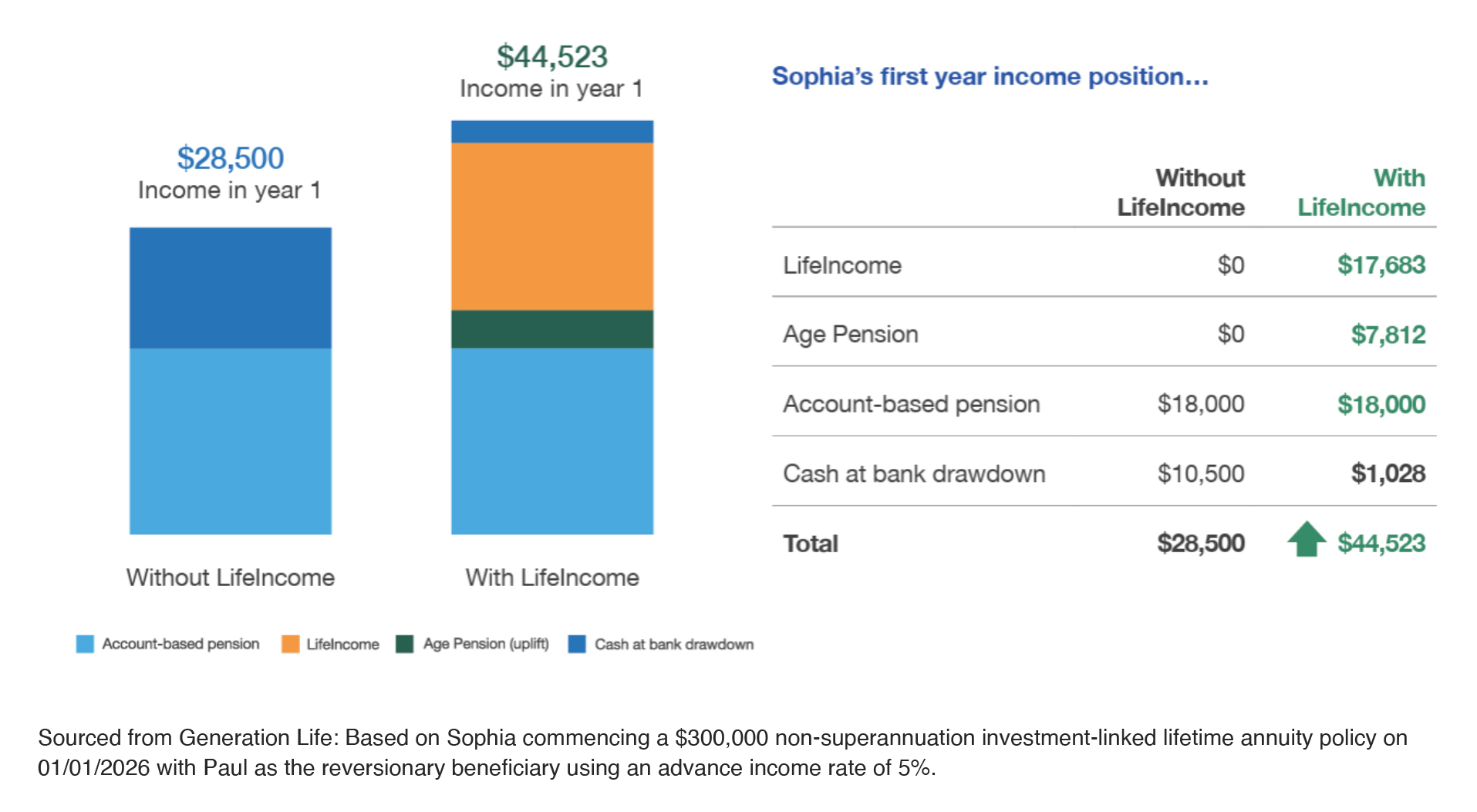
Comparing Sophia’s first year income
By setting up an investment-linked lifetime annuity, Sophia receives an immediate uplift in annual income of $16,023, including an Age Pension uplift of $7,812.
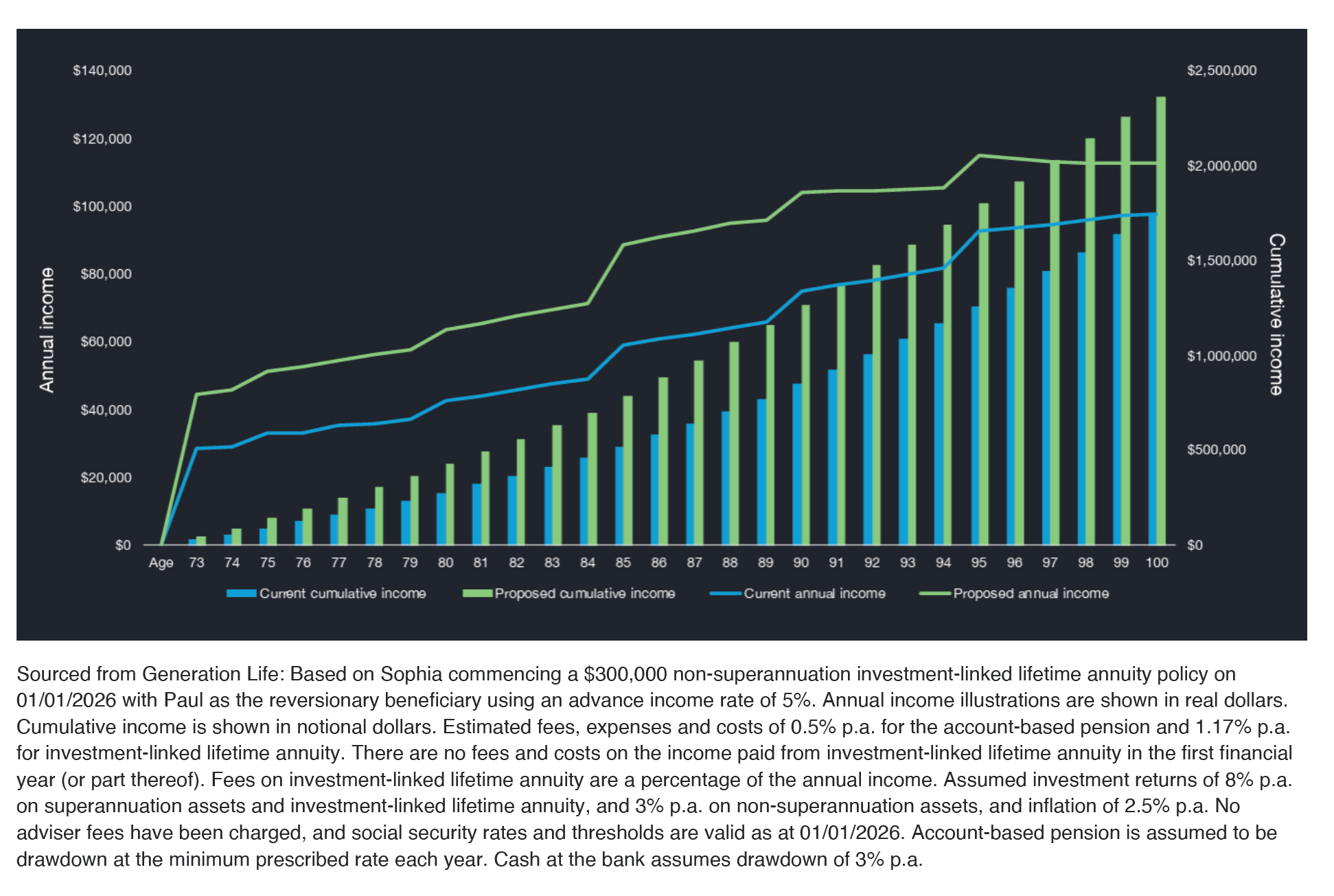
Comparing Sophia’s annual income and cumulative income with and without an investment-linked lifetime annuity until age 100
By bringing forward Age Pension eligibility by four years, she receives an additional $45,369 in cumulative Age Pension by age 77. Sophia also receives an additional $630,084 in cumulative income by Age 100.
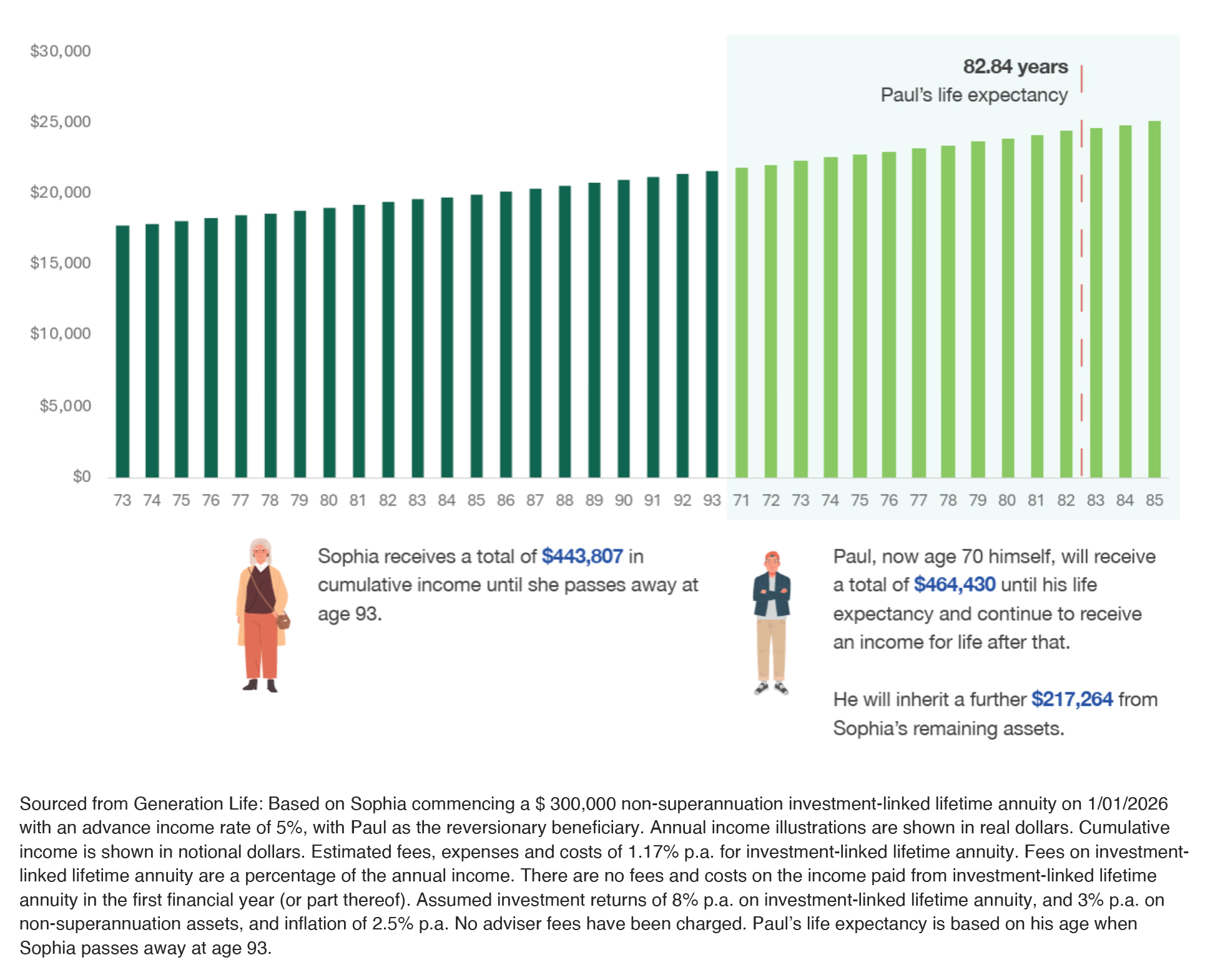
What if Sophia passes away at age 93…
Sophia receives a total of $443,807 in cumulative income until she passes away at age 93. Paul, now age 70 himself, will receive a total of $464,430 until his life expectancy and continue to receive an income for life after that. Importantly, there is no tax on earnings and concessional taxation treatment on the income payments should their income exceed SAPTO.
Case study 3: Meet George
George is 88, a homeowner in Port Macquarie, living alone following the passing of his wife, three years ago. His two adult children live in Sydney and visit infrequently, typically once a year at Christmas.
As George has aged, maintaining his home and managing day-to-day tasks has become increasingly difficult, and he has begun to feel isolated. His neighbour and a father of three, Sam, has stepped in, regularly helping with groceries, home maintenance, and providing much-needed companionship.
George is clear in his intention: he would like to recognise Sam’s support by providing him with a lifelong “paycheque for life,” while ensuring this arrangement cannot be challenged by his children. At the same time, George intends to leave his home, remaining superannuation balance, and other non-super assets to his two children, allowing him to support Sam without compromising his broader estate planning objectives.
By working with a financial adviser, George restructures part of his retirement savings; withdrawing a portion of him account-based pension and setting up an investment-linked lifetime annuity. He nominates Sam as the reversionary beneficiary.
This structure allows George to create an income stream guaranteed to be paid to Sam for life after George passes away, rather than leaving a lump sum that could be contested. Importantly, as an investment-linked lifetime annuity is issued under a life insurance structure, it can be established as a non-estate asset – helping to reduce the risk of estate disputes and providing additional protection, including in the event of bankruptcy.
For George, this approach delivers certainty and control, ensuring his wishes are carried out, and that Sam receives a legacy for life.
Thinking outside the box
Investment-linked lifetime annuities challenge the idea that retirees must choose between enjoying their retirement and leaving a legacy.
For financial advisers, this presents an opportunity to rethink beneficiary planning. As client needs evolve, whether its supporting dependent children, protecting vulnerable loved ones or planning for legacies to last a lifetime, strategies must evolve to deliver more flexible, intentional and client-aligned outcomes.
Take the FAAA accredited quiz to earn 0.5 CPD hour:
CPD Quiz
The following CPD quiz is accredited by the FAAA at 0.5 hour.
Legislated CPD Area: Technical Competence (0.5 hrs)
ASIC Knowledge Requirements: Estate Planning (0.5 hrs)
please log in to start this quiz
———-
Notes:
[1] JBWere Australia, Family Advisory and Philanthropic Services, The Bequest Report – Reshaping Australia by passing on more than assets July 2024, accessed 20 March 2025
[2] Ibid
[3] Grattan Institute, The story of inheritances in Australia – and why it needs to change https://grattan.edu.au/news/the-story-of-inheritances-in-australia-and-why-it-needs-to-change/, 20 August 2019 accessed 1 August 2025
[4] Sydney Morning Herald, ‘Divorce applications up as marriages hit the rocks’, https://www.smh.com.au/national/divorce-20220628-p5axco.html 3 July 2022 accessed on 15 April 2025.
[5] Australian Financial Review, ‘Big increase in inheritance feuds among blended families’, https://www.afr.com/wealth/personal-finance/big-increase-in-inheritance-feuds-among-blended-families-20191212-p53jbs 27 December 2019 accessed on 15 April 2025.
[6] Australian Financial Review, ‘Court enforces rights of stepchildren in blended families’ https://www.afr.com/wealth/personal-finance/court-enforces-rights-of-stepchildren-in-blended-families-20220311-p5a3u5, 16 March 2022, accessed on 15 April 2025.
[7] ‘Disability expectations – Investing in a better life, a stronger Australia’ – Price Waterhouse Coopers, November 2011, accessed 17 June 2024 https://www.pwc.com.au/industry/government/assets/disability-in-australia.pdf
[8] Disability statistics, accessed 17 June 2024 https://www.aruma.com.au/about-us/about-disability/disability-statistics/
Generation Life Limited AFSL 225408 ABN 68 092 843 902 (Generation Life) is the product issuer, provides general financial product advice and other services related to investment life insurance products and life risk insurance products. Any superannuation general financial product advice provided is by Generation Development Services Pty Limited ABN 14 093 660 523 (GDS) as Corporate Authorised Representative, No. 001317211 of Evidentia Financial Services Pty Ltd AFSL 546217 ABN 97 664 546 525 (Evidentia). The information provided is general in nature and does not consider the investment objectives, financial situation or needs of any person and is not intended to constitute personal financial advice. The product’s Product Disclosure Statement and Target Market Determination are available at www.genlife.com.au and should be considered in deciding whether to acquire, hold or dispose of the product. Superannuation products’ PDSs, offer documents and TMDs are available via the websites of their product issuers. Professional financial advice is recommended. Generation Life, GDS and Evidentia exclude, to the maximum extent permitted by law, any liability (including negligence) that might arise from this information or any reliance on it. Generation Life, GDS and Evidentia do not make any guarantee or representation as to any particular level of investment returns or income, pay back periods or age pension entitlements. Generation Life does not accept any responsibility or liability for superannuation general financial product advice provided by GDS. Past performance is not an indication of future performance. Government entitlements and benefits referred above may not apply to all individuals and may vary depending on an individual’s (or couple’s) personal circumstances which may change over time. All decisions regarding social security assessment for individuals will be made by Centrelink or the Department of Veterans’ Affairs officers based on social security law and the circumstances of the individual at the time of claim. All scenarios have been prepared in good faith based on Generation Life’s understanding of laws, taxes, fees, social security and aged care assessment, rates and thresholds and product features known as at 1 January 2026 unless specified otherwise. All Age Pension entitlement calculations include pension and energy supplements.
CPD Quiz
The following CPD quiz is accredited by the FAAA at 0.5 hour.
Legislated CPD Area: Technical Competence (0.5 hrs)
ASIC Knowledge Requirements: Estate Planning (0.5 hrs)
please log in to start this quiz———-
Notes:
[1] JBWere Australia, Family Advisory and Philanthropic Services, The Bequest Report – Reshaping Australia by passing on more than assets July 2024, accessed 20 March 2025
[2] Ibid
[3] Grattan Institute, The story of inheritances in Australia – and why it needs to change https://grattan.edu.au/news/the-story-of-inheritances-in-australia-and-why-it-needs-to-change/, 20 August 2019 accessed 1 August 2025
[4] Sydney Morning Herald, ‘Divorce applications up as marriages hit the rocks’, https://www.smh.com.au/national/divorce-20220628-p5axco.html 3 July 2022 accessed on 15 April 2025.
[5] Australian Financial Review, ‘Big increase in inheritance feuds among blended families’, https://www.afr.com/wealth/personal-finance/big-increase-in-inheritance-feuds-among-blended-families-20191212-p53jbs 27 December 2019 accessed on 15 April 2025.
[6] Australian Financial Review, ‘Court enforces rights of stepchildren in blended families’ https://www.afr.com/wealth/personal-finance/court-enforces-rights-of-stepchildren-in-blended-families-20220311-p5a3u5, 16 March 2022, accessed on 15 April 2025.
[7] ‘Disability expectations – Investing in a better life, a stronger Australia’ – Price Waterhouse Coopers, November 2011, accessed 17 June 2024 https://www.pwc.com.au/industry/government/assets/disability-in-australia.pdf
[8] Disability statistics, accessed 17 June 2024 https://www.aruma.com.au/about-us/about-disability/disability-statistics/
Generation Life Limited AFSL 225408 ABN 68 092 843 902 (Generation Life) is the product issuer, provides general financial product advice and other services related to investment life insurance products and life risk insurance products. Any superannuation general financial product advice provided is by Generation Development Services Pty Limited ABN 14 093 660 523 (GDS) as Corporate Authorised Representative, No. 001317211 of Evidentia Financial Services Pty Ltd AFSL 546217 ABN 97 664 546 525 (Evidentia). The information provided is general in nature and does not consider the investment objectives, financial situation or needs of any person and is not intended to constitute personal financial advice. The product’s Product Disclosure Statement and Target Market Determination are available at www.genlife.com.au and should be considered in deciding whether to acquire, hold or dispose of the product. Superannuation products’ PDSs, offer documents and TMDs are available via the websites of their product issuers. Professional financial advice is recommended. Generation Life, GDS and Evidentia exclude, to the maximum extent permitted by law, any liability (including negligence) that might arise from this information or any reliance on it. Generation Life, GDS and Evidentia do not make any guarantee or representation as to any particular level of investment returns or income, pay back periods or age pension entitlements. Generation Life does not accept any responsibility or liability for superannuation general financial product advice provided by GDS. Past performance is not an indication of future performance. Government entitlements and benefits referred above may not apply to all individuals and may vary depending on an individual’s (or couple’s) personal circumstances which may change over time. All decisions regarding social security assessment for individuals will be made by Centrelink or the Department of Veterans’ Affairs officers based on social security law and the circumstances of the individual at the time of claim. All scenarios have been prepared in good faith based on Generation Life’s understanding of laws, taxes, fees, social security and aged care assessment, rates and thresholds and product features known as at 1 January 2026 unless specified otherwise. All Age Pension entitlement calculations include pension and energy supplements.


Have feedback on this article? Contact Us
Earn CPD Points
 CPD: Trend following investments – patience is a virtue
Trend following strategies have several properties desirable to investors, particularly during periods of market volatility. In this article from GSFM’s investment partner Man Group explains why patience is a virtue [...]
 CPD: Listed investments and the ethical practice
The announcement of tariffs to be imposed by the US heralded increased volatility across global financial markets. In such an environment, investors may be more likely to scrutinise the advice [...]
 CPD: Conflicts of interest – preparing for ASIC’s overhaul of RG 181
Introduction In late 2024, ASIC announced[1] it would be consulting with licensees and other stakeholders as part of its review and update of several Regulatory Guides, including RG 181- Licensing: [...]
 CPD: Tax and Self-Managed Super Funds
Super assets reached $4.2 trillion at the end of 2024, with SMSF assets forming roughly one third of the superannuation savings pool and exhibiting a six percent year on year [...]
 CPD: US middle market private credit – the investment case
In today’s rapidly shifting investment landscape, traditional sources of fixed income are struggling to meet the yield and diversification needs of investors. They are also becoming more closely correlated with [...]