
The challenge is to understand and to recognise that geopolitics has moved from the margins to the core of markets.
Key takeaways
- The global system is becoming more fragmented and policy-driven, leading to more uneven and less predictable market outcomes.
- Geopolitical risk is now persistent, showing up not just in shocks but through ongoing volatility, bottlenecks and disruptions to how goods, capital and energy move.
- For investors, the priority is resilience: diversifying more deliberately, understanding where risks concentrate, and positioning for a wider range of outcomes shaped by policy.
The global operating system is being re-wired. Strategic rivalry is back, self interest is back, and the institutions built to manage a more cooperative world are visibly straining. None of this is sudden — the pressures have been building since the Global Financial Crisis (GFC) — but their impact on markets is becoming harder to ignore. This paper outlines the forces behind this transition, how they are playing out across major powers and regions, and what they mean for portfolio construction in a more fragmented global system.
Part I – The structural transition
Across modern history, world orders have followed a familiar pattern: initial stability, gradual weakening, crisis, and eventual renewal. The 20th century offers a clear illustration, as periods of stability gave way to crisis and renewal.
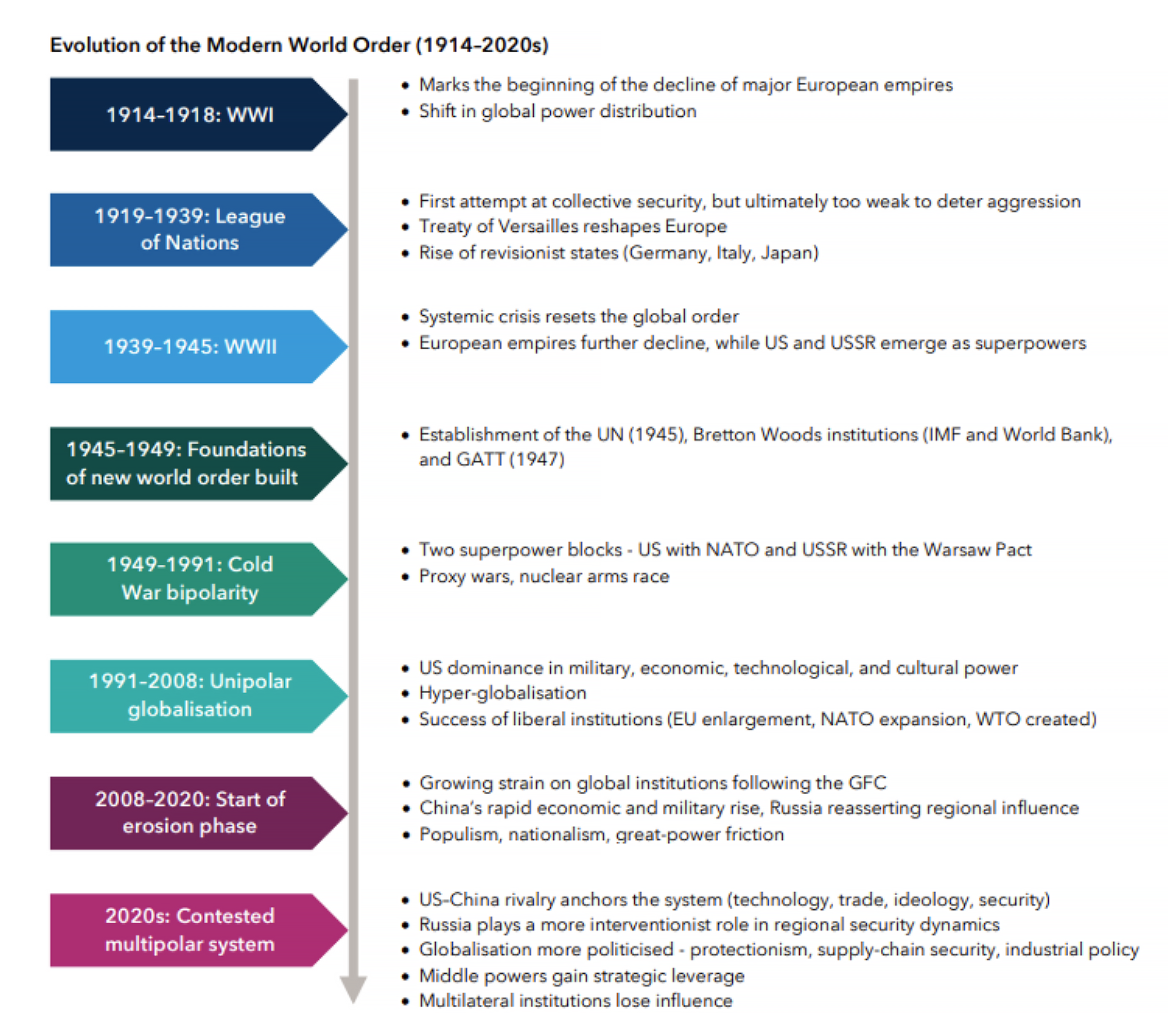
The post-Cold War system has followed a similar pattern — not through a single break, but through a structural shift compounded by a series of shocks.
China’s accession to the World Trade Organisation (WTO) in 2001 marked an important inflection point in a broader process of global integration. As trade barriers fell and economies became more connected, production networks expanded rapidly across borders. The scale and speed of that shift brought clear benefits, but also changes that were not always fully anticipated1.
Over the following two decades, factories moved, supply chains stretched across borders, and production increasingly migrated to lower-cost countries. Many communities benefited from globalisation, but others saw jobs disappear and wages come under pressure. Governments began asking whether they had become too dependent on foreign suppliers for critical goods and technologies2. This broader evolution sits at the heart of the current re-wiring.
Compounding this structural shift are events that challenged assumptions about stability and security which have further weakened the post-Cold War framework. The rise of non-state threats such as ISIS and Al-Qaeda drew sustained Western military engagement that produced mixed outcomes, eroding the perception of the United States as a reliable security guarantor. Russia’s military action in Ukraine in 2014 and again in 2022 demonstrated that borders that many assumed were settled could still be challenged by force. And more recently, contested episodes across the Western Hemisphere, the Arctic and the Middle East have shown how economic tools — tariffs, sanctions, investment screening — are increasingly used to pursue strategic objectives in lieu of, or alongside, traditional diplomacy3. Politics has grown more polarised, and the trust that underpinned the liberal order has deteriorated. Institutions such as the United Nations (UN) and WTO have struggled to bring countries together when crises emerge.
Taken together, these pressures have contributed to a gradual erosion of the post‑Cold War order.
Part II – Where we are now: A more contested and decentralised global landscape
The most recent transition is showing up in three important ways. First, the institutions designed to manage cross-border challenges are weakening. Second, the balance of global power is changing. And third, competition is increasingly moving into the economic domain, where states can exert pressure through trade, finance, technology and the systems that connect them.
Shift 1: Institutions are weakening and coordination is harder
The institutions that once anchored the global system are under strain. Governments are becoming more focused on jobs, security and resilience at home — often at the expense of cross-border cooperation. As a result, multilateral organisations such as the UN and WTO are finding it harder to coordinate responses or enforce rules. This is not just a shift in alliances, but in how the system functions. Instead of waiting for global agreement, countries are increasingly working through smaller coalitions and regional partnerships. The result is a system driven less by agreed rules and more by influence, bargaining power and changing partnerships.
Shift 2: Conflict is moving into the economic domain
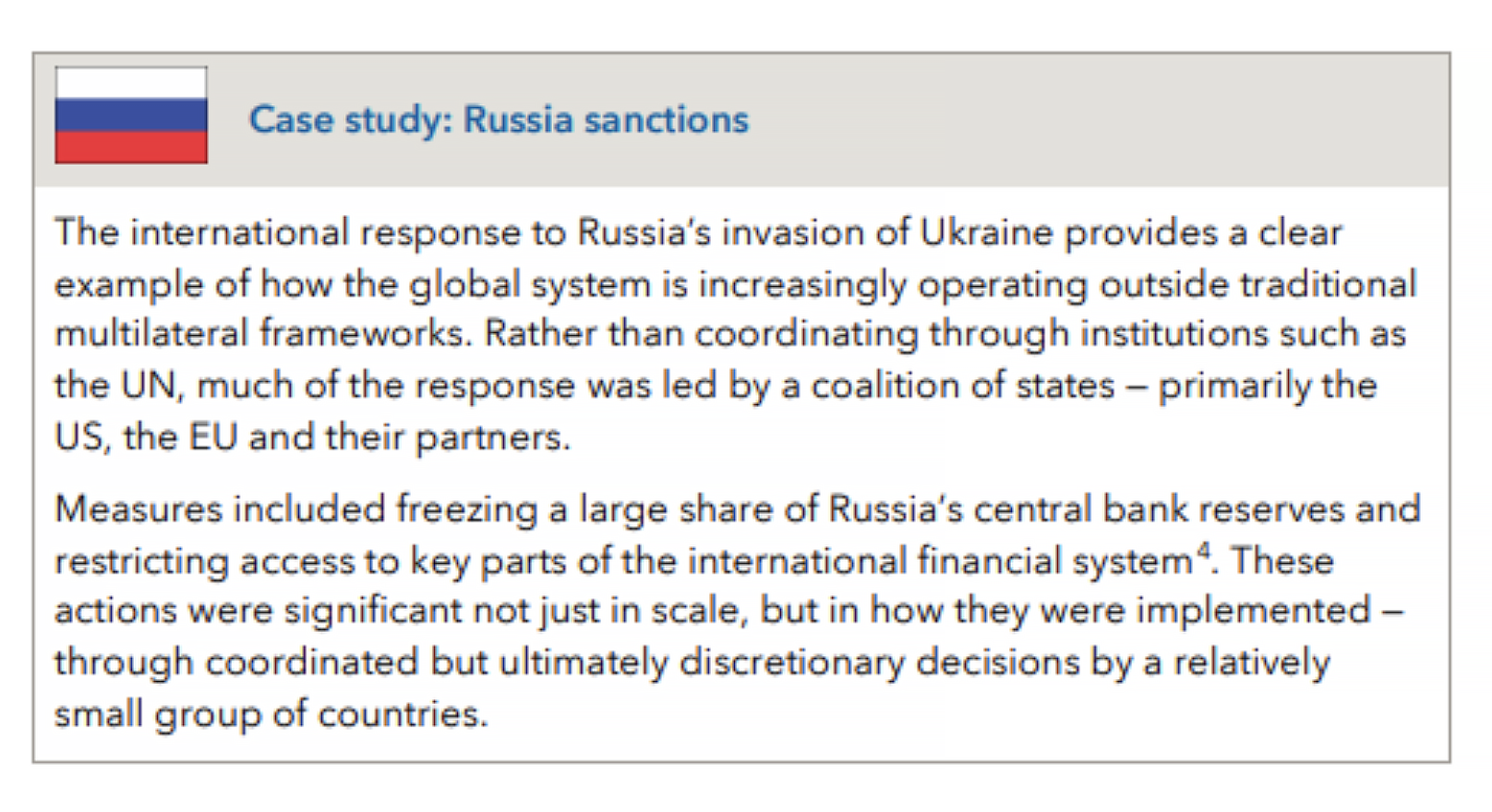
Countries are competing in different ways. Rather than escalating into direct conflict, major powers are increasingly using tariffs, sanctions, export controls and restrictions on investments to shape outcomes.
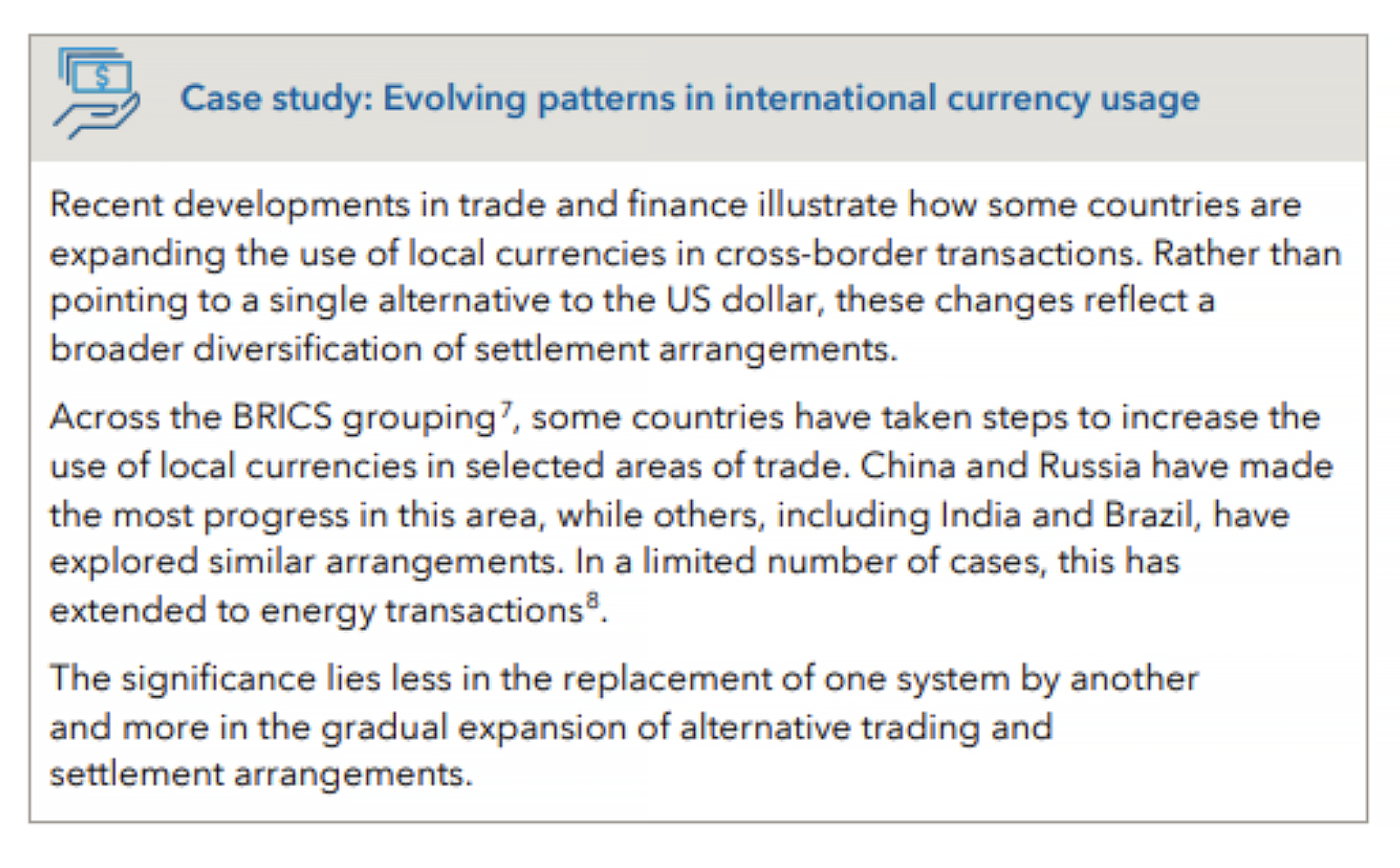
At the same time, this competition is increasingly expressed through control over the networks that move goods, money and technology. Ownership of supply still matters. But increasingly, real leverage lies in controlling how that supply moves. Recent examples include gas flow to Europe, critical mineral restrictions and export controls. These show that economic pressure is now often applied by controlling key networks and relationships rather than disrupting supply altogether.
History reinforces the pattern. From wartime rationing to the control of shipping routes, states have long used bottlenecks as instruments of power.5 The result is that economic systems themselves have become arenas of competition.
Shift 3: Power is spreading
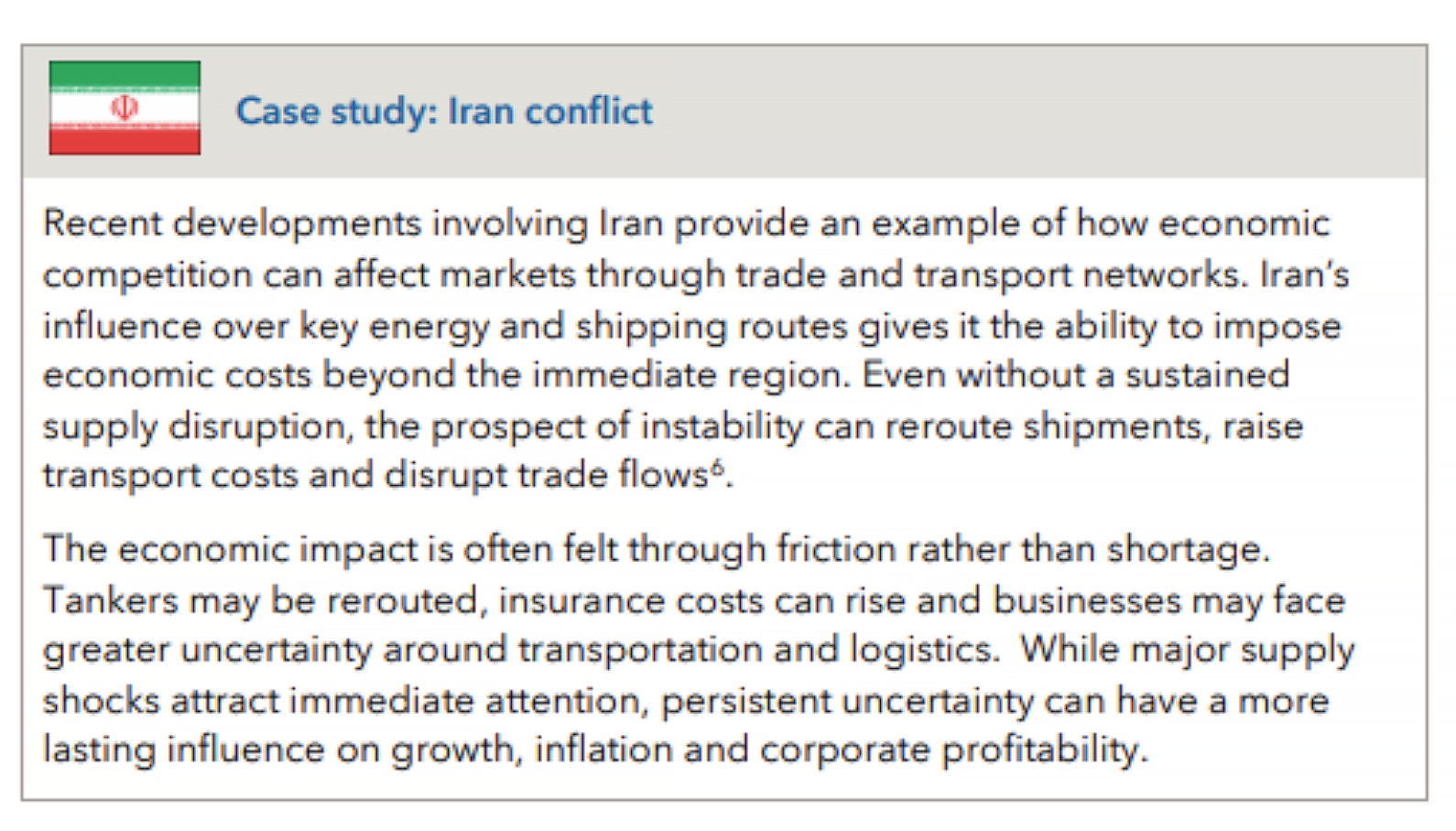
Global power is shifting — but not toward a new centre. Instead, it is spreading across multiple regional blocs. Major powers are consolidating influence, while smaller states are asserting more autonomy and aligning selectively. Relationships are becoming more flexible, and countries are working to reduce dependence on any single system, whether in trade, technology or finance. In practice, this shows up in efforts to diversify supply chains, payment systems and transport routes. The result is a world that is becoming more regional, with different centres of influence pursuing different priorities.
Part III – How major powers and regions are repositioning
Countries are responding to the same underlying shift, but not in the same way. So, the question isn’t simply who is doing what. The more useful question is: What are they trying to achieve? How are they going about it? Where are the pressure points? And where might those pressures create risks or opportunities for investors?
That’s the lens we apply in the table below. Rather than cataloguing every player, it focuses on four simple questions for each: what’s the objective, what’s the approach, what are the constraints, and why does it matter for markets.
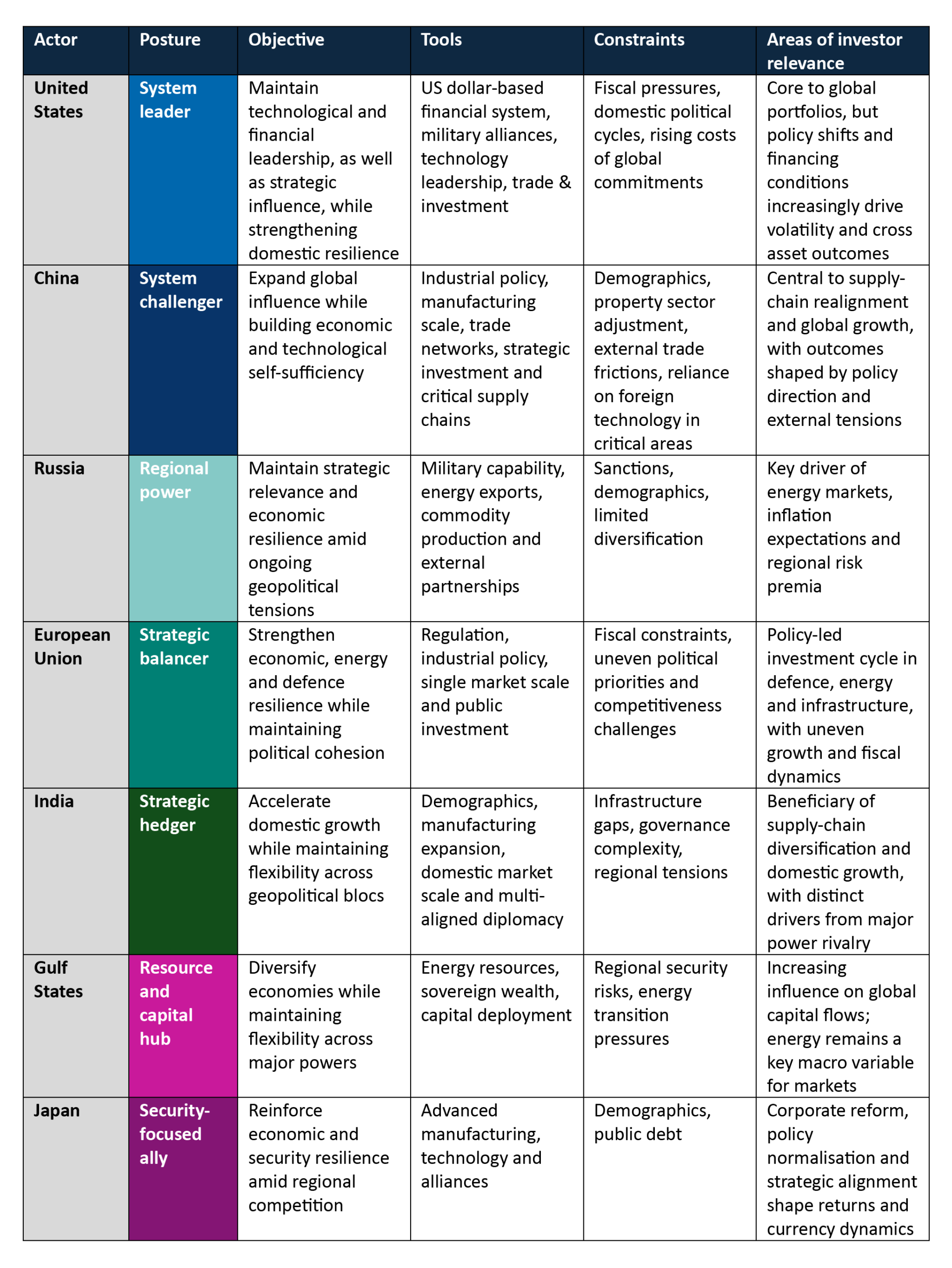
There are a few common themes we can take away:
- Core system drivers: The US and China still sit at the centre of global markets, but policy changes, supply chains and technology competition are playing a bigger role in shaping outcomes.
- How shocks flow through markets: Russia and the Gulf states tend to affect markets mainly through energy prices, commodities and geopolitical tensions.
- Where diversification comes from: The EU, Japan and India offer different sources of return, driven more by local policy, reforms and regional growth.
Part IV – Investment implications
In today’s environment, investors face not just higher risk, but a broader set of potential scenarios. Three implications follow.
Takeaway 1: Geopolitical risk is no longer episodic
As international coordination becomes harder and competition plays out in economic channels (Shifts 1 and 2), geopolitical tensions are increasingly lasting longer and affecting markets through multiple channels. Markets have historically treated geopolitics as short-lived shocks. Today, the more important variable is duration. When tensions persist, costs accumulate through supply delays, tighter financing conditions, and higher required returns. While markets often price the initial shock quickly, historically, they have often been less effective at pricing the duration. For investors, this means reassessing exposures that rely on stable cross-border trade, financing, or policy assumptions, as well as concentrations that depend on a quick easing of tensions. Investors should not assume geopolitical shocks will be short-lived or quickly reverse themselves. Ongoing monitoring should focus on the duration of sanctions, tariffs, and export controls; whether trade and transport disruptions are becoming persistent; and signs that financing conditions or risk premia are adjusting beyond the initial shock.
Takeaway 2: Risk sits in bottlenecks, not just supply
Competition is increasingly expressed through control over the flow of goods, capital and technology, rather than outright supply disruption (Shift 2). Across sectors such as energy, semiconductors, critical minerals, and infrastructure, even limited disruption at key transit points can raise costs and create lasting disruption.
For investors, this means looking beyond supply and demand to understand dependence on key transport routes, infrastructure hubs, suppliers, access to funding and other critical networks.
Ongoing monitoring should focus on shipping patterns, insurance costs, and freight disruption as indicators of stress in trade networks, alongside export controls, investment restrictions, and other limits on the movement of goods, capital, or technology. Investors should also watch for evidence that chokepoints are creating persistent cost pressure rather than one-off disruptions.
Takeaway 3: Policy divergence is driving return dispersion
Policy divergence is no longer a background condition; it is increasingly shaping cost structures, market access, capital flows and strategic support across countries and sectors (Shift 3 and Part III). Reducing dependence is becoming a policy objective in its own right, even when it comes with higher costs. Over time, this is likely to contribute to greater variation in inflation, growth and corporate profitability across countries and sectors.
For investors, this means looking more closely at how businesses are exposed to government decisions. Companies that depend on highly globalised, lowest cost supply chains may face greater challenges, while those aligned with national priorities could benefit from public investment, incentives or regulatory support. Country and sector selection may therefore become more important.
Monitoring should focus on government initiatives aimed at strengthening domestic industries, securing critical supplies and encouraging local production, as well as signs that economic policies are becoming more differentiated across major economies.
Part V – Geopolitics has moved from the margins to the core
We are entering a period that no longer fits neatly within the frameworks investors have relied on for decades. It is a world less unified, less predictable, and at times less efficient. It is a world where cooperation cannot be assumed, and where policy choices carry greater weight.
But this is not a world without structure. Even as the old order evolves, new patterns are emerging, shaping how countries act, how markets adjust, and how risk moves through the system. For investors willing to look closely, those patterns offer something valuable: not certainty, but clarity of direction.
The challenge, then, is not simply to react. It is to understand and to recognise that geopolitics has moved from the margins to the core of markets. And in that environment, the advantage will not come from predicting every outcome, but from the discipline to study what is changing, to test assumptions against evidence, and to invest with a long-term perspective. Because for research based investors, insight is built over time, and it is that depth of understanding that enables portfolios not only to adapt, but to endure as the system continues to evolve.
By Andy Budden, investment director
Take the FAAA accredited quiz to earn 0.25 CPD hour:
CPD Quiz
The following CPD quiz is accredited by the FAAA at 0.25 hour.
Legislated CPD Area: General (0.25 hrs)
ASIC Knowledge Requirements: Economic Environment (0.25 hrs)
please log in to start this quiz
———–
References:
[1] Autor, Dorn and Hanson (2016), “The China Shock: Learning from Labor Market Adjustment to Large Changes in Trade,” which examines how large trade shifts can have uneven and long-lasting effects across regions and workers.
[2] These developments reflect tensions highlighted by Dani Rodrik, who argued that deep economic integration would eventually clash with domestic priorities, leading to political backlash and more sovereignty-driven policy. Rodrik, D. (1997). Has globalization gone too far? Institute for International Economics.
[3] Aiyar, Ilyina and others (2023),“Geoeconomic Fragmentation and the Future of Multilateralism,” IMF Staff Discussion Note, which explores the growing use of economic policies to pursue strategic objectives and the risks this poses to global integration.
[4] Source: US Department of the Treasury press release, 28 February 2022.
[5] Olson, M. (1963). The economics of the wartime shortage: A history of British food supplies in the Napoleonic War and World Wars I and II. Duke University Press. His analysis shows how wartime pressures led states to manage supply through rationing, stockpiling and control of trade routes— illustrating how critical systems and bottlenecks can become instruments of power.
[6] The Strait of Hormuz is one of the world’s most critical energy chokepoints, with a significant share of global oil and LNG trade passing through it. Limited alternative routes mean that even temporary disruption can delay supply, increase shipping costs and affect global energy prices. See International Energy Agency (IEA), Strait of Hormuz; U.S. Energy Information Administration (EIA), World Oil Transit Chokepoints.
[7] Includes: Brazil, Russia, India, China, South Africa, Egypt, Ethiopia, Iran, United Arab Emirates
[8] Sources: IMF (2023),“Currency Usage for Cross-Border Payments,” IMF Working Paper No. 2023/072; Carnegie Endowment (2023),“The Difficult Realities of the BRICS’ Dedollarization Efforts—and the Renminbi’s Role”; ECB (2025),“Global trade invoicing patterns.”
Risk factors you should consider before investing:
– This material is not intended to provide investment advice or be considered a personal recommendation.
– The value of investments and income from them can go down as well as up and you may lose some or all of your initial investment.
– Past results are not a guarantee of future results.
– If the currency in which you invest strengthens against the currency in which the underlying investments of the fund are made, the value of your investment will decrease. Currency hedging seeks to limit this, but there is no guarantee that hedging will be totally successful.
– Some portfolios may invest in financial derivative instruments for investment purposes, hedging and/or efficient portfolio management.
– Depending on the strategy, risks may be associated with investing in fixed income, derivatives, emerging markets, sustainability-related investments and/or high-yield securities; emerging markets are volatile and may suffer from liquidity problems.
Statements attributed to an individual represent the opinions of that individual as of the date published and may not necessarily reflect the view of Capital Group or its affiliates. This communication is intended for the internal and confidential use of the recipient and not for onward transmission to any other third party. This communication is of a general nature, and not intended to provide investment, tax or other advice, or to be a solicitation to buy or sell any securities. All information is as at the date indicated and attributed to Capital Group unless otherwise stated. While Capital Group uses reasonable efforts to obtain information from third-party sources that it believes to be accurate, this cannot be guaranteed. In Australia, this communication is issued by Capital Group Investment Management Limited (ACN 164 174 501 AFSL No. 443 118), a member of Capital Group, located at Suite 4201, Level 42 Gateway, 1 Macquarie Place, Sydney, NSW 2000 Australia. All Capital Group trademarks are owned by The Capital Group Companies, Inc. or an affiliated company. All other company names mentioned are the property of their respective companies. © 2026 Capital Group. All rights reserved.
CPD Quiz
The following CPD quiz is accredited by the FAAA at 0.25 hour.
Legislated CPD Area: General (0.25 hrs)
ASIC Knowledge Requirements: Economic Environment (0.25 hrs)
please log in to start this quiz———–
References:
[1] Autor, Dorn and Hanson (2016), “The China Shock: Learning from Labor Market Adjustment to Large Changes in Trade,” which examines how large trade shifts can have uneven and long-lasting effects across regions and workers.
[2] These developments reflect tensions highlighted by Dani Rodrik, who argued that deep economic integration would eventually clash with domestic priorities, leading to political backlash and more sovereignty-driven policy. Rodrik, D. (1997). Has globalization gone too far? Institute for International Economics.
[3] Aiyar, Ilyina and others (2023),“Geoeconomic Fragmentation and the Future of Multilateralism,” IMF Staff Discussion Note, which explores the growing use of economic policies to pursue strategic objectives and the risks this poses to global integration.
[4] Source: US Department of the Treasury press release, 28 February 2022.
[5] Olson, M. (1963). The economics of the wartime shortage: A history of British food supplies in the Napoleonic War and World Wars I and II. Duke University Press. His analysis shows how wartime pressures led states to manage supply through rationing, stockpiling and control of trade routes— illustrating how critical systems and bottlenecks can become instruments of power.
[6] The Strait of Hormuz is one of the world’s most critical energy chokepoints, with a significant share of global oil and LNG trade passing through it. Limited alternative routes mean that even temporary disruption can delay supply, increase shipping costs and affect global energy prices. See International Energy Agency (IEA), Strait of Hormuz; U.S. Energy Information Administration (EIA), World Oil Transit Chokepoints.
[7] Includes: Brazil, Russia, India, China, South Africa, Egypt, Ethiopia, Iran, United Arab Emirates
[8] Sources: IMF (2023),“Currency Usage for Cross-Border Payments,” IMF Working Paper No. 2023/072; Carnegie Endowment (2023),“The Difficult Realities of the BRICS’ Dedollarization Efforts—and the Renminbi’s Role”; ECB (2025),“Global trade invoicing patterns.”
Risk factors you should consider before investing:
– This material is not intended to provide investment advice or be considered a personal recommendation.
– The value of investments and income from them can go down as well as up and you may lose some or all of your initial investment.
– Past results are not a guarantee of future results.
– If the currency in which you invest strengthens against the currency in which the underlying investments of the fund are made, the value of your investment will decrease. Currency hedging seeks to limit this, but there is no guarantee that hedging will be totally successful.
– Some portfolios may invest in financial derivative instruments for investment purposes, hedging and/or efficient portfolio management.
– Depending on the strategy, risks may be associated with investing in fixed income, derivatives, emerging markets, sustainability-related investments and/or high-yield securities; emerging markets are volatile and may suffer from liquidity problems.
Statements attributed to an individual represent the opinions of that individual as of the date published and may not necessarily reflect the view of Capital Group or its affiliates. This communication is intended for the internal and confidential use of the recipient and not for onward transmission to any other third party. This communication is of a general nature, and not intended to provide investment, tax or other advice, or to be a solicitation to buy or sell any securities. All information is as at the date indicated and attributed to Capital Group unless otherwise stated. While Capital Group uses reasonable efforts to obtain information from third-party sources that it believes to be accurate, this cannot be guaranteed. In Australia, this communication is issued by Capital Group Investment Management Limited (ACN 164 174 501 AFSL No. 443 118), a member of Capital Group, located at Suite 4201, Level 42 Gateway, 1 Macquarie Place, Sydney, NSW 2000 Australia. All Capital Group trademarks are owned by The Capital Group Companies, Inc. or an affiliated company. All other company names mentioned are the property of their respective companies. © 2026 Capital Group. All rights reserved.


Have feedback on this article? Contact Us
Earn CPD Points
 CPD: Currency risk – friend or foe?
In today’s interconnected world, global companies play a significant role in our daily lives. However, when Australian investors allocate their capital to global markets, they are exposed not only to [...]
 CPD: Ethics and moral dilemmas
When it comes to financial advice, the numbers may be black and white, but the ethical decisions often aren’t. This article, proudly sponsored by GSFM, examines moral dilemmas and the [...]
 CPD: Jump in my CAR. Client Advice Records – why, what, how
Introduction The forthcoming replacement of Statements of Advice (SOAs) with Client Advice Records (CARs) has once again shone a spotlight on the vexed issue of client communication within financial advice. [...]
 CPD: Investor Behaviour – Retirement
To best understand how and why clients make financial decisions – particularly during retirement – advisers must look beyond technical strategies and consider investor behaviour. Before addressing product selection or [...]
 CPD: A star is (re)born – Investment Bonds are the new headline act of tax-smart investing
Introduction Tax-smart investing is one of the central pillars of quality, effective, financial advice. The capacity for tax to drag on investment returns, stifle compounding, and eat away at gains [...]