
National vacancy rate rises to 1.4% – house and unit rents diverge as Sydney shows signs of easing
SQM Research has released its latest data on residential property vacancy rates and advertised rents for September 2026.
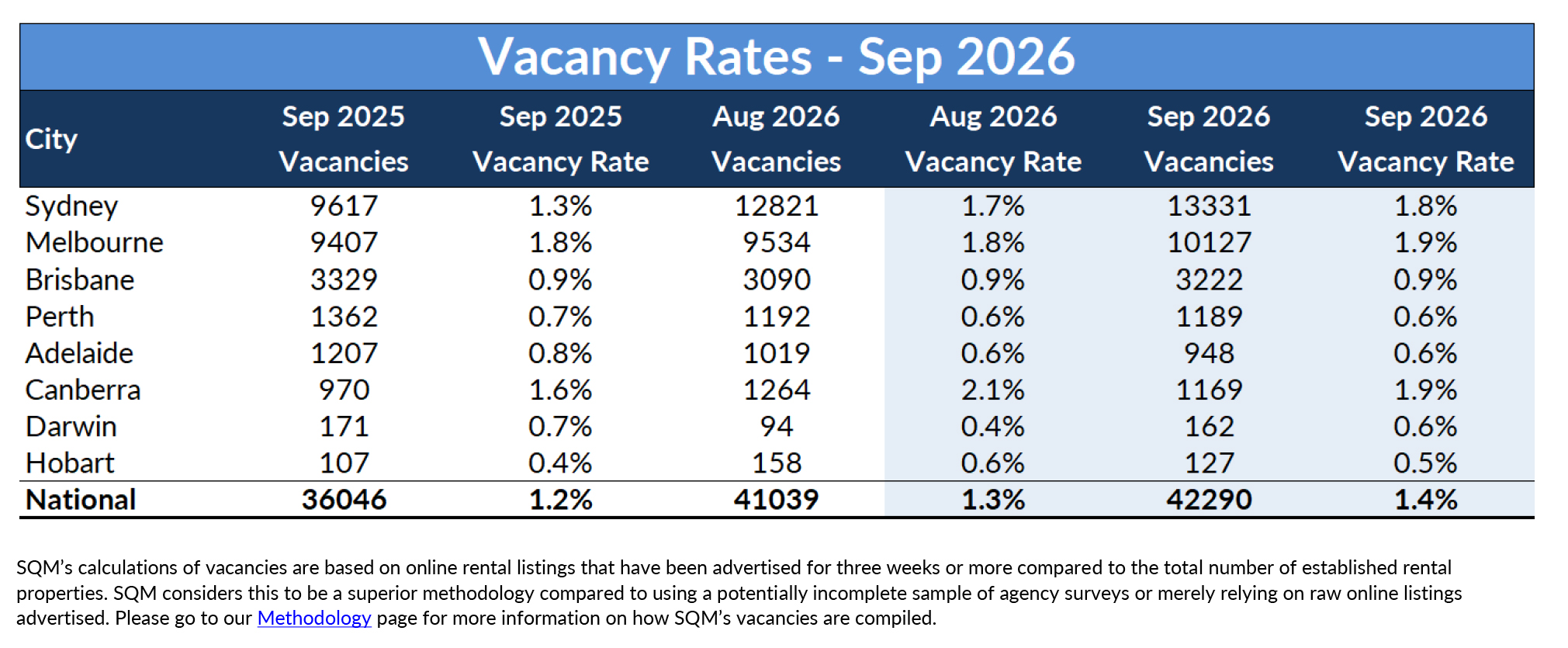
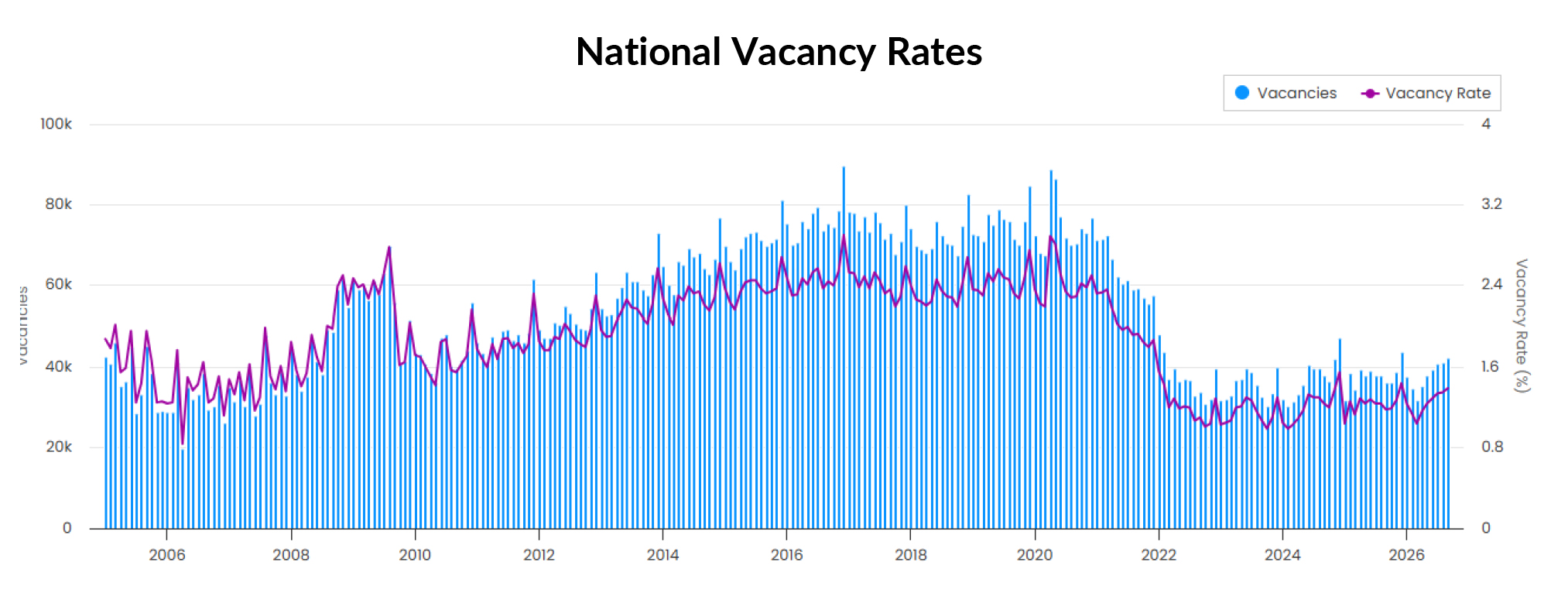
Australia’s national residential vacancy rate increased to 1.4% in September 2026, up from 1.3% in August. The total number of residential vacancies rose to 42,290 dwellings, compared with 41,039 the previous month.
Compared with September 2025, when the national vacancy rate stood at 1.2%, rental availability has increased, suggesting a gradual easing in rental conditions across parts of the country.
The increase has been particularly evident in Sydney and Melbourne, where vacancy rates rose to 1.8% and 1.9% respectively. Canberra also recorded a relatively elevated vacancy rate of 1.9%, despite easing from 2.1% in August, highlighting the differing rental conditions across capital cities.
Sydney is beginning to show signs of softening, with rental availability increasing and a divergence emerging between house and unit rents. While house asking rents continue to rise, unit rents appear to be easing, suggesting some moderation in rental pressures.
Elsewhere, rental conditions remain tight, particularly in Brisbane, Perth, Adelaide, Darwin and Hobart, where vacancy rates remain below 1%.
Capital city highlights
Sydney: The vacancy rate rose to 1.8% from 1.7% in August, with 13,331 dwellings available. A year ago, the rate was 1.3%.
Melbourne: The vacancy rate rose to 1.9% from 1.8% in August, with 10,127 vacancies recorded. Melbourne continues to record comparatively higher rental availability than most other capital cities, indicating a gradual easing in rental market conditions.
Brisbane: The vacancy rate remained unchanged at 0.9%, with 3,222 dwellings available. Brisbane continues to experience tight rental conditions, with available stock remaining limited despite some moderation in rental growth.
Perth: The vacancy rate held steady at 0.6%, with 1,189 dwellings available. Perth remains one of Australia’s tightest rental markets, although advertised rental growth has moderated compared with earlier periods.
Adelaide: The vacancy rate remained unchanged at 0.6%, with 948 dwellings available. Rental supply continues to be constrained, maintaining competitive conditions for tenants.
Canberra: The vacancy rate declined to 1.9%, down from 2.1% in August, with 1,169 dwellings available. Despite the monthly decline, Canberra continues to record relatively higher rental availability than most other capital cities.
Darwin: The vacancy rate increased to 0.6%, up from 0.4% in August, with 162 dwellings available. While rental availability has improved, Darwin remains one of the tightest rental markets nationally.
Hobart: The vacancy rate declined to 0.5% from 0.6% in August, with 127 dwellings available. Rental supply remains exceptionally limited, continuing to place pressure on tenants. 13_10_26_National_Vacancy_Rates…
Advertised rents analysis
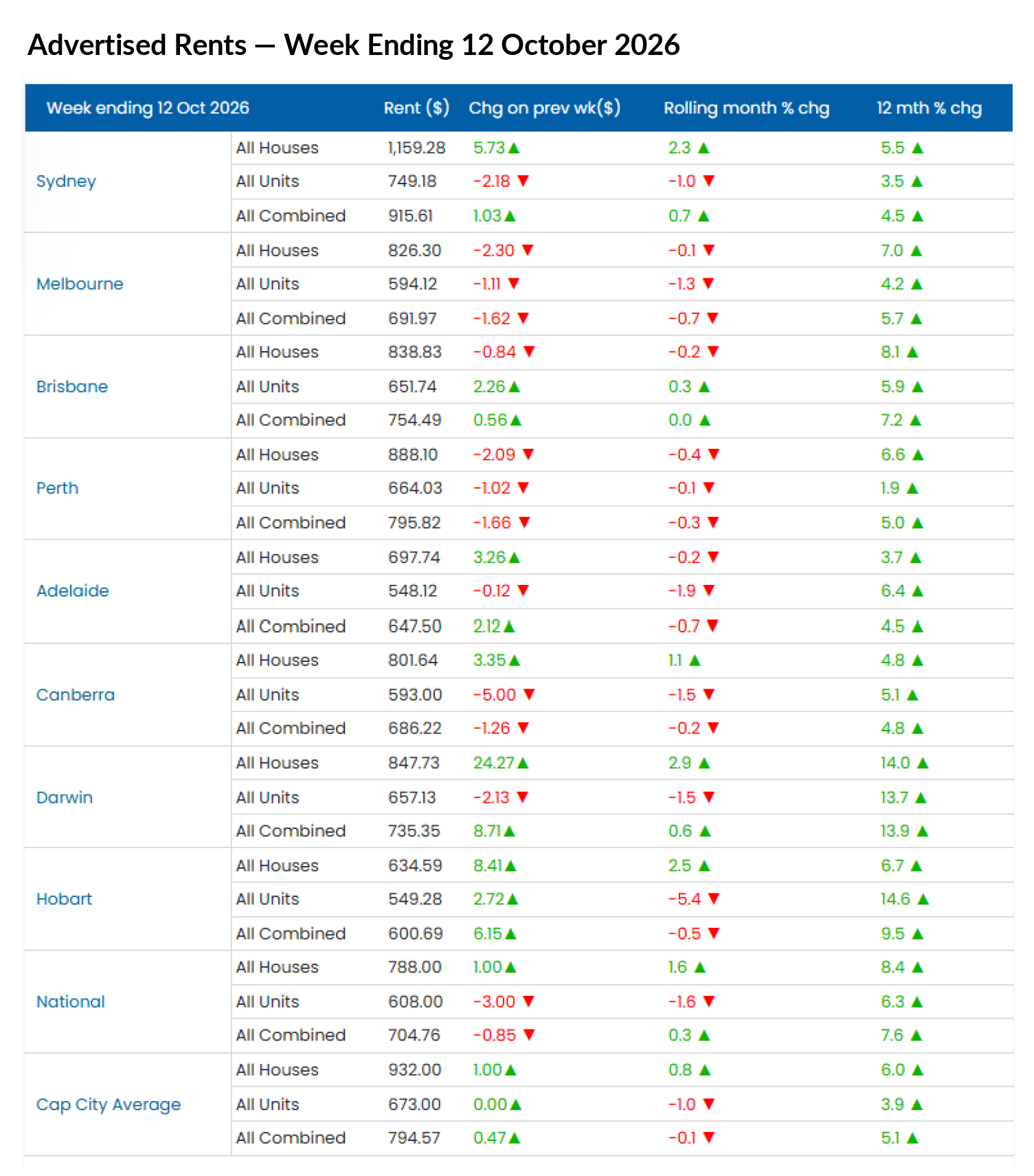
National combined advertised rents rose 0.3% over the 30 days to 12 October. House rents rose 1.6% while unit rents fell 1.6%. Combined rents are 7.6% higher than a year ago, with house rents up 8.4% and unit rents up 6.3%. The capital city average combined rent eased 0.1% over the month and is 5.1% higher over the year.
The national combined advertised rent now stands at $704.76 per week, while the capital city average sits at $794.57 per week.
The latest figures indicate that house rents continue to experience upward pressure, while unit rents are showing signs of softening. Unit rents declined across seven of the eight capital cities during the month, highlighting a growing divergence between rental property types.
Sydney: Combined rents rose 0.7% over the month to $915.61 per week, driven by house rents, up 2.3% to $1,159.28. Unit rents fell 1.0% to $749.18. Combined with increasing rental vacancies, this suggests that rental pressures may be beginning to ease, particularly in the unit market.
Melbourne: Combined rents fell 0.7% to $691.97 per week and are 5.7% higher over the year. Both house (-0.1%) and unit (-1.3%) rents fell over the month, with no sign yet of a spring lift as vacancies rise.
Brisbane: Combined rents were flat at $754.49 per week and are 7.2% higher over the year, with house rents up 8.1% annually. At 0.9% vacancy, Brisbane retains the capacity for further rent rises into summer.
Perth: Combined rents eased 0.3% to $795.82 per week and are 5.0% higher over the year. Annual unit rent growth has slowed to 1.9%, the weakest of any capital, while house rents are up 6.6%.
Adelaide: Combined rents fell 0.7% to $647.50 per week and are 4.5% higher over the year. Unit rents fell 1.9% over the month but remain 6.4% higher annually.
Canberra: Combined rents eased 0.2% to $686.22 per week and are 4.8% higher over the year. House rents rose 1.1% over the month while unit rents fell 1.5%.
Darwin: Combined rents rose 0.6% to $735.35 per week and are 13.9% higher over the year, the strongest annual growth of any capital city, with house rents up 14.0%. Darwin’s small rental stock makes monthly moves volatile.
Hobart: Combined rents fell 0.5% to $600.69 per week but are 9.5% higher over the year. Unit rents fell 5.4% over the month yet remain 14.6% higher annually, the strongest unit rent growth of any capital.
Louis Christopher, Managing Director of SQM Research, commented: “The national vacancy rate rising to 1.4% suggests we are beginning to see a gradual easing in rental conditions, led by Sydney and Melbourne, where available rental stock has increased over the past year.
“Sydney is the market to watch. Vacancies are well up on a year ago, and while house rents rose over the month, unit rents fell. That divergence suggests rental pressures are beginning to ease, starting with the unit market.
“Nationally, house rents rose 1.6% over the month while unit rents fell by the same amount. Some of the strength in house rents reflects the usual spring lift, so the more telling signal is in units, where tenants may finally be seeing some relief. Annual rental growth of 7.6% nonetheless remains elevated.
“The smaller capitals are a different story. With vacancy rates still below 1% in Brisbane, Perth, Adelaide, Darwin and Hobart, there is little sign yet of relief for tenants in those cities.
“We will be watching closely over the coming months to see whether the softening in unit rents continues through the spring leasing season and broadens into a moderation in rental growth overall. For now, the market remains mixed, with some cities beginning to ease while others remain under significant pressure.”


