
Testimony of Reserve Bank Governor
- In delivering testimony to the House of Respresentatives Economics Committee, the Reserve Bank Governor has given clear signals that interest rate settings are on hold for now.
- The Governor didn’t want to dissaude people of the view that while rates could rise in the future, it would “not imminently” occur.
- The Reserve Bank Governor was asked about market views about where rates will be in a year’s time and responded: “I’m not sure myself actually”. But he did note that there was value in getting rate hikes out of the road “so you can sit and rest for a while”.
What does it all mean?
- Australia’s top economist – the Reserve Bank Governor – has candidly remarked that he wasn’t sure where rates would be in a year’s time: “I’m not sure myself actually.” Of course no one does know with certainty where rates will be in the future, although some economists regularly give the impression that they do have a more accurate crystal ball than the Reserve Bank. The Reserve Bank Governor said “the fact is I can’t tell you with certainty about what we will be doing in six months time.”
- But while not providing numerical forecasts for rates over the coming year, the Reserve Bank has certainly given plenty of hints that they have done enough for now.
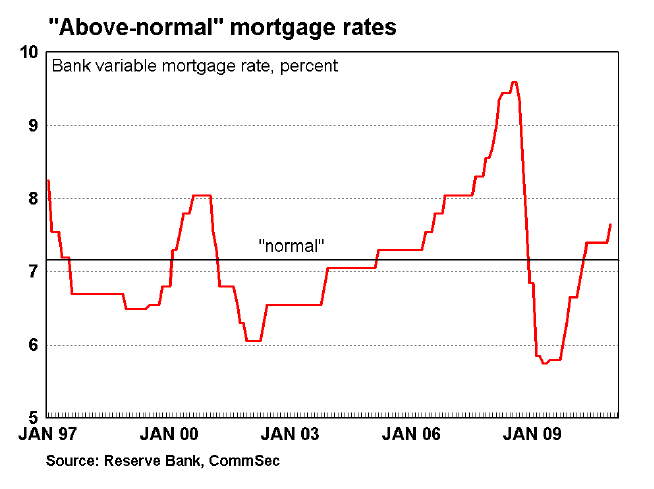
- Governor Stevens noted that official rates were now a little above normal. And while he noted that recent rate decisions were “finely balanced”, he thought that most people would be happy to get the rate hike out of the road “so you can rest for a while.” And while he acknowledged criticism of the last rate hike (RBA “criticised for being trigger happy”), the RBA Governor defended the decision, noting that there wasn’t too many times when you look back with regret that you lifted rates too early.
- The Reserve Bank Governor and the Bank’s Assistant Governor Guy Debelle observed that while economists expected cash rates to be around 5.50 per cent, market pricing tipped rates of 5 per cent mid next year. The Governor suggested that market pricing regularly changes but he didn’t want to dissuade people of the view that in the future there would be gradual increases in rates and not sufficiently close together.
- Overall, the Governor suggested that market pricing was about right – that is, that there could be a rate hike before mid next year and perhaps another increase late in the year.
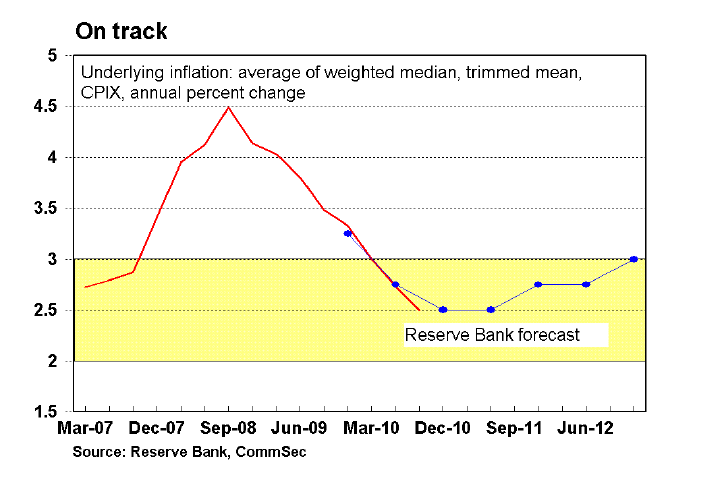
- The Reserve Bank Governor has confirmed that inflation was likely to remain in the target band over the coming year, no doubt underpinning the view that he could now pause on rates for a while: “Over the coming year, we think that inflation will be pretty close to where it is now, consistent with the target.”
- The Governor noted that a “normal” cash rate was 5.50 per cent, but banks had lifted rates a percentage point above the cash rate. “Most recently, as you know, the Board decided to lift the cash rate by 25 basis points. Many lenders raised their loan rates by more than this. These moves have left the overall setting of monetary policy a little tighter than average, as judged by interest rate criteria.” The Governor noted that the Board judged at the last meeting that “it was prudent to take an early Economic Insights Reserve Bank Governor signals pause on rates modest step in the tightening direction.”
- Governor Stevens has referred to the “sea-change” in consumer behaviour with people now cautious to spend and borrow. He acknowledged that while this is tough for retailers, noting that consumption was below average at present, but said it was likely to persist for a while longer. He noted that the trend would be helpful given that significant investment was planned: “I suspect a little more caution on consumption is not a bad thing if we are to fit it all (investment) in.”
- The Reserve Bank officials have highlighted supply side deficiencies with Assistant Governor Philip Lowe noting the need for investment in transport, education and health. The Reserve Bank Governor also said that increased investment in electricity, water and urban infrastructure “would be desirable.” Further, Stevens noted that if the amount of new private sector investment were to be efficient, it would need to be accompanied by public sector investment.
- Certainly the Reserve Bank is laying down the challenge to government to do its part in keeping down inflation and the level of interest rates by correcting supply side deficiencies.
- The Reserve Bank Governor rejected concerns about the size of Australia’s public debt: “we do not have a problem of public debt sustainability.” He further noted that government debt “is not a material problem.”
- The Governor sought to highlight changes in banking over time, noting the reduction in bank operating costs and reduction of the net interest rate margin. He also sought to correct perceptions that banks were given free access to the Federal Government’s AAA rating to raise wholesale funds, stating that the Government “sold the guarantee at quite a nice price” and would collect $1 billion per annum in fees from banks as a result.
What are the implications for interest rates and investors?
- Investors will welcome the relative candid comments by the Reserve Bank Governor on interest rates, and the economy more broadly. Glenn Stevens reckons that rate settings are appropriate to keep inflation in the target band over the coming year. Certainly he acknowledges that no one knows the future with certainty, but Glenn Stevens must be pretty happy with a situation where the economy is recording good growth and where inflation is within the target band – especially when other economies are struggling with weak growth, high unemployment and deflationary risks.
- Many economists, analysts and media commentators will attempt to put their own spin on the RBA Governor’s comments. We would simply suggest that people get a transcript of his testimony and read it yourself. The messages are fairly clear – especially for a Reserve Bank that has been accused in the distant past of being quite opaque.
- Monetary policy can now be described as “tight” – not markedly so, but rates are between a quarter and a half a per cent above “normal”. As we noted when rates were lifted earlier in the month, the RBA has effectively taken out insurance by lifting rates – the hope being that you do a little now and a lot less in the future.

Produced by Commonwealth Research based on information available at the time of publishing. We believe that the information in this report is correct and any opinions, conclusions or recommendations are reasonably held or made as at the time of its compilation, but no warranty is made as to accuracy, reliability or completeness. To the extent permitted by law, neither Commonwealth Bank of Australia ABN 48 123 123 124 nor any of its subsidiaries accept liability to any person for loss or damage arising from the use of this report.
The report has been prepared without taking account of the objectives, financial situation or needs of any particular individual. For this reason, any individual should, before acting on the information in this report, consider the appropriateness of the information, having regard to the individual’s objectives, financial situation and needs and, if necessary, seek appropriate professional advice. In the case of certain securities Commonwealth Bank of Australia is or may be the only market maker.
This report is approved and distributed in Australia by Commonwealth Securities Limited ABN 60 067 254 399 a wholly owned but not guaranteed subsidiary of Commonwealth Bank of Australia. This report is approved and distributed in the UK by Commonwealth Bank of Australia incorporated in Australia with limited liability. Registered in England No. BR250 and regulated in the UK by the Financial Services Authority (FSA). This report does not purport to be a complete statement or summary. For the purpose of the FSA rules, this report and related services are not intended for private customers and are not available to them.
Commonwealth Bank of Australia and its subsidiaries have effected or may effect transactions for their own account in any investments or related investments referred to in this report.


