
The big picture
- In the US, investors have been cheering the election result. That may seem odd, given the fact that it appears a recipe for doing nothing – a Republican-controlled House of Representatives, Democrat-controlled Senate and a Democrat in the White House. One study found that returns for the Dow Jones almost doubled in periods when there was a divided government compared with periods when one party ruled the White House and Congress.
- The theory goes that when the Government is divided there is less political interference with the economy, allowing companies and consumers to get on with business.
- So how does that theory apply to Australia? Unfortunately we don’t have a lot of past experience to work on. When a hung parliament last occurred between September 1940 and August 1943 the Sydney sharemarket lifted by 9.6 per cent or 3.2 per cent a year – around half the average annual average growth over the past 135 years. Still, the Second World War adds another complication to the analysis.
- When the most recent incarnation of a hung parliament became a reality in August, opinion was divided about the impact. Some thought it would prove positive with greater consultation between the parties and independent members. Others thought that little would get done.
- Unfortunately it appears that the latter will now be the more likely outcome. Despite initial optimism, there is no spirit of co-operation in the new Parliament. As a result little is getting done. And that means that businesses are still struggling to get certainty on key issues like the resource rent tax, pricing of carbon emissions, faster internet, migration and broader tax reform.
- The lack of certainty on the resource rent tax is stifling investment across the mining sector. Simply, how can you commit to a long-term investment with the knowledge that the tax regime could be dramatically altered? The final mining tax proposal and legislation are unlikely to be submitted until late 2011. That means that major mining companies may either further delay key projects or look to opportunities outside the country.
- Similarly, environmental issues. The Government has asked the Productivity Commission to give guidance on overseas carbon pricing schemes but the report is not due until May 2011. And Ross Garnaut has been asked to update his 2008 report. Again it will be a six-month process with no guarantees at the end.
- Add in the fact that there is a $43 billion National Broadband Network being built without a cost-benefit study and both the Opposition and Labor are putting limits on migration and it is clear that the economy is at risk.
The week ahead
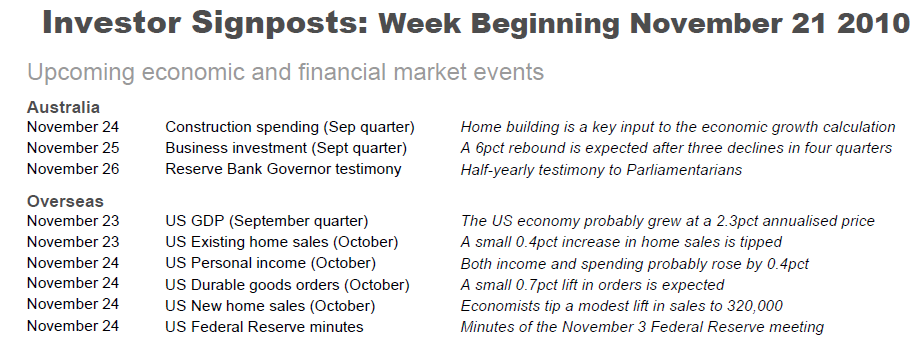
- Another quiet week is in prospect in Australia with only three events of note on the economic calendar. In the US, the key date is Wednesday with at least seven indicators scheduled for release.
- In Australia, data on construction work done is released on Wednesday with business investment (private capital expenditure) on Thursday while on Friday the Reserve Bank Governor delivers testimony to Federal Parliamentarians.
- The “construction work done” release from the Bureau of Statistics provides a raft of information on the construction sector. Not only are estimates provided on home building, commercial and engineering construction activity in the September quarter, but there are also more forward-looking estimates such as commencements and work yet to be done.
- In the June quarter construction work completed hit record highs while work yet to be done was only marginally below record highs. At face value the construction sector appears in good shape. But the problem is that new approvals have slid by 25 per cent over the past nine months, pointing to weaker conditions ahead.
- Business investment has also been soft over the past year with spending falling in three of the past four quarters. But in contrast the outlook for investment has been upbeat, suggesting that investment lifted by 6 per cent in the September quarter. If the optimism about investment is to be maintained, the estimate of spending in 2010/11 will need to lift from $123.3 billion to around $131.5 billion.
- The Reserve Bank Governor faces a grilling by Federal Parliamentarians on Friday. Usually questions centre on inflation, interest rates and the job market, but this time around Glenn Stevens may get more than the odd question on bank funding. It’s clear that Federal politicians have incomplete knowledge of the topic, while at the last Reserve Bank Board meeting, members discussed the topic at length. Hopefully the Governor can fill the knowledge gap of politicians as well as some of the assembled media.
- In the US, the big day in the coming week is Wednesday with all manner of indicators due for release. Amongst the indicators to be released are personal income & spending, durable goods orders, new home sales, consumer sentiment, jobless claims and home prices. In addition minutes of the last Federal Reserve meeting will also be released.
- Personal income and spending are both expected to have risen by 0.4 per cent in October; new home sales may have lifted 4 per cent; and small gains are likely in durable goods orders and consumer sentiment.
- Earlier in the week GDP (economic growth) figures are released on Tuesday together with data on existing home sales. The US economy probably grew at a 2.3 per cent annual pace in the September quarter with existing home sales up modestly. Overall the data should give investors added confidence that the US economy is continuing to heal.
Sharemarket
- Many investors have been disappointed at the performance of the sharemarket this year. While the US Dow Jones has lifted by over 6 per cent, the ASX 200 has dropped 5.5 per cent while the All Ordinaries is down 2.5 per cent.
- However to get a better sense of how the Australian market has fared, its worth taking a different perspective. The capitalisation of the sharemarket is probably a better measure in the current environment, reflecting moves by companies to shift from debt capital to equity. Over 2010, the capitalisation of the All Ords has lifted 4.4 per cent and now stands 17 per cent lower that the November 2007 record high. By comparison, the All Ordinaries index is still 32 per cent below its high point.
Interest rates, currencies & commodities
- Politicians of all persuasions criticised the banks for lifting rates on loans by more than the movement in the cash rates. Banks were accused of being greedy and losing touch. A number of journalists and other commentators added to the debate. But that was before the Reserve Bank released minutes of the last Board meeting. According to the minutes, members spent some time considering the evidence. The conclusion was that old loans were being rolled over at higher spreads, leading to the risk that the higher funding costs would need to be passed on. Reserve Bank Board members took time to consider the issues, now it is up to others to get up to be brought up to speed.
- It may seem perverse, but the sharp lift in longer-term US treasury yields in recent days is clearly a positive development. Over the past seven days, US 10-year bond yields have risen by almost 40 basis points to 2.86 per cent. Given the fact that the Federal Reserve has embarked on QE2 – the second leg of quantitative easing or bond purchases – the lift in yields may seem surprising. But investors are starting to get the sense that the US economy is indeed recovering. At the same time commodity prices are rising and both these developments point to higher inflation. Clearly one of the biggest risks for holders of long-term government bonds is higher inflation, and bond investors are voting with their feet, moving to other asset classes.
Produced by Commonwealth Research based on information available at the time of publishing. We believe that the information in this report is correct and any opinions, conclusions or recommendations are reasonably held or made as at the time of its compilation, but no warranty is made as to accuracy, reliability or completeness. To the extent permitted by law, neither Commonwealth Bank of Australia ABN 48 123 123 124 nor any of its subsidiaries accept liability to any person for loss or damage arising from the use of this report.
The report has been prepared without taking account of the objectives, financial situation or needs of any particular individual. For this reason, any individual should, before acting on the information in this report, consider the appropriateness of the information, having regard to the individual’s objectives, financial situation and needs and, if necessary, seek appropriate professional advice. In the case of certain securities Commonwealth Bank of Australia is or may be the only market maker.
This report is approved and distributed in Australia by Commonwealth Securities Limited ABN 60 067 254 399 a wholly owned but not guaranteed subsidiary of Commonwealth Bank of Australia. This report is approved and distributed in the UK by Commonwealth Bank of Australia incorporated in Australia with limited liability. Registered in England No. BR250 and regulated in the UK by the Financial Services Authority (FSA). This report does not purport to be a complete statement or summary. For the purpose of the FSA rules, this report and related services are not intended for private customers and are not available to them.
Commonwealth Bank of Australia and its subsidiaries have effected or may effect transactions for their own account in any investments or related investments referred to in this report.


