
January has wrapped up with strong gains in shares. There’s an old saying, “as goes January so goes the year” which is often referred to as the January barometer.
- While it’s not reliable when shares fall in January, since 1980 up Januarys in Australia have had a 70% hit rate of going on to see gains for the year as a whole and in the US the hit rate has been 90%. So the fact shares have started the year well augurs well for a good year. That said, while January is seasonally a solid month, February is often soft and after the huge gains since the last correction in November shares are overbought and vulnerable to a short term pull back or consolidation.
- Floods down the coast of Queensland and NSW are devastating for those involved, but the economic impact is likely to be far less than was seen from the early 2011 floods. This time around the area affected is smaller, Brisbane has not seen mass flooding, the disruption to coal exports looks like it will be far less and there has been less damage to food production (recall the 400% rise in Banana prices after Cyclone Yasi).
- The announcement of the Australian Federal election well in advance for September 14 risks acting as a dampener on spending to the extent that it may effectively mean a very long election campaign, and election campaigns often see a bit of caution creep into consumer spending and investor behaviour. However, I doubt that the impact will be significant. More likely Australian’s won’t really start thinking about it much till August.
Major global economic events and implications
- The big news in the US over the past week was that the economy contracted slightly in the December quarter, but this looks more like an aberration driven by a slump in inventories on the back of production disruptions flowing from Hurricane Sandy and a fall in normally volatile defence spending rather than the start of a renewed recession. The pace of growth in private final demand actually picked up from 2% in the September quarter to 3% in the December quarter suggesting underlying growth is fine. More timely and forward looking indicators continue to point up for the US economy. The ISM manufacturing conditions index rose much more than expected in January, durable goods order rose strongly pointing to strength in business investment, construction spending rose, consumer sentiment is up and jobs growth remained reasonable in January.
- December quarter earnings results remain reasonable in the US. So far 73% of the 254 stocks to have reported have beaten earnings expectations and 65% have beaten revenue expectations.
- In Europe, Spain’s economy continued to contract in the December quarter and an ECB survey showed a slight tightening in bank lending standards but perhaps more importantly a further improvement in economic sentiment in January adds to evidence that the European recession is likely to be over by the second half of the year.
- Japanese economic data remained soft with weaker than expected readings for household spending, housing starts and industrial production but at least Japan’s manufacturing conditions PMI improved in January.
- Elsewhere in Asia there was good news with a gain in Korean industrial production, a stronger than expected rebound in Taiwanese GDP and more monetary easing in India. Chinese manufacturing PMIs were mixed but averaging the HSBC and official PMIs for January shows a further gain consistent with a pick up in growth.
Australian economic events and implications
- Australian data remains soft, particularly for the manufacturing PMI, export prices and producer prices, but there are signs of improvement with a bounce back in December business confidence, a slight pick up in credit growth, a rise in new home sales in December for the third month in a row and a solid start to the year for house prices. These are positive signs that rate cuts are starting to get some traction.
Major market moves
- While shares had a mid week pull back, most share markets with the exception of Europe went on to see another week of solid gains helped by ongoing good news on the global economy. US shares rose 0.7%, Japanese shares rose 2.4%, Chinese shares rose 5.6% and Australian shares rose 2.3%
- The $A fell slightly and the Yen continued to slide on Japanese monetary reflation.
- Bond yields rose as safe haven demand continues to go in reverse.
What to watch over the next week?
- In Australia, the focus will be on the Reserve Bank where we expect interest rates to remain on hold. To be sure it’s a close call. The case for further rate cuts remains strong and I continue to see more cuts in the months ahead. The mining investment boom is slowing rapidly and bank lending rates still look too high to drive a decent recovery in sectors of the economy like housing and retail at a time when the $A remains strong. Most economic indicators remain well below the average levels they normally attain this far into a interest rate easing cycle. See the table below.
- Against this, global economic conditions have improved significantly over the past few months, share prices have surged, the iron ore price has rebounded sharply from its lows last year and the tentative signs of an uptick in housing indicators and some confidence measures are likely to encourage the RBA to wait a bit longer to see the impact of past rate cuts. So on balance we see rates remaining on hold for now.
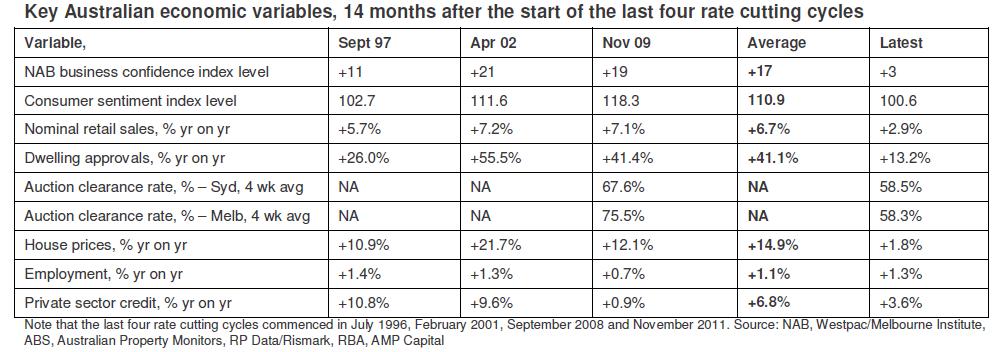
Key economic variables
- Also in Australia, expect a small further rise in building approvals (Monday), flat December quarter house prices (Tuesday), a small gain retail sales (Wednesday), weak employment resulting in a rise in unemployment to 5.5% (Thursday) and on Friday the RBA will release of its quarterly Statement on Monetary Policy.
- December half Australian earnings reports will also start to trickle through, kicking off an earnings reporting season which will likely show that earnings remain weak but with conditions starting to stabilise. After sharp downgrades to earnings expectations for 2012-13, to show near zero growth, the risk of another round of significant earnings disappointment is low.
- In China, expect CPI inflation to have fallen back to around 2% in January, and growth in exports and imports to have improved further (Friday). Also, new bank loans in January are likely to have risen sharply.
- In the US, the non-manufacturing ISM and trade data will be released and earnings results will continue to flow.
- In Europe, expect both the ECB and Bank of England (Thursday) to leave interest rates on hold.
Outlook for markets
- Having risen sharply since the last correction in mid November shares are overbought technically and vulnerable to a short term correction. February is often soft for shares after December/January strength and several hurdles may constrain markets in the month ahead including negotiations around US spending cuts due to kick on March 1, Italian elections and uncertainty around the earnings reporting season in Australia.
- However, any set back should be seen as a buying opportunity as shares are likely to head much higher this year. The positive momentum seen in recent months in share markets is indicative of a bull market, during which corrections are usually short lived and mild. The global growth outlook is steadily improving which should result in better momentum for profits.
- Global monetary conditions are ultra easy and getting even easier. Shares are likely to benefit from investors switching out of low yielding cash & bonds. Share market valuations remain reasonable. Australian shares will also benefit from RBA rate cuts starting to drive a pick up in the key cyclical parts of the economy. So notwithstanding the usual bumps along the way this all adds up to a positive backdrop for share markets. Our year end target of 5000 for the ASX 200 is already within striking distance, and while it’s likely to provide some short term resistance, it’s starting to look too conservative.
- Sovereign bonds have been a great diversifier and a great investment in recent years but are now very vulnerable as the year ahead is likely to see a rising trend in bond yields as global economic growth improves which will result in capital losses for investors in sovereign bonds.
- The outlook for the Australian dollar remains messy. Softish Australian data is a negative but growing quantitative easing in the US and now Japan is a positive. The likely outcome is for a $US0.95 to $US1.10 range.


