
Weekly market update – week ending 2 April, 2015
Investment markets and key developments over the past week
Share markets were messy and mixed over the last week with US shares down on some soft economic data, Australian shares constrained by the falling iron ore price and Japanese shares also down slightly but European shares getting a boost from solid data and Chinese shares continuing to roar ahead helped by hopes for more policy easing. Bond yields generally fell and commodity prices were mixed with metal prices down but oil up a bit as talks with Iran about lifting sanctions on its oil exports dragged on. The $A fell below $US0.76 as the iron ore price fell below $US50/tonne and expectations for an RBA cut this month increased.
The argy bargy in relation to Greece continues to drag on. Our base case is that agreement will be reached in time to head off any Greek default, but it’s getting down to the wire with a payment to the IMF due in the week ahead. In any case the threat to other peripheral Eurozone countries from a Grexit has subsided following their economic reforms of the last few years and the ECB’s quantitative easing program which is helping shield other countries in Europe from any Greece related contagion.
Economic reform was back on the front pages in Australia over the last week with the release of the Treasury’s Tax Discussion Paper and the final report of the Competition Policy Review. On the tax front the big issues are well known and are Australia’s excessive reliance on personal and corporate income tax, the relative high marginal personal tax rate compared to average wages, the low reliance on the GST and various tax concessions. However, the obvious difficulty in broadening and raising the GST, which should only occur with compensation, makes prospects for fundamental tax reform as opposed to tinkering at the edges rather bleak. The capital gains tax discount, dividend imputation, stamp duty, the high corporate tax rate and aspects of the superannuation breaks were all questioned by Treasury. And rightly so in relation to the capital gains tax discount, stamp duty and corporate tax. However, it would be a huge retrograde step to return to the double taxation of dividends – dividend imputation was never designed to encourage foreign investment into Australian share and sure it biases Australian investors into Australian shares but this is no reason to return to taxing dividends twice. Doing so would only encourage firms to retain more earnings which all the evidence suggests is negative for capital allocation in the economy and bad news for long term share-holder returns. If there is a better way to achieve the same as dividend imputation then let’s move to that but I doubt there is.
The Competition Policy Review rightly added to what has been apparent for years – and that is we need another round of deregulation and reforms across the economy if we wish to boost productivity and our living standards. Hopefully the Government and the Senate are listening.
Major global economic events and implications
US economic data continues to provide a very mixed picture. On the one hand pending home sales, consumer confidence, home prices and the Markit manufacturing PMI for March were all solid. But against this, personal spending, construction spending, the ADP employment survey and the ISM manufacturing conditions index were softer than expected. The divergence between the Markit and ISM manufacturing PMIs is particularly interesting and may reflect the impact of the narrower survey base of the ISM picking up more large companies that have been affected by the strong $US. Time will tell but with mixed data and the core private consumption deflator remaining low in March the Fed can afford to continue to take its time on interest rates.
But while US data has been a bit disappointing, Eurozone data continues to better expectations. Economic confidence rose further in March driven by both consumers and business, the March manufacturing PMI was revised up further and unemployment is trending down. However, while headline deflation is fading, core inflation remains low so doesn’t expect any early end to the ECB’s quantitative easing program.
Japanese industrial production fell sharply in February but conditions according to the Tankan business survey for the March quarter suggest that it should rebound and that the recovery in growth is continuing.
China announced further policy easing with reduced down payment requirements for second properties and a waiving of the property transaction tax on homes owned over two years. With the Soufun 100 city property price index showing a further loss of downwards momentum in home prices this adds to confidence that the threat to the Chinese economy from the property market is receding. Further monetary easing is still needed though. While the official manufacturing PMI rose slightly in March it would be wrong to get excited as its just wiggling up and down in the same range it’s been in for 3 or 4 years. In any case the non-manufacturing PMI fell slightly.
Australian economic events and implications
Australian economic data over the last week clearly shows that the housing recovery is continuing. Despite a small fall in February, building approvals remain around record highs and new home sales remain strong pointing to continued strength in dwelling construction. While home prices continued to rise in March this was concentrated in Sydney with other cities decidedly soft indicating that, despite the hoopla, home price momentum overall is waning. It is also noteworthy that there has been some modest loss of momentum in investor housing credit. As a result the housing market may be becoming less of a constraint on the RBA’s flexibility to cut interest rates again. With the TD Securities Inflation Gauge showing inflation at a headline and underlying level running around 1.5% over the year to March, inflation is clearly not a constraint on the RBA.
In a further blow to Australia’s national income, the iron ore price fell below $50/tonne in the last week and is now down over 70% from its 2011 high and points to a further fall in the terms of trade.
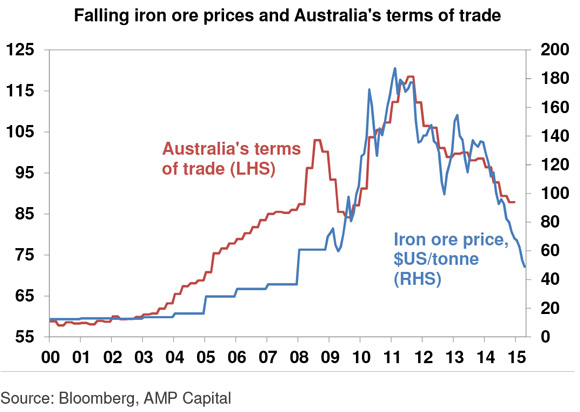
Since the March RBA Board meeting the iron ore price has fallen another 21% which is adding urgency for the RBA to cut rates again to provide a direct boost to the economy and an indirect boost via ongoing downwards pressure on the value of the $A. With each $1 fall in the iron ore price knocking around $300m off Federal Government tax revenue fiscal stimulus is not an option.
What to watch over the next week?
In the US, the focus will likely be on the start of the March quarter profit reporting season which is kicked off by Alcoa on Wednesday. Consensus expectations for a 5.6% fall in profits over the year to the March quarter may prove to be a bit too pessimistic but there is little doubt that the rise in the value of the $US will have hurt earnings, with around 25% of US earnings sourced in foreign currencies. Meanwhile, expect the ISM services conditions index (Monday) to remain solid and the minutes from the last Fed meeting (Wednesday) to confirm that the Fed has become more dovish but is now dependent on the flow of economic data in terms of determining when the first rate hike will come.
In the Eurozone the main focus will be on whether Greece gets new funding released in time to cover debt payments it needs to make.
In China, expect inflation (Friday) to have remained low in March with producer prices continuing to deflate.
In Australia, the RBA (Tuesday) is expected to cut the cash rate by 0.25% taking it to a record low of 2%. Once again it’s a close call as the RBA may decide to wait for March quarter inflation data due later this month and ongoing strength in the Sydney property market is clearly an argument against further rate cuts. However, the additional 21% fall in the iron ore price since the RBA’s last meeting has added urgency to the case for the RBA to cut rates again at a time when the growth outlook remains subdued, the outlook for business investment is poor, inflation remains benign and the $A is still too high. What’s more outside of Sydney, property markets are losing momentum and in some cases quite week so isolated strength in the Sydney property market should really be dealt with by APRA and is not an argument to deny the overall economy lower interest rates. The RBA needs to set interest rates for the “average” of the economy, not just one city. And so on balance we expect the RBA to cut rates again on Tuesday.
On the data front expect to see a modest gain in retail sales (Tuesday) and a bounce back in housing finance (Friday) after softness in January. ANZ job ads data will also be released.
Outlook for markets
At some point this year shares are likely to see a decent correction with the anticipation of the Fed’s first interest rate hike likely to provide the trigger. However, the trend in shares is likely to remain up as: valuations, particularly against bonds, are good; economic growth is continuing; and monetary policy is set to remain easy with further easing in Europe, Japan, China and Australia and only a gradual tightening in the US. As such, share markets are likely to see another year of reasonable returns. Eurozone, Japanese and North Asian shares are likely to outperform.
Low bond yields point to soft medium term returns from sovereign bonds, but it’s hard to get too bearish on bonds in a world of too much saving, spare capacity and deflation risk.
The trend in the $A is likely to remain down as the Fed is still likely to raise rates this year whereas the RBA remains on track to cut and the long term trend in commodity prices remains down. We expect a fall to $US0.70 this year, and a probable overshoot into the $US0.60s in the years ahead.
By Shane Oliver, AMP Capital
———–


