
Investment markets and key developments over the past week
- Shares had a rough week on the back of a continuation of the global bond sell-off, some soft US data, comments by Fed Chair Yellen regarding equity valuations and concerns regarding Greece. The correction in the $US continued and this helped metal prices see further gains and the $A rise helped by the removal of an explicit RBA easing bias.
- What’s driving the market wobble? It seems the global and Australian investment scene has hit another rough patch. From recent highs US shares are down 1%, Japanese shares are down 4%, Eurozone shares are down 7%, Chinese shares are down 8% and Australian shares are down 5%. Several factors are driving this. First deflation fears have abated, which is good but its pushed up bond yields. This partly reflects the fall back in the $US (on Fed rate hike delays) which has allowed commodity prices and notably oil to rebound and so the acute oil price collapse driven fear of deflation from earlier this year has receded allowing bond yields to move higher. This has been given a push in Europe by stronger growth and higher German bond yields have also removed a lid on US and Australian bond yields. The back-up in bond yields has impacted high yield shares dragging down share markets generally. Second, some share markets were due a correction – notably Europe, Japan and China – after very strong gains and were thus vulnerable. Third, we have entered a seasonally tougher part of the calendar year (“sell in May and go away…”). Finally, Australian shares have also been hit by perceptions that the RBA may have finished easing, fears about a stronger $A and talk (and reality in NAB’s case) of bank capital raisings.
- Is it a correction or something worse? In the absence of unambiguous and broad based share market overvaluation, bull market extreme investor euphoria and excessively tight global or Australian monetary conditions that will drive bond yields rapidly higher or slow growth significantly the broad trend in shares is likely to remain up. However, periodic corrections are healthy and normal. For example, Australian shares are so far down 5% from their recent peak but they had a 9% pullback last September-October and an 11% pull back in mid 2011 all against a rising trend – so what’s new? It’s too early to say that this correction is finished. But in anticipation of a correction in bonds and shares we have been running a higher than normal cash allocation and see recent moves as healthy and as setting up investment opportunities for when the bull market resumes.
- Too early to say for sure that the RBA has finished cutting rates. While it was no surprise to see the RBA cut rates again taking the official cash rate to an historic low of 2%, it was disappointing to see the RBA drop its explicit easing bias, which has led many to conclude that the next move in rates is up. My base case is that 2% is the low, but it’s way too early to be confident of this. With the mining investment boom still unwinding, non-mining investment remaining weak and the $A remaining too high and at risk of going higher the longer the Fed delays the risks are still skewed towards another rate cut. While the RBA has once again dropped its explicit easing bias the combination of its now lowered growth and inflation forecasts, its expectation that unemployment will be around 6.5% mid next year and its assessment that a further fall in the $A is necessary all suggest that it retains a soft easing bias. If the $A does not oblige and head lower and the investment outlook start to improve then it will be back threatening, and if necessary, cutting rates again. At the very least rates are set to remain low for a long while. With the RBA not seeing growth above trend until 2017 a rate hike looks to be a long way off.
Major global economic events and implications
- US economic data was messy again. The services conditions PMIs were solid and unemployment claims remained low, but the trade deficit blew out, the ADP employment survey was weaker than expected and productivity was weak in the March quarter thanks to the weak Q1 GDP outcome.
- The March quarter US profit reporting season continues to come in better than expected. We are now 90% done and 72% of companies have exceeded earnings expectations and more importantly earnings growth expectations for the quarter have moved up from -5.6% year on year six weeks ago to now +2%, a record turnaround.
- While Eurozone retail sales disappointed in March, final business conditions PMIs were revised up for April to show only a trivial fall from March and remain at a solid level indicating that the pick-up in economic growth continues. Stronger German factory orders added to the case.
- Weaker than expected Chinese exports and imports for April reinforce the case for more Chinese monetary easing, with the pause in the Chinese share market making it easier to do so.
- In the UK, exit polls and early results suggest the return of the Cameron Government, avoiding a long period of political uncertainty although a referendum on the UK’s membership of the EU will create a bit of noise. Don’t forget though that the EU is not the Eurozone.
Australian economic events and implications
- Australian economic data was reasonably positive. While the labour market was soft in April this followed two strong months and the ANZ job ads survey continues to point to more jobs growth ahead. Meanwhile the housing construction cycle is continuing to point up with a new record high in dwelling approvals and a new cyclical high in new home sales. Retail sales slowed a bit in March but the March quarter was solid and annual growth is good. Of course all of this just reinforces what we have known for a while, ie that household demand is strong. But what’s still lacking is a pick-up in non-mining investment. Meanwhile, the AIG’s services and construction business conditions surveys were on the weak side and the TD Securities Inflation Gauge for April was benign providing the RBA with plenty of flexibility.
What to watch over the next week?
- In the US, expect a 0.3% gain in April retail sales (Wednesday) as the winter freeze in the US continues to recede, an improvement in the New York regional manufacturing conditions index and industrial production (Friday) and another low reading for producer price inflation (Thursday).
- Eurozone March quarter GDP data (Wednesday) is expected to confirm that growth has picked up, probably to around 0.4% quarter on quarter, which will be the strongest in four years. Spain is likely to be a star performer with March quarter growth of 0.8% qoq already reported.
- Chinese economic activity data for April (Wednesday) is expected to show a slight improvement in momentum particularly for industrial production and retail sales. Money supply and credit growth will also be watched for an improvement following recent monetary easing.
- In Australia, the main focus will be the Budget to be delivered Tuesday. After the political failure of last year’s tough Budget, this year’s Budget is likely to be “dull” and “boring.” The bad news will be that lower than expected commodity prices and wages growth will have delivered another blow to revenue and blow out in the budget deficit of around $8-$10bn per annum compared to the projections in the December Mid-Year Economic and Fiscal Outlook and a further delay in the return to surplus to around 2021. After a 2014-15 budget deficit of $45bn (or 2.8% of GDP) the deficit for 2015-16 is likely to be around $41bn (2.4% of GDP), which is $10bn worse than projected in December.
- We are now looking at a 13 year run of budget deficits which swamps the 7 years seen in the 1990s and the 5 years in the 1980s. What’s worse is that this time around we haven’t even had a recession. The continuing delay in returning to surplus from a projection of 2012-13 in the 2012-13 budget, to 2016-17 in the 2013-14 budget, to 2019-20 in the 2014-15 budget and now to around 2021-22 is cause for concern and begs the question whether we will ever get there. There are real reasons for concern here because demographic pressures on the budget will start to build from early next decade and we now don’t have a lot of flexibility to provide stimulus should our luck turn against us and the economy really turn down.
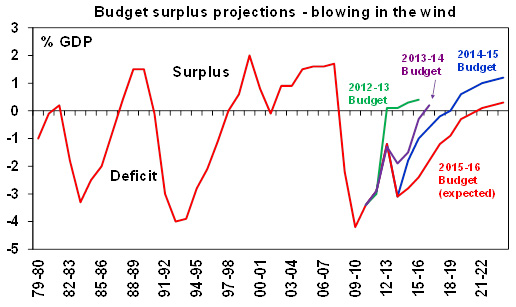
Source: Commonwealth Budgets, AMP Capital
- The good news is that this year is likely to see a more politically measured approach from the Government so there is unlikely to be the big negative for confidence that last year’s fairness debate and Senate debacle proved to be. The Government is unlikely to fight the hit to revenue but rather fund any additional spending by middle ground political measures – such as lowering the assets test for the pension, measures to combat tax avoidance by multinational companies, extending the GST to low value online imports and a bank deposit tax. “Spending” measures are likely to include more generous but more targeted child care payments, a small business tax cut and increased infrastructure funding.
- On the data front in Australia, the NAB business survey for April (Monday) will be watched for further signs of improvement, expect another modest rise in housing finance (Tuesday) and wages growth (Wednesday) is expected to remain soft at around 2.5% year on year.
Outlook for markets
- As we come into May I get kind of nervous given the old saying “sell in May and go away, buy again on St Leger’s Day” and the last week vindicates that nervousness to some degree. Given the uncertainties around the bond sell off, the Fed’s eventual move to tightening and Greece the next few months could remain volatile.
- However, notwithstanding near term risks, the conditions for an end to the cyclical bull market in shares are still not in place: valuations, particularly against bonds, remain good; economic growth is continuing at a not too cold but not too hot pace; and monetary conditions are set to remain easy. As such, share markets are likely to see another year of reasonable returns. My year-end target for Australian shares remains 6000. It’s just that the market got ahead of itself with the surge earlier this year.
- Still low bond yields point to soft medium term returns from bonds, but it’s hard to get too bearish on bonds in a world of too much saving, spare capacity and deflation risk. Central banks won’t be ratifying a bond crash like in 1994.
- Despite the risk of a further short term bounce in the $A, the broad trend is likely to remain down as the Fed is likely to raise rates later this year whereas the RBA retains a soft easing bias and the long term trend in commodity prices remains down. We expect a fall to $US0.70 by year end, and a probable overshoot into the $US0.60s in the years ahead.


