
Weekly market update – week ending June 19, 2015
Investment markets and key developments over the past week
Shares had another messy and mixed week with worries about Greece weighing, particularly on European shares.
Japanese shares also fell and Chinese shares had another plunge as IPOs surged and the authorities further tightened rules around bank exposure to margin trading. Against this though, US shares were helped by good economic news and a benign Fed and Australian shares also continued to bounce from previously oversold conditions. Bond yields fell except in some peripheral Eurozone countries on Greece worries. The $US fell on expectations that Fed rate hikes will be gradual and this saw the $A rise slightly despite soft commodity prices.
The Greek standoff continues. The lack of progress in negotiations and the negative rhetoric from the Greek Government is clearly worrying for investors and the risk of no deal, setting Greece on a path of default and exit from the Euro has clearly gone up. However, several points are worth noting:
- First, there is still a way to go yet. While a €1.5bn payment to the IMF is due June 30, an actual default will not come till the IMF writes a letter informing Greece it’s in default and this may not come till some time into July. Also if a late agreement is reached the IMF, ECB and EU may simply agree to delay payment until any necessary parliamentary votes and referendums occur. The next event to watch is an emergency Eurozone leaders meeting on Monday
- Second, Greek banks may help bring the crisis to a head because without continued ECB support the escalating outflow of deposits may soon force them to close which will bring on a credit crunch in Greece. Either this or the fallout from a default (the so-called “Graccident”) could force the Greek “Government” to soften its stance.
- Third, a consistent 70% or so of the Greek population wants to stay in the Euro & the Greek Government knows this.
- Fourth, it’s in the interest of both sides to reach an agreement: for Greece to avoid a banking crisis, economic mayhem that would follow if they have to balance their budget immediately and forced exit from the Euro; and for creditors to preserve as much as possible of the €300bn or so lent to Greece and to head off any contagion. In this regard the war of words around Greece is very similar to that amongst US politicians ahead of its various debt ceiling deadlines.
- Finally, although a Graccident need not mean a Grexit, even if there is to be a Grexit the rest of Europe is in far better shape now than in 2010-12 with Portugal and Ireland now both off bailout support, peripheral countries having reformed their economies and reduced their budget deficits and the ECB in a far stronger position to protect countries from attacks on their bond markets (via both its QE program and its Outright Monetary Transactions program which enables the buying of bonds in troubled countries).
While the Greek mess is unnerving & may go on for a while yet, it’s unlikely to drive a return to the mini bear market in shares we saw back in 2011 at the height of the Eurozone crisis.
Chinese shares have had another sharp pull back with the Shanghai composite having had a 10% fall from its June 12 high. After rising 140% over 12 months and around 50% year to date such volatility is to be expected as it has risen a bit too far too fast. The easy gains are probably over and a period of correction would be healthy. However, it’s worth reiterating that the Shanghai composite index on an historic PE of 21 times is still below its long term average and should benefit as further monetary easing comes through. See the next chart. In fact with Chinese authorities wanting the share market to be strong but not manic, the latest share market correction means that it wouldn’t be surprising to see another PBOC rate cut or required reserve ratio reduction soon.
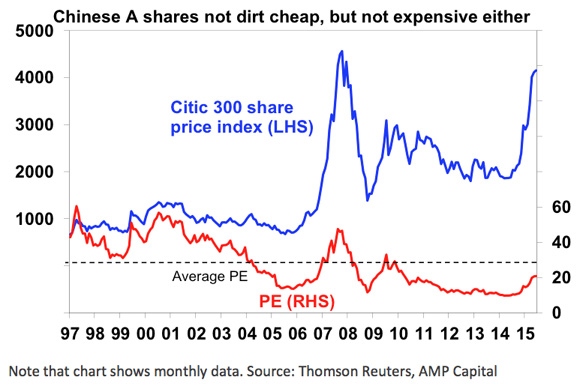
Note that chart shows monthly data. Source: Thomson Reuters, AMP Capital
The Fed remains on track to hike later this year, but it’s looking more gradual. The message from the Fed’s latest meeting was relatively benign with growth and the jobs market looking stronger and a rate hike on track for later this year, but the hike remaining dependent on a further improvement in employment and confidence that inflation has bottomed. The Fed has also revised down its interest rate expectations (the so-called dot plot) reinforcing that rate hikes will be gradual. My base case remains that the first hike will be in September – but the risks are that a combination of slower growth, Greek related turmoil or a stronger US dollar could push this out to December. So far it feels like the experience with the taper in 2013, with investor nervousness ahead of the taper, but by the time it started it was already factored in.
Major global economic events and implications
US economic data was mostly good consistent with the view that growth has picked up after the March quarter slowdown, albeit not as strongly as occurred last year. On the soft side, industrial production fell in May and manufacturing conditions in in the New York region were soft. Housing starts also fell in May, but this followed an upwards revision for April and in any case the more forward looking permits to build new homes and the NAHB home builders’ conditions index both rose solidly indicating that the housing recovery is continuing. On top of this, manufacturing conditions in the Philadelphia region improved significantly in June, jobless claims fell and the US leading index rose. At the same core CPI inflation was weaker than expected in May with the annual increase falling to 1.7%, partly highlighting why the Fed is in no hurry.
In the Eurozone, bank take up of cheap ECB Targeted Long Term Refinancing Operations (TLTRO) money was strong for the second quarter in a row adding to confidence that bank lending will continue to improve.
In Japan, the BoJ left monetary policy unchanged but this was as expected. Pressure for more easing remains though, and despite BoJ Governor Kuroda’s confusing comments on the value of the Yen, it’s likely that it will see further falls ahead.
China saw more evidence that property prices have bottomed with average of property prices rising again in May. This compares to monthly declines of around 1% a year ago. A stabilisation in Chinese property market indicates that a key source of risk to the Chinese economy is now receding.
Australian economic events and implications
Monetary policy still works. This was the clear message from a speech by Assistant RBA Governor Christopher Kent, who rightly pointed out that it has been up against strong headwinds of the mining investment downturn, fiscal consolidation and a less helpful exchange rate. The RBA probably does not want to cut rates further and is hoping Fed tightening will negate the need but the clear message from Governor Steven’s the week before and Kent’s assessment that rate cuts have been working indicates that it will cut again if needed. So while the Minutes from the RBA’s last Board meeting offered little new, my view remains that another rate cut is a 50/50 proposition with the August meeting being the one to watch.
What to watch over the next week?
In the US, expect to see a decent gain in existing home sales (Monday) but a fall in new home sales, a further gain in home prices, a continued trend improvement in durable goods orders and the Markit manufacturing conditions PMI remaining reasonable at around 54 (all due Tuesday) and continued benign core inflation according to the personal consumption deflator (Thursday). March quarter GDP growth (Wednesday) is also likely to be revised up to -0.3% annualised from -0.7%.
In Europe the focus will remain on whether there is a resolution on Greece. Meanwhile, expect the noise around Greece to have weighed on the Markit manufacturing and services conditions PMIs (Tuesday) but money supply and bank lending growth (Friday) are expected to show further improvement.
In Japan, the Markit manufacturing conditions PMI (Tuesday) and a range of economic data to be released Friday will be watched for confirmation that the Japanese economic recovery is on track. In terms of the latter expect to see jobs data remaining strong and a rebound in household spending growth. Core inflation is expected to have remained only just above zero though highlighting why the Bank of Japan is still likely to be forced to undertake more monetary easing.
In China, the Markit manufacturing PMI (Tuesday) is expected to show a slight improvement from 49.2 to 49.4 for June consistent with other indicators.
In Australia, expect ABS data to show a solid 2.5% gain in March quarter home prices (Tuesday), driven largely by Sydney and Melbourne, consistent with private sector estimates that have already been released. Data for job vacancies and population will also be released.
Outlook for markets
The combination of seasonal weakness and uncertainties around bond yields, Greece and the Fed mean that the volatility/correction we are now seeing in share markets could have further to go in the short term. However, notwithstanding near term risks, the conditions for an end to the cyclical bull market in shares are still not in place: valuations against bonds remain good; economic growth is continuing at a not too cold but not too hot pace; and monetary conditions are set to remain easy. As such, share markets are likely to see another year of reasonable returns, despite current uncertainties. It’s worth noting that we have seen similar bouts of uncertainties at some stage through most of the last few years, so in a big picture sense its nothing new.
Australian shares ran too hard earlier this year and this set the market up for a correction that has been triggered by a combination of softer global markets, the back-up in bond yields weighing on high dividend payers and uncertainty around the Australian growth outlook. So far the market has had a correction of 8.5% and the resultant improvement in valuations and continued low rates and an eventual improvement in the growth outlook should set the scene for a renewed run up later this year, probably back up to around the 6000 level.
Still low bond yields point to soft medium term returns from bonds, but it’s hard to get too bearish on bonds in a world of too much saving & spare capacity. Central banks won’t ratify a bond crash like in 1994, by raising interest rates aggressively.
The broad trend in the Australian dollar remains down as the Fed is likely to raise rates later this year whereas there is a 50/50 chance that the RBA will cut again and the long term trend in commodity prices remains down. We expect a fall to $US0.70 by year end, and a probable overshoot into the $US0.60s in the years ahead.
By Shane Oliver, AMP Capital
———


