
Weekly market update – week ending 6 November, 2015
Investment markets and key developments over the past week
Global shares mostly saw solid gains over the last week helped by good economic data, albeit with talk of ongoing Fed warnings of a possible December rate hike and nervousness ahead of the October payroll report in the US constraining the gains. Chinese shares are now up 20% from their August low. Australian shares remain under pressure though, dragged down by banks and mining stocks. The $US also broke higher, putting pressure on commodity prices but despite this the $A managed a small gain as expectations for a near term RBA rate cut were reduced.
A “good” versus a “bad” Fed hike. The past week saw Fed Chair Yellen reiterate the message from the Fed’s last post meeting statement that a December rate hike is a “live possibility” if economic data supports its relatively upbeat expectations regarding the economy and inflation. The key for investors is to recognise that there is a difference between a “good Fed hike” (where rates are raised against a backdrop of solid economic news and receding worries about the US/global growth and inflation outlook) and a “bad Fed hike” (where rates are raised against a backdrop of global and US growth worries probably made worse by a rising $US adversely affecting commodities and emerging market currencies). Either way a December rate hike would likely see market wobbles but they would be short lived with a “good hike” and longer lived with a “bad hike” as the latter would be seen as a policy error. The key is that by making a hike dependent on receiving information consistent with its upbeat economic view the Fed should be unlikely to embark on a “bad hike”.
RBA still content on interest rates, but adopts an easing bias. While the RBA has signalled that it remains content with current interest rate settings, it has adopted an easing bias with RBA Governor Steven’s noting that were there to be a change in monetary policy “in the near term, it would almost certainly be an easing, not a tightening”. The RBA’s easing bias is reinforced by the downwards revision to the RBA’s inflation forecasts in its Statement on Monetary Policy. Although the RBA is sounding a bit more upbeat on the economy, it’s noteworthy that yet again it’s revised down its GDP growth forecast for this year to 2.25% from 2.5% in August, which in turn was down from a mid-point of 2.75% in February. Its 2017 growth forecasts were also shaved.
While the RBA is clearly in no rush to move on rates, so a December cut may be premature, we expect the RBA to act on its easing bias sometime in the months ahead as: bank mortgage rate hikes which have now spread to the smaller banks are likely to weigh on retail sales in the run-up to Christmas; the non-mining investment outlook remains poor; peaking building approvals point to a peak in the contribution to growth from home construction next year; El Nino related drought risks are posing an additional threat to growth; the terms of trade is still sliding; the $A risks a rebound if the Fed doesn’t hike next month and if other global central banks continue to ramp up monetary easing; and inflation is likely to remain below target.
It’s worth noting that I am not in the bearish camp on the Australian economy. It has been rebalancing nicely, but I do see it needing more help to continue doing so as the mining investment downturn continues. It is noteworthy that since the RBA started cutting interest rates four years ago we have seen several occasions where the RBA has expressed reluctance to ease again, only to ultimately resume easing.
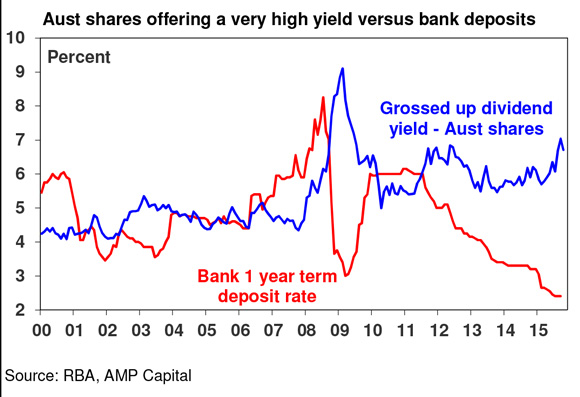
Regardless of whether the RBA holds or cuts, interest rates look like remaining at very low levels for a long while to come as we are only about half way through the mining investment downturn. As a result higher yield assets like Australian shares and commercial property are likely to remain attractive for investors looking for decent income flows. The gap between the dividend yield on Australian shares grossed up for franking credits and 12 month term deposit rates remains about as wide as it has been since the GFC. As we have seen in recent years “search for yield” investor demand is likely to remain a source of support for the Australian share market – in between the periodic scares about growth, bank capital raisings, etc.
Major global economic events and implications
In terms of global growth worries its notable that there has been some good news over the last week with October manufacturing and services conditions PMIs (as published by Markit) mostly seeing decent gains in the US, Europe, Japan and China. While monthly data can be volatile, it could be a sign that the September quarter soft patch in global business surveys that helped drive growth worries through the quarter may have come to an end.
Meanwhile in the US, jobs reports were mixed but still solid, the trade deficit improved and construction spending is continuing to rise. Productivity also rose solidly in the September quarter for the second quarter in a row but is up just 0.4% year on year.
US September quarter earnings have come in better than expected but still down slightly. 86% of S&P 500 companies have now reported with 73% beating on earnings and consensus earnings expectations for the year to the September quarter have improved from -6.3% three weeks ago to -2.8%. Revenue has been disappointing though with only 44% of companies beating on sales as the strong $US and falling oil price have weighed. These drags will recede though if the $US and oil price stabilise.
German factory orders fell for the third month in a row in September, despite okay readings for the German manufacturing PMI suggesting a bounce back soon.
It looks like there is a good chance that the IMF will include the Renminbi in its basket of Special Drawing Right currencies (currently the $US, Euro, British Pound and Yen) as early as late this month. While inclusion in the rather archaic SDR supplementary foreign exchange reserve assets is unlikely to have a major impact on global financial markets or Chinese economic prospects it will symbolically help boost the Renminbi’s global status as a reserve currency and China’s importance in global financial markets.
Australian economic events and implications
Australian economic data releases were a mixed bag. On the one hand retail sales are continuing to motor along with okay growth, albeit this is being helped by weak pricing, and continued growth in retail sales volumes and a strong contribution from trade look like underpinning September quarter GDP growth at a reasonable rate. On the other hand though (..starting to sound like an economist here!) the AIG’s manufacturing and services conditions PMIs fell in October to around 50 or below pointing to a renewed weakening in business conditions, building approvals look increasingly like they have peaked pointing to a peak in the contribution to growth from home construction in the first half next year, CoreLogic RP Data for October shows further evidence of a cooling in the housing market and the October TD Securities Inflation Gauge shows that inflation continues to remain below target.
What to watch over the next week?
In the US, expect an improvement in Oct retail sales growth and benign producer price inflation (both Friday). Data will also be released for small business confidence, job openings and consumer confidence.
Chinese economic data for October is expected to show continued robust growth in retail sales at 10.9% year on year, a slight pick-up in industrial production growth to 5.8% yoy (both due Wednesday), a fall back in credit growth after a surge in September and a fall in consumer price inflation (Tuesday) to 1.5% yoy.
In Australia, housing finance data (Tuesday) is expected to show a slowing led by investors, the NAB business survey (Tuesday) and the Westpac consumer confidence survey (Wednesday) will be watched for improvements in confidence and labour force data (Thursday) is expected to show a 10,000 bounce in jobs after a soft September but with unemployment remaining at 6.2%.
Outlook for markets
After a strong recovery in shares from their September lows, it’s likely we will see a pause or modest pull back in share markets in the weeks ahead. US shares in particular are now looking a bit overbought, some complacency has crept back in and worries about a Fed driven rise in the $US and its flow on to commodities and emerging market currencies look like they could re-emerge.
But following a pause or correction share markets are likely to see the normal “Santa Claus” rally into year end and the broad trend in shares is likely to remain up. Shares are cheap relative to bonds; monetary conditions are set to remain easy and the Fed is unlikely to do anything to threaten global growth; and this in turn should help see the global economic recovery continue. As such, share markets are likely back in a broad rising trend. This includes the Australian share market, where we continue to see the ASX 200 rising to around 5500 by year end.
Low bond yields point to soft medium term returns from bonds, although government bonds remain a great portfolio diversifier.
The broad trend in the $A is likely to remain down as the Fed is likely to raise interest rates sometime in the next six months whereas the RBA is more likely to cut rates again and the trend in commodity prices remains down. This is expected to see the $A fall to $US0.60 in the next year or so.


