
Weekly market update – week ending 12 February, 2016
Investment markets and key developments over the past week
The turmoil in financial markets continued over the last week as worries about global growth, and specifically the exposure of global banks to energy loans and rising bad debts if there is a recession, continue to build. As a result share markets saw more sharp falls, sovereign bonds in core countries continued to collapse, credit markets remained under pressure, commodity prices excluding gold fell with the oil price making a new low. Despite this the $A rose slightly as the $US continued to slide.
The continuing slump has seen Australian shares tip over into bear market territory (albeit using the rather arbitrary 20% decline line in the sand definition) joining many other markets that were already there. From last year’s highs to most recent lows US shares have had a fall of -14%, Australian shares -20%, Eurozone shares -27%, Japanese shares -27%, Emerging market shares -27% and Chinese shares -49%.
The slump in share markets is increasingly looking to be feeding on itself – as eg investors fret that financial turmoil will bring on a recession and cause big problems for banks which in turn drives more selling of shares.
Our assessment is that another GFC style credit and banking crisis is unlikely: banks in the US, Europe and Australia are better capitalised now; US and European bank exposure to energy loans at around 2-4% of total assets is a fraction of their exposure to housing loans which were at the centre of the GFC; new restrictions on proprietary trading have limited banks’ exposure to riskier corporate debt; and the issues of low transparency and complexity that plagued the sub-prime mortgage market are not really an issue in corporate debt markets now. So far we are not seeing any blow out in interbank lending rates relative to official interest rates in contrast to what we saw in 2007-2008 as bank funding costs soared. Similarly we remain of the view that a US global/recession is unlikely, albeit with a 25% probability.
However, it does seem that markets need to see some sort of circuit breaker to end the negative feedback loop that is now developing. Central banks are most likely source of this. On this front, Janet Yellen’s comments in the past week indicate that while the Fed is aware of the risks it is not yet at the point of reversing course and providing more monetary stimulus, the Bank of Japan is likely still mulling its next steps after negative interest rates seemingly backfired but the ECB is likely getting closer to action, particularly with Eurozone bank share prices now down 42% from last year’s high and back to levels seen in the 1990s. This is likely to take the form of increased quantitative easing, probably focussed on corporate debt, and maybe more cheap financing for banks.
With Australian shares having entered a bear market, the following table provides some historic perspective on them.
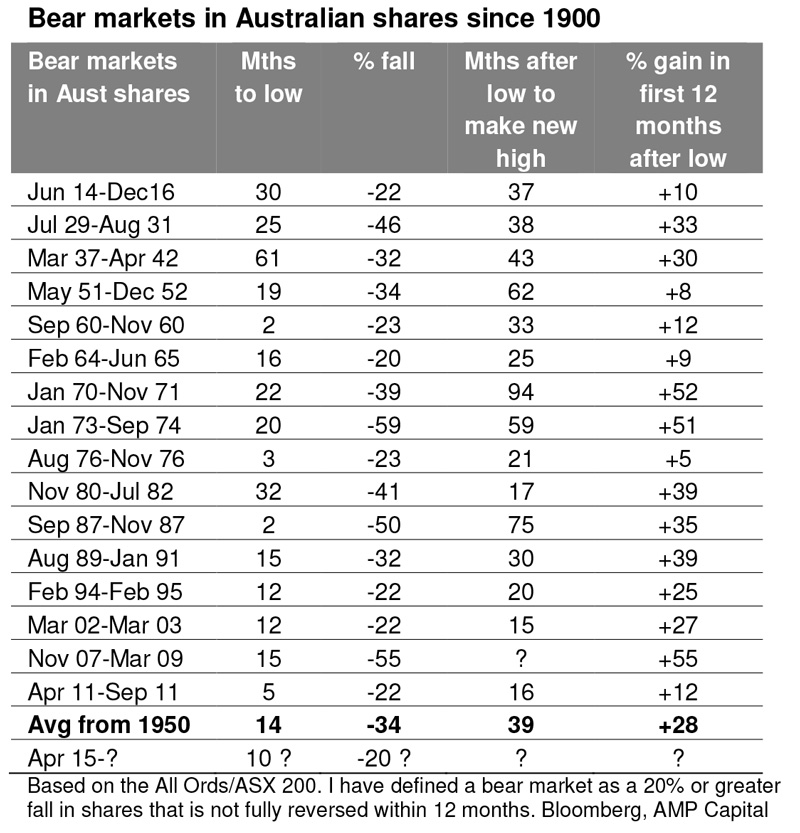
The average bear market since 1950 has lasted 14 months with a decline of 34%. It’s then taken an average 39 months to get back up to and exceed the previous high with an average 28% gain in the first 12 months after the low. Of course this masks a wide range but generally speaking the deeper and longer bear markets have been associated with recessions in either Australia or the US or both.
RBA Governor Steven’s Parliamentary testimony highlighted the improvement in non-mining activity in the Australia, labour market strength and low inflation. But he also reiterated the RBA’s easing bias and the uncertainty around the impact from recent global financial turbulence. Right now the RBA remains in wait and see mode, but our view is that it will cut interest rates again sometime in the months ahead.
Major global economic events and implications
US economic news was mixed with a slight fall in small business optimism but solid readings for job openings, hirings and employees quitting their jobs for new jobs and another decline in jobless claims.
So far the US December quarter earnings reporting season is about 75% complete. 76% of results have beaten on earnings but the size of positive surprises has been lower than in prior quarters and so earnings are still down 4.3% year on year. Only 48% have beaten on sales. The manufacturing slump and the strong $US have clearly weighed.
Japanese economic data was mixed with weak machine tool orders and economic sentiment but stronger bank lending and weaker bankruptcies.
China was pretty quiet over the last week being closed for the Lunar New Year holiday. The PBOC’s foreign exchange reserves reportedly fell another $US99bn in January consistent with ongoing capital outflow but interestingly the decline was less than in December.
One BRIC at least is continuing to do better than expected with India seeing 7.3% GDP growth through 2015, helped by strong domestic demand.
Australian economic events and implications
Despite the global turmoil recent the NAB and Westpac surveys put recent business and consumer confidence readings around long term average levels – flat for business and up a bit for consumers. On the housing front, housing finance remained solid driven largely by refinancing activity by owner occupiers as investor finance remained weak and new home sales rose strongly in December according to the Housing Industry Association, albeit the trend remains down from last year’s highs.
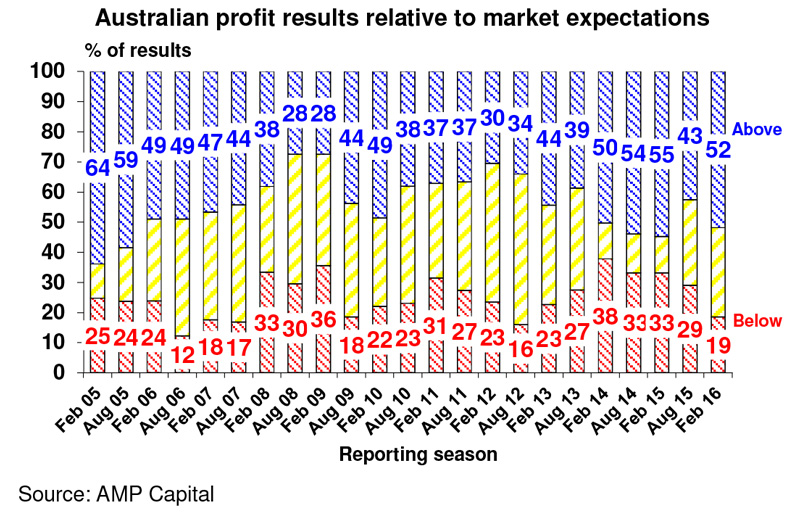
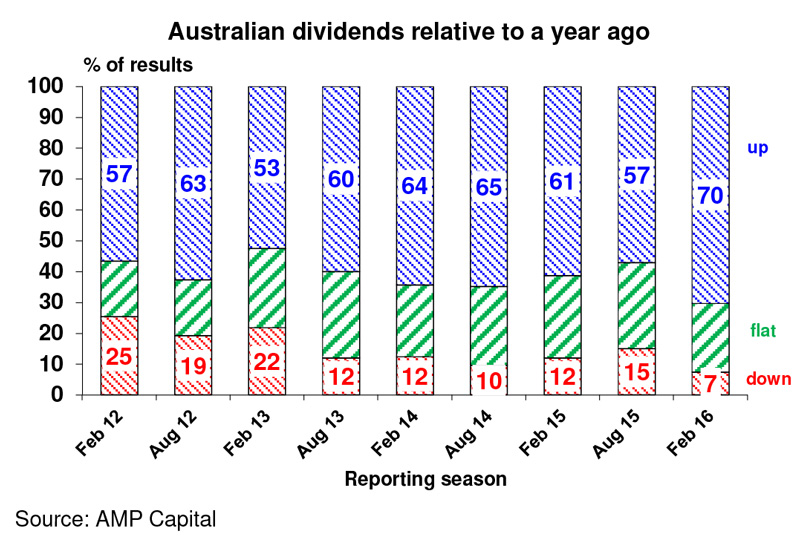
Its early days in the December half profit reporting season for Australia with only 17% of major companies having reported but so far so good with 52% of results coming in better than expected, 63% seeing profits up on a year ago and 70% raising their dividends relative to a year ago. It’s about horrible as expected for resources stocks with RIO’s profits down sharply and it warned that its dividend will be cut as has long seemed inevitable, but conditions seem okay for the much of the rest of the market. Of course the good results have a habit of coming out early in the reporting season.
What to watch over the next week?
In the US, the minutes from the Fed’s last meeting (Wednesday) are likely reiterate its dovish tilt, but they are rather dated given recent market movements and comments by Janet Yellen and other Fed officials. On the data front, expect the NAHB home builders conditions index (Tuesday) to remain solid at around 60, housing starts (Wednesday) to bounce back after a fall in December, industrial production to gain about 0.3% month on month, headline inflation (Friday) to fall 0.1% mom but core inflation remaining around 2.1% year on year.
Japanese GDP data for the December quarter is likely to show a 0.2% quarter on quarter contraction driven by consumer spending and business investment.
In China, expect import growth to improve but export growth (Monday) to soften a bit after the upside surprise seen in December. CPI inflation (Thursday) is expected to rise to 1.9% reflecting higher food prices on the back of bad weather.
In Australia, the minutes from the last RBA Board meeting (Tuesday) will be watched for more clues as to how concerned the RBA is about the turmoil being seen in financial markets as a guide to how strong it’s easing bias is. It is likely to continue to reiterate a reasonable degree of confidence about Australian conditions though. Meanwhile, the jobs data on Thursday will be looked at to see whether recent unbelievable strength has continued into January. Given that the recent samples rotating into the jobs survey have had higher levels of employment than those moving out the odds are that it has. So we expect a 10,000 gain in jobs and unemployment to remain at 5.8%.
The Australian December half profit reporting season will hit the big time in the week ahead with 77 major companies reporting including CSL, Woodside, Lend Lease, AMP, GPT and Telstra Key themes are likely to be: ongoing horrific conditions for resources companies (where 2015-16 earnings are expected to fall another 61%); continued modest profit growth for the rest of the market (of around 5%) led by healthcare, building materials, general industrials and discretionary retail; help from the lower $A; and an ongoing focus on cost control.
Outlook for markets
Shares are getting oversold again and due for at least a bounce, but with global growth worries remaining it’s still premature to say that shares have bottomed. Beyond the near term uncertainties, we still see shares trending higher this year helped by a combination of relatively attractive valuations compared to bonds, further global monetary easing and continuing moderate economic growth. But expect volatility to remain high.
Very low bond yields point to a soft medium term return potential from sovereign bonds, but it’s hard to get bearish in a world of fragile growth, spare capacity, weak commodity prices and low inflation.
Commercial property and infrastructure are likely to continue benefitting from the ongoing search by investors for yield. The further decline in bond yields will only add to this.
National capital city residential property price gains are expected to slow to around 3% this year, as the heat comes out of Sydney and Melbourne. Prices are likely to continue to fall in Perth and Darwin, but growth is likely to pick up in Brisbane.
Cash and bank deposits are likely to continue to provide poor returns, with term deposit rates running around 2.5% and the RBA expected to cut the cash rate to 1.75%.
New found dovishness from the Fed poses a short term upside risk for the $A to $US0.73-74. However, the broad trend is likely to remain down as the interest rate differential in favour of Australia narrows, commodity prices remain weak and the $A undertakes it’s usual undershoot of fair value. Expect a fall to around $US0.60 by year end.
By Shane Oliver, AMP Capital
——


