
How Pokemon Go is reflecting investment behaviour

While Pokemon Go is in its infancy similar investment behaviour has been taking place in Australian equities over the past year.
It’s been hard to miss the phenomenal popularity of Pokemon Go. Even in the office we’ve managed to capture a plague of Zubats that until recently we didn’t even know existed.
Players of the app are taking to the streets in their droves in the pursuit of Pokemon which they can then train and ultimately battle for Master Trainer glory. Indeed large gatherings have been reported where lures have been placed to attract Pokemon and where battles take place at so-called gyms.
Why am I saying all this? Well in behavioural terms you’d describe this as herding. And while Pokemon Go is in its infancy we’ve seen similar investment behaviour taking place in Australian equities over the past year. Fueled by low interest rates, many investors are being lured into sectors where they believe they can get both income and some downside protection in falling markets.
Over the past year the strategy has actually worked very well, while the ASX200 turned in a meagre 0.56% return, the spread between the best and worst performing sectors were at levels rarely seen in the market.
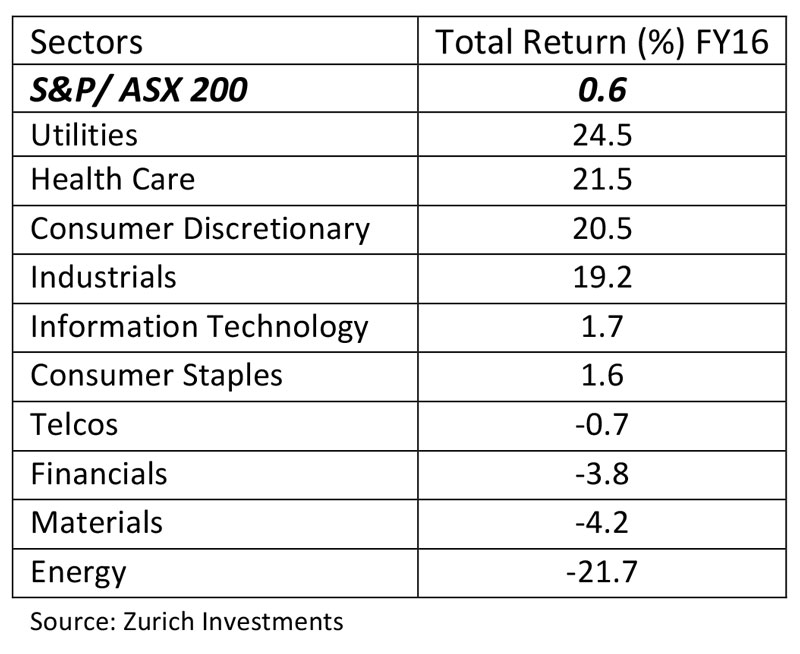
Given increasing valuations (multiple expansions) have played a large part in this outperformance there is growing debate about the merit of “equities as bonds” and what looks like a crowded trade.
Here’s some high level observations of the Australian equity market;
- The dispersion of return has been pronounced. Goldman Sachs recently noted that “Despite the ASX 200 total return being flat over FY16, there was a 60% spread between the three best and three worst sectors (just below the peak level of dispersion during 2008).”
- In a weak environment, the performance of the fifty leaders lagged, with the major banks, the miners and Woolworths impacting returns. On the other hand, Industrials (ex-financials) performed well, aided by falling interest rates and a lower Australian dollar.
- Simply put, if you’re domestic share portfolio was dominated by a portfolio of blue chip leaders, it more than likely underperformed.
- The performance of banks, traditionally considered a “yield” sector, decoupled during the year as the sector was hit by capital and regulatory concerns. On a relative basis, the majors are now trading at a significant discount to the ASX 200 industrials.
- Conversely, “defensive growth” stocks have aggressively re-rated, leaving that segment of the market looking expensive versus history.
Having different Pokemon at your disposal is a good thing because you need to counter the different strengths and weaknesses of your opponent during battle. For portfolios this is very much along the lines of diversification. The aggressive re-rating of “defensive growth” stocks has left that segment of the market looking expensive versus history. While the strategy has worked with great success in recent times there are other avenues for investors pursuing regular income and some downside protection in their equity portfolio.
A well diversified portfolio remains a good starting point to mitigate risk, but for those who remain cautious on equity markets, a portfolio that actively uses options strategies to generate income and provide some downside protection is another way of gaining exposure to shares without riding the highs and lows of market sentiment.
The Zurich Investments Equity Income Fund, managed by Denning Pryce, invests in a portfolio of the top fifty leaders. The strategy utilises exchange traded options to generate attractive levels of income at lower levels of volatility than the overall market.
Low interest rates and a more expensive market is creating a testing backdrop. Employing a range of strategies can help investors in their battle against low growth and high volatility.
————


