
Fed speakers are optimistic ahead of the FOMC meeting, says Principal Global Investors
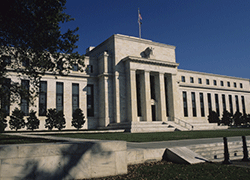
Federal Reserve building, Washington DC.
Fed funds rate
“The Federal Open Market Committee (FOMC) meets March 20 to March 21. The market expects the Federal Reserve (Fed) to raise the fed funds rate once to 1.625%, or an upper band of 1.75% and lower band of 1.50%. We see no reason to disagree.
What’s in a dot?
“The market is focused on the so-called dot plots, or FOMC member’s views on the path of the federal funds rate. As of December, the median FOMC member expected three rate hikes this year, with a fed funds rate up to 2.125%. In the long run, the median dot suggested a fed funds rate of 2.75%. For 2018, the bar for moving up the median dot is high. Four FOMC members would have to change their views. But for next year, only one member would have to upgrade their forecast. In the longer term, two members would have to shift their views to raise the median dot.”
Fed speakers are optimistic
“Chair Jerome Powell upgraded his view on the U.S. economy. Dove Lael Brainard moved from stating that the Fed should prepare to pause rate hikes, to emphasising that the pace of rate hikes should be gradual. Raphael Bostic moved from calling for two rate hikes this year to three.”
Constraints to the Fed
“The unemployment rate has not budged over the last five months. Wage growth, while generally trending up, is still soft. Inflation is also moving up, but the February Consumer Price Index (CPI) report suggests that the trend up remains gradual. The month-over-month paces of CPI and core CPI inflation decelerated. In addition, if the Fed wants a symmetric inflation target around 2%, they will want the pace of rate hikes slow, even as inflation moves above 2%.”
Market volatility worries
“While many Fed speakers emphasised that the early February rout was not concerning, the Fed is going to be careful not to tighten financial conditions too much. In the longer run, the Fed is also likely focused on the yield curve. An inverted yield curve, or when longer-dated bonds have interest rates below shorter-dated bonds, is a risk if the fed funds rate moves much above 3%. An inverted yield curve is a key recession sign.”
Our thoughts
“In general, we feel like the FOMC will still call for three rates hikes this year, although risk is to the upside. The FOMC likely does not want to move too quickly to upgrade its views and then be forced to back track.”
Market implications
“For 2018, the market has already priced in three rate hikes, and some investment firms are calling for four. So, a move up to four rate hikes may not cause too much market reaction. On the other hand, investors have priced in fewer rate hikes in later years, so markets may react more to shifts up in 2019 and beyond. If the Fed tightens too quickly that would be negative for markets and for the U.S. economy.”


