
Wesfarmers (ASX: WES) surprised the market in March 2018 by announcing its intention to demerge the Coles supermarket business from its portfolio.
This reverses the original decision made in July 2007 to acquire Coles for $22 billion in what was then the largest takeover in Australia. For many years, WES was a shining example of a successful and large-scale conglomerate model. With the demerger of Coles, Lonsec questions whether the market is calling time on such structures.
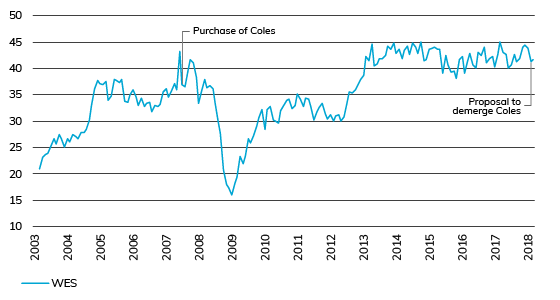
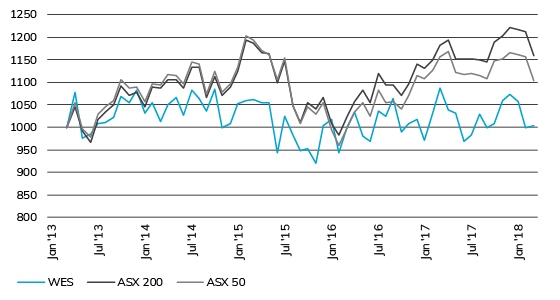
Lonsec notes that WES’s original ‘profit improvement plan’ in 2007 has largely worked, with the resulting 9.5% EBIT CAGR for Coles since 2009 having extracted maximum valuation upside for WES and allowing it now to cash in on its original investment. But if WES’s intention was always to sell, it begs the question why it was willing to pay a substantial premium (10%) over Coles’ prevailing share price at the time. As the chart below shows, WES has underperformed both the S&P/ASX 200 Index as well as the S&P/ASX 50 Index, with Coles proving to be a drag on overall growth.
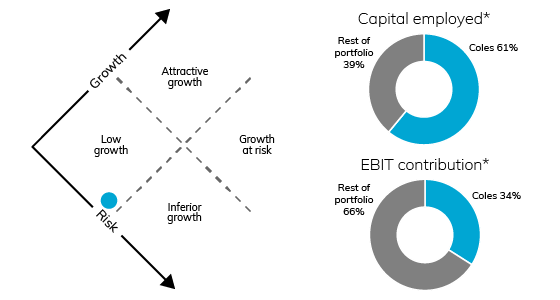
For a rationally managed conglomerate, the marginal capital dollar should be allocated to the highest returning assets. In the case of WES, this would mean allocating capital to Bunnings locally or Kmart. Instead, capital was disproportionately allocated to the capital hungry Coles, more to defend its market position than to fund organic growth. This misallocation meant that the market justifiably had an issue with applying a ‘sum-of-the-parts’ valuation, in effect trapping shareholder value in the conglomerate structure. This is partly the reason why Lonsec’s growth outlook for WES has been low (see chart below).
Demergers have been in vogue on the ASX of late, with other contemporary examples including Fairfax’s demerger of Domain and the demerger of the old BHP Billiton into separate vehicles holding the BHP and Billiton (or S32) assets. Lonsec believes that a demerger trend could be beneficicial for shareholders in cases where the conglomerate model is failing to provide a balanced and diversified portfolio.


