

The path to retirement income confidence can be uneven. Layering income sources can help retirees manage risk and secure greater financial certainty.
The often-quoted retirement income guideline known as the 4% rule has achieved something close to mythical status in retirement planning. Developed by US financial adviser Bill Bengen, it was designed to answer a deceptively simple question: how much can retirees withdraw from their savings without running out of money?[1]
While the rule remains influential, retirement in Australia has evolved far beyond a simple withdrawal-rate calculation. Minimum drawdown rates for account-based pensions already begin at 4% and rise with age.[2]
More importantly, the challenge facing retirees today is not simply avoiding ruin. It is finding the confidence to spend.
Research and industry experience suggest many retirees are far more cautious than their financial circumstances require. Longevity, market volatility, inflation, healthcare costs and aged care expenses are just some of the concerns that encourage a mindset of preservation.[3]
The result is often accidental austerity. Retirees delay travel, reduce discretionary spending and sometimes compromise lifestyle even when they possess substantial retirement savings.
This matters because Australia is entering a new retirement era. Around 3 million Australians are forecast to retire over the next decade with more than a $1 trillion dollars in accumulated superannuation savings.[4] An industry that’s been highly effective at helping people build wealth now must help them use it.
Confidence is often the missing ingredient.
The confidence challenge
Retirees face a unique problem. During their working lives they are rewarded for saving. In retirement they are required to do the opposite. They must convert capital into income and spend the money they spent decades accumulating.
That transition is harder than many expect.
The Retirement Income Covenant has shifted industry attention toward sustainable retirement income rather than accumulation alone. This change reflects a broader recognition that success should not be measured solely by account balances. Success should also be measured by how effectively those balances support a fulfilling retirement.
Many retirees continue to view their superannuation balance as something that must be protected. Every withdrawal feels like a reduction in wealth, a wider door to vulnerability, rather than a conversion of wealth into lifestyle. This perspective is understandable but can produce poor outcomes. One study found the median pensioner died with around 90% of the wealth they had at retirement.[5]
Leaving a legacy may be important. However, preserving assets unnecessarily can come at the expense of retirement experiences that cannot be recovered later.
Income rather than capital
One of the most valuable shifts advisers can make is to move the conversation away from capital and toward income.
We would argue that retirees generally do not think in terms of portfolio balances. They think about paying bills, funding travel, supporting family, and maintaining their desired lifestyle. Reliable income provides psychological comfort in a way that a fluctuating portfolio balance rarely can.
This is where the concept of an income floor becomes powerful. An income floor represents the level of income that retirees can rely upon regardless of market conditions. The higher and more secure that floor becomes, the more willing retirees may be to spend from the remainder of their assets.
Historically, retirees had two primary options. Account-based pensions offered flexibility and capital access. Lifetime annuities offered certainty but often required significant trade-offs. Innovative Retirement Income Streams, or IRIS products, have emerged to bridge this gap.[6]
They are not traditional annuities. Nor are they simply account-based pensions. Instead, they combine investment exposure, longevity pooling and lifetime income features in ways that aim to improve retirement outcomes.[7]
The rise of income layering
The most useful way to think about retirement income may not be through individual products but through income layering.
Income layering recognises that different retirement objectives require different income sources. Essential spending, discretionary spending, contingencies and legacy objectives each have unique characteristics. Attempting to satisfy every objective with a single product can create unnecessary compromises.
A layered framework might include a secure income layer for essential spending, a flexible layer for discretionary expenses, a contingency layer for unexpected costs and a legacy layer designed to preserve wealth for beneficiaries.
This approach aligns naturally with how retirees actually spend. Essential costs such as food, utilities and housing are relatively stable. Travel and leisure spending can vary substantially. Healthcare costs are uncertain. Estate planning objectives differ widely between households.
When advisers allocate income sources to specific purposes, retirement planning becomes more intuitive and, we’d suggest, often more effective too.
Why sequencing risk matters
One of the most impactful risks in retirement is sequencing risk, which occurs when poor investment returns arrive early in retirement while withdrawals are taking place. Even if long-term average returns ultimately prove satisfactory, early losses can permanently damage portfolio sustainability.
This was a central insight of Bengen’s original work.[9]A retiree who experiences a severe market downturn shortly after retirement may be forced to sell assets at depressed values to fund living expenses. Those assets are then unavailable to participate in future recoveries.
The consequences can be profound. Income layering offers a practical response. By combining a lifetime income component with an account-based pension, retirees can reduce the pressure on market-linked assets during periods of volatility. A greater proportion of income can come from stable sources while growth assets are given time to recover.
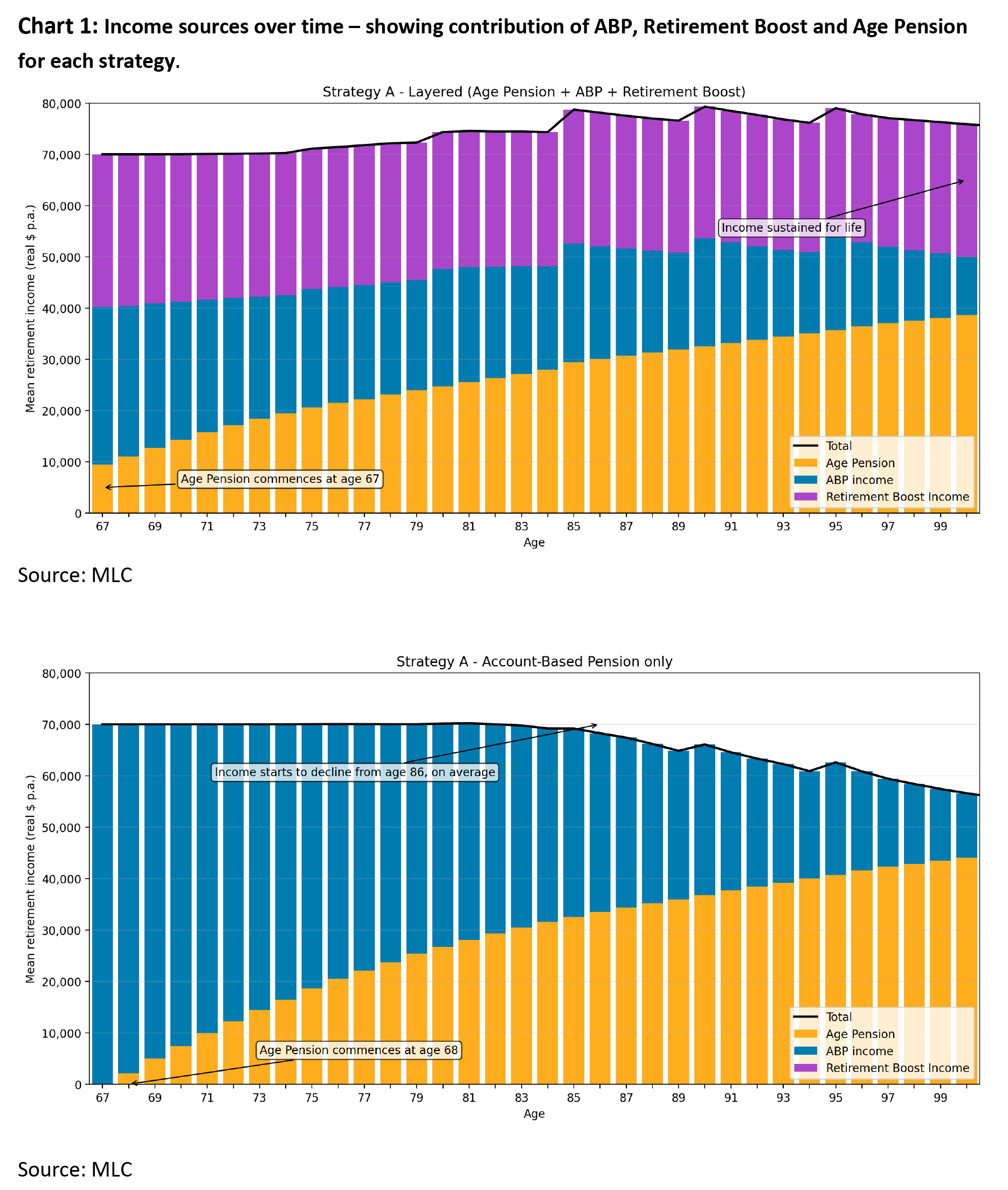
A case study illustrates the concept (Chart 1). Strategy A allocates all retirement assets to a balanced account-based pension. Strategy B allocates around half to an account-based pension and half to a lifetime income solution. Overall portfolio risk remains broadly similar, but risk is allocated differently across income sources.
Also important to note is that if a member dies well before their life expectancy, any leftover funds available for beneficiaries or the estate is reduced.
Improved income stability
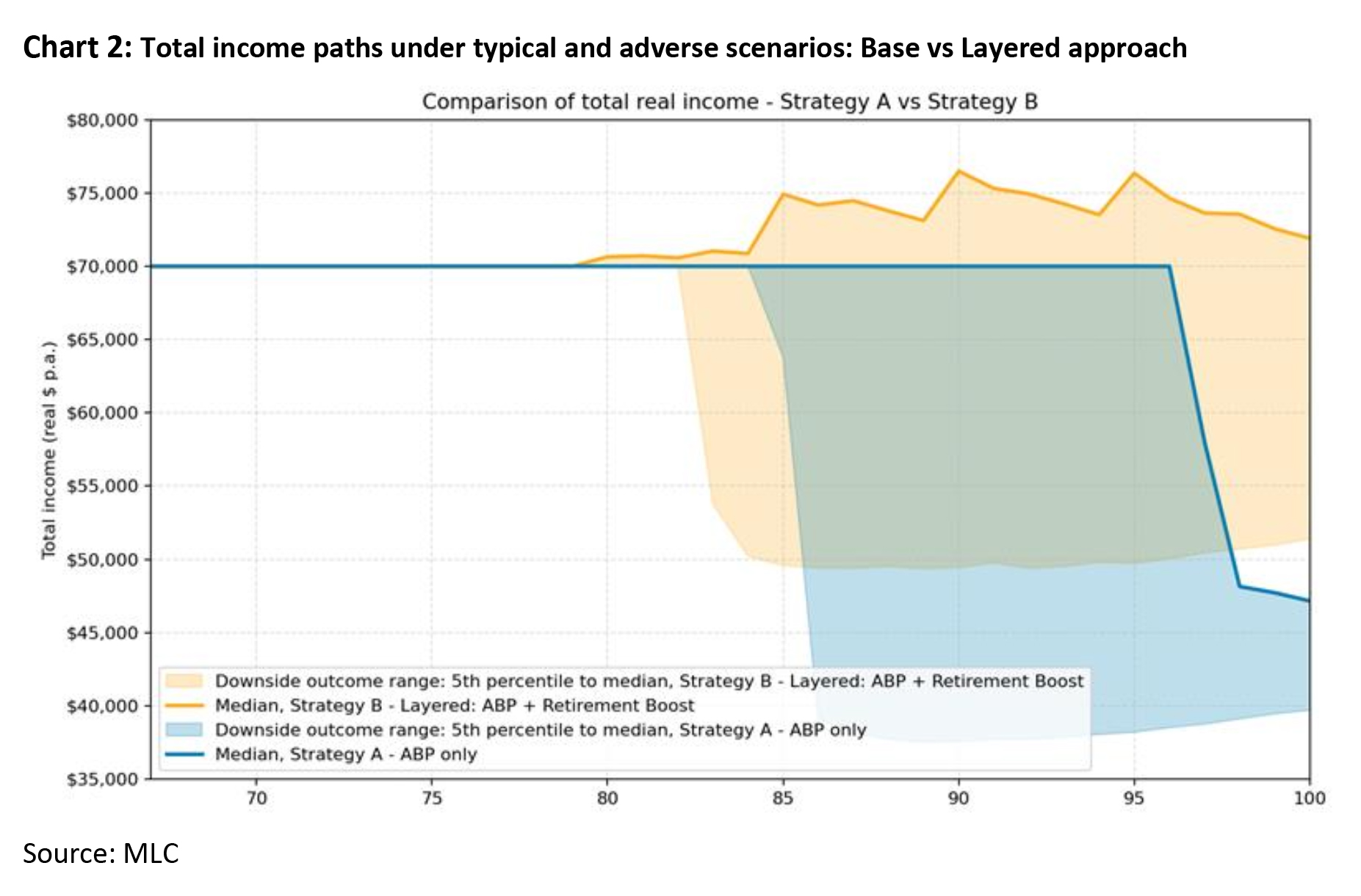
The layered strategy produces a more stable income profile (Chart 2) in the early years of retirement. While total income levels remain comparable, the variability of income is reduced, particularly in adverse scenarios.
This can have a meaningful impact on client behaviour, reducing the likelihood of reactive decisions such as cutting spending excessively or switching strategies following market downturns.
Behaviour matters. Retirement outcomes are influenced not only by mathematics but also by psychology. Retirees frequently make decisions based on how secure they feel. A strategy that delivers confidence can sometimes be more effective than one that merely produces a higher projected return.
This helps explain why lifetime income solutions continue to attract attention from policymakers and advisers. Research indicates that around 76% of retirees would feel happier if they had access to income for life.[9] Confidence influences spending behaviour. When retirees know a portion of their income will continue regardless of market conditions or lifespan, they often become more comfortable spending their savings.
Managing risk differently
One of the most interesting findings from retirement income research is that improved outcomes do not always require higher returns. Sometimes they require different risk allocation. Traditional retirement portfolios focus heavily on asset allocation. Advisers determine an appropriate mix of growth and defensive assets and then seek to manage risk within that framework.
Income layering introduces a second dimension. Risk can be allocated across income sources rather than solely across asset classes.
The account-based pension can continue to serve as the primary growth engine. Exposure to equities and other growth assets remains essential because a significant portion of retirement income is generated by investment earnings achieved during retirement itself.
Meanwhile, the lifetime income component can focus on managing longevity and sequencing risks. The result is a portfolio structure that seeks to place each risk where it can be managed most effectively.
Age Pension as part of the solution
Another important aspect of income layering is the deliberate use of Age Pension entitlements. For many retirees, the Age Pension is viewed as a secondary consideration. In reality, it is one of the most significant sources of retirement income in Australia.
Certain lifetime income products receive concessional treatment under Age Pension means testing rules.[10] This can improve eligibility relative to holding all retirement assets inside an account-based pension.[11] The implications extend beyond social security.
Earlier or enhanced access to the Age Pension can reduce pressure on private savings, improve sustainability and increase total retirement income. More capital remains invested and retirees may feel more comfortable maintaining growth exposure within their portfolios.
The retirement income case study cited earlier demonstrates that incorporating a lifetime income solution can bring forward Age Pension eligibility and reduce reliance on private drawdowns during critical years of retirement.
For advisers, we think this represents a powerful planning opportunity.
Balancing certainty and flexibility
Whenever lifetime income products are discussed, one concern inevitably arises. What about access to capital? It is a valid question.
Account-based pensions provide great flexibility. Retirees can adjust income, withdraw lump sums and retain control over their assets. Lifetime income solutions typically involve some reduction in flexibility. This trade-off is one reason they can deliver income for life. The objective is not to choose one approach over the other. The objective is to combine them intelligently.
A well-constructed retirement strategy can use account-based pensions to provide liquidity and flexibility while relying on lifetime income solutions to deliver certainty and longevity protection.
In practice, many advisers find it useful to separate lifestyle capital from legacy capital.
Lifestyle capital exists to support the retiree’s own wellbeing and experiences. Legacy capital exists to support beneficiaries or charitable causes.
This distinction often changes behaviour. Clients may become more comfortable spending money intended for retirement when they can clearly identify the assets reserved for inheritance.
Helping retirees spend at the right time
Perhaps the most overlooked aspect of retirement income planning is timing.
Retirement spending is rarely constant. The early years are often the most active. Retirees travel, pursue hobbies, spend time with family and enjoy the freedom that retirement provides.
Ironically, these are also the years when many retirees spend most cautiously.
A secure income floor can help address this mismatch. When retirees know that a portion of their income is protected for life, they may be more willing to enjoy their savings while they are healthiest and most capable of doing so.
This is not an argument for excessive spending. It is an argument for appropriate spending.
The goal is not simply to avoid running out of money. It is to ensure that money supports a meaningful retirement.
The adviser opportunity
For advisers, the emergence of IRIS products and income layering frameworks represents an opportunity to rethink retirement advice. The conversation can move beyond withdrawal rates and portfolio balances.
Instead, advisers can focus on income design, risk management, behavioural outcomes, and lifestyle objectives.
The case study supporting this article shows that relatively small implementation changes can produce meaningful improvements in income stability, sustainability and confidence.
Importantly, these improvements are achieved without requiring a wholesale change in investment philosophy.
Retirement income advice is evolving from portfolio construction to income construction. That evolution is likely to define the next decade of retirement planning.
Raising the bar
The question facing retirees is not simply whether they have enough money. For many Australians, the more important question is whether they feel confident enough to use it.
Income layering offers a practical framework for addressing that challenge. By combining account-based pensions, lifetime income solutions and Age Pension entitlements, advisers can help clients manage sequencing risk, longevity risk, and behavioural risk simultaneously.
Most importantly, they can help clients enjoy the retirement they have spent decades preparing for. Retirement is not about preserving wealth for its own sake. It is about converting wealth into income, confidence and quality of life.
That is the real opportunity presented by income layering. It is also why raising the bar for retirement spending may become one of the most important challenges and opportunities facing advisers in the years ahead.
By Ashton Jones, Director, Customer Innovation
Take the FAAA accredited quiz to earn 0.5 CPD hour:
CPD Quiz
The following CPD quiz is accredited by the FAAA at 0.5 hour.
Legislated CPD Area: Technical Competence (0.5 hrs)
ASIC Knowledge Requirements: Retirement (0.5 hrs)
please log in to start this quiz
———–
References:
[1] https://www.morningstar.com.au/retirement/the-4-rule-explained
[2] https://www.mlc.com.au/personal/retirement/super-and-retirement-rules/pension-drawdown-requirements
[3] https://www.morningstar.com.au/personal-finance/aussie-retirees-are-more-frugal-than-they-need-to-be-what-can-be-done
[4] https://www.firstlinks.com.au/the-trillion-dollar-sea-change-facing-australian-investors
[5] Super is not only for retirement
[6] Retirement Income Streams: Navigating Your Options with Confidence – Bridges
[7] https://theconexusinstitute.org.au/wp-content/uploads/2026/02/Benefits-of-investment-linked-LIS-Non-technical-overview-FINAL-updated-20260213.pdf
[8] https://www.morningstar.com.au/retirement/the-4-rule-explained
[9] Challenger Retirement Happiness Index
[10] 4.9.3.35 Means test assessment of asset-tested income streams (lifetime) | Social Security Guide
[11] Ibid.
Important information This article has been prepared by IOOF Investment Management Limited (IIML) ABN 53 006695 021, AFSL 230524, RSE License No. L0000406 as Trustee of the IOOF Portfolio Service Superannuation Fund ABN 70 815 369 818. IIML is part of the Insignia Financial Group of companies, consisting of Insignia Financial Ltd ABN 49 100 103 722 and its related bodies corporate. The information in this document is factual information or general advice only and does not consider any individual needs or objectives. Any calculations are for illustrative purposes only. The information in this document has been given in good faith and has been prepared based on information believed to be accurate and reliable at the time of publication. Before making any decisions, advisers and their clients should consider the relevant Product Disclosure Statement, which together with the Target Market Determination is available to view and download at myexpand.com.au.
CPD Quiz
The following CPD quiz is accredited by the FAAA at 0.5 hour.
Legislated CPD Area: Technical Competence (0.5 hrs)
ASIC Knowledge Requirements: Retirement (0.5 hrs)
please log in to start this quiz
———–
References:
[1] https://www.morningstar.com.au/retirement/the-4-rule-explained
[2] https://www.mlc.com.au/personal/retirement/super-and-retirement-rules/pension-drawdown-requirements
[3] https://www.morningstar.com.au/personal-finance/aussie-retirees-are-more-frugal-than-they-need-to-be-what-can-be-done
[4] https://www.firstlinks.com.au/the-trillion-dollar-sea-change-facing-australian-investors
[5] Super is not only for retirement
[6] Retirement Income Streams: Navigating Your Options with Confidence – Bridges
[7] https://theconexusinstitute.org.au/wp-content/uploads/2026/02/Benefits-of-investment-linked-LIS-Non-technical-overview-FINAL-updated-20260213.pdf
[8] https://www.morningstar.com.au/retirement/the-4-rule-explained
[9] Challenger Retirement Happiness Index
[10] 4.9.3.35 Means test assessment of asset-tested income streams (lifetime) | Social Security Guide
[11] Ibid.
Important information This article has been prepared by IOOF Investment Management Limited (IIML) ABN 53 006695 021, AFSL 230524, RSE License No. L0000406 as Trustee of the IOOF Portfolio Service Superannuation Fund ABN 70 815 369 818. IIML is part of the Insignia Financial Group of companies, consisting of Insignia Financial Ltd ABN 49 100 103 722 and its related bodies corporate. The information in this document is factual information or general advice only and does not consider any individual needs or objectives. Any calculations are for illustrative purposes only. The information in this document has been given in good faith and has been prepared based on information believed to be accurate and reliable at the time of publication. Before making any decisions, advisers and their clients should consider the relevant Product Disclosure Statement, which together with the Target Market Determination is available to view and download at myexpand.com.au.


Have feedback on this article? Contact Us
Earn CPD Points
 CPD: Currency risk – friend or foe?
In today’s interconnected world, global companies play a significant role in our daily lives. However, when Australian investors allocate their capital to global markets, they are exposed not only to [...]
 CPD: Ethics and moral dilemmas
When it comes to financial advice, the numbers may be black and white, but the ethical decisions often aren’t. This article, proudly sponsored by GSFM, examines moral dilemmas and the [...]
 CPD: Jump in my CAR. Client Advice Records – why, what, how
Introduction The forthcoming replacement of Statements of Advice (SOAs) with Client Advice Records (CARs) has once again shone a spotlight on the vexed issue of client communication within financial advice. [...]
 CPD: Investor Behaviour – Retirement
To best understand how and why clients make financial decisions – particularly during retirement – advisers must look beyond technical strategies and consider investor behaviour. Before addressing product selection or [...]
 CPD: A star is (re)born – Investment Bonds are the new headline act of tax-smart investing
Introduction Tax-smart investing is one of the central pillars of quality, effective, financial advice. The capacity for tax to drag on investment returns, stifle compounding, and eat away at gains [...]