

The US-China trade war could further slow China’s economic expansion.
The continuing trade war between the United States and China has heated up amid increasingly bombastic accusations from both sides.
The US fired the first salvo, announcing a set of tariffs on $50 billion worth of Chinese goods, which was met by a similar set of tariffs by China on American imports. The US is now said to be considering another $200 billion in tariffs and perhaps a further $200 billion after that. Receiving less media coverage, but as impactful, are proposed US tariffs on European Union goods (cars and car parts, for example) as well as the potential lapsing of NAFTA, which could reinstate tariffs between the US, Mexico, and Canada.
In reaction, many investors are asking: What does this trade war mean for emerging-market equities?
Tim Atwill, Head of Investment Strategy at Parametric says “Our first response will seem familiar—equity markets are unpredictable, and doubly so when dealing with US-China relations.
“If this escalation continues, we believe this conflict has serious ramifications for China, moderate implications for the US, and varying consequences for other emerging-market countries. The unknowable nature of the ultimate impact of this trade war at the country level should make investors revaluate the degree of country concentration in their emerging-market exposure to ensure their convictions are matched by their portfolio positioning. A portfolio overly reliant on one country’s returns exposes an investor to significant peril in the current market environment.
“To explain these three scenarios, lets dig deeper into the issue. It becomes evident that a real trade war could cause three things to tip in sequence,” Mr Atwill notes.
First domino to fall: China
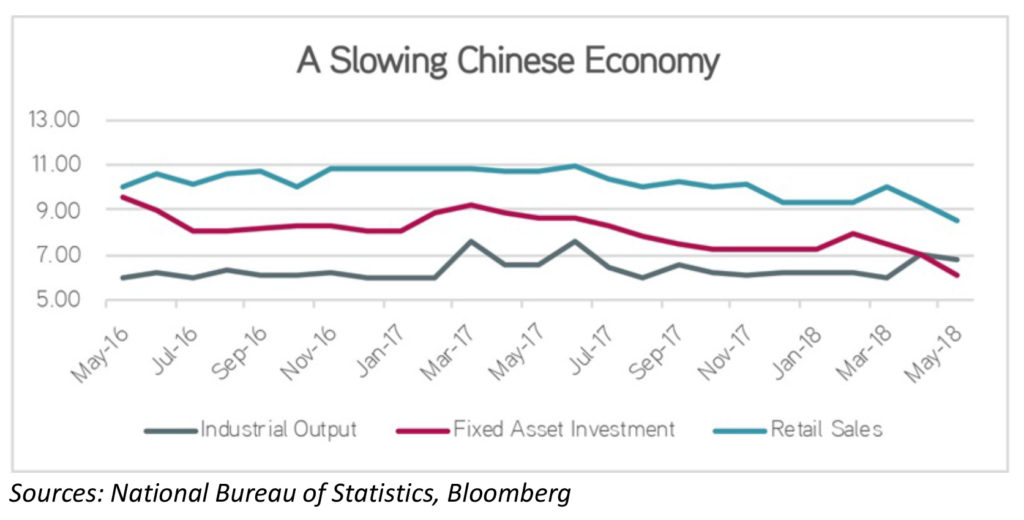
The US-China trade war could further slow China’s economic expansion, which was already showing signs of fatigue thanks to the central government’s attempt to deleverage the country’s precarious financial system. That is, China is starting from a weakened state even before the tariffs come into play, as you can see in the below chart:
The Chinese government has other tools to respond to the tariffs, but each has negative side effects to consider. For example, Chinese authorities could open the nation’s monetary spigots to provide a temporary growth spurt to counteract the impact of the US tariffs. However, this would further amplify the perils of their overleveraged financial system. Authorities could also choose to devalue the yuan versus the dollar. This would help China’s exporters, thus providing economic stimulus, but historically a devaluation has resulted in capital flight by mainland investors, undercutting economic stability on many fronts. All in all, if this trade war continues to escalate, it could make a mildly bad situation for Chinese equities much worse.
Second domino to drop: the United States
The erection of US trade barriers upsets the global supply chains companies have developed over the past two decades. The result? Manufactured goods would become more expensive. In terms of economic growth, then, tariffs would be similar to the impact of a tax increase on consumer-spending habits.
Given the rather abundant fiscal stimulus measures currently in place, this would essentially take a “very strong” growth story in the US to a simply “good” growth story. To the extent the stimulus is priced into stock prices, though, we would expect a falloff in US equities. Combined, the price increases from tariffs and the wealth impact from a fall in US stock prices could negatively impact US consumer-purchasing patterns.
Third domino to tumble: other emerging-market countries
Given the reliance on the US consumer by many emerging-market economies, developing countries would need to reckon with reduced US consumption as well as any tariffs that directly impact their exports. These impacts are tough to puzzle out due to the interaction between the various countries’ trade flows and the myriad tariff programs put into place. However, they would undoubtedly require a reconsideration across emerging-market equities, with different markets reacting to reflect each country’s unique trade situation. These country-level returns are all but impossible to predict, which makes diversification the only prudent course of action.


