
Client complaints – new adviser obligations strengthen consumer protections

Advisers need to understand the nature of their new IDR obligations and the background to their introduction.
Background to the new obligations
It is difficult to overstate the extent to which transparent, accessible, and trusted complaints handling processes are a cornerstone of financial consumer protection.
At the micro level, formal dispute resolution procedures afford clients a degree of protection from poor product and service experiences, while at a macro level, the existence of these mechanisms helps improve overall confidence in financial offerings – including financial advice, itself an important protection from poor consumer decision making.
The collecting and reporting of complaints data also helps authorities target problematic areas, with either enforcement or policy interventions.
Recognising this importance, the handling of complaints, and resolving of disputes between clients and financial firms has been a big focus for governments, regulators, and consumer advocates.
The intensity of this focus ramped up significantly in the aftermath of the 2017 Ramsay Report, and 2018 ASIC Report 603, and has most recently culminated in the release of new mandatory complaints reporting requirements that will come into effect from 2023.
From an adviser perspective, there is now a comprehensive set of guidelines to be adhered to, applying to every aspect of client dispute resolution, and including, but not limited to:
- an expanded definition of what constitutes a complaint
- mandated response times
- staff training
- the content of complaints related correspondence
- the content and accessibility of complaints processes
- complaints reporting, including data fields, formats, and definitions, and reporting frequency.
Of course, effective complaints handling is not just about compliance. As many a customer service expert delights in reminding us, complaints are ‘gold’, because they help alert us to improvement opportunities, and because – if handled well – they can actually increase client satisfaction and loyalty.
In this article, we will help advisers understand the nature of their new Internal Dispute Resolution (IDR) obligations, the background to their introduction, and the current dispute resolution context, including the operations of AFCA. Best practice complaints handling tips are also provided, designed to help advisers turn a negative experience into one that is positive for everyone involved.
As a sector we haven’t always handled complaints well
In mid – 2017, Professor Ian Ramsay issued the final report of his review into external dispute resolution channels in the financial sector[1]. Amongst the 11 recommendations included in that report was the establishment of a single external dispute resolution body (AFCA) for financial and superannuation disputes. Such a body would replace the previously fragmented approach which had seen bodies like Financial Ombudsman Service (FOS), the Superannuation Complaints Tribunal (SCT), and the Credit and Investments Ombudsman (CIO) coexist while each applying their own – different – processes, limits, and accessibility guidelines.
Subsequent to this report, ASIC conducted an investigation into how financial firms themselves handled complaints (internal dispute resolution, or IDR), the results of which were contained in their December 2018 Report 603 ‘The consumer journey through the Internal Dispute Resolution process of financial service firms’.[2]
The Report was a wakeup call, identifying numerous ways consumers were being failed by the sector:
- half of all clients whose complaints were not resolved in their favour did not receive any explanation
- four in five people whose complaints took more than 45 days to conclude were not told about external dispute resolution schemes
- one in three people spoke to too many contacts over the course of the complaint
- one in seven people withdrew from the complaint process due to an inadequate response from the financial firm.
Unsurprisingly, this impacted client perceptions of the firm they had complained about, with 80% forming a negative impression of that firm because of the way their complaint was handled.
Fast forward to July 2020, and ASIC announced[3] its updated requirements for financial firms, via Regulatory Guide (RG) 271. These updated requirements, which came into effect in October 2021, replace those previously applying under RG 165. ASIC supplemented RG 271 with its IDR data reporting handbook[4], released in March 2022.
What has changed?
The updated guidelines introduced changes across many aspects of IDR processes, from definitions, to timeframes, to communication requirements.
They also work in tandem with the Design and Distribution Obligations, under which distributors were required to start recording complaints data (and where appropriate, report that data to the relevant product issuer).
Public complaints policy
Firms (including advice practices) must have a publicly available complaints policy, covering:
- channels through which complaints can be lodged (phone, email etc)
- options available to those who need additional assistance lodging their complaint
- steps for dealing with complaints
- response timeframes
- information on how to access AFCA services if a complaint remains unresolved.
A broader definition of a complaint now includes social media posts
The definition of a complaint was broadened, to now include:
“Any expression of dissatisfaction made to or about an organization, related to its products, services, staff or the handling of a complaint, where a response or resolution is explicitly or implicitly expected or legally required”.[5]
Importantly, social media posts can now constitute formal complaints, and must now be dealt with in the same way ad complaints registered through more traditional channels.
Under the broader definition, clients can use a firm’s IDR process to complain about its IDR process, its outcomes, and its remediation program.
Complaints must be acknowledged within 24 hours
Financial firms must acknowledge a complaint within 24 hours, or one day of receiving it, or as soon as practicable. Firms must also take into account the method used by the client to lodge the complaint, and any expressed preferences about future communication with them (which could include email, post, or social media).
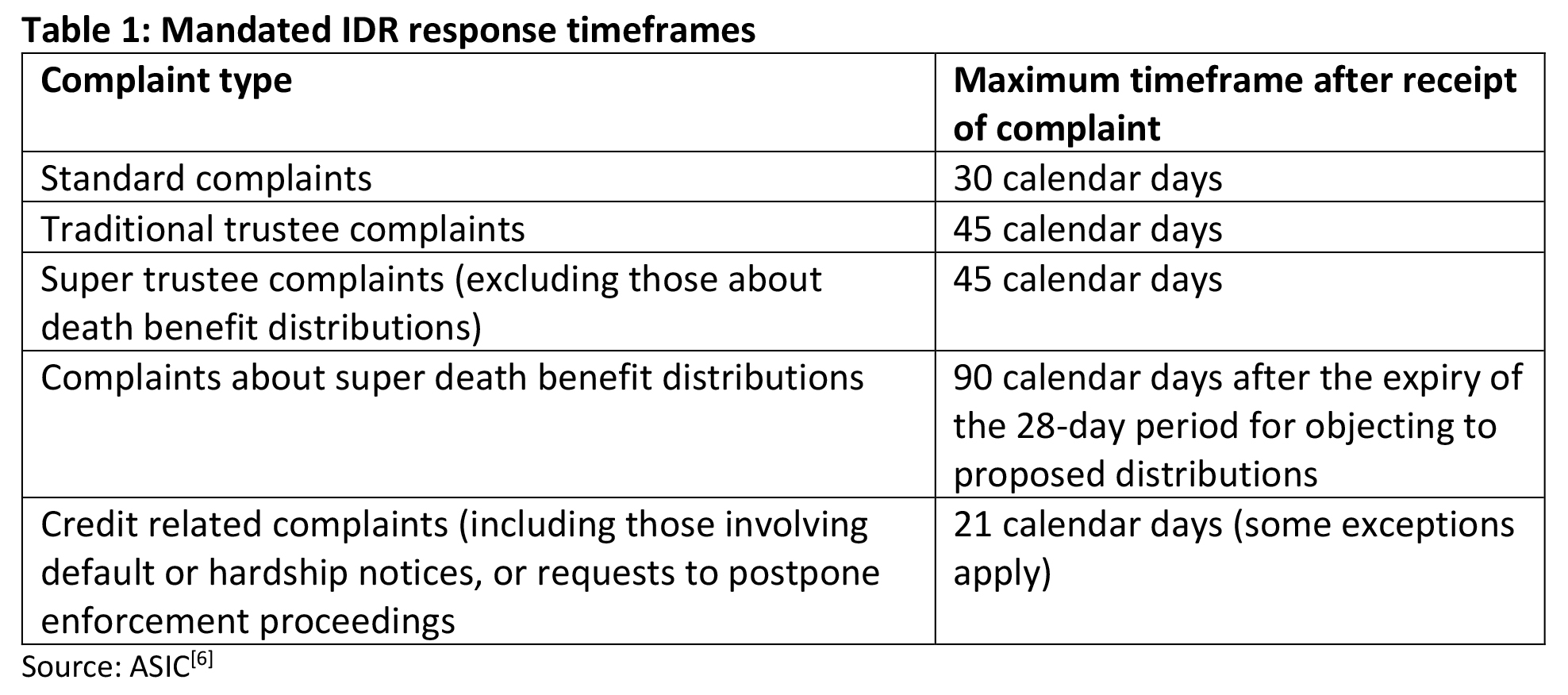
Tighter timeframes for providing IDR responses
Generally, a response must be provided to complainants within 30 days, however there are exceptions, as summarised in Table 1, below.
Information to be provided when rejecting part or all of a complaint
Financial firms rejecting, partially or wholly, a complaint, must clearly set out its reasons for doing so. This includes:
- identifying and addressing the issues raised in the complaint
- the findings on material questions of fact, and evidence supporting those findings
- providing enough detail for the complainant to understand the basis of the decision and to be fully informed should they decide to escalate the matter to AFCA.
Complaints resolved within 5 days
Subject to some exceptions (noted below), ASIC does not require formal IDR responses to be provided to complainants if that complaint is closed within 5 days, either because it has been resolved to the satisfaction of the complainant, or the firm has given an explanation and/or apology when it can take no further action to reasonably address the complaint.
Those exceptions include:
- when the complainant has specifically requested a written response
- when the complaint relates to hardship, declined insurance claims, or the value of an insurance claim, and
- complaints about trustee decisions.
More detailed staff training requirements
While staff training was referred to in RG 165[7], RG 271 provides far more detailed guidance around the nature of that training, requiring firms to provide targeted induction and ongoing training to all staff who handle complaints. The suggested training topics include:
- the firm’s IDR policy and processes, including roles, responsibilities, authority, and escalation points
- the requirements of RG 271
- financial services consumer protection laws, AFCA position statements and industry codes of practice
- identifying complainants who need additional assistance
- complaints data capture and reporting
- effective communication and negotiation
- identifying and escalating possible systemic issues.
New IDR reporting requirements
In March 2022, ASIC published its long-awaited guidance on the IDR reporting framework, including detailed data requirements.
Under this framework, licensed financial services entities will be required to lodge their IDR data with ASIC every six months, with – for the majority of licensees – the first report due by 31 August 2023, for the period 1 January to 30 June 2023 inclusive. Subsequent reporting will be due every January and July.
ASIC identified a group of 11 large licensees[8] – including the big 4 banks, AMP, Insignia, and a number of industry funds – who are required to start the new regime earlier. For these licensees, the first data lodgement deadline is 28 February 2023, for the period 1 July to 31 December 2022. lodge data by 28 February.
ASIC stipulates the type and format of data
In its IDR data reporting handbook[9], ASIC provides a detailed guide to the data financial firms must collect and report.
ASIC classifies the data to be reported into three categories – mandatory, conditional, and optional. The data elements and their categories are shown in Table 2, below.

The stipulated format for data includes that it be presented as:
- unit record data (one row of data for each complaint, each reporting period)
- includes the data elements shown in Table 2, and
- CSV (comma separated values).
ASIC applies a two-stage validation process
IDR data must be lodged with the ASIC Regulatory Portal, and will need to pass two stages of validation before it is accepted by the system:
- a basic validation of formatting, including file type and machine-readable headers, and
- deep validation to ensure each individual row of data meets the rules prescribed in the data dictionary included in the data reporting handbook.
Helpful resources for smaller practices
The new IDR recording and reporting requirements undoubtedly pose a resourcing challenge for many businesses, especially smaller advice practices. Recognising this, ASIC provides a number of helpful templates and examples, including an IDR Data Reporting Excel Template – which can help ensure the right data, in the right format, is collected – and Data Validation Rules Examples, which present practical examples of data that has either passed or failed ASIC’s data validation processes.
These resources can be downloaded from ASIC’s website[11].
ASIC encourages firms to conduct their own analysis of their complaints data
Complaints are not just issues to be solved, they are important signals about process failures within your business, potentially even systemic problems.
In that context, ASIC recommends firms conduct their own data analysis to monitor the performance of their IDR processes and identify opportunities for improvement.
RG 271 contains recommendations about the minimum data required to conduct such analysis. This includes (but is not limited to):
- number of complaints received, and closed, by type
- time taken to acknowledge and resolve complaints
- complaints outcomes, including those resolved, abandoned, unresolved
- value of any financial remedies paid, and
- complaints escalated to AFCA.
Digging deeper – the complaints context
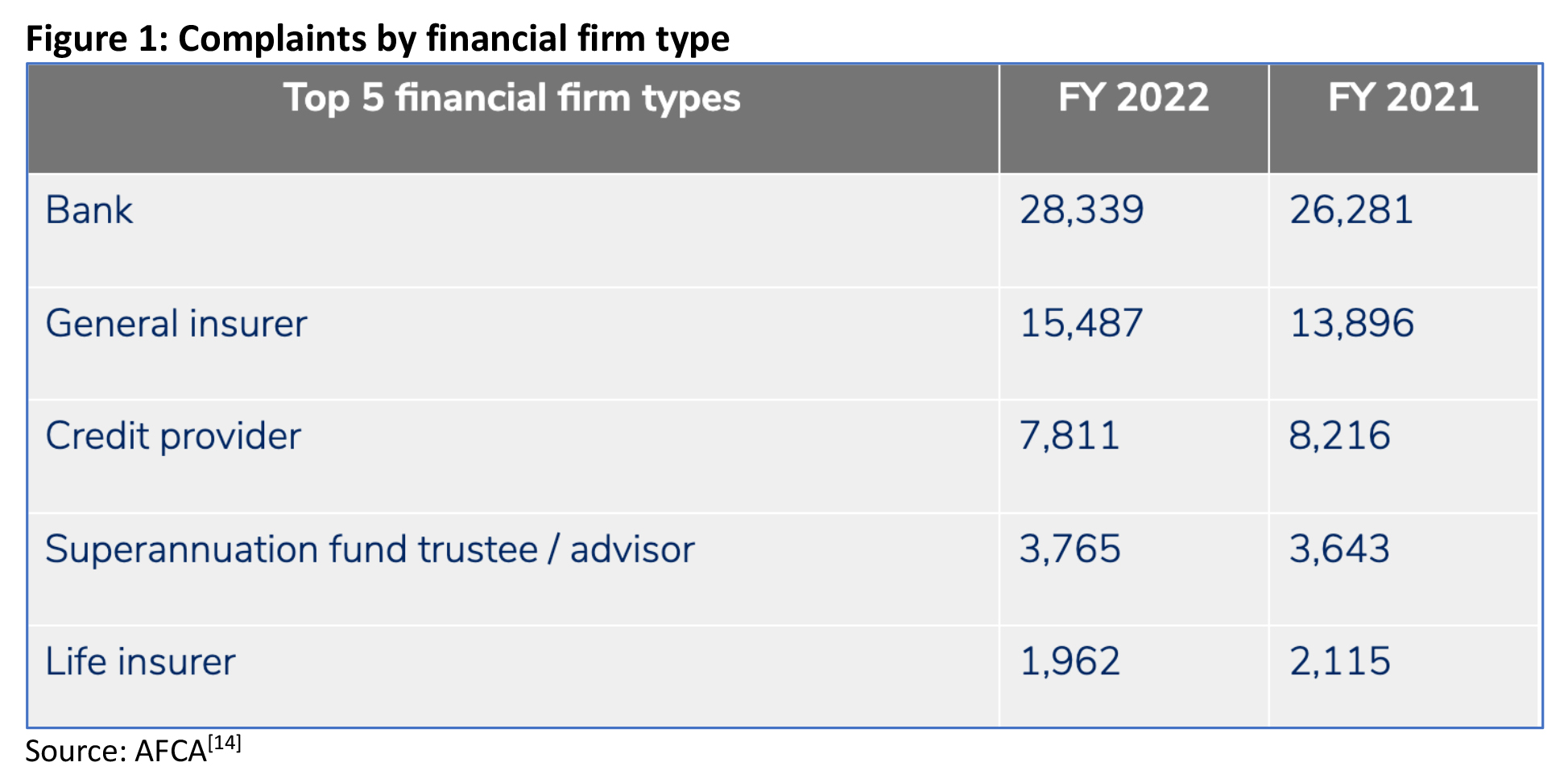
People love to complain, and the financial services sector attracts more than its fair share of dissatisfied customers, with AFCA receiving more than 72,000 complaints for the 21/22 Financial Year[12].
Happily, the number of these relating to advice was miniscule, with 241 complaints about inappropriate advice, 281 about the failure to act in the client’s best interests, and 570 relating to service quality[13].
These figures pale into insignificance when compared to the 28,000 complaints about banks, over 15,000 complaints about general insurers, and nearly 8,000 complaints about credit providers[14].
This outcome is consistent with a continuing downward trend in advice related complaints and has prompted a verbal pat on the back from AFCA itself, with their Lead Ombudsman for investments and advice – Natalie Cameron – congratulating advisers at an AFCA member forum, observing “there are enormous amounts of professionalism in advice and investments out there”[15].
With advice complaints making up less than 2% of all complaints dealt with by AFCA, it is perhaps appropriate that their recently revised funding model is designed to be more equitable, by making heavy users shoulder more of the burden.
New AFCA funding model benefits smaller advice firms
Under the revised AFCA funding model, effective 1 July 2022, all AFCA members will be eligible to receive five free complaints per financial year (previously all complaints were subject to a complaints fee of varying size).
Commenting on their new model, AFCA said “The model aims to reduce the burden on small members like financial planning firms through its user-pays approach.”[16]
According to their estimates, around 16% of all AFCA members will see a decrease in total annual fees, while 78% will see no change.
Best practice tips on handling complaints
Whilst the main focus of this article has been on the compliance aspects of complaints handling, we shouldn’t overlook the deeply human and emotional side of complaints. Financial advice, more so than many other businesses, is built on relationships, and the strength of these relationships can play a vital role in determining the ultimate course of a complaint. If the relationship is robust and transparent, the client’s dissatisfaction may be discussed and resolved more informally before it even reaches the status of a formal complaint. On the other hand, if the client doesn’t feel their issues are being given the attention they deserve, the relationship itself is at stake.
If we look at complaints handling through a common sense – rather than compliance – lens, then the following list of dos and don’ts may prove valuable.
Dos:
- let the complainant decide whether to pursue the complaint
- make it as easy as possible for complaints to be made
- take every complaint seriously
- allow the complainant to fully have their say
- acknowledge you have received the complaint and explain what happens next
- be sympathetic
- prioritise resolution of the complaint
- be transparent and accept responsibility
- have re-usable templates and a documented process
- keep an eye out for recurring themes, which could be systemic issues.
Don’ts:
- ignore the complaint
- take the complaint as a personal criticism
- Get angry or emotional or argumentative, even if the client does
- assume a superior knowledge of the circumstances/facts
- deny responsibility
- pass ownership of the issue onto someone else in your business (if you received the complaint, take ownership for its resolution)
- take a ‘gotcha’ mentality to cases where you are proven to be in the right
- use jargon in any communication about the complaint.
The payoff for managing complaints well
Managing complaints positively can pay dividends for your business.
Being prepared to admit, then fix faults and put clients first can be beneficial for your relationship with those clients and your overall brand reputation. Complaints are also valuable signals around aspects of your business that are possibly not performing to expectation, allowing you to make adjustments as necessary. By adopting a mindset that embraces complaints and matching that with a process which allows complaints to be managed effectively and consistently across your business, you and your staff will feel more motivated, more empowered, and more positive about the role you play in your clients’ lives.


