
The new breed of multi-asset funds

What are the pros and cons of multi-asset funds and where these products fit in an investor portfolio?
While the concept of a ‘multi-asset’ or diversified fund is not new, technology has enabled increasingly sophisticated products. This article, proudly sponsored by Russell Investments, examines the investment case for the new breed of multi-asset funds.
Investors looking to diversify their portfolio and reduce risk can individually invest across a range of funds and direct assets, invest in a diversified fund or consider investing in a multi-asset fund.
A multi-asset fund invests in a variety of asset classes and are managed by an experienced fund manager. Multi-asset funds can provide investors with several benefits, including diversification, risk management, and potentially, higher returns.
What is a multi-asset fund?
Sometimes described as a ‘one-stop shop’, multi-asset funds are comprised of a number of asset classes in a single product. These generally include global and domestic investments across equities, fixed income, commodities, alternatives, property and currency. Further, each asset class will usually be managed by one or more professional investment managers. For example, the allocation to global equities might be distributed between growth and value, fundamental and quantitative, or other investment approaches.
Each multi-asset fund is managed by a professional investment manager who is responsible for asset allocation, asset selection and manager selection, with the goal to deliver on the investment objective/s of their multi-asset strategy. The multi-asset manager is also responsible for the weighting of assets within each portfolio and mitigates some of the risk by diversifying across asset classes. The manager generally has the ability to pull levers of risk and return across all asset classes within the fund, which helps them to meet the objective/s of each multi-asset strategy.
Objectives generally focus on a particular level of capital growth or income return, degree of volatility, risk or diversification. Often, the objective embraces a combination of all these factors and, as such, investing in multi-asset strategies can potentially help your clients to meet a number of their financial goals within a single solution.
Multi-asset managers use a variety of strategies to determine the asset allocation of the fund, including strategic asset allocation, tactical asset allocation and dynamic asset allocation, with the latter being the most common:
- Strategic asset allocation – a long-term approach that entails the selecting of a combination of assets based on their expected risk and return characteristics. The asset allocation is based on the target investor’s objectives and risk tolerance and is typically adjusted quarterly or semi-annually.
- Tactical asset allocation – a short-term approach that involves adjusting the asset allocation based on prevailing market conditions. This is typically adjusted monthly, or more frequently during periods of more extreme market volatility.
- Dynamic asset allocation – a combination of strategic and tactical asset allocation in which the manager selects a strategic asset allocation but makes periodic tactical adjustments based on market conditions.
Importance of diversification
One of the most important investment tenets is diversification, which is one of the primary benefits of investing in multi-asset funds. While diversifying a portfolio cannot completely eliminate the prospect of capital loss, it is a widely accepted investment principle and considered to be an effective way to enhance overall returns for a given level of risk.
By investing in a variety of asset classes, investors can spread their risk and reduce the impact of any single asset class on their portfolio. For example, if an investor only invests in Australian equities, their portfolio may suffer if the Australian market experiences a significant downturn. However, if the investor also has exposure to global equities, bonds, commodities, and other asset classes, the impact of the stock market downturn may be offset by gains in other areas of the portfolio.
While traditional ‘balanced’ or ‘diversified’ funds sought a similar outcome in terms of diversification, multi-asset solutions differ from those traditional products because they generally target a specific investment outcome, such as an explicit return above inflation, rather than measuring performance against a benchmark.
What are the benefits of multi-asset funds?
There are five key benefits of multi-asset investing.
1. Multi-asset funds seek to generate returns while managing risk
Multi-asset funds can offer investors exposure to a broader range of assets, sectors, strategies and direct investment exposures (e.g. individual securities) with greater flexibility. They are diversified across both traditional (e.g. shares and fixed income) and non-traditional (e.g. real estate and infrastructure) asset classes. The primary goal is to provide the opportunity for growth while carefully managing risk; however, it is important to note that diversification and multi-asset investing do not guarantee capital growth or protect against loss.
Multi-asset investing provides upside potential through equities and alternatives, plus potential downside protection that a risk-managed portfolio can help to deliver, where a traditional ‘balanced’ portfolio tends to focus on more traditional assets (figure one).

2. Multi-asset funds target specific and measurable investment outcomes
Multi-asset investing is designed to provide measurable investment outcomes that aim to help your clients reach their investment goals. Unlike the traditional balanced funds, a multi-asset fund’s performance success is not measured against a specific benchmark. Rather, the strategy is focused on a specific outcome – such as a targeted return above inflation or to achieve a specific level of income measured against the prevailing Bank Bill rate.
3. Multi-asset funds are dynamically managed
Multi-asset portfolios dynamically adjust their exposure to take advantage of short-term opportunities to increase the potential return or to avoid unnecessary risk. This approach aims to provide smoother positive returns over time and can also provide longer term stability through exposure to a broad range of asset classes, each of which will react differently to the same market event.
As such, a multi-asset portfolio is designed to navigate potential market shifts through tactical trades, tilts and factor exposures. It has the flexibility to respond to changing market conditions, seeking areas of greater potential return while attempting to avoid sectors that could add unnecessary risk to a portfolio. Multi-asset solutions rely on dynamically allocating portfolios based on strategy views and outlooks.
As already touched upon, diversification is one of the primary benefits of investing in multi-asset funds. By investing in a variety of asset classes, investors can spread their risk and reduce the impact of any single asset class on their portfolio.
4. Multi-asset funds quickly adapt to markets using enhanced capabilities
Multi-asset portfolios provide actively managed exposure to various sectors, asset classes, geographies and market capitalisations, providing your clients access to a broad investment universe. Many multi-asset portfolios can also use derivatives such as options, futures and currency hedging. These tools allow the portfolio manager to steer the funds in pursuit of the desired investment outcome through risk management and return-seeking positions.
Although strategic asset allocation is critical to long-term investment success, over a shorter-term horizon, the ability to dynamically adapt to changing market conditions through tactical positioning and the use of derivatives can help a portfolio navigate through volatility.
5. Multi-asset funds can provide access to “best-in-breed” investment managers
Multi-asset portfolios can provide your clients exposure to some of the world’s leading investment opportunities and money managers through an open architecture approach. By combining independent money managers from around the globe in a single fund — not just managers who work for one fund company — your clients can access a broad range of investment managers, styles and approaches.
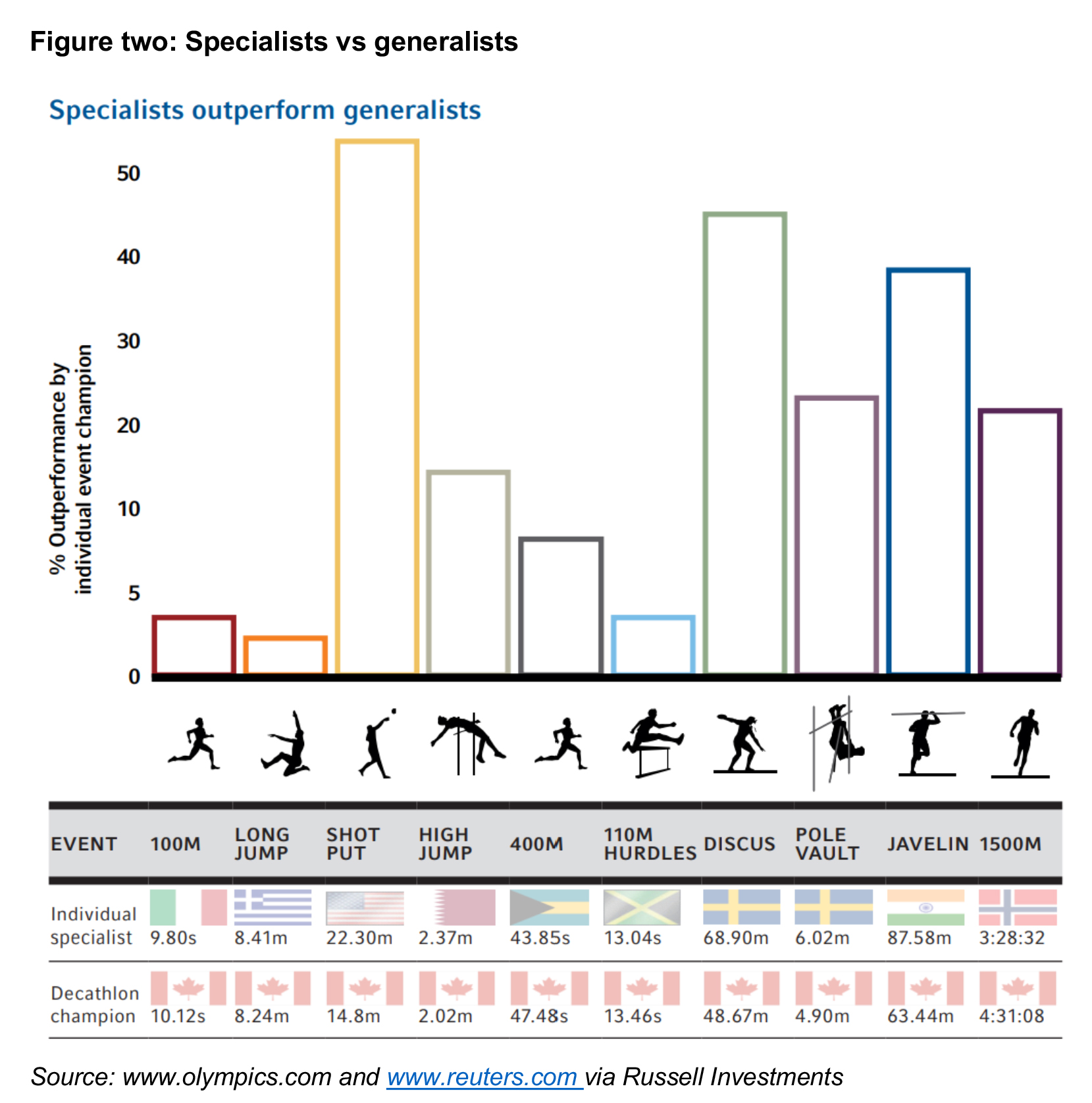
It can be difficult for an individual manager to be effective in more than one asset class or to produce stable performance under various market environments, which is why most multi-asset funds opt for specialists who excel in their fields and can generally provide enhanced risk-adjusted returns.
Consider this illustration from the 2021 Tokyo Olympics (figure two):
While they are strong athletes, the difference in the performance of the gold medal-winning decathlon champion compared to the individual specialist for each event is obvious.
Why should investing be any different? While a generalist investment manager who can provide exposure to different markets may give you a good return, finding the best individual performer in each of those markets may provide a much better return with lower risk. And, just as in the athletic sphere, those individual champions can easily change from year to year.
What to consider when assessing multi-asset funds?
As with all investment options, while there may be benefits, there will also be product differences and potential drawbacks you should be aware of.
Considerations of variations between multi-asset funds include:
- The fund’s investment strategy – does the fund have a focus on income or growth, or a bias towards certain asset classes or geographic regions? What are its risk mitigation strategies and importantly, will the strategy meet your client’s financial objectives?
- Performance history – the variation in investment strategy between funds will result in performance differences, particularly when you examine after fee returns. As when assessing any financial product, its track record during different market conditions is an important indication of its potential to provide longer term risk adjusted returns that meet your client’s financial objectives.
Potential drawbacks include:
- Fees – multi-asset funds typically charge a higher fee load than single asset class funds, because of the additional management required to manage the portfolio across multiple asset classes and multiple managers. Additionally, fees can vary widely between funds, and as outlined above, you should consider the impact of fees on investor returns over the long term.
- Flexibility – multi-asset funds may not be as flexible as a direct investment into preferred individual assets, such as shares.
Where do multi-asset funds fit in a client’s portfolio?
In the same way you assess any financial product or investment, it’s important to view multi-asset funds through the lens of each client’s financial objectives and risk profile. There are a number of different types of multi-asset funds available, including:
- Target date funds – retirement oriented funds with an asset allocation based on the investor’s approximate retirement year. As the target date approaches, the asset allocation adjusts, generally becoming more defensive in nature.
- Balanced funds – balanced multi-asset funds provide exposure to multiple asset classes based on target percentages, such as a 60/40 split between growth and fixed income assets. Some managers will offer a suite of ‘balanced’ funds that change according to the targeted risk profile.
- Total return funds – this cohort of multi-asset funds are designed to try and provide positive returns in any market environment; they are generally unconstrained – or benchmark unaware – and aim to deliver returns in excess of measures such as CPI or the Bank Bill rate.
- Risk-based funds – often named according to the target risk level of the fund, such as:
- Conservative multi-asset funds – designed for risk averse investors and/or those with a shorter-term investment horizon. Conservative multi-asset funds typically have a higher allocation to fixed income and defensive assets and a lower allocation to equities and other growth assets.
- Moderate multi-asset funds – designed for investors willing to take on some risk in exchange for higher returns. Such funds typically have a more balanced allocation between defensive and growth assets.
- Aggressive multi-asset – designed for investors willing to take on higher risk for the potential of higher returns. These funds typically have a higher allocation to equities and a lower allocation to fixed income.
The majority of multi-asset funds are designed for investors with a medium to high risk and return profile and are less likely to be suitable for those clients with a low risk tolerance, who seek any sort of capital guaranteed product or who have a short investment timeframe.
Many multi-asset funds take an unconstrained investment approach, one that is not bound to a specific benchmark. Instead, this product class tends to focus on delivering specific outcomes for your clients; it provides exposure to ‘hard-to-access’ areas of the market that individual retail investors generally cannot access (e.g. currencies). This unconstrained approach allows the product manager to adjust the asset allocation over time to take advantage of market opportunities and mitigate risk.
Overall, multi-asset funds can be a valuable investment option for clients looking for diversification across a range of traditional and alternative asset classes, along with professional management. However, it is important to consider their investment objectives, risk tolerance and existing portfolio when selecting the appropriate multi-asset fund to recommend.


