
CPD: How to keep ASIC happy – FY 2025/26 edition

What’s shaping compliance in FY25/26 — ASIC enforcement trends, looming regulatory deadlines, and media commentary.
Introduction
For financial advisers in Australia, maintaining ongoing compliance is not only about avoiding penalties—it’s fundamental to preserving client trust, practice continuity, and professional standing. FY 2025/26 is shaping up as a period of heightened scrutiny, with looming deadlines, and a flurry of recent actions suggesting ASIC are increasingly willing to test matters in court.
ASIC’s Financial Advice Update, released in August 2025[1], touches on several topics in their sights – including adviser registration, ongoing fee consents, breach reporting transparency, and cybersecurity – and provides advisers with a concrete roadmap of what best practice does and doesn’t look like. Advisers who read these signals and integrate them into everyday workflows will be best placed to protect clients and keep the regulator away from their door.
In the rear-view mirror – ASIC enforcement actions since 1st January to 31st July 2025
The first half of 2025 has seen ASIC extremely active, with over 25 enforcement actions against advisers and licensees, categorised as follows[2]:
- inappropriate/non-compliant advice 33.3%
- fraud/theft 23.8%
- other regulatory breaches and serious misconduct 23.8%
- unregistered financial advice 9.5%
- cybersecurity failures 4.8%
- product misrepresentation/misleading conduct 4.8%.
The themes present in many of these actions are instructive about ASIC’s focus over the near term and form the basis of the following tips for keeping ASIC happy in FY 2025/26.
1. Ongoing fee consents: what changed, what was waived, what must still be reported
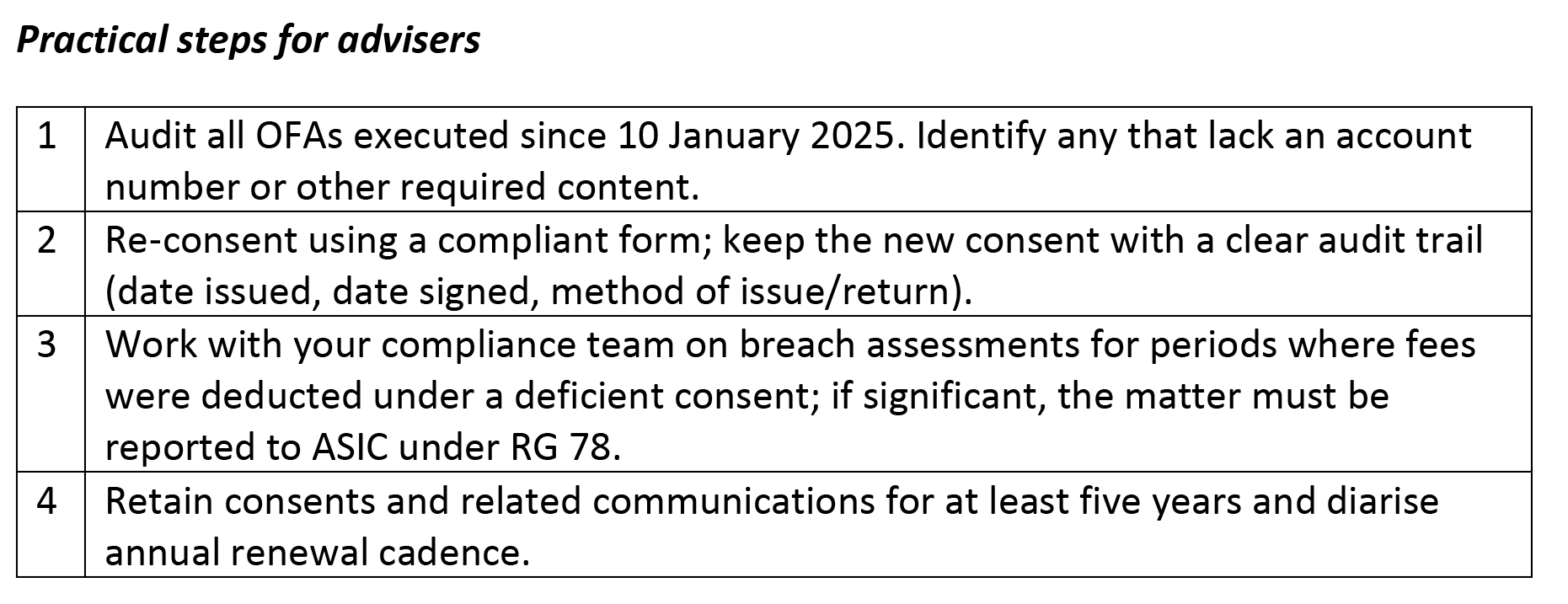
DBFO tranche 1 saw the introduction of new fee consent requirements, which took effect from 10 January 2025. While intended to streamline arrangements (by replacing FDSs and renewals, with a single, consolidated written consent), their introduction actually caused a great deal of confusion and adviser angst, mainly due to the requirement for these ‘OFA’ consents to include an account identifier/number. In response to industry feedback, ASIC granted a limited no‑action position for consents missing the account number between 10 January and 5 September 2025, provided advisers obtained a compliant fresh consent.
Crucially, ASIC’s no‑action stance did not mean non-compliant OFAs didn’t need to be reported. As industry coverage has made clear, licensees may still need to lodge reportable situations where deficient consents were used:
“Communication to its members by the Financial Advice Association Australia, seen by Professional Planner, says the regulator confirmed to the association that any consent forms previously signed without an account number must be reported to ASIC as a breach.”[4]
At the time of publishing, ASIC had not wavered from this hard – September 5 – deadline. Advisers must therefore be aware that, despite considerable pushback from the FAAA and others[4], OFAs that do not include account numbers are non-compliant.
2. January 2026: Check your qualifications and your ASIC register entry
Most advisers will be aware of the looming January 1st deadline to be appropriately qualified to provide personal financial advice. Ahead of this major milestone, ASIC conducted another spot check of the Financial Adviser Register (FAR), following which they issued another reminder(warning) to advisers and licensees to check the accuracy of their own entries on the (FAR). Inaccurate or incomplete information, particularly around approved qualifications and pathway eligibility, remains a live concern, and it is likely that many of the problems ASIC found in their previous spot check[5] (in 2024) persist. Common errors identified then included:
- some of the qualifications marked as ‘approved’ did not accurately match the wording of the course in the Corporations (Relevant Providers Degrees, Qualifications and Courses Standard) Determination 2021
- some of the qualifications marked as ‘approved’ were not approved qualifications, they were professional designations (e.g. ‘Certified Financial Planner’)
- some of the qualifications marked as ‘approved’ were not, in isolation, approved qualifications, they were bridging courses. These may be listed in the Determination but are required to be coupled with another qualification to meet the requirements of the professional standard, and
- some of the qualifications marked as ‘approved’ were not approved qualifications under the Determination (examples include: the Financial Adviser Exam, Australian Qualifications Framework 1-5 qualifications, and Regulatory Guide 146 training/qualifications).
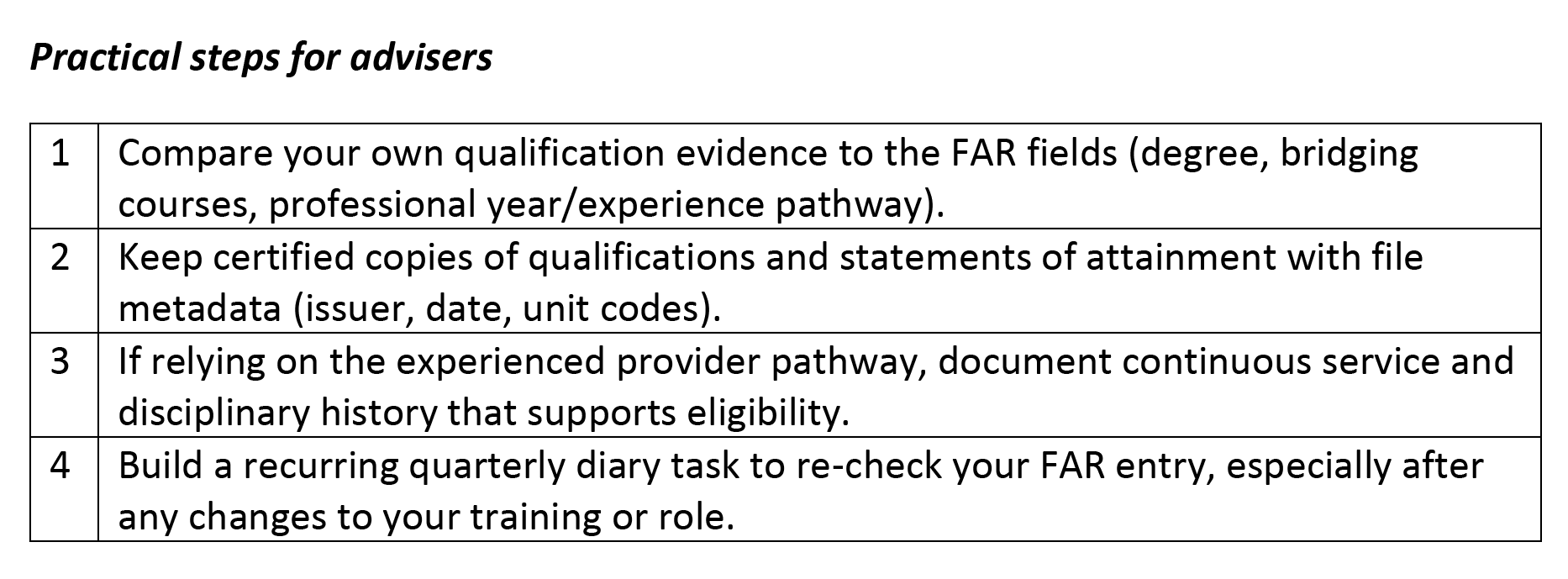
To further help advisers, ASIC recently released a dataset[6] which shows if an AFS licensee has notified ASIC that a relevant provider has made a declaration that they are relying on the experienced provider pathway to meet the qualifications standard and the date the relevant provider passed the exam.
3. Provide personal advice only if you’re registered
Several experienced, professional advisers have been caught out by the need to be registered (as opposed to ‘authorised’), and 2025 has seen ASIC issue multiple infringement notices to advisers falling foul of this ‘clunky double-up’ requirement. On 8 April 2025, three licensees paid penalties for authorising advisers who gave personal advice while unregistered; on 17 July 2025, ASIC reported further infringement notices to two licensees for the same behaviour. One adviser was so shocked at the penalty – which exceeded $30,000 – for his honest mistake, he intentionally drew attention to the matter through the media[7], and advisers should take heed of the lesson he learned.
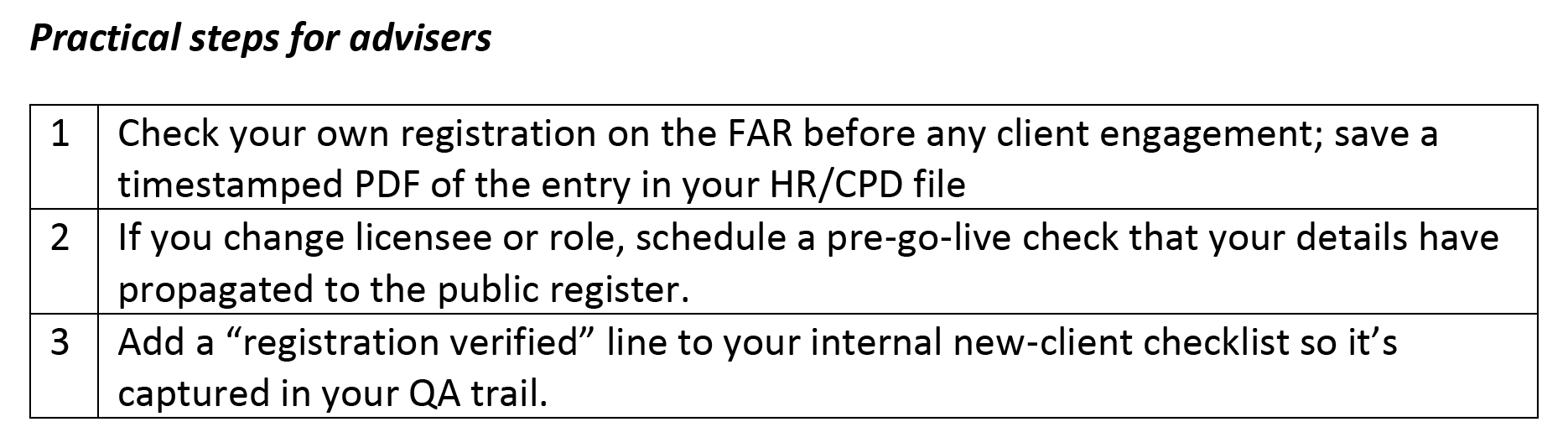
Registration confirms minimum competency and fitness; advising without it undermines informed consent and creates remediation risk if advice later proves defective.
4. Treat AFCA determinations like court orders that must be acted on
Recent ASIC action has made clear that payments due as a result of AFCA determinations are not optional, or indicative, they are ultimately legally enforceable and can result in cancellation of AFS licences.
This played out recently when a firm failed to pay a determination, forcing the Compensation Scheme of Last Resort (CSLR) to step in and pay the determined amount ($21,888.20). Payments from the CSLR automatically trigger licence cancellation, which is exactly what ASIC did in April 2025[8].
The firm was also ordered to remain a member of AFCA for a period of 12 months, ending on 29 April 2026.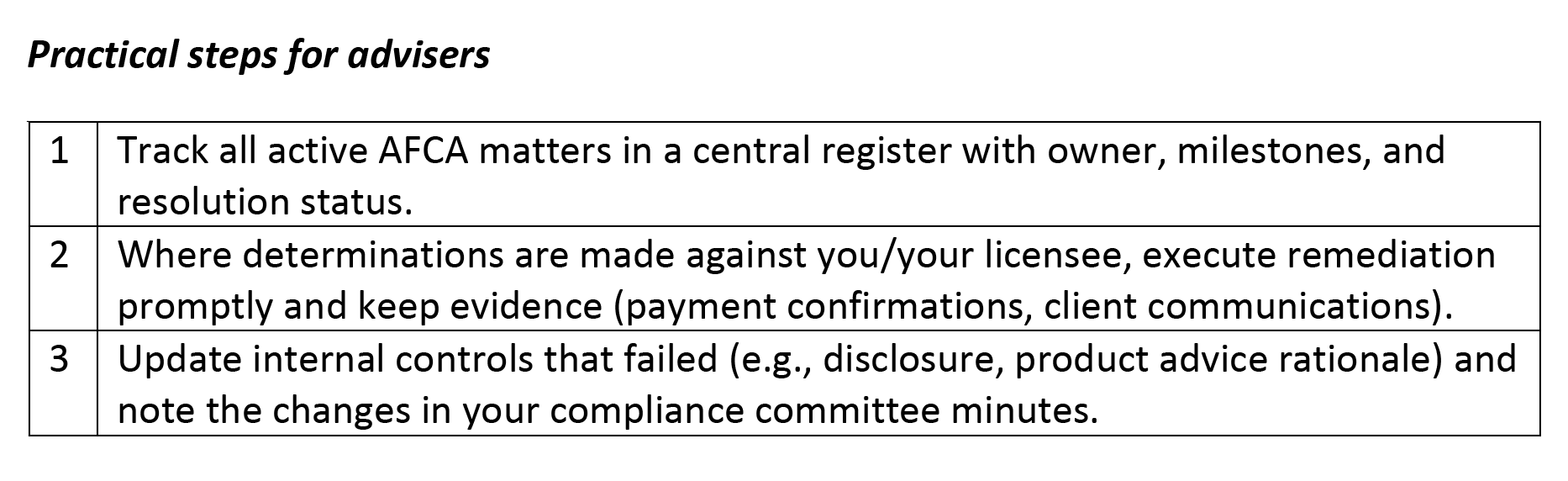
5. Cybersecurity: advisers and licensees in the crosshairs
Financial advisers are regulated under the Corporations Act s912A licence obligations, which ASIC has enforced in court as requiring adequate cyber risk and governance systems. The latest demonstration of this was seen in July 2025, when they commenced proceedings in the NSW Supreme Court against a high-profile licensee, alleging failure to adequately manage cybersecurity risks across its advice network[9].
Often an afterthought in smaller practices – either through lack of understanding or lack of priority – it is clear even smaller advice businesses must be able to evidence cyber governance, training, and incident readiness.
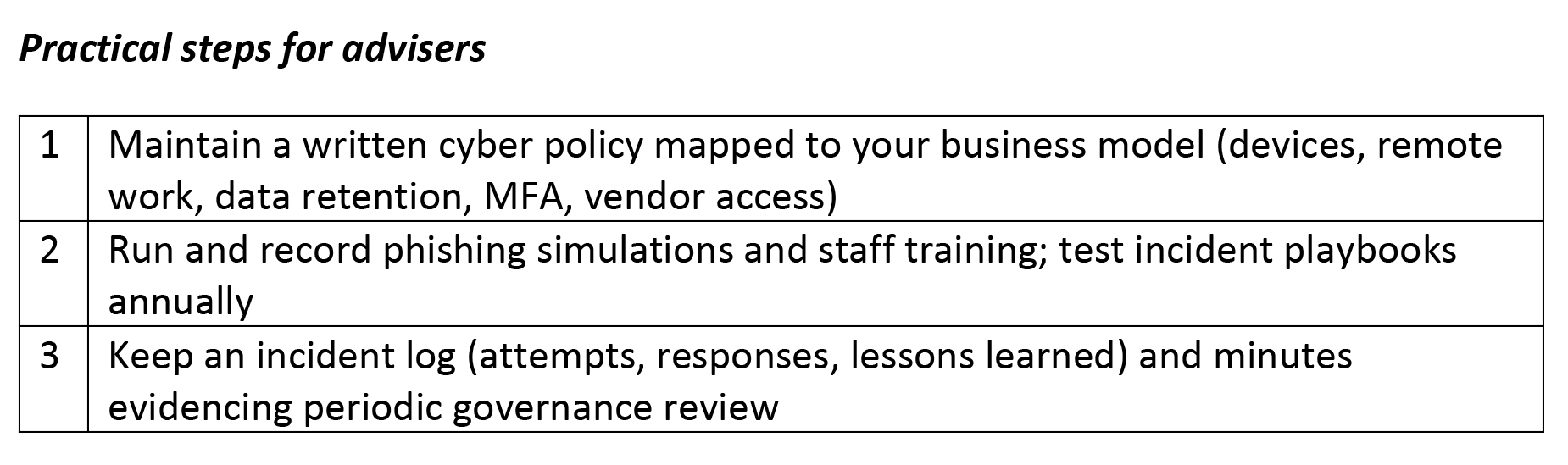
Cyber incidents compromise confidentiality and can enable fraud. Financial advisers, who deal with highly sensitive financial and personal data from their clients, are an obvious target for cyber criminals. Good cyber hygiene directly protects client data and assets.
6. Learn from the First Guardian/Shield collapse
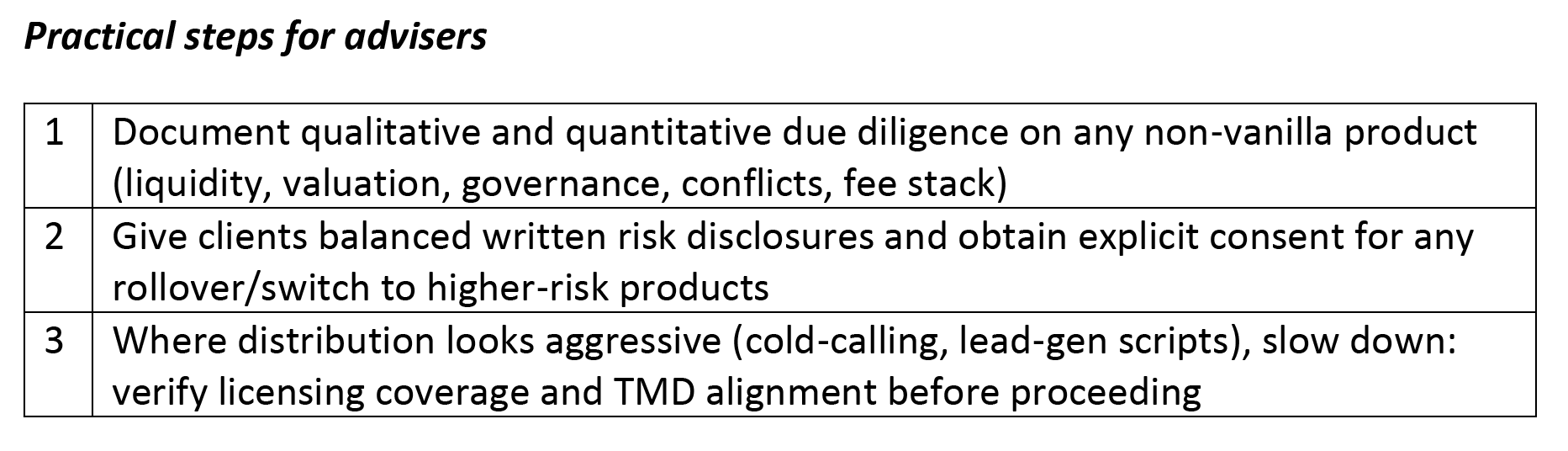
It has been hard to avoid recent media coverage of the First Guardian and Shield master funds’ failures, which exposed thousands of investors to losses[10]. This collapse has seen ASIC step up their scrutiny of platform trustees and distribution arrangements.
For advisers, the lesson is pre‑emptive, there are several ‘red flags’ that should have been heeded, including:
- rapid capital influx into obscure and/or illiquid schemes
- use of high-pressure sales tactics and referral models pushing super rollovers and advice funnels
- opaque governance and valuation practices, including significant related-party dealings and offshore transfers.
7. Correcting clients who have been ‘finfluenced’
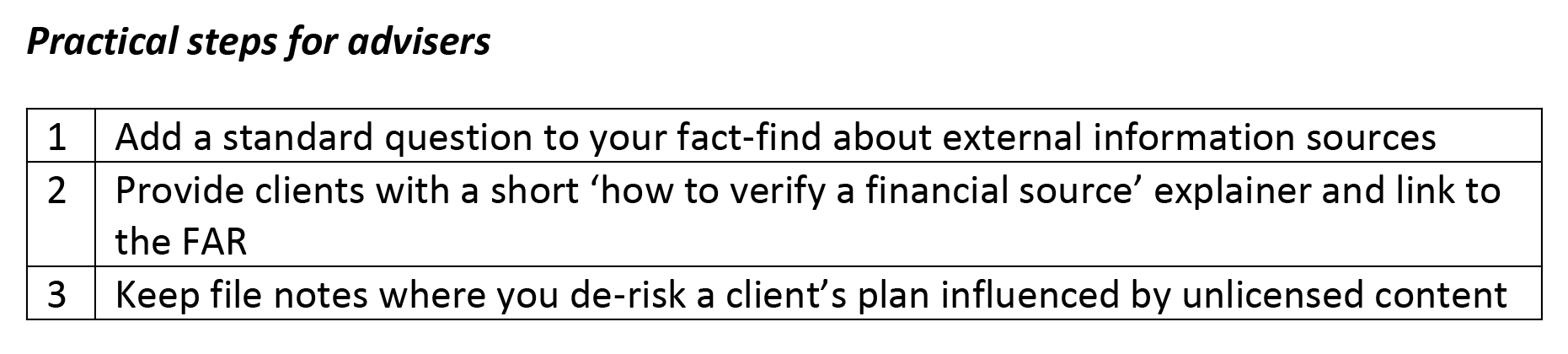
ASIC has repeatedly warned about unlicensed financial advice via social media[11]. Even when enforcement targets ‘finfluencers’, advisers face the downstream risks: clients arrive primed with misinformation and unrealistic expectations, making the concept of informed consent even more critical. The question “What have you read or watched lately?” should almost be seen as a standing agenda item, and advisers should feel free to reference the various ASIC actions against unlicensed finfluencers and other non-compliant peddlers of misinformation
8. Beware the ‘cookie‑cutter’: personalisation is being enforced
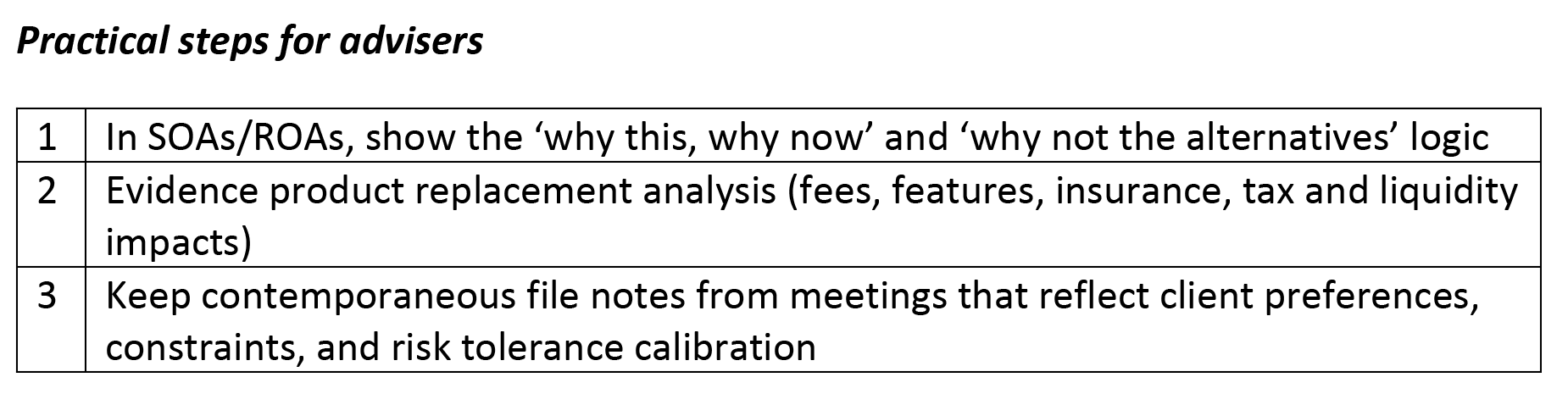
‘Cookie-cutter’ advice – generic, templated financial advice that is not tailored to an individual client’s circumstances – has attracted significant focus from ASIC and AFCA over the last 12 months. Advice that is not personalised to a client’s ‘objectives, financial situation and needs’ fails to meet the Best Interests Duty (BID) under law, and ASIC have wasted little time in acting. Recent cases successfully prosecuted run the gamut from SMSF/property advice, life insurance, and superannuation rollovers, to unbalanced ‘one size fits all’ portfolios.
In one high profile case, the Federal Court imposed a penalty of $11 million on a financial services provider for cookie‑cutter superannuation advice influenced by conflicted bonus payments[12].
AFCA has previously referenced[13] how they have seen batches of disputes where the same SOA was used for every single client, and what a massive red flag this represents.
For the average, compliant, adviser, the lesson here is perhaps a nuanced one. The desire for simplification and efficiency often involves the use of templated documents and processes. To an extent, model portfolios are also templates. These are not problematic unless they result in advice which is also templated, rather than personalised.
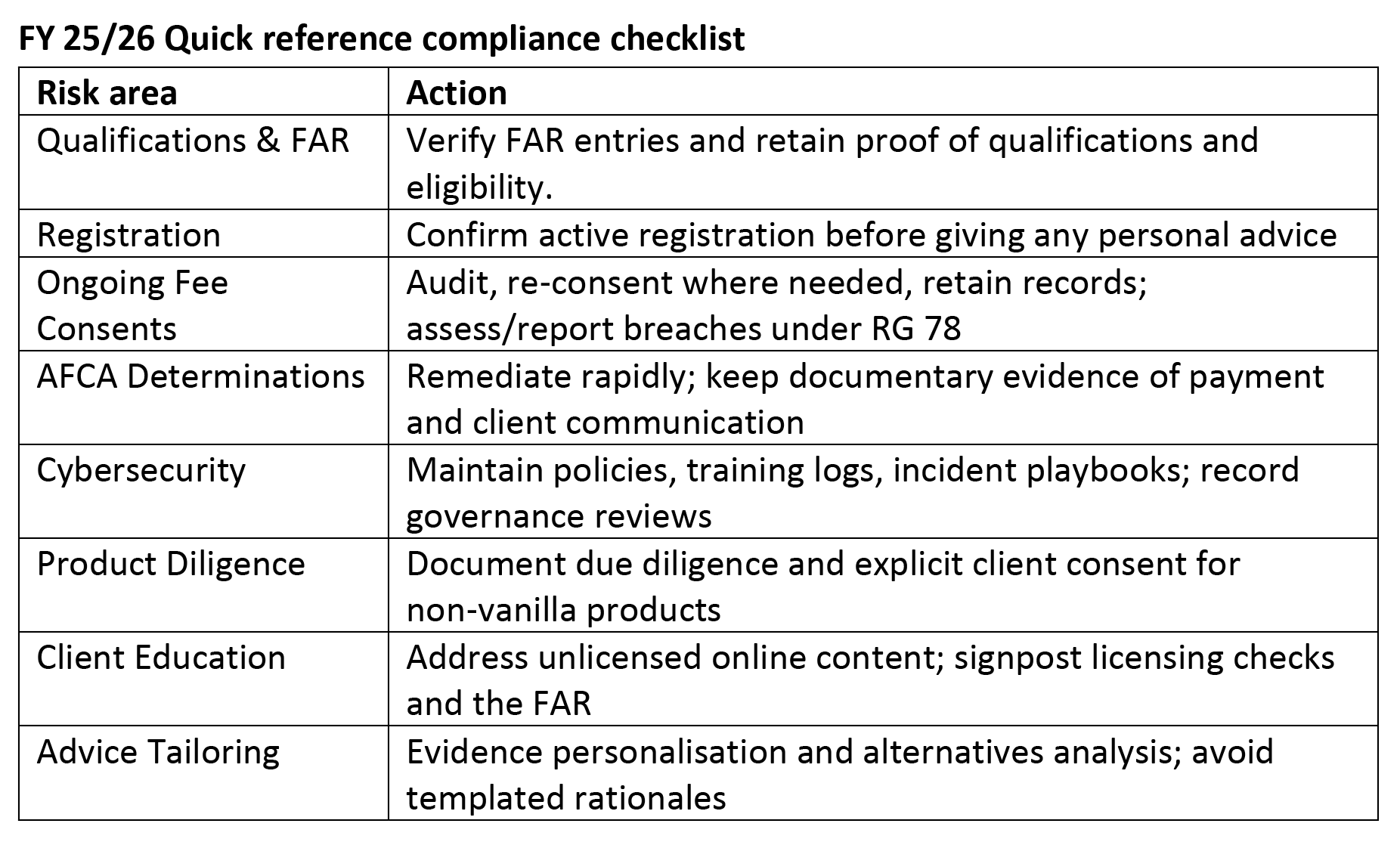
Summary
While none of ASIC’s current focus areas should come as a surprise, advisers – especially those who also manage a practice – ought to be forgiven if specific complexities and nuances of everchanging regulatory requirements fall through the cracks. Sadly, ASIC is not always as generous, and as their various actions taken already in 2025 demonstrate, their antennae is raised on several fronts
By interpreting the signals ASIC continues to send – through the media and through its own website – advisers can get a clear picture about where to focus their attention. Although not an exhaustive list, the steps suggested in this article are a solid platform on which to build a practice that better protects its clients, and for which ASIC has less reason to knock.
Take the FAAA accredited quiz to earn 0.5 CPD hour:
CPD Quiz
The following CPD quiz is accredited by the FAAA at 0.5 hour.
Legislated CPD Area: Regulatory Compliance & Consumer Protection (0.5 hrs)
ASIC Knowledge Requirements: Regulatory Environment (0.5 hrs)
please log in to start this quiz

———–
References:
[1] https://www.asic.gov.au/about-asic/news-centre/news-items/financial-advice-update-august-2025/
[2] Ibid.
[3] https://www.professionalplanner.com.au/2025/07/asic-still-expects-breach-reports-despite-no-action-on-fee-consent/
[4] https://www.ifa.com.au/news/36094-fee-consent-technical-flaw-causing-angst-for-advisers
[5] https://www.asic.gov.au/about-asic/news-centre/find-a-media-release/2024-releases/24-142mr-asic-urges-afs-licensees-to-correct-records-on-the-financial-advisers-register/
[6] https://www.asic.gov.au/regulatory-resources/financial-services/financial-advice/professional-standards/providing-tax-financial-advice-services/
[7] https://www.ifa.com.au/news/36007-how-asic-s-clunky-double-up-registration-process-punishes-honest-mistakes
[8] https://www.asic.gov.au/about-asic/news-centre/find-a-media-release/2025-releases/25-067mr-asic-cancels-licence-of-brite-advisors-pty-ltd/
[9] https://www.moneymanagement.com.au/news/financial-planning/asic-sues-fortnum-private-wealth-over-alleged-cyber-security-breach
[10] https://www.afr.com/companies/financial-services/compensation-for-first-guardian-shield-victims-may-be-a-third-of-1b-loss-20250716-p5mf9b
[11] https://www.ifa.com.au/news/35844-asic-puts-finfluencers-in-the-crosshairs-over-unlicensed-financial-advice
[12] https://www.asic.gov.au/about-asic/news-centre/find-a-media-release/2025-releases/25-063mr-financial-services-provider-penalised-11-million-over-cookie-cutter-advice-and-conflicted-bonus-payments/#:~:text=DOD%20Bookkeeping%20Pty%20Ltd%20,provided%20inappropriate%20%E2%80%9Ccookie%20cutter%E2%80%9D%20advice
[13] https://www.professionalplanner.com.au/2023/06/simpler-dealing-with-banks-than-smaller-licensees/#:~:text=in%20planning%20in%202008%2C%20I,%E2%80%9D
CPD Quiz
The following CPD quiz is accredited by the FAAA at 0.5 hour.
Legislated CPD Area: Regulatory Compliance & Consumer Protection (0.5 hrs)
ASIC Knowledge Requirements: Regulatory Environment (0.5 hrs)
please log in to start this quiz
———–
References:
[1] https://www.asic.gov.au/about-asic/news-centre/news-items/financial-advice-update-august-2025/
[2] Ibid.
[3] https://www.professionalplanner.com.au/2025/07/asic-still-expects-breach-reports-despite-no-action-on-fee-consent/
[4] https://www.ifa.com.au/news/36094-fee-consent-technical-flaw-causing-angst-for-advisers
[5] https://www.asic.gov.au/about-asic/news-centre/find-a-media-release/2024-releases/24-142mr-asic-urges-afs-licensees-to-correct-records-on-the-financial-advisers-register/
[6] https://www.asic.gov.au/regulatory-resources/financial-services/financial-advice/professional-standards/providing-tax-financial-advice-services/
[7] https://www.ifa.com.au/news/36007-how-asic-s-clunky-double-up-registration-process-punishes-honest-mistakes
[8] https://www.asic.gov.au/about-asic/news-centre/find-a-media-release/2025-releases/25-067mr-asic-cancels-licence-of-brite-advisors-pty-ltd/
[9] https://www.moneymanagement.com.au/news/financial-planning/asic-sues-fortnum-private-wealth-over-alleged-cyber-security-breach
[10] https://www.afr.com/companies/financial-services/compensation-for-first-guardian-shield-victims-may-be-a-third-of-1b-loss-20250716-p5mf9b
[11] https://www.ifa.com.au/news/35844-asic-puts-finfluencers-in-the-crosshairs-over-unlicensed-financial-advice
[12] https://www.asic.gov.au/about-asic/news-centre/find-a-media-release/2025-releases/25-063mr-financial-services-provider-penalised-11-million-over-cookie-cutter-advice-and-conflicted-bonus-payments/#:~:text=DOD%20Bookkeeping%20Pty%20Ltd%20,provided%20inappropriate%20%E2%80%9Ccookie%20cutter%E2%80%9D%20advice
[13] https://www.professionalplanner.com.au/2023/06/simpler-dealing-with-banks-than-smaller-licensees/#:~:text=in%20planning%20in%202008%2C%20I,%E2%80%9D


Have feedback on this article? Contact Us
Earn CPD Points
 CPD: Currency risk – friend or foe?
In today’s interconnected world, global companies play a significant role in our daily lives. However, when Australian investors allocate their capital to global markets, they are exposed not only to [...]
 CPD: Ethics and moral dilemmas
When it comes to financial advice, the numbers may be black and white, but the ethical decisions often aren’t. This article, proudly sponsored by GSFM, examines moral dilemmas and the [...]
 CPD: Jump in my CAR. Client Advice Records – why, what, how
Introduction The forthcoming replacement of Statements of Advice (SOAs) with Client Advice Records (CARs) has once again shone a spotlight on the vexed issue of client communication within financial advice. [...]
 CPD: Investor Behaviour – Retirement
To best understand how and why clients make financial decisions – particularly during retirement – advisers must look beyond technical strategies and consider investor behaviour. Before addressing product selection or [...]
 CPD: A star is (re)born – Investment Bonds are the new headline act of tax-smart investing
Introduction Tax-smart investing is one of the central pillars of quality, effective, financial advice. The capacity for tax to drag on investment returns, stifle compounding, and eat away at gains [...]