
CPD: Investment bonds revisited – understanding the fundamentals in a changing tax landscape

As Australia’s tax landscape changes, investment bonds offer advisers another pathway for accumulating and transferring wealth.
For many years, investment bonds have occupied a relatively small corner of the Australian investment landscape. While familiar to some advisers, others may have had limited reason to consider them alongside more commonly used structures such as superannuation, personally held investments, property and trusts.
That conversation is changing.
Recent reforms to the taxation of superannuation, capital gains, negatively geared property and potentially, discretionary trusts have brought renewed attention to the structures through which Australians accumulate and transfer wealth.
The 2026 Federal Budget, for example, included significant changes to capital gains tax and negative gearing arrangements, while changes to the taxation of large superannuation balances have also altered the considerations for some investors.
These reforms do not automatically make one investment structure preferable to another. They do, however, reinforce an important advice principle: where an investment is held can be just as important to a client’s after-tax outcome as what they invest in.
Against that backdrop, investment bonds are receiving renewed attention.
But for advisers who have not regularly used them, an important question comes first: what exactly is an investment bond, and how does it work?
Let’s start with the structure, not the name
One of the first misconceptions to address is the word “bond”.
An investment bond is not a bond in the conventional fixed-income sense.
Instead, an investment bond is a life insurance policy with an investment component, issued by a life insurance company or friendly society.
The investor contributes capital to the policy and selects from the investment options made available by the issuer. Depending on the product, these may include Australian and international shares, fixed interest, property, cash, diversified portfolios and other investment strategies.
This means an investment bond can potentially accommodate a range of risk profiles. The defining characteristic is not the underlying asset allocation, it is the tax and legal structure surrounding those investments.
Understanding that distinction is fundamental.
A tax-paid investment
Perhaps the most important characteristic of an investment bond is that it is a tax-paid investment.
With many personally held investments, income and realised capital gains flow through to the investor and may need to be included in their individual tax return every year. The amount of tax ultimately payable depends on the investor’s circumstances and marginal tax rate. This can require investors and their advisers to keep track of different components of investment income, distributions and realised capital gains for tax purposes.
An investment bond works differently.
Tax on assessable investment earnings within an investment bond is generally paid by the issuer, at a headline tax rate of up to 30%, rather than being distributed to the investor each year and the investor being taxed at their personal, marginal tax rate.
Importantly, the investment bond provider is responsible for managing the tax obligations within the investment bond, including the tax treatment of investment income and realised gains generated by the underlying investments. This means the investor does not need to manage these underlying tax positions or include annual investment earnings from the investment bond in their personal tax return.
The actual effective tax rate paid by the issuer may be lower depending on factors such as the underlying investments, deductions, franking credits and tax management within the portfolio of investments selected by the investor.
For clients, this means that unlike investing directly in assets such as shares, ETFs, managed funds or term deposits where dividends, distributions or interest may need to be included in the investor’s personal tax return each year, investment earnings in an investment bond do not create annual taxable distributions that need to be included in their personal tax return. Instead, tax on investment earnings is paid within the investment bond structure. This can make investment bonds particularly relevant for long-term wealth accumulation where a client’s marginal tax rate is higher than the tax rate or effective tax rate applying within the investment bond.
This tax simplicity may become increasingly relevant if proposed Federal Budget changes affecting certain discretionary trust structures are enacted. Depending on the final form of the legislation, trustees may face additional requirements to track, manage and report different tax positions and components within the trust.
The combination of tax efficiency and administrative simplicity can make investment bonds particularly relevant for long-term wealth accumulation where a client’s marginal tax rate is higher than the tax rate or effective tax rate applying within the investment bond.
The 30% headline rate, however, does not automatically mean an investment bond will deliver a better after-tax outcome. Advisers still need to consider factors such as asset allocation, fees, investment performance, timeframe and the client’s individual tax circumstances and compare the overall benefits and trade-offs of different ownership structures.
Understanding the 10-year rule
Investment bonds are designed as long-term investments, with an important tax benefit available once the investment bond has been held for at least 10 years.
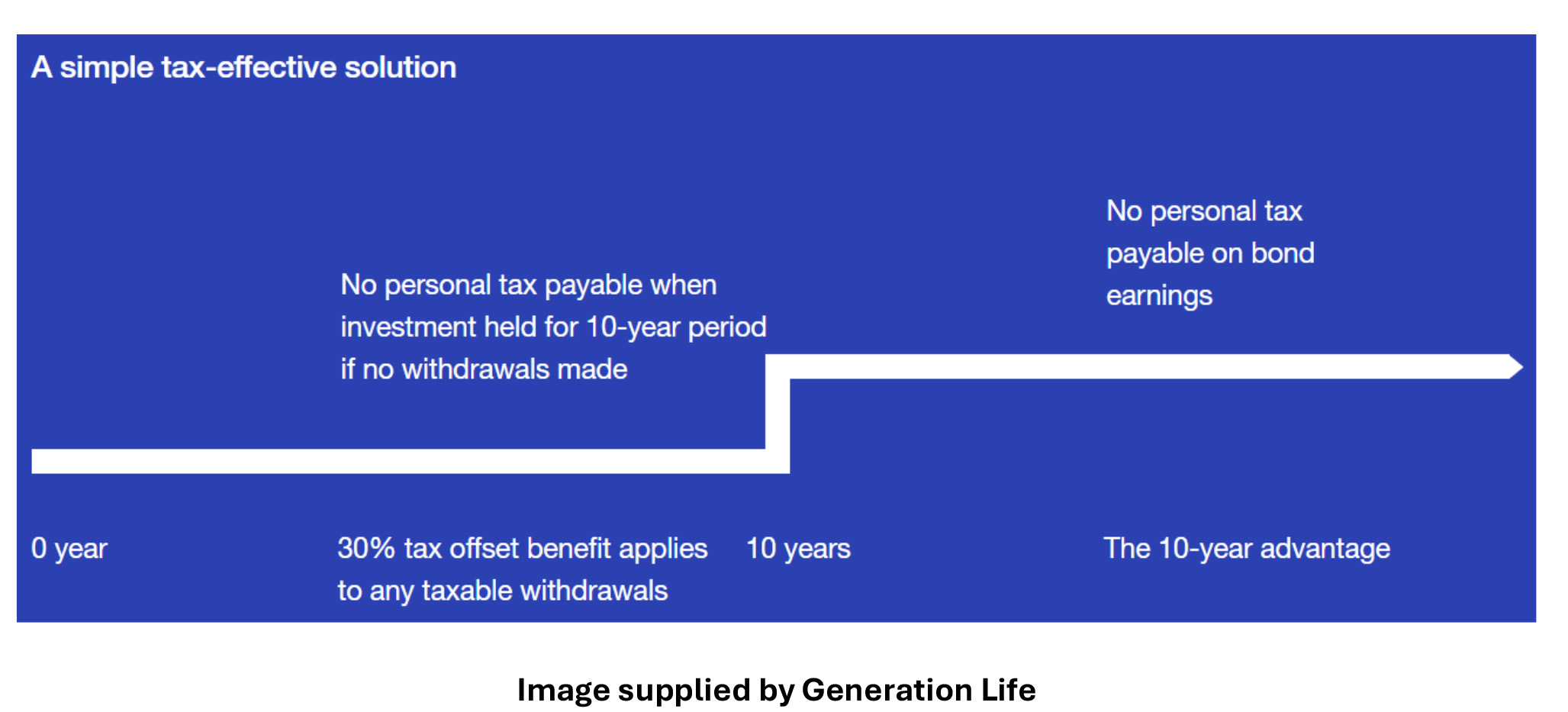
Investors can access their money at any time, but it’s important to understand the personal tax consequences on the earnings component of any withdrawals within the first 10 years. In summary:
- Years 1–8: all of the relevant earnings component of the withdrawal may be assessable in the investor’s personal tax return.
- Year 9: two-thirds of the relevant earnings component of the withdrawal may be assessable
- Year 10: one-third of the relevant earnings component of the withdrawal may be assessable
- After 10 years: withdrawals are tax-paid, with no additional personal tax on the investment earnings, provided the relevant requirements are met.
Where earnings are assessable, the investor may also be entitled to a 30% tax offset for tax already paid within the investment bond, to eliminate any double taxation effects.
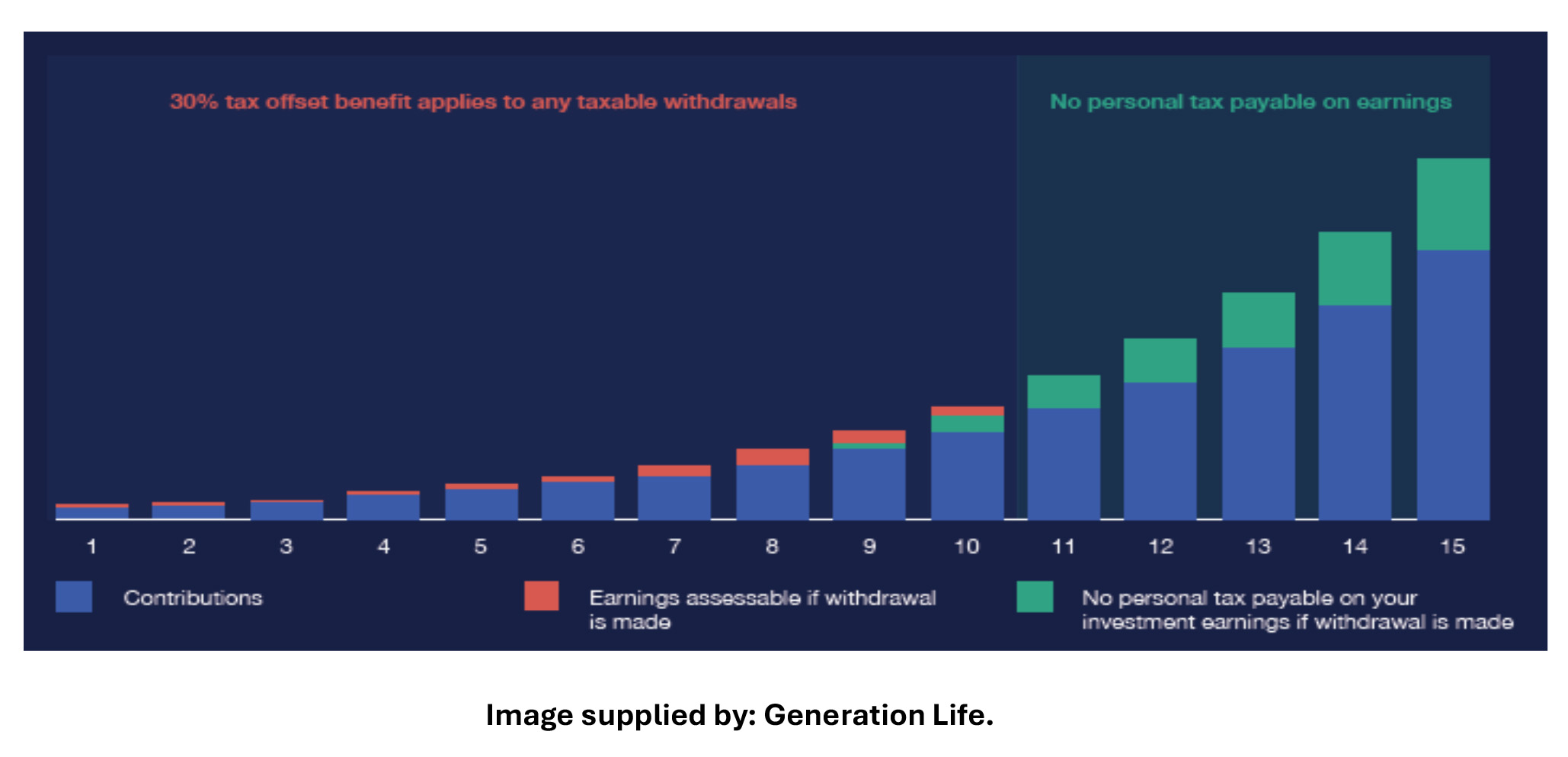
Importantly, the 10-year rule does not mean the money is locked away for 10 years. Unlike superannuation, investment bonds are not subject to preservation rules, so investors can generally access their capital at any time.
The 10-year period is therefore a tax consideration, rather than an access restriction.
The 125% opportunity: an important technical detail
Understanding the 10-year rule also requires understanding what is commonly called the 125% opportunity.
Before we look at how the 125% opportunity works, it’s important to understand what an investment year is. In summary, an investment year starts on the day the investment bond is established and concludes at the following annual anniversary date. For example, if your investment bond commenced on 1 June 2026, your next anniversary date would be 1 June 2027.
Firstly, there are no caps or rules on the level of investment that can be made in an investment bond in the first investment year. For example, you can start an investment with $20,000 on 1 June 2026 and make additional contributions during the first year of $100,000. There are no caps or rules to consider when making contributions in the first investment year.
After establishing an investment bond and in the second and subsequent investment years, an investor can generally continue making contributions without restarting the original 10-year period, provided contributions in an investment year do not exceed 125% of the contributions made in the previous policy year.
For example, if $20,000 is contributed in the first investment year, up to $25,000 could generally be contributed in the following investment year without restarting the 10-year period.
If contributions exceed the 125% amount, the investment bond will be treated as having recommenced for tax purposes from the beginning of that investment year.
This makes contribution planning important.
It also means advisers should distinguish between two separate concepts: the initial investment, which is not subject to the annual 125% formula in the same way, and subsequent contributions, which need to be managed if maintaining the original commencement date is important to the strategy.
Example below provided by Generation Life:
Jane establishes an investment bond on 18 January 2001 and contributes $10,000 in investment year 1. Below is a summary of the allowable contributions Jane could make to maximise the 125% opportunity every subsequent year:
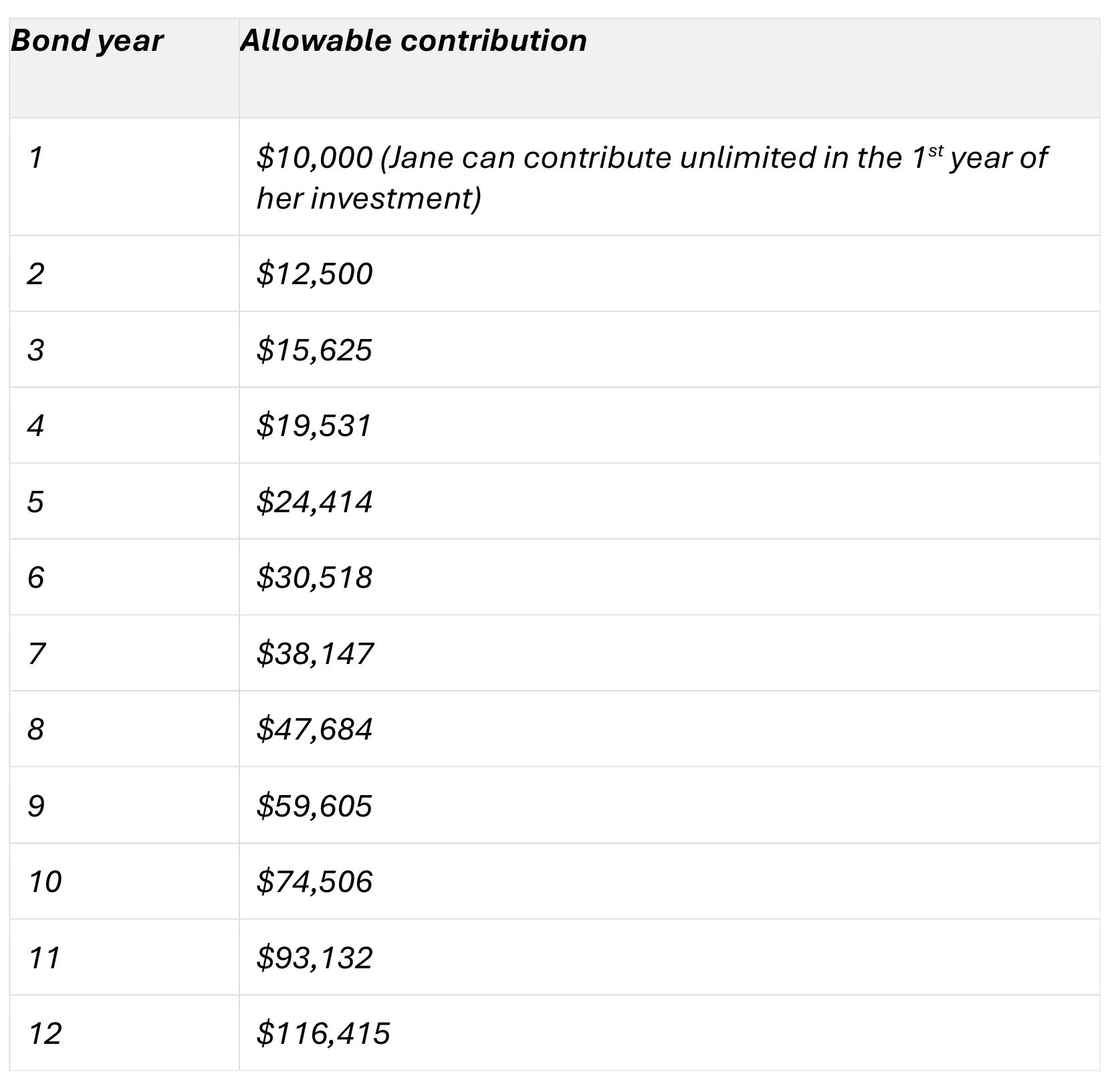
It’s important to note: If contributions in the second and subsequent investment years exceed 125% of the previous investment year’s contributions, then the start date of the 10-year rule resets to the beginning of the year that the excess contributions were made. Resetting the 10-year rule start date will mean that the full tax benefits of the investment will be delayed.
Example: If Jane contributes $40,000 on the 24 April 2005 in bond year 5 and exceeds the allowable contribution, she will reset her subsequent bond year to year 1 on the 18 January 2005.
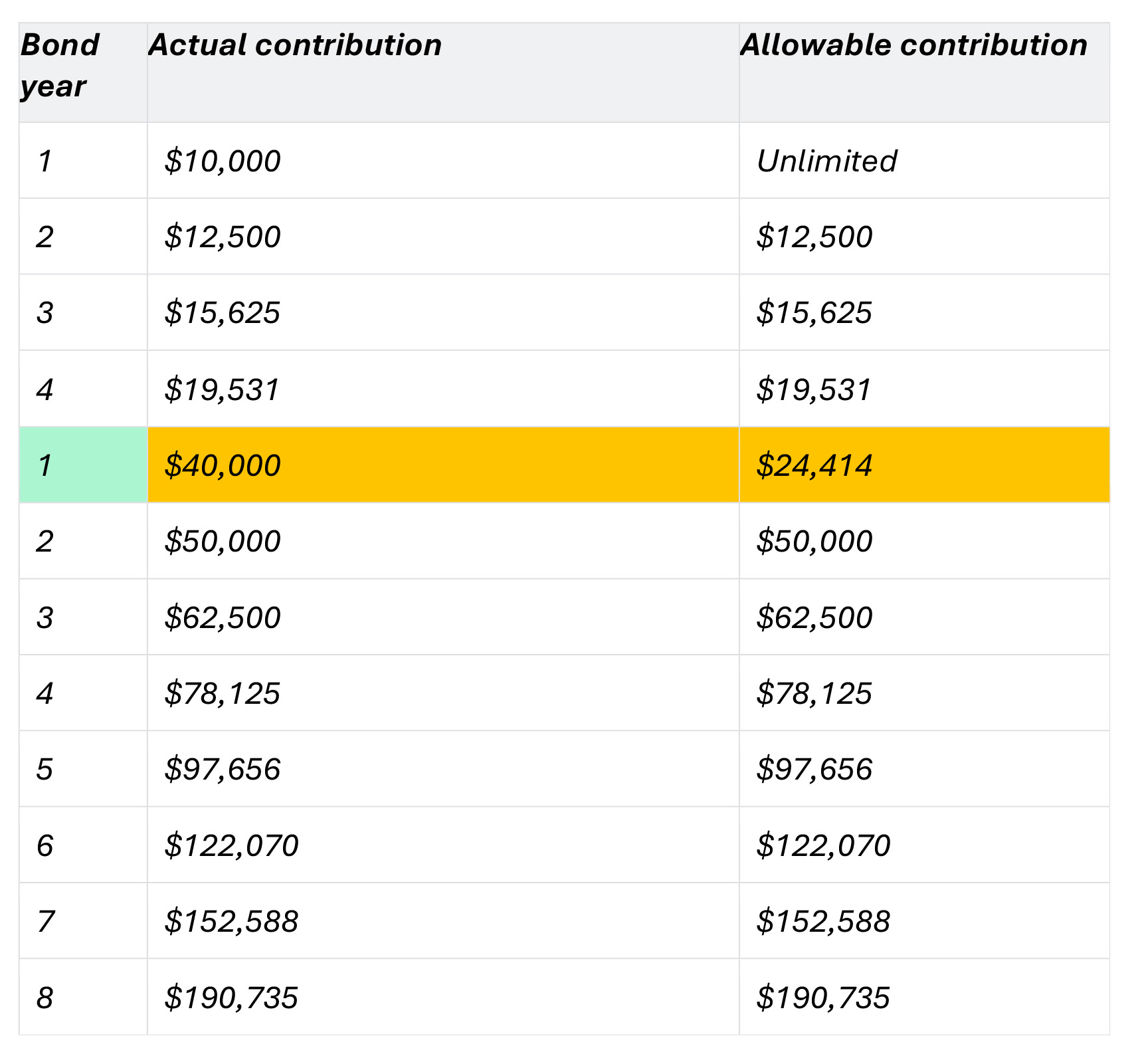
Example continued: What if Jane only contributes $8,000 every year from year 2 and $3,000 from year 7?
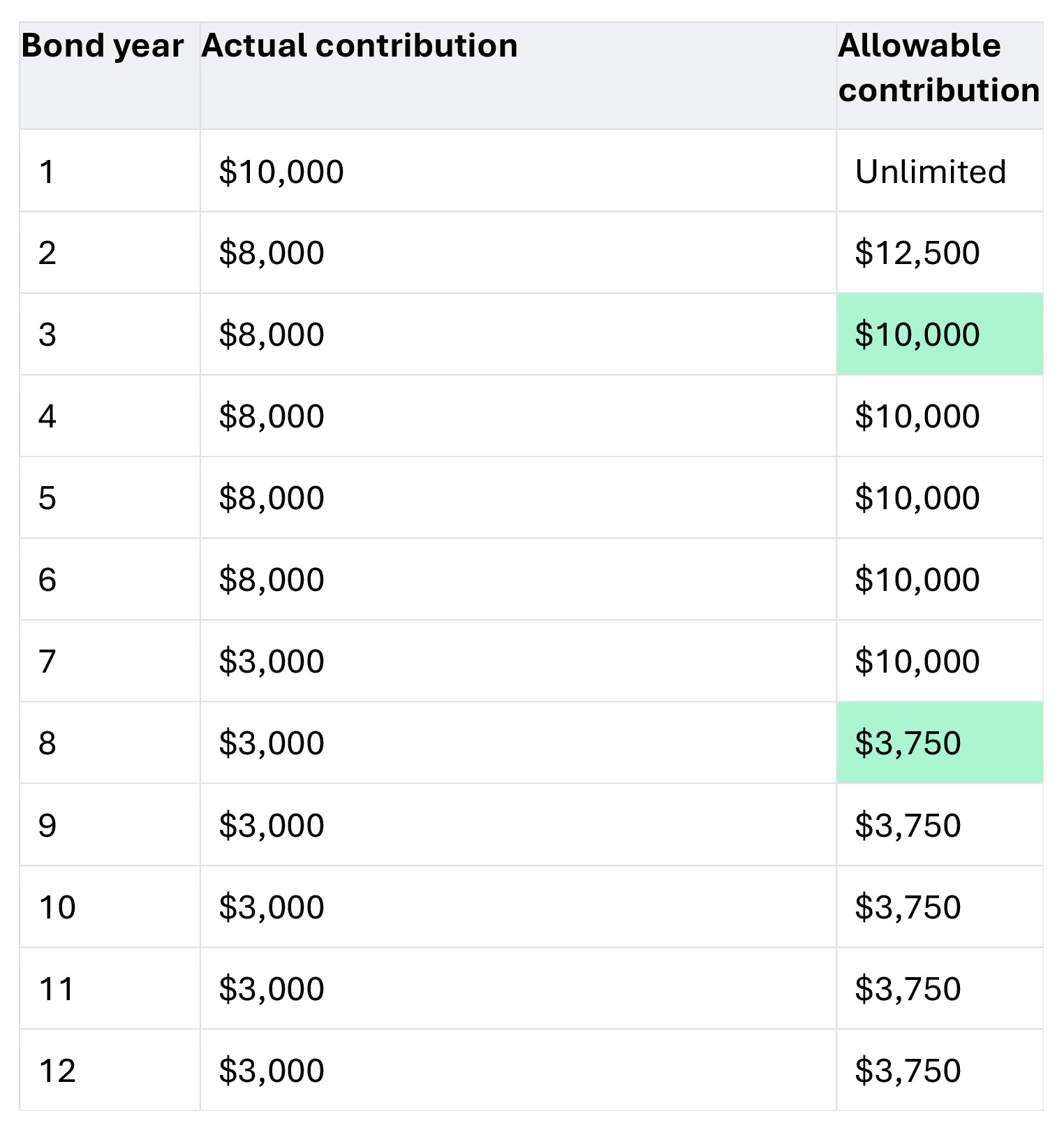 Jane’s allowable contribution reduces in year 3 as she only contributed $8,000 in year 2. Her allowable contribution further reduces in year 8 as she only contributed $3,000 in year 7.
The flexibility to switch investment options
Another important feature of investment bonds is the ability to switch between investment options without triggering a personal capital gains tax (CGT) event for the investor.
With personally held investments, selling one investment to move into another can trigger a CGT event. Within an investment bond, investors can switch between the investment options available without personally realising a capital gain each time they make a change.
This provides flexibility to adjust an investment strategy over time. For example, a client may switch from growth-oriented investments to more defensive options as they approach their goal or rebalance their portfolio as their circumstances change.
For long-term investors, this ability to switch investment options without triggering personal CGT can be a valuable feature of the investment bond structure.
Where can investment bonds sit alongside super?
Investment bonds and superannuation should not necessarily be viewed as substitutes.
Superannuation remains one of Australia’s most concessionally taxed investment environments and provides benefits that investment bonds do not replicate.
But superannuation also operates within a specific regulatory framework. Contribution caps, preservation requirements, balance thresholds and rules governing the taxation of contributions, earnings and benefits all influence how it can be used.
Investment bonds operate outside the superannuation system.
They generally do not have the same contribution caps or preservation requirements, and their taxation is governed by a different legislative framework.
For advisers, the relevant question may therefore be less about choosing superannuation or an investment bond and more about understanding whether different structures can perform different roles within a client’s broader wealth strategy.
Recent legislative reform has made that structural question increasingly relevant.
More than an accumulation vehicle
Although tax-effective wealth accumulation is often the starting point for understanding investment bonds, the investment bond’s structure can also create unique estate-planning opportunities.
Most investment bond providers offer the ability to nominate beneficiaries to receive proceeds following the death of the life insured (normally the investment bond owner).
Some investment bonds may also offer a future transfer option, allowing ownership of the investment bond to automatically transfer to another person or entity when a specified future event occurs (which may include the passing of the owner). Conditions may also be attached to the recipient accessing funds from the investment bond. This can provide greater control over when wealth is transferred and when the intended recipient gains access to the investment. Investment bonds can also be used for long-term goals extending across generations, including investing for children or grandchildren, saving for education and other future financial objectives.
These characteristics mean the structure can potentially address several planning considerations simultaneously: investment, taxation, access and wealth transfer.
That combination is one reason investment bonds warrant understanding as a distinct product category rather than simply as another managed investment.
Looking beyond asset diversification to structural diversification
The recent tax reforms have not changed the fundamental mechanics of investment bonds.
What they have changed is the environment in which advisers are assessing those mechanics.
When established strategies are affected by changing thresholds, tax rates or concessions, advisers may need to look more closely at the diversification of a client’s wealth across different tax structures.
That does not mean abandoning established structures or automatically directing capital towards investment bonds.
Instead, it means considering a broader question: “Does the way my client’s wealth is structured remain appropriate for their objectives, timeframe, access requirements, tax position and estate-planning needs?”
For some clients, investment bonds may form part of the answer. For others, they will not.
The starting point is understanding precisely what they are: a long-term, tax-paid investment structure operating under life insurance legislation, with distinctive features and benefits governing taxation, contributions, withdrawals and wealth transfer.
As Australia’s tax landscape evolves, that knowledge gives advisers another structure to assess when determining how clients can accumulate, manage and ultimately transfer their wealth.
Take the FAAA accredited quiz to earn 0.25 CPD hour:
CPD Quiz
The following CPD quiz is accredited by the FAAA at 0.25 hour.
Legislated CPD Area: Tax (Financial) Advice (0.25 hrs)
ASIC Knowledge Requirements: Taxation (0.25 hrs)
please log in to start this quiz
———–
Disclaimer: Generation Life Limited (Generation Life) AFSL 225408 is the product issuer and provides general financial product advice and other services related to investment life insurance products and life risk insurance products. Any superannuation general financial product advice provided is by Generation Development Services Pty Limited ABN 14 093 660 523 (GDS) as Corporate Authorised Representative, No. 001317211 of Evidentia Financial Services Pty Ltd AFSL 546217 ABN 97 664 546 525 (Evidentia). The information provided is general in nature and does not consider the investment objectives, financial situation or needs of any person and is not intended to constitute personal financial advice. The product’s Product Disclosure Statement (PDS) and Target Market Determination (TMD) are available at www.genlife.com.au and should be considered in deciding whether to acquire, hold or dispose of the product. Superannuation products’ PDSs, offer documents and TMDs are available from the websites of their product issuers. Professional financial advice is recommended. Past performance is not a reliable indicator of future performance. Generation Life, GDS and Evidentia do not make any guarantee or representation as to any particular level of investment returns. Generation Life does not accept any responsibility or liability for superannuation general financial product advice provided by GDS. Generation Life’s investment bonds can provide certainty as they are governed by legislation that has changed infrequently and can be appropriately structured to bypass an estate and be protected in case of bankruptcy of the life insured. Investments carry risks.
CPD Quiz
The following CPD quiz is accredited by the FAAA at 0.25 hour.
Legislated CPD Area: Tax (Financial) Advice (0.25 hrs)
ASIC Knowledge Requirements: Taxation (0.25 hrs)
please log in to start this quiz———–
Disclaimer: Generation Life Limited (Generation Life) AFSL 225408 is the product issuer and provides general financial product advice and other services related to investment life insurance products and life risk insurance products. Any superannuation general financial product advice provided is by Generation Development Services Pty Limited ABN 14 093 660 523 (GDS) as Corporate Authorised Representative, No. 001317211 of Evidentia Financial Services Pty Ltd AFSL 546217 ABN 97 664 546 525 (Evidentia). The information provided is general in nature and does not consider the investment objectives, financial situation or needs of any person and is not intended to constitute personal financial advice. The product’s Product Disclosure Statement (PDS) and Target Market Determination (TMD) are available at www.genlife.com.au and should be considered in deciding whether to acquire, hold or dispose of the product. Superannuation products’ PDSs, offer documents and TMDs are available from the websites of their product issuers. Professional financial advice is recommended. Past performance is not a reliable indicator of future performance. Generation Life, GDS and Evidentia do not make any guarantee or representation as to any particular level of investment returns. Generation Life does not accept any responsibility or liability for superannuation general financial product advice provided by GDS. Generation Life’s investment bonds can provide certainty as they are governed by legislation that has changed infrequently and can be appropriately structured to bypass an estate and be protected in case of bankruptcy of the life insured. Investments carry risks.


Have feedback on this article? Contact Us
Earn CPD Points
 CPD: Currency risk – friend or foe?
In today’s interconnected world, global companies play a significant role in our daily lives. However, when Australian investors allocate their capital to global markets, they are exposed not only to [...]
 CPD: Ethics and moral dilemmas
When it comes to financial advice, the numbers may be black and white, but the ethical decisions often aren’t. This article, proudly sponsored by GSFM, examines moral dilemmas and the [...]
 CPD: Jump in my CAR. Client Advice Records – why, what, how
Introduction The forthcoming replacement of Statements of Advice (SOAs) with Client Advice Records (CARs) has once again shone a spotlight on the vexed issue of client communication within financial advice. [...]
 CPD: Investor Behaviour – Retirement
To best understand how and why clients make financial decisions – particularly during retirement – advisers must look beyond technical strategies and consider investor behaviour. Before addressing product selection or [...]
 CPD: A star is (re)born – Investment Bonds are the new headline act of tax-smart investing
Introduction Tax-smart investing is one of the central pillars of quality, effective, financial advice. The capacity for tax to drag on investment returns, stifle compounding, and eat away at gains [...]