
Key points
- Further tightening in China is likely to ensure that inflation expectations remain under control and to mop up capital inflows flowing from US quantitative easing and Chinese resistance to a stronger Renminbi.
- However, with activity indicators having calmed down after last year’s growth rebound and non-food inflation under control, further tightening should be seen as fine tuning rather than a move to crunch the economy. Policies to boost consumer spending and inland growth are likely to remain in place. Growth is likely to remain around 9 to 10% pa.
- Chinese shares are likely to have more solid upside underpinned by reasonable valuations, solid economic growth, foreign capital inflows and a switch by Chinese investors from property to shares. Further monetary tightening is unlikely to have much impact.
What happened to the China collapse?
Sentiment on China seems to constantly swing between expectations of a boom or a bust. Earlier this year the China sceptics were out in force with claims that China was “Dubai times one thousand” and that a collapse lay ahead as Chinese authorities would over-tighten and cause a property crash and a surge in bad debts.
Today there is little sign of collapse. Having just returned from China the economy seems to be motoring along as per usual. Freeways and airports that weren’t even there a few years ago are full, shopping malls that were deserted in late 2008 are now doing well and confidence seems to be running high. This assessment is consistent with macro economic data showing growth down from the overly strong pace of early this year, but still solid. Against this backdrop, and with data showing rising inflation and capital expected to flood in on the back of more quantitative easing in the US, suddenly the sentiment on China seems to have swung back to China being at risk of overheating, and with it a renewed risk of policy over-tightening.
Our assessment is that China’s economy will settle around a 9 to 10% growth rate over the year ahead, that economic policy will continue to focus on fine tuning the economy rather than crunching it and that Chinese shares remain attractive. But first to the sceptics.
China worries
The common worries about China are: it has overinvested; it excessively relies on exports; the property market is a bubble, bank lending is excessive; it is run by communists who can’t get it right; inflation is out of control; and its managed exchange rate is making it bubble-prone. Looking at each of these:
- With per capita income being 7% of US and Australian levels, pent up demand is huge making it virtually impossible for China to overinvest in infrastructure. Today’s glut quickly becomes tomorrow’s shortage.
- Net exports accounted for just 10% of China’s growth over the last decade. Far less than many claim and also suggestive of a smaller vulnerability to slow growth in consumer demand in the US and Europe than feared.
- While bubble like conditions clearly exist in some cities’ housing markets, nationwide house price increases have lagged income gains and moves to slow the residential property market appear to be working with house price growth slowing to 8.6% over the year to October down from a peak of 12.8% over the year to April. What’s more, household debt is low, average deposits are around 30% of values and 20% of buyers pay in cash. Hardly the stuff of bubbles.
- Bank lending has been strong but household debt is low at around 20% of household disposable income and many of the bank loans to local governments to fund the stimulus of a few years ago are really part of fiscal policy so will be backed by the Government.
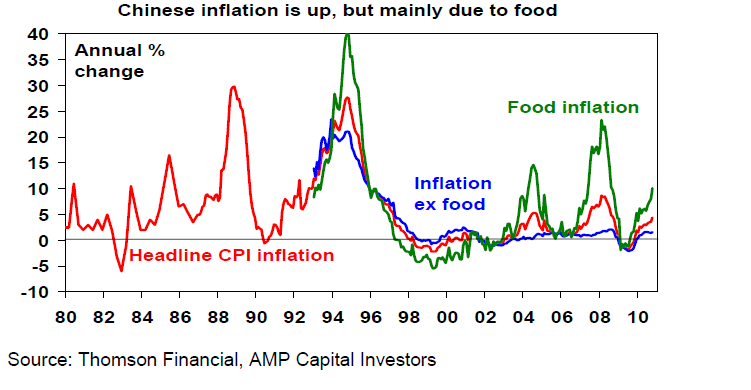
- Claims inflation is out of control are nonsense. On the latest data inflation over the year to October rose to 4.4%. This sounds high but is not unusual for a high growth emerging country, it is well down from 30% or so levels seen in the past, and most of it is food with non-food inflation running at just 1.6%. Nevertheless the authorities have been right to tighten to ensure real interest rates remain positive and that inflationary expectations don’t increase.
- While it may surprise some that the Chinese communist party can do a good job of managing mostly capitalist growth, the reality is that it has been.
- Finally, the latest worry is that by limiting upwards movement in the Renminbi at a time when the US is increasing the supply of US dollars via QE2, it will see significant capital inflows potentially fuelling asset price bubbles. This is a legitimate concern. By limiting the rise in the Renminbi the Chinese authorities have to buy US dollars with their own currency and this boosts China’s money supply. Effectively they have lost some control over their monetary policy. The authorities are reluctant to rely too much on higher interest rates because it only attracts in more hot money. So to mop up the liquidity, China has been using administrative controls such increasing bank reserve requirements, forcing banks to hold more foreign exchange, directives on bank lending, etc. More of this is likely but it is a relatively imperfect way to control money supply and bank lending and so asset bubbles remain a high risk.
The current state of economic activity
Recent readings on Chinese growth paint a mixed picture:
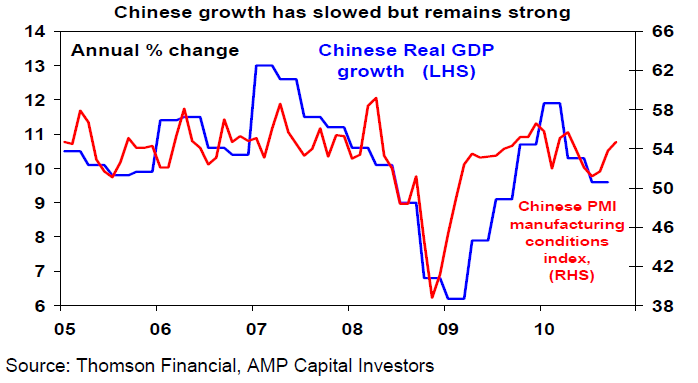
- GDP growth slowed to 9.6% over the year to the September quarter, down from 11.9% growth over the year to the March quarter;
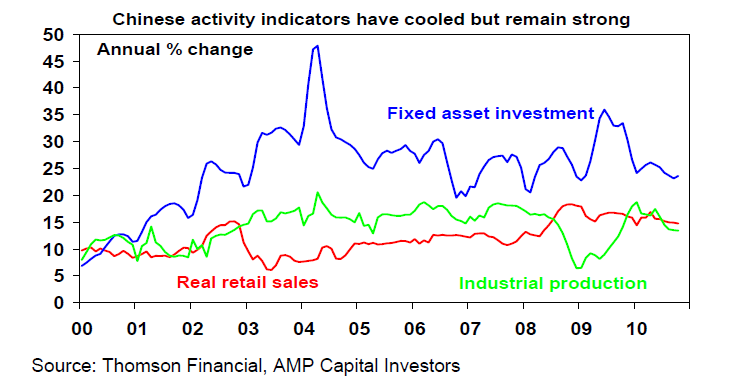
- Fixed asset investment has slowed from an annual growth rate of around 35% 18 months ago to around 24% and growth in industrial production has cooled;
- Retail sales growth has slowed, but still remains very strong consistent with policies to rebalance the economy towards consumption;
- Loan growth has slowed from a peak of 34% year on year to 19% year on year, but still remains too strong for the authorities liking; and
- Inflation has risen further reaching 4.4% over the year to October. However, non-food inflation is just 1.6%.
- Finally, house price and sales momentum has slowed.
The bottom line is that further tightening measures are likely in order to ensure inflationary expectations don’t increase, that loan growth slows further and just to soak up the liquidity flowing from China’s efforts to stop the Renminbi from rising. However, with growth indicators pointing to GDP growth running at a healthy pace of around 9 to 10% and non-food inflation running at just 1.6% it’s hard to see further measures becoming aggressive. While it’s reasonable to expect another two or three 0.25% increases in interest rates over the next six months, most of any additional tightening moves are likely to take the form of administrative measures. At the same time measures to boost consumer spending and inland growth are likely to remain in place. Overall, it will remain a case of fine tuning the economy rather than trying to crunch it. As such we remain of the view that China’s economy will grow around 9.5% next year.
What is the Chinese share market telling us?
In recent times the Chinese mainland share market has become a good directional barometer of the Chinese economy. A 30% rebound in Chinese shares since early July is consistent with continued solid growth in China. Certainly the continuing strength in Chinese shares despite various tightening moves over the last month is a very different reaction to the negative response to tightening measures earlier this year, and is consistent with our view that Chinese tightening amounts to fine tuning and as such remains consistent with continued economic strength.
Our assessment is that, after a possible brief pause following recent strong gains, Chinese shares are likely to have more upside. Economic growth remains solid, the authorities will be unable to mop up the entire liquidity surge flowing from quantitative easing in the US and investors will switch from the property market as recent property tightening measures continue to bite. What’s more, despite the huge rally since early July, valuations for Chinese shares are still attractive with the price to earnings multiple based on historic earnings of 22 times, which is still well below the average over the last decade of 34 times.
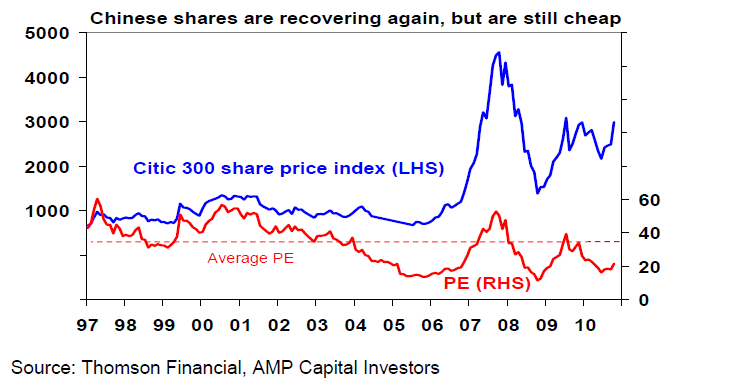
Given the recent coincident to leading relationship from Chinese to global shares, a likely continuing recovery in the former should be good for the latter.
Concluding comments
Further policy tightening is likely in China, but it will amount to fine tuning and economic growth in China will settle around 9.5% over the year ahead. This is likely to be positive for Chinese shares. It is also likely to be positive for commodity prices and Australian resources stocks.


