
Retail trade; Job advertisements; Performance of Construction
- Weak consumer spending. Retail spending grew by just 0.2 per cent in December, below expectations centred on a rise of 0.5 per cent. In the December quarter, inflation-adjusted retail trade fell by 0.3 per cent – the first fall in 15 months. The measure of retail prices fell by 0.1 per cent in the quarter. Prices fell in seven of the 15 detailed sectors in the quarter.
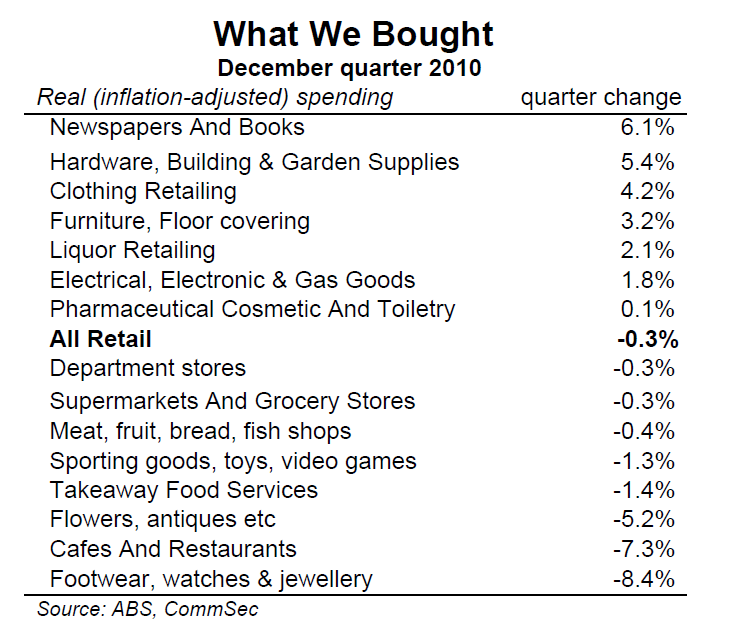
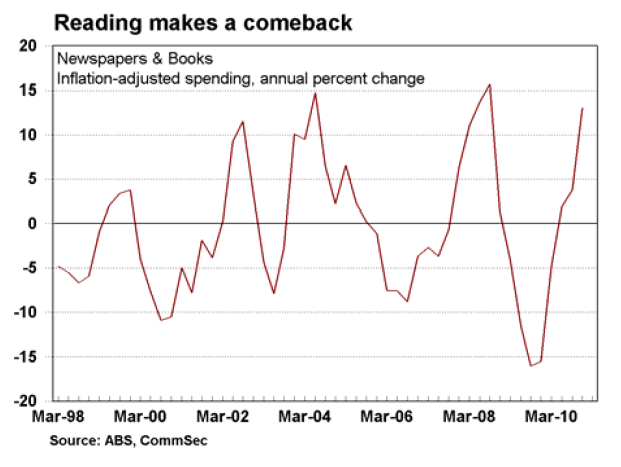
- Books in; cafes out. Unpublished data shows that Aussies spent up big on newspapers and books in the December quarter together with hardware items and clothing. But spending on shoes was slashed while people made fewer visits to cafes & restaurants.
- Mixed signals on the job market. The Advantage internet job index fell by 0.4 per cent in January after falling 2.3 per cent in December. The ANZ job ads index rose by 2.4 per cent.
- Construction is sliding. The Performance of Construction index fell by 3.6 points to 40.2 in January – the lowest reading since July 2009.
What does it all mean?
- Over the last three months of 2010, more Aussies decided to get lost in a good book in their breaks from painting, decorating and home renovation projects. At the same time we made fewer outings to cafes & restaurants, bought fewer shoes and cut back on take-away food, toys and video games. Overall it seems that the average consumer has gone back in time to when life was simpler.
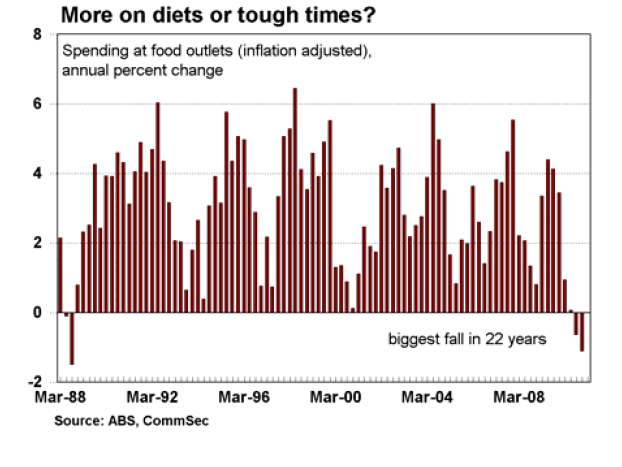
- It also seems that we are eating less – perhaps finally waking up to the obesity problem. For the second straight quarter, spending on food (in inflation-adjusted terms) has been cut with specialty retailers like butchers, bakers and fruit and vegetable shops seemingly the hardest hit.
- All the anecdotes from retailers have been spot on – we just aren’t in the mood to spend. Spending over the Christmas period was extremely weak with higher interest rates, electricity rates and petrol prices seemingly the main factors causing us to cut back.
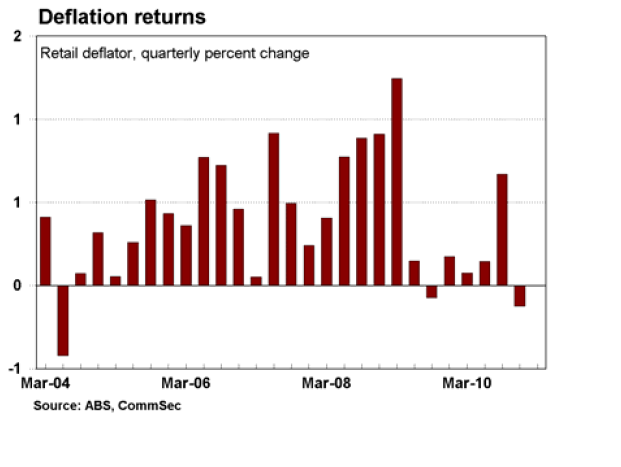
- More and more retailers are feeling the bracing winds of deflation, or falling prices. In fact around half of retail sectors saw prices fall in the December quarter.
- The bad news is that picky consumers aren’t even being enticed by cheaper prices. Despite retail prices falling 0.1 per cent in the December quarter, spending went backwards by 0.3 per cent.
- It’s not all bad news for retailers. With the job market tight, wages rising and wealth at record highs, there are good reasons for consumers to start spending again. But it will require the Reserve Bank to take an extended period on the interest rate sidelines.
- Employment growth is showing mixed signals. The Advantage job index has tracked lower for two consecutive months while the ANZ job ads series has shown more subdued growth. Overall the result would please the Reserve Bank given its recent forecasts for a more sedate pace of growth in the labour market.
What do the figures show?
Retail trade (December month):
- Retail trade rose by just 0.2 per cent in December after lifting 0.4 per cent in November. Over the last five months, retail spending has gone nowhere. Over the past year retail trade rose by just 2.1 per cent.
- Spending fell most in South Australia and Tasmania (both down 1.3 per cent) with spending in the ACT down 0.5 per cent and Western Australian spending down 0.2 per cent.
- Sales by chain stores and other large retailers fell by 0.1 per cent in seasonally terms in December while sales by smaller retailers rose by 0.6 per cent. In annual terms sales at both chain stores and smaller retailers were up 2.1 per cent on a year ago.
- During December, sales increased most at footwear and jewellery outlets (up 3.6 per cent) followed by electrical and electronic goods retailers (up 2.5 per cent) and clothing outlets (up 2.3 per cent). Spending fell most at butchers, fruit & veg and other specialty retailers (down 3.1 per cent).
Retail trade (December quarter):
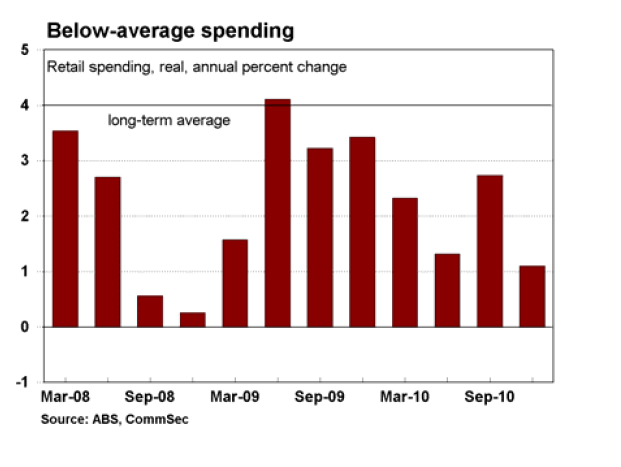
- Retail trade fell by 0.3 per cent in real (inflation-adjusted) terms in the December quarter after rising 0.5 per cent in the September quarter. Annual growth fell from 2.7 per cent to a two-year low of 1.1 per cent.
- The measure of retail inflation – the retail deflator – fell by 0.1 per cent in the December quarter after 0.7 per cent growth in the September quarter. Annual retail inflation fell from 1.1 per cent to 0.8 per cent in the December quarter. Deflation – falling prices – occurred in seven of the 15 retail sectors in the December quarter.
- In real terms, spending rose most in the quarter at newspapers & books outlets (up 6.1 per cent) but spending on footwear slumped by 8.4 per cent with visits to cafes and restaurants down 7.3 per cent.
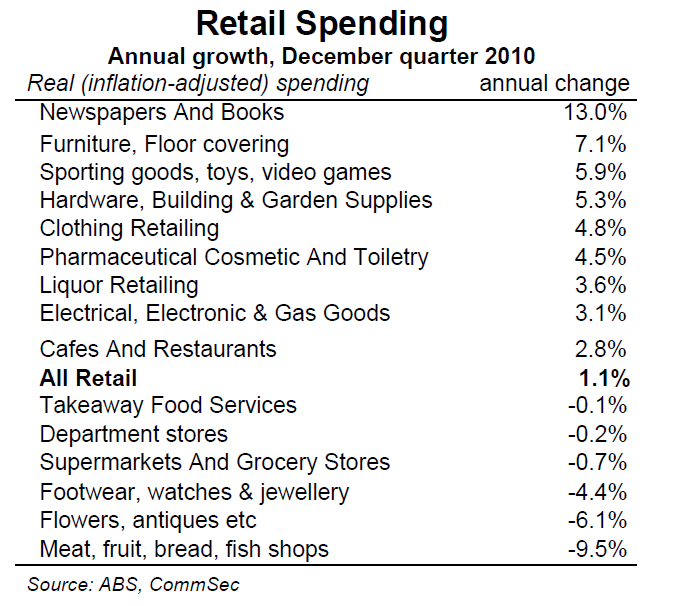
- Compared with a year ago, newspapers & books spending is up 13.0 per cent in real terms with furniture & floor covering sales up 7.1 per cent. But at the other end of the scale spending at butchers, fruit & veg and other specialty retailers were down 9.5 per cent.
Performance of Construction:
- The Performance of Construction index fell by 3.6 points to 40.2 in January. Any reading below 50.0 indicates the sector is contracting. Houses, apartments, engineering and commercial construction were all below 50.
- The PCI is at the lowest level since July 2009 with the employment component the lowest since March 2009.
Job advertisements:
- The Advantage internet job index fell by 0.4 per cent in January. Job ads were weak in ACT (down 9.5 per cent) and Queensland (down 5.8 per cent) but strongest in Western Australia (up 5.8 per cent). Across sectors, gains were recorded for human resources (4.7 per cent), education (3.2 per cent) and sales and marketing (2.4 per cent). Declines were recorded for transport (-8.8 per cent), legal (-8.1 per cent) and tourism (-2.7 per cent).
- By contrast the ANZ job ad index rose by 2.4 per cent in January after lifting 1.2 per cent in November. But the index provides no break-up across states or industries.
What is the importance of the economic data?
- The Bureau of Statistics’ Retail trade publication contains the most current readings on the performance of consumer spending. The ABS surveys 500 ‘larger businesses’ and 2,750 ‘smaller businesses’. Retail trade covers spending at a broad range of retail outlets but excludes both petrol and motor vehicle sales. A weak retail trade result may point to a slowing economy as well weighing on the share prices of listed retail stocks. But retail trade estimates can’t be assessed in isolation – it is important to look at the influences determining future trends in consumer spending, such as income, employment and confidence levels.
- The monthly Job Advertisements release is a leading employment indicator. Employers only seek additional staff if business activity is strong, and more importantly, if they expect that conditions will remain favourable in coming months. It takes around 5-6 months for the new staff to be added to the payrolls. But a fall in job advertisements would have a more immediate impact on monthly employment estimates.
- The monthly Performance of Construction Index is a gauge of operation conditions across residential, commercial and engineering construction. The PCI is useful not just in showing how the construction sector is performing but in providing some sense about where it is heading. The key ‘forward looking’ components are orders and employment.
What are the implications for interest rates and investors?
- Day by day the Reserve Bank is being presented with more reasons to stay on the interest rate sidelines. Key sectors like manufacturing, services and construction are going backwards while deflation is taking a greater grip on the retail sector. And while retailers are cutting prices in an attempt to move stock, it seems like retailers aren’t interested.
- We just don’t know how long the current bout of consumer conservatism will last. The longer-term outlook for retailers is positive though with the job market still healthy, wages rising and wealth at record highs.
- The key issue for policy makers is to maintain a healthy labour market. As the Reserve Bank highlighted in last week’s Monetary Policy statement unemployment is forecast to only fall by about half a per cent over the next two years. A rise in productivity, weaker employment growth and a pickup in skilled migration should ensure that excessive wage growth is well contained.
- We can’t rule out the possibility that the Australian economy could experience a modest technical recession over the December 2010 and March 2011 quarters.
Produced by Commonwealth Research based on information available at the time of publishing. We believe that the information in this report is correct and any opinions, conclusions or recommendations are reasonably held or made as at the time of its compilation, but no warranty is made as to accuracy, reliability or completeness. To the extent permitted by law, neither Commonwealth Bank of Australia ABN 48 123 123 124 nor any of its subsidiaries accept liability to any person for loss or damage arising from the use of this report.
The report has been prepared without taking account of the objectives, financial situation or needs of any particular individual. For this reason, any individual should, before acting on the information in this report, consider the appropriateness of the information, having regard to the individual’s objectives, financial situation and needs and, if necessary, seek appropriate professional advice. In the case of certain securities Commonwealth Bank of Australia is or may be the only market maker.
This report is approved and distributed in Australia by Commonwealth Securities Limited ABN 60 067 254 399 a wholly owned but not guaranteed subsidiary of Commonwealth Bank of Australia. This report is approved and distributed in the UK by Commonwealth Bank of Australia incorporated in Australia with limited liability. Registered in England No. BR250 and regulated in the UK by the Financial Services Authority (FSA). This report does not purport to be a complete statement or summary. For the purpose of the FSA rules, this report and related services are not intended for private customers and are not available to them.
Commonwealth Bank of Australia and its subsidiaries have effected or may effect transactions for their own account in any investments or related investments referred to in this report.


