
The big picture
- The big issue across the globe at present is inflation. At the start of the year sharply rising food prices prompted riots in Algeria, with dissatisfaction quickly spreading to Tunisia and Egypt. The unrest in Egypt also served to unsettle other regimes across the Middle East as evidenced in anti-government riots in Jordan, culminating in the dismissal of the government.
- And it’s not just food prices that have been soaring, textile prices have risen sharply over the past five months with cotton doubling in price to record highs and wool hitting the highest levels in 23 years.
- While some may blame speculators for the higher prices, for most markets it is simply the result of supply and demand. Emerging economies have grown strongly, prompting higher demand for food, clothing and other staples. But supply has been struggling to keep up – a function of weather, a delay in response to the surprising strength in demand and industrialisations in many countries that has led to a reduction of agricultural land.
- Of course in some respects, higher prices for agricultural commodities is positive for emerging and developing nations, reliant on commodities for income. But while producers gain, poorer workers, especially in manufacturing and tertiary sectors, are faced with higher living costs. Thus the rising levels of unrest across the developing world as people complain that governments are failing to look after their interests.
- Many advanced nations must wonder what all the fuss is about. In the US, the headline rate of inflation stands at 1.5 per cent while the core rate (excludes food and energy) is just 0.8 per cent. In Australia, recent figures showed underlying inflation at decade lows in the December quarter while the measure of retail prices actually fell by 0.1 per cent.
- But as economies in the US and Europe continue to recover, fuelled by arguably the most stimulatory monetary policies on record, inflation will become a more pressing concern. Certainly longer-dated US treasury bond yields have risen sharply with 10-year yields up 32 basis points in just the past eight days, hitting a 10-month high of 3.76 per cent on February 8. And over the past four months, US 10-year yields have risen by 133 basis points, out-pacing a 75 basis point lift in equivalent Australian bonds.
- China has lifted interest rates for the third time since October last year to head off inflationary pressures and we can expect a progression of other central banks to tighten policy over coming months.
The week ahead
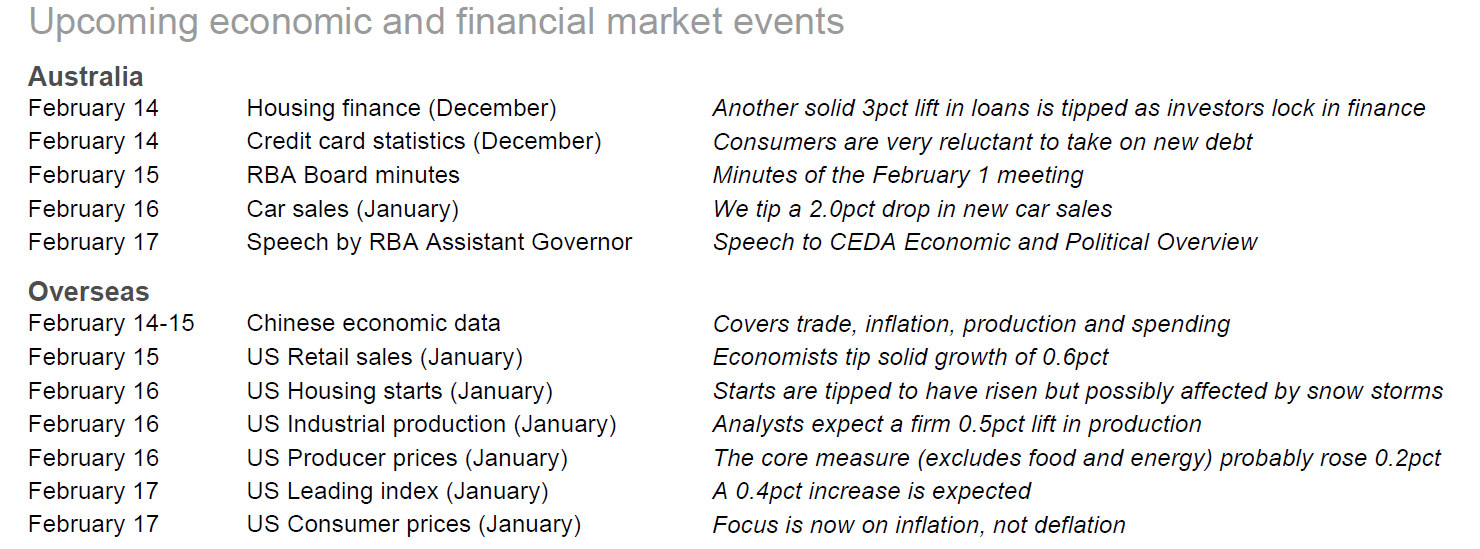
- Lending figures dominate the domestic economic calendar over the coming week while in the US there is a solid array of top-shelf economic indicators due for release.
- On Monday, figures are expected to show another solid lift in housing lending with borrowers locking in commitments made before the November rate hike. Overall we expect that the value of loans lifted by 3 per cent in December after a 2.9 per cent increase in November. But the real test will come when potential borrowers decide to actually take up the commitments made by lenders.
- On Tuesday, data on lending commitments is made, covering personal, lease and commercial categories as well as the housing figures revealed a day earlier. On the same day the Reserve Bank will release minutes of its February 1 Board meeting while ABARES will release its latest Crop Report.
- On Wednesday, the January new car sales figures will be recast by the Bureau of Statistics. Industry data has already been released showing sales of 73,584 vehicles, down 1.7 per cent over the year. CommSec expects the seasonally adjusted estimates provided by of ABS to show a fall of around 2 per cent for the January month.
- On Thursday, detailed monthly employment statistics are released together with January imports data. And on the same day Assistant Governor Philip Lowe presents views on the economy when he fronts an Economics and Political Overview conference conducted by business group, CEDA.
- Overseas, the week starts with key economic data from China. On Monday, trade data is released while on Tuesday the customary barrage of inflation, production, consumer spending and investment figures are released. The old adage used to be that if the US sneezed, the world caught cold. Now it is more accurate to say if China sneezes the world would catch a cold and Australia would get pneumonia.
- In the US, a bevy of market-moving statistics will be released over the week. On Tuesday, retail sales data is issued together with capital flows, business inventories, trade prices and the Empire state index. Economists expect another solid 0.6 per cent lift in retail sales in January after a similar strong gain in December.
- On Wednesday, industrial production figures are issued alongside housing starts and producer prices. The Federal Reserve also releases minutes of the January 26 meeting on the same day. Production is tipped to rise 0.5 per cent with housing starts up 2 per cent to 540,000 and core producer prices (excludes food and energy) up 0.2 per cent.
- On Thursday, consumer prices, the leading index and Philadelphia Fed index are released. Core consumer prices are tipped to edge just 0.1 per cent higher.
Sharemarket
- The Australian profit-reporting season continues in the coming week. And if the past week has been anything to go by, expect companies to be generally sombre on the outlook, especially for consumer-focussed businesses.
- Amongst those to report on Monday include Bendigo Bank and Leighton Holdings. On Tuesday Brambles, Foster’s, Primary Healthcare, MAp group, Commonwealth Property and CFS Retail are scheduled to release earnings. A rash of companies will report on Wednesday including BHP Billiton, CSL, SEEK, The Reject Shop, SMS Management and Dominos Pizza. It’s another big day for earnings reports on Thursday with Coca Cola Amatil, ConnectEast, Prime Media, Qantas, Santos, Westfield and Wesfarmers scheduled to report. And on Friday Automotive Holdings, Billabong, Fortescue, James Hardie, Duet and Consolidated Media are amongst those to report.
Interest rates, currencies & commodities
- Little to report in currency land with major currencies largely trending sideways against the greenback over the past week. What is remarkable is the relative absence of volatility – a trend in evidence across all financial markets. The Aussie dollar is seemingly comfortable near parity against the greenback, holding between US98.5 and 102.0 cents over 2011.
- Bond yields have lifted sharply over the past week as investors have become more confident about the US economic recovery, and similarly more worried about a lift in inflationary pressures. Australian 10-year bond yields have lifted to 10-month highs of 5.75 per cent with 3-year yields up to 5.30 per cent. Interestingly, short-term rates have been largely stable with 90-day bill yields holding near 4.90 per cent.
- In contrast to the inflationary fears, commodity prices have actually retreated over the past week, dragged down by lower energy prices. The CRB futures commodities index hit 28-month highs of 342.17 on February 1 but has since eased by around 1.0 per cent.
- But while overall prices have eased, a key area of strength on commodity markets has been fibres. Cotton prices have lifted to record highs with prices doubling in just under five months. Also doing well is wool with the eastern market indicator soaring to 23-year highs. Demand from Europe has strengthened, Chinese demand has remained firm but supply hasn’t kept pace. In fact wool prices have lifted 45 per cent in US dollar terms in just over four months.
Produced by Commonwealth Research based on information available at the time of publishing. We believe that the information in this report is correct and any opinions, conclusions or recommendations are reasonably held or made as at the time of its compilation, but no warranty is made as to accuracy, reliability or completeness. To the extent permitted by law, neither Commonwealth Bank of Australia ABN 48 123 123 124 nor any of its subsidiaries accept liability to any person for loss or damage arising from the use of this report.
The report has been prepared without taking account of the objectives, financial situation or needs of any particular individual. For this reason, any individual should, before acting on the information in this report, consider the appropriateness of the information, having regard to the individual’s objectives, financial situation and needs and, if necessary, seek appropriate professional advice. In the case of certain securities Commonwealth Bank of Australia is or may be the only market maker.
This report is approved and distributed in Australia by Commonwealth Securities Limited ABN 60 067 254 399 a wholly owned but not guaranteed subsidiary of Commonwealth Bank of Australia. This report is approved and distributed in the UK by Commonwealth Bank of Australia incorporated in Australia with limited liability. Registered in England No. BR250 and regulated in the UK by the Financial Services Authority (FSA). This report does not purport to be a complete statement or summary. For the purpose of the FSA rules, this report and related services are not intended for private customers and are not available to them.
Commonwealth Bank of Australia and its subsidiaries have effected or may effect transactions for their own account in any investments or related investments referred to in this report.


