
The big picture
- The role of a business economist is to educate, inform and occasionally entertain. But most people merely want business economists to explain what key issues mean in practical terms.
- And the one concept that most people want to understand is the terms of trade. Simply, the terms of trade relates the prices that we receive for our exports to the prices we pay for imports. If we get paid more for our exports and we pay less for our imports, it means that we are – collectively – better off. It means more income for Australians.
- The Reserve Bank constantly notes that the extra income being received because of the high terms of trade is a key source of concern, but most don’t know what that has got to do with them. And rightly so because the gains aren’t easy to see and aren’t distributed evenly.
- But since 2004 when the terms of trade started to lift in a meaningful way, our exports have increased by $34 billion, with the extra income from higher prices totalling $23 billion and volumes up $11 billion. Over the same time imports rose by almost $22 billion with almost all the increase in extra volumes – we effectively paid no more but also paid no less in net terms over the period in response to price changes.
- Most of the income gains have gone to businesses – in the form of increased revenue, higher profits, cheaper inputs and savings on new equipment. But consumers have also done well with the higher Australian dollar making imported goods more attractive.
- If businesses and consumers use the increased revenue and cheaper prices to boost spending on a raft of domestic and foreign goods and services then the Reserve Bank would be worried. In other words there would be more money chasing the goods and services on offer, potentially driving up prices and economy-wide inflation.
- But if businesses and consumers instead use the terms of trade gains to cut debt levels and boost savings then the Reserve Bank has less to worry about. And that is precisely what has been happening.
- So don’t let anyone tell you that interest rates will need to go up because the terms of trade is rising. It depends whether the extra income is spent or saved, and the latter continues to dominate, serving to minimise the inflation risk. The Reserve Bank has been at pains to point this out, but it has had mixed success in getting the message through – even to the business and media economists that should know better.
The week ahead
- It comes around every three months – the time when the stars appear to align and we are bombarded by what appears to be every imaginable economic statistic.
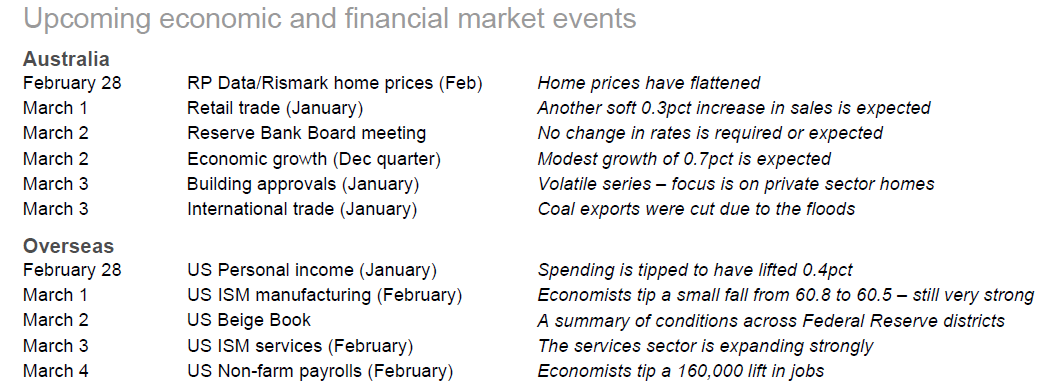
- The ‘autumn avalanche’ kicks off on Monday with data on private sector credit (lending), home prices and the Bureau of Statistics (ABS) business indicator series. The latter includes figures on inventories, profits and sales.
- On Tuesday the Reserve Bank Board meets to decide interest rate settings – but no change is required or expected. Also the quarterly balance of payments data is released the same day together with government finance, retail trade and the performance of manufacturing survey. Retail trade is expected to grown by 0.3 per cent in January but the floods may have distorted the results.
- On Wednesday, GDP or economic growth estimates for the December quarter are released. At this early stage (key components will be released over the next few days) we estimate that the economy grew by 0.7 per cent in the quarter after an anaemic 0.2 per cent increase in the September quarter. There is the risk that a ‘technical recession’ may be revealed in the GDP numbers over the next year – two consecutive quarters of economic contraction. As noted, this would be more of a ‘technical’ event – influenced by floods and cyclones – but it will serve to keep the Reserve Bank on the interest rate sidelines for longer.
- On Thursday data on building approvals and international trade are released. Again the figures will be affected by the floods. Building approvals probably rose 3 per cent while a trade surplus of $1.5 billion is expected.
- In the US, the first Friday of the month is notable because it is when monthly employment data is released. And after disappointing figures in the last couple of months, there is a lot riding on the upcoming February data. The good news is that economists tip an improvement with non-farm payrolls expected to lift by 160,000, although the unemployment rate may edge up from 9.0 per cent to 9.1 per cent. Nevertheless the results should encourage investors and thus keep the bull market alive.
- Turning to the other data, personal income and spending figures are released on Monday together with pending home sales and regional manufacturing gauges for New York and Chicago. On Tuesday the ISM manufacturing survey is released together with construction spending and car sales. The Federal Reserve Beige Book is released on Wednesday with the ADP employment index and Challenger job layoff series.
- On Thursday the ISM services index is issued while factory orders data is released on Friday alongside the nonfarm payrolls data.
- Also of note, the Chinese purchasing managers for February will be released on Monday. Investors hope for solid, but not sensational growth.
Sharemarket
- No doubt the post-mortems are about to start – with analysts and investors alike dissecting the results from the profit-reporting season. But overall the simple conclusion is that the earnings results have been very mixed. And understandably so. Consumers haven’t been spending, forcing businesses to slash prices and margins, and ultimately depressing earnings. There have also been headwinds provided by the lofty Australian dollar – not just for those with significant overseas operations – but also for retailers, contributing to price deflation at home. The ongoing strength of the Chinese economy has lifted mining revenues but it has also caused headaches for companies – what to do with all the cash? In aggregate, though, profits by ASX 200 companies rose by around 40 per cent over the past year, so it is clear that Corporate Australia is in fundamentally strong shape.
Interest rates, currencies & commodities
- The tensions in the Middle East and Africa have caused oil and gold prices to gyrate and injected more life into equities markets, but currency markets have been relative immune from the volatility. The Aussie dollar continues to hover near parity against the greenback although it has lost some ground against the Euro. The inflation hawks at the European Central Bank have been rattling sabres, threatening to push up interest rates, despite many countries in the process of implementing austerity measures to get debt and budget deficits under control.
- Financial markets are preparing for a long period of inaction by the Reserve Bank on interest rates. The Reserve Bank Governor has noted the “reasonably lengthy” periods in the past of “sitting, waiting and watching.” Shortterm interest rates have barely budged over 2011 with physical 90-day bill yields holding close to 4.90 per cent, modestly above the 4.75 per cent cash rate.
- It’s important to highlight the conflicting forces acting on world oil markets. On the one hand there are the tensions in the Middle East and Africa, raising concerns about potential disruptions of crude oil supplies – especially into Europe. Speculative forces have also been active in pushing up Brent prices. But on the other hand, China is attempting to slow its economy, US gasoline inventories are near 21-year highs and OPEC is intimating that some members may be allowed to lift production if there are disruptions to global supply. The Australian petrol price may be near 28-month highs, but interestingly the $1.35 per litre average price is not far above the 5-year average of $1.28 a litre.
Produced by Commonwealth Research based on information available at the time of publishing. We believe that the information in this report is correct and any opinions, conclusions or recommendations are reasonably held or made as at the time of its compilation, but no warranty is made as to accuracy, reliability or completeness. To the extent permitted by law, neither Commonwealth Bank of Australia ABN 48 123 123 124 nor any of its subsidiaries accept liability to any person for loss or damage arising from the use of this report.
The report has been prepared without taking account of the objectives, financial situation or needs of any particular individual. For this reason, any individual should, before acting on the information in this report, consider the appropriateness of the information, having regard to the individual’s objectives, financial situation and needs and, if necessary, seek appropriate professional advice. In the case of certain securities Commonwealth Bank of Australia is or may be the only market maker.
This report is approved and distributed in Australia by Commonwealth Securities Limited ABN 60 067 254 399 a wholly owned but not guaranteed subsidiary of Commonwealth Bank of Australia. This report is approved and distributed in the UK by Commonwealth Bank of Australia incorporated in Australia with limited liability. Registered in England No. BR250 and regulated in the UK by the Financial Services Authority (FSA). This report does not purport to be a complete statement or summary. For the purpose of the FSA rules, this report and related services are not intended for private customers and are not available to them.
Commonwealth Bank of Australia and its subsidiaries have effected or may effect transactions for their own account in any investments or related investments referred to in this report.


