
Why the classics always come back in fashion
Investing for growth has long been in vogue for Australian investors, and with recent periods of long term growth, it is easy to see why. However, the often overlooked dividend may provide a more consistent source of return that can help investors tailor a portfolio to meet their needs.
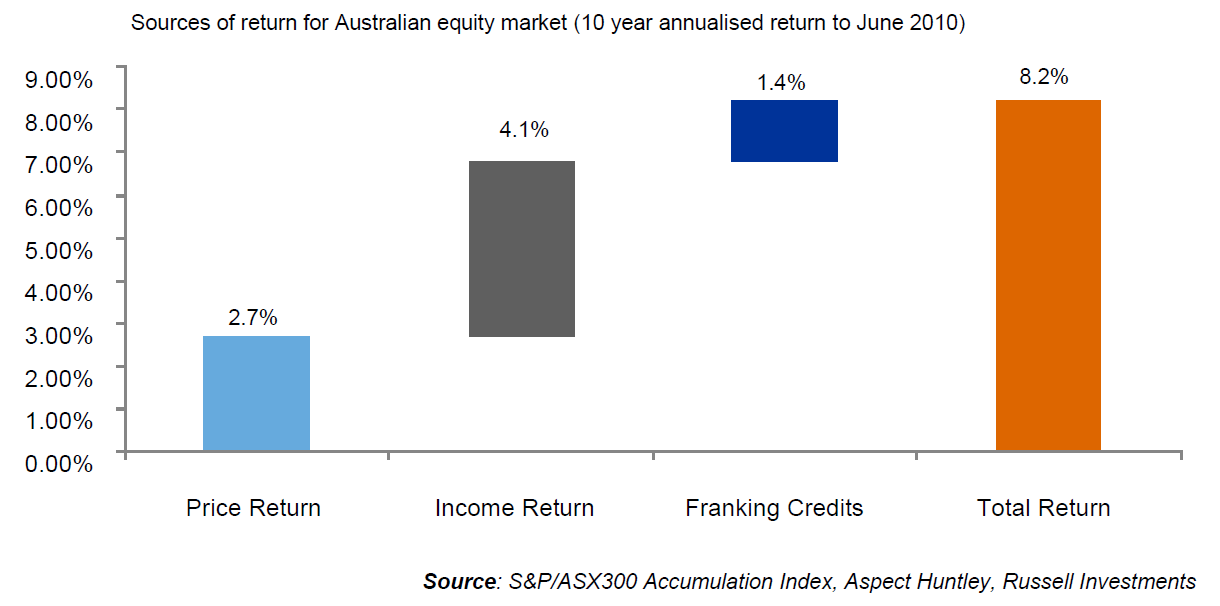
While the Australian market is well known for its growth opportunities, it may be surprising to some that it is the old faithful dividend that has driven a significant component of our historical share market
return. As shown below, over the last 10 years dividends represent 4.1% of the total return of the Australian market with a further 1.4% attributed to franking credits.
Dividends – always in season
Any balanced and well diversified portfolio needs an element of growth, but income as a source of return should not be overlooked and left for the bottom drawer.
In high growth periods, we can see that dividends still provide a valuable contribution to the total return of the market. Dividends can play an important complement to the growth component of a portfolio, even in high growth environments.
In negative return periods, dividends can also provide a positive source of return that can minimise the impact of the negative return on the capital component.
Why dividends are so hot right now
However, it is in times of low or slow growth that we see a greater interest in dividend opportunities. As we see increasing indicators that we will continue to have a slow growth environment at least in the short term, dividends can play an important role in getting the most out of your portfolio return.
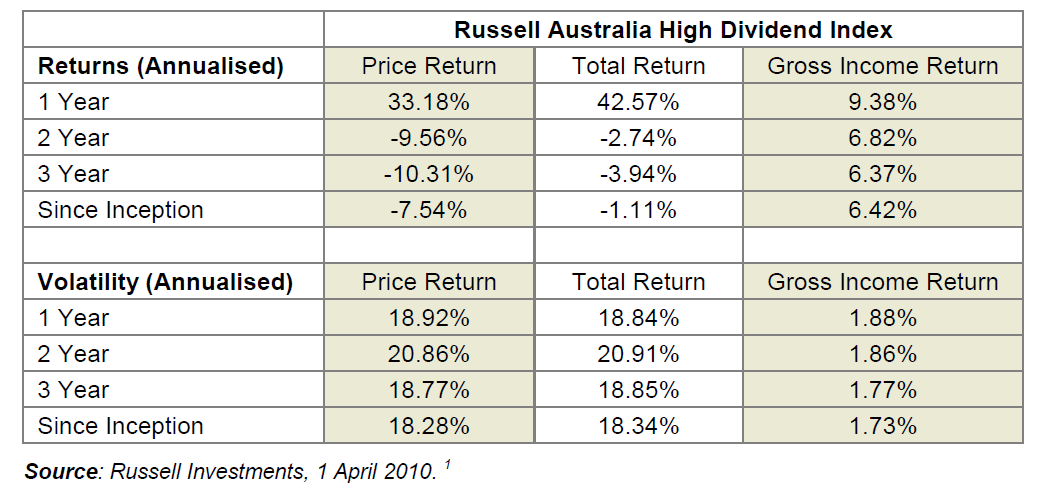
Furthermore, by comparing the sources of return of the Russell Australia High Dividend Index (below), it demonstrates dividends provide a consistent positive return source that has a much lower volatility compared to the price returns. So while an investor may not require income in itself, income as a source of return may be attractive with its lower volatility over market cycles and greater value of total return in slow growth environments.
Picking designer dividends from cheap imitations
Dividends can be used to give an illustration of the general health of company, including its growth prospects and its predictability and stability of earnings. However, it is important to know how to tell a designer from a cheap imitation.
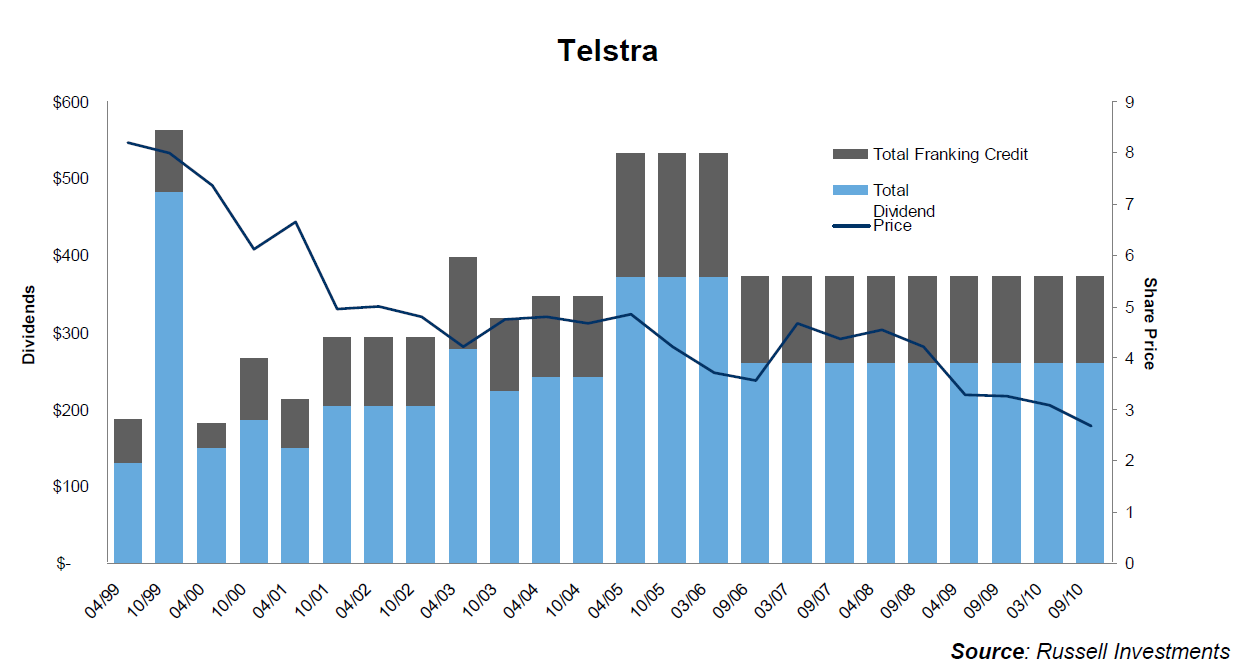
Dividend yield alone is not a good indication of future income. High dividend yield figures may in fact be a result of extreme falls in price that potentially reflect market concerns regarding the sustainability and stability of a company’s earnings.
For example, Telstra’s recent yield has moved around 10% p.a. If we take an investor who made a $10,000 investment in Telstra 10 years ago, they would now be receiving income of around $370 per year.
We can see from this chart that by chasing yield alone your future income opportunities can be limited if the price is not sustainable.
However, by looking beyond yield alone, a number of other strong and sustainable income opportunities can be identified.
For example, BHP is not synonymous with being a high dividend paying stock. But under the same scenario, our investor would be receiving around $750 in dividends plus franking credits. This is in addition to the capital growth opportunities an investor can benefit from.
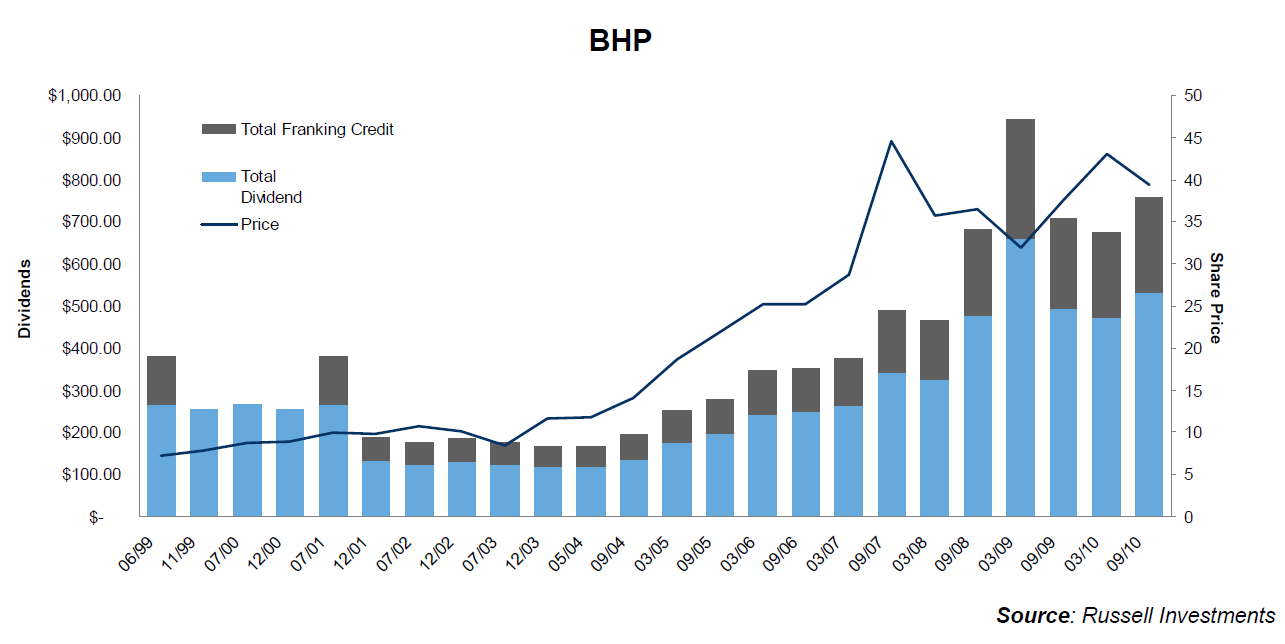
Therefore, if an investor looks beyond yield alone, they can benefit from a growing income stream that is delivering a greater dollar value while also maintaining the potential for capital growth over time.
Therefore instead of relying on a simplistic yield metric, there are additional characteristics that can be evaluated when identifying more sustainable dividend opportunities. The Russell Australia HighDividend Index for example, assesses dividend characteristics based on four key criteria:
- Historical dividend yield
- Forward looking dividend yield
- Historical dividend trajectory
- Earnings variability
By assessing multiple characteristics, and over multiple time periods, it provides a more robust way to evaluate dividend opportunities and ensure that future dividend opportunities are sustainable. Instead
of chasing the higher yielding stocks and creating portfolio turnover to do so, the more sustainable dividend opportunities allows you to minimise transactions and also the subsequent taxation
implications.
Franking credits – the perfect portfolio accessory
As after-tax investing grows in fashion, investors are seeking ways to include tax strategies to complement their portfolios. Dividends and their associated franking credits can be an ideal way to give the after tax portfolio return some much sought after enhancement.
By receiving dividends, investors also receive the benefit of franking credits that represent a tax credit that can be used to offset tax liabilities. For low or zero tax paying investors, such as those in pension phase, franking credits can be exchanged for cash through the Australian Taxation Office. In order to quantify this benefit when evaluating income opportunities, the dividends can be grossed-up to ensure the franking credit value is considered.
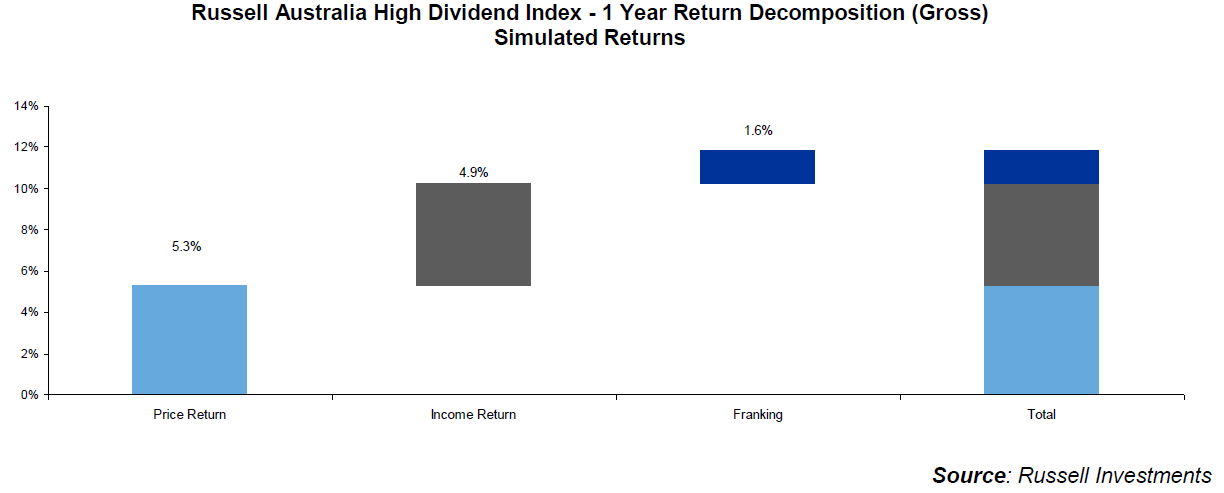
Therefore, a way to consider franking credits is an alternative source of return in addition to price and income return. To illustrate this, the grossed up total return of the Russell Australia High Dividend Index
can be deconstructed to unique sources of return, demonstrating that franking credits may provide material benefits to a portfolio on an after tax return basis in addition to other return sources.
How you can get the most wear out of your Dividends
By tracking the different capital and income return of the Australian equity market, we can see that as the capital value increases over time, so does the dollar value of the income. This is in contrast to cash, where the capital value and income return does not see growth over the long term.
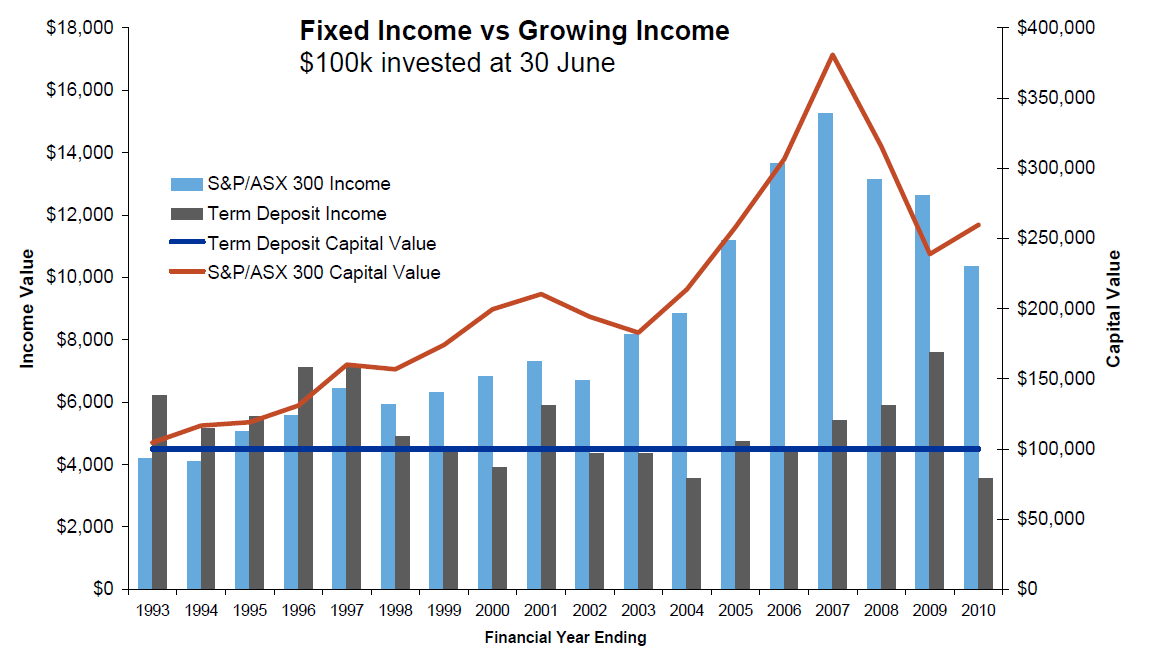
Source: Shares = S&P/ASX300 Price Index and S&P/ASX300 Accumulation Index, Term Deposit = Reserve Bank of Australia 12 Month Term Deposit Rate (> $10,000)
If an investor does require an income stream to grow over time the growth of capital is also important. To enhance the potential of this growing income, the capital base needs to increase also.
A way to potentially do this is to reallocate some gains from the growth part of the portfolio to the dividend paying component, this will enable an increase in the capital base of the dividend component and further enhance the dividend opportunities. In practice, this may be implemented by re-allocating realised capital gains (eg distributable CGT of an actively managed fund) to a dividend strategy.
Alternatively there are strategies that combine growth and dividend objectives that support this concept.
How you can style your dividend strategy for all seasons
Dividends can play a key role in any investors’ portfolio. Dividends can deliver a more consistent source of return over the long term, while price values may be volatile in short term, but knowing that they will
continue to provide a sustainable component of the total return even in high growth environments. The added benefit of dividends is their associated franking credits and the tax benefits they can bring investors.
There are specific ways that different types of investors may wish to implement and use dividends in their portfolios throughout their investment lifecycle.
Accumulation
- Not all investors want income. However, dividends can provide a sustainable source of positive return that offsets the impact of negative price returns in volatile markets.
- Franking credits used to offset tax liabilities – useful for those with higher marginal tax rates
- Income can be used to offset or reduce expenses in gearing strategies such as margin lending interest.
Transition to Retirement (TTR)
- Income can be used in TTR strategies. Not only does the income provide a way to assist strategies such as salary sacrificing, but also the franking credits can be used to offset tax liabilities.
- By purchasing investment with dividends before retirement, using the income and deferring any sale of capital until the pension phase, capital gains tax implications can be deferred until investors are in a zero-tax environment.
Decumulation
- Use dividends to supplement income and avoid drawing on capital.
- By remaining invested in equities, sustainable dividend opportunities can provide growing income potential with capital growth opportunities.
- Use your franking credits to receive a cash payment from the ATO.
The Russell High Dividend Australian Shares ETF tracks an index that is weighted towards companies that are expected to deliver dividends higher than the market average, however high dividends cannot be guaranteed.
Issued by Russell Investment Management Ltd ABN 53 068 338 974, AFS License 247185 (RIM). This communication provides general information only and has not been prepared having regard to your objectives, financial situation or needs. Before making an investment decision, you need to consider whether this information is appropriate to your objectives, financial situation and needs. Any potential investor should consider the latest Product Disclosure Statement (PDS) for the Russell High Dividend Australian Shares ETF (RDV) in deciding whether to acquire, or to continue to hold, units in RDV. Only persons who have been authorised as trading participants under the Australian Securities Exchange (ASX) Market Rules can apply for units in RDV through the latest PDS. Investors who are not Authorised Participants looking to acquire units in RDV cannot invest through the PDS but may purchase units on the ASX. Please consult your stockbroker or financial adviser.
The Russell Indexes are trademarks of Frank Russell Company (FRC) and have been licensed for use by RIM. RDV is not sponsored, issued, sold or promoted by FRC and FRC makes no representation or warranty regarding the advisability of investing in RDV or in any of the securities upon which the Russell Index is based. FRC has no obligation or liability in connection with the administration, marketing or trading of RDV. FRC is not responsible for and has not reviewed RDV nor any associated literature or publications and makes no representation or warranty express or implied as to their accuracy or completeness. FRC does not guarantee the accuracy and/or the completeness of the Russell Indexes or any data included therein and FRC shall have no liability for any errors, omissions or interruptions therein. MKT/2782/1110


