
Health insurance provides the same sort of cover as life insurance. The Government will look after my family if I die. Life insurance isn’t necessary for those without family.
These are some of the most common myths exposed in the findings of ongoing financial protection research1 by Australia’s leading specialist life insurer, TAL.
TAL sought to find out why people do not have some form of life cover2. In the poll of more than 1200 people, 47 per cent of people living in households where the main breadwinner doesn’t hold life insurance claimed they could not afford to take out some form of personal cover.
This, says TAL Group CEO Jim Minto, is a major cause for concern because life insurance is not only affordable but provides vital support for a person’s main asset: their ability to earn an income.
“We know from our polling that some people will not let their insurance drop for their car or even their phone, but when people are not having life insurance due to home budget pressure or because of a lack of understanding then we know the life industry has a responsibility to help educate people on the risks they face and benefits of life protection.
“The great irony is that times of reduced confidence in job and financial security are the times when people need life insurance protection the most. Life insurance is essential, not a luxury that people should let go of easily. Being unable to earn an income can have life-long and devastating consequences for Australians, their dependents and families.”
A further one in five people (18%) claimed they didn’t need life insurance because they had no immediate family to protect and 17 per cent of people felt that they could get the same level of cover from their private health insurance policy.
Rounding out the top five reasons why a household’s main income earner doesn’t have life insurance were the belief that life insurance was redundant if a person had other assets that can be drawn on in the event of death (16%), and the fact that people felt life insurance was simply unimportant (13%). 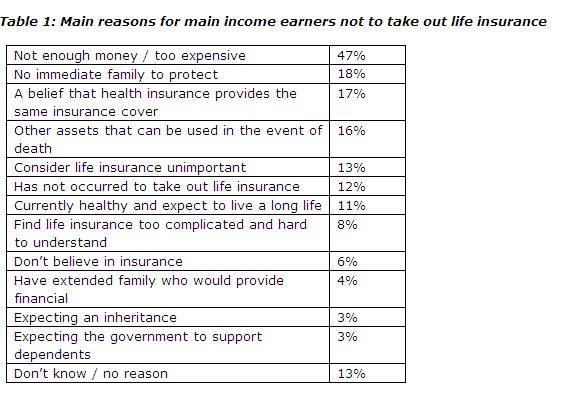 Geography and gender differences were particularly pronounced in some of the reasons respondents gave for not holding insurance. More than three times as many men than women believed that their plans for a long and healthy life reduced the need for life insurance (15% vs. 6%). This tendency for men to think they are immune from health risks is tempered by women who tend to be far more realistic about health issues and the related risks.
Men were also more likely than women to think that their health insurance would give them the same benefits as a life policy (19% vs. 14%).
The TAL poll also found that one third of young people (18 to 24 year olds) felt life insurance was unnecessary because they expected to life a long and healthy life (34%).
The same proportion of young people felt that life insurance was just a duplication of their health insurance policy. A further 29 per cent of young people felt that life insurance was unnecessary for those people who had no immediate family to protect, and the same number simply “haven’t thought about it”. 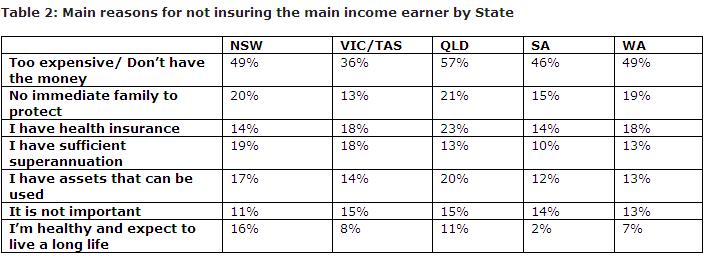 Commenting on the research, Mr Minto concluded that the results revealed just how much more the industry needs to do to educate people on the unique benefits of life insurance and how it differs from other forms of insurance and social supports.
“The vast majority of Australians benefit from holding life insurance,” he said. “It isn’t just for people with dependents or those who think that, because they have assets such as a home, that their family will not need financial assistance should they be no longer able to work through illness or death. Men also need to think more about the financial risks to their families and dependents from them being unwell. It is not enough just to think it will never happen.”
Earlier poll analysis for TAL showed that younger people indicated they actually had more life cover than their baby boomer parents, but this analysis indicates that of those without personal insurance, younger people believe there are a greater number of reasons for not having cover than older people.
“Perhaps surprisingly, younger generations seem to understand the role of life cover more than older people, but those without cover display a greater misunderstanding about the need for personal insurance than their older generations,” Mr Minto said.


