
Global investment manager clears misconceptions about alternatives
Despite their growing popularity, particularly in the institutional space, many investors are still unsure what alternatives really are, let alone how they can best be used to diversify risk in a portfolio.
These are the views of Andrew Landman, Head of Client Business for BlackRock.
“Alternatives may be less well understood than traditional asset classes, but the fact is that they can offer great diversification benefits to portfolios struggling in the new, more volatile return environment.”
Mr Landman went on to say that many investors are of the view that traditional portfolio models, such as the 60/40 growth/defensive assets just aren’t working in the current environment, in which returns are down and volatility is up in a way not seen in the past. The question they are asking is how to address this situation.
“There is a growing realisation among more experienced investors that alternatives can offer a way of diversifying by risk source that is potentially very attractive,” he said. “In fact, institutional exposure is rising sharply, and alternatives now account for 16% of the global institutional market.
“Despite this, there remain a number of myths surrounding alternatives, and these may be holding some investors back from seriously considering them,” he said. “At BlackRock, we thought it was timely to de-bunk some of these.”
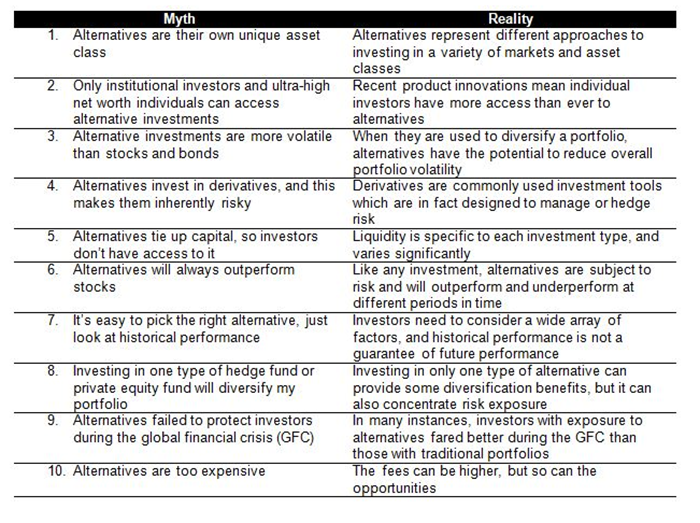
Mr Landman concluded by saying that when used properly, alternatives can play a vital role in the portfolio.
“A well-constructed portfolio of alternative investments can offer a number of benefits, including downside and inflation protection, diversification along time horizons and a low correlation to traditional market indices,” he explained.
“The key is to be sure to do your homework first. Making portfolio construction decisions in line with your personal risk and return objectives is a sensible way to invest, whether that be in alternatives or any other asset class.”


