
Petrol prices; Lending Finance; Credit & debit card lending
-
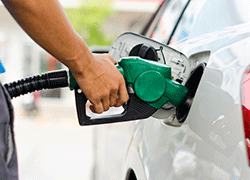
Petrol prices falling.
Petrol prices: According to the Australian Institute of Petroleum, the national average Australian price of unleaded petrol fell by 2.3 cents a litre to 151.2 c/l in the week to August 11. CommSec expects fuel prices to fall by a further 2-3 cents a litre in the next fortnight.
- Lending lifts to five-year high. Total lending finance rose by 6.9 per cent in June – marking the strongest increase in 15 months. Lending is up by 12.2 per cent on a year ago.
- Record fall in credit card debt. The average credit card balance fell by 3.7 per cent in the year to June, the biggest drop in 19 years of records. Average use of credit and debit cards is at record highs.
What does it all mean?
- Motorists are certainly enjoying a much needed reprieve. Fuel prices have fallen by a combined total of almost 7 cents a litre in the past fortnight. And more importantly there is better news ahead, with a further fall in pump prices around the corner.
- The recent Aussie dollar strength and slide in global oil prices has resulted in regional fuel prices falling substantially in the past week. The Singapore unleaded fuel price has fallen by over $6 a barrel in Australian dollar terms and should result in cheaper fuel prices in a fortnight’s time. CommSec expects pump prices to fall by 2-3 cents a litre.
- The encouraging signs that have been prevalent in the new lending environment in past few months are gaining traction. Not only have new finance commitments lifted for the past five months, but new lending surged by almost 7 per cent in June – marking the strongest increase in 15 months – and is now holding at the best levels in over five years. The low interest rate environment, and more importantly the perception of lower rates over longer-term, are fostering a modest appetite for borrowings.
- Importantly it is still early days, and consumers and business are still relatively cautious. And the lift in lending in June was underpinned by defensive practices such as debt consolidation and refinancing. But a further improvement in activity should take place after election is done and dusted.
- Consumers are using their plastic cards more often but still aren’t keen to take on more debt. So the average credit card balance continues to shrink. Overall consumers are getting smarter about making purchases – using cash less often to make purchases and paying with their own funds rather than going into debt.
- While there are encouraging signs of a modest lift in borrowing activity, it is off a low base. And as the central bank highlighted in the Monetary Policy Statement last week, the risks surrounding the rebalancing of the economy and higher unemployment are the key concerns. The Reserve Bank will maintain an easing bias over the next few months, but will focus on digesting how the economy progress through a post-election period.
What do the figures show?
Weekly petrol prices:
- According to the Australian Institute of Petroleum, the national average Australian price of unleaded petrol fell by 2.3 cents a litre to 151.2 c/l in the week to August 11. CommSec had tipped a fall of 2-3 cents a litre. The metropolitan price fell by 2.9 c/l to 149.3 c/l, while the regional average price fell by 1.0 c/l to 155.2 c/l. The average diesel price was up by 0.2 cents a litre to 156.5 cents.
- Average unleaded petrol prices across states over the past week were: Sydney (down by 2.2 cents to 147.6 c/l), Melbourne (down by 5.0 cents to 147.1 c/l), Brisbane (down by 1.0 cents to 152.6 c/l), Adelaide (down by 5.4 cents to 144.9 c/l), Perth (down by 2.2 cents to 150.7 c/l), Darwin (steady at 167.0 c/l), Canberra (steady at 157.8 c/l) and Hobart (down by 0.3 cents to 163.9 c/l).
- Today, the national average wholesale (terminal gate) unleaded petrol price stands at 142.7 c/l, up 1.1 cents a litre over the week but down 6.4 cents from highs set 17 days ago. Motorists can expect further relief at the petrol pump with prices to fall another 2-3 cents a litre over the next 7-10 days.
- Last week the key Singapore unleaded petrol price fell by US$3.10 (2.6 per cent) to US$115.40 a barrel. And in Australian dollar terms the Singapore gasoline price fell even more sharply, down by $6.45 (4.9 per cent) last week to $126.56 a barrel or 79.60 cents a litre.
Lending Finance:
- Total new lending commitments (housing, personal, commercial and lease finance) rose for the fifth straight month in June, up by 6.9 per cent to $59.79 billion. Lending is up by 12.2 per cent on a year ago.
- Housing finance (owner occupier and investment and alterations & additions) rose by 2.1 per cent in June after rising by 2.2 per cent in May. Housing lending is up 13.3 per cent over the year.
- Commercial finance rose by 11.5 per cent in June – the fifth straight gain – after rising by 3.4 per cent in May Revolving credit commitments rose by 48.8 per cent after falling by 9.1 per cent in May. Fixed lending commitments rose by 0.5 per cent. Commercial loans are up 11.5 per cent on a year ago.
- Personal finance fell by 2.7 per cent in June after falling by 4.1 per cent in May. Revolving credit commitments fell by 3.2 per cent and fixed lending commitments fell by 2.5 per cent. Personal loans are up 3.1 per cent on a year ago. Across the categories, debt consolidation (up 6.9 per cent over the year) and refinancing (up 9.2 per cent) were the strongest performing categories, followed by individual blocks of land (up 5.9 per cent). Overall fixed loans are up 10.1 per cent on a year ago.
- Lease finance rose by 8.2 per cent in June – the first increase in four months. Lease loans are down 3.9 per cent over the year.
Credit & debit card lending:
- Figures released today from the Reserve Bank show that the average credit card balance rose by $7.60 (0.2 per cent) in June to $3,243.80. The average credit card balance is down by 3.7 per cent on a year ago – the biggest fall in 19 years of records.
- Of credit cards attracting interest charges, the average outstanding balance fell by $32.70 in June to $2,272.70. The average balance accruing interest is down by a record 6.7 per cent on a year ago.
- The average credit card limit rose by $4.50 to $9,095.50 in June. The average credit card limit rose by just 1.2 per cent in the year to June – just above the slowest growth rate in 19 years.
- The average number of transactions on credit cards was 9.6 in June. In smoothed terms the average number of credit card transactions was 10.2 in June – a record high.
- The average number of transactions on debit cards in June was 7.3, down from 7.7 in May. In smoothed terms the average number of debit card transactions was 7.4 in June – a record high.
- The number of credit card cash advances fell by 8.5 per cent in June. In smoothed terms, credit card advances are down 3.0 per cent on a year ago and have consistently fallen in the past five years.
- The number of purchases made with credit cards rose by 4.8 per cent over the year to June. Purchases made with debit cards were up 11.0 per cent on a year ago.
- The number of ATM withdrawals in June was down by 8.3 per cent on a year ago. In smoothed terms, ATM withdrawals were down by 5.5 per cent on a year ago.
- Weekly figures on petrol prices are compiled by ORIMA Research on behalf of the Australian Institute of Petroleum (AIP). National average retail prices are calculated as the weighted average of each State/Territory’s metropolitan and non-metropolitan retail petrol prices, with the weights based on the number of registered petrol vehicles in each of these regions. AIP data for retail petrol prices is based on available market data supplied by MotorMouth.
- Lending Finance is released monthly by the Bureau of Statistics and contains figures on new housing, personal, commercial and lease finance commitments. The importance of the data lies in what it reveals about the appropriateness of interest rate settings, confidence and spending levels in the economy.
- The Reserve Bank would be encouraged that consumers and businesses are starting to borrow again, even if activities like refinancing are underpinning activity. Refinancing serves to bolster balance sheets and free up dollars for spending in other areas.
- Retailers must acknowledge that consumers are savvier about their shopping and must change with the times. The average Aussie shopper will shop around more often to get the best quality goods and the lowest price. More shoppers are using their cards online to make purchases. Retailers must change to reflect the way that consumers want to shop, especially those selling services, making sure they have mobile payment devices and secure online sites to attract and retain customers. Pressure on retail margins will continue.
- CommSec expects the Reserve Bank to remain on the interest rate sideline over the next few months.
What is the importance of the economic data?
- Weekly figures on petrol prices are compiled by ORIMA Research on behalf of the Australian Institute of Petroleum (AIP). National average retail prices are calculated as the weighted average of each State/Territory’s metropolitan and non-metropolitan retail petrol prices, with the weights based on the number of registered petrol vehicles in each of these regions. AIP data for retail petrol prices is based on available market data supplied by MotorMouth.
- Lending Finance is released monthly by the Bureau of Statistics and contains figures on new housing, personal, commercial and lease finance commitments. The importance of the data lies in what it reveals about the appropriateness of interest rate settings, confidence and spending levels in the economy.
What are the implications for interest rates and investors?
- The Reserve Bank would be encouraged that consumers and businesses are starting to borrow again, even if activities like refinancing are underpinning activity. Refinancing serves to bolster balance sheets and free up dollars for spending in other areas.
- Retailers must acknowledge that consumers are savvier about their shopping and must change with the times. The average Aussie shopper will shop around more often to get the best quality goods and the lowest price. More shoppers are using their cards online to make purchases. Retailers must change to reflect the way that consumers want to shop, especially those selling services, making sure they have mobile payment devices and secure online sites to attract and retain customers. Pressure on retail margins will continue.
- CommSec expects the Reserve Bank to remain on the interest rate sideline over the next few months.


