
There has been plenty of focus on the increased supply of Australia’s mining and energy exports following the tremendous investment in this sector over the past decade. The unprecedented investment boom has translated into record high production and export volumes and contributed to sharp falls in the prices of some of our leading commodities. What lies ahead for our biggest export sector, particularly as the economy of Australia’s largest trading partner, China is slowing and undergoing its transition away from a materials-intensive economy to a consumption-driven economy?
Background
Exports contribute around one quarter of Australia’s total economic output. Mining and energy exports accounted for over 50% of Australia’s total exports in 2014. Coal and iron ore were the top two largest exports by a comfortable margin, accounting for AUD 66 billion and AUD 38 billion respectively of the total AUD 327 billion of exports (ie a combined 32% of total exports).
In the energy space, natural gas (Australia’s fastest-growing export over the past five years) accounted for 5% of Australia’s exports, to be the third-largest individual export. Australia is now the third largest exporter of natural gas in the world and will be the largest exporter when the projects under construction are completed.
With commodities representing such a significant proportion of Australia’s GDP, shifts in supply and demand and the subsequent impact on our national income cannot be understated. This paper looks at the factors currently driving the demand and supply of Australia’s key commodity exports and the role other sectors may play in assisting Australia’s transition from relying on mining to non-mining investment for its growth.
Bulks and steel
The prices of bulk commodities, including iron ore, coal (both thermal and metallurgical) and steel continue to weaken due to a supply-demand imbalance. In particular, they are underperforming relative to already weak expectations. Rather than being a solely supply-related issue, as we have commented on in the past, it appears the slowing in growth in China and fixed asset investment (a key driver of demand for bulk commodities) has seen all bulk commodity prices fall to their lowest level since the global financial crisis in 2009.
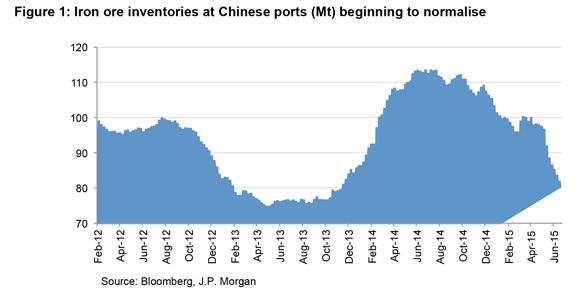
The modest rally in the benchmark 62% iron ore fines price from USD 45 per tonne to above USD 60 per tonne appears to have been short-lived. The rally was a function of seasonally stronger steel demand, unusually wet weather in Western Australia and Brazil, and supply-side issues from Rio Tinto which has been impacted more than most iron ore miners as it ramps up its new infrastructure to 360 million tonnes per annum (mtpa). The result has seen China port inventories begin to normalise from highs, with a drawdown of stocks to mills of approximately 30 million tonnes (see figure 1). The surprisingly weak Australian supply looks to be the reason for the strength in prices from April 2015 to June 2015.
The currently depressed steel prices and new supply emerging in the iron ore seaborne market in the third quarter of 2015 are likely to weigh on iron ore prices for the rest of the year. Figure 2 highlights the deterioration in steel price spreads for the key construction steel, rebar. Steel prices have fallen to 2002 levels and utilisation levels at steel mills globally sit in the low 70% range, suggesting mill profitability in China, and the rest of the world, is very poor. This environment is not conducive to bulk commodity price rallies. As a result, coking coal prices have also been very weak in recent months, with a key Japanese quarterly coking coal contract for high-quality hard coking coal settled at USD 93 per tonne, down from USD 110 per tonne the previous quarter.
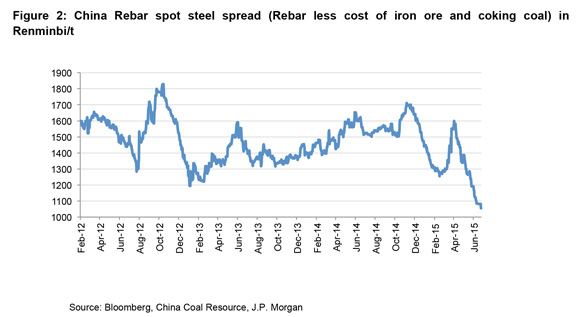
The medium-term outlook will be driven by a recovery in steel spreads and a return of mill profitability. In order to achieve this outcome, steel mill utilisation needs to recover to above 80%. There are two ways to achieve this. The first is to close capacity. Due to the impact on employment and the local government, it is unlikely the Chinese government will allow mills to close en masse, but this is the longer-term goal of the central government. Managing the transition away from being a manufacturing-based economy is a slow and difficult process so is not expected to occur in the next few years. The closure of steel mills will also be a key signal that the Chinese economy has transitioned to a less material-intensive services economy (although this signal is typically a later transition signal).
The other option is a demand-led recovery. This will require targeted stimulus to material-intensive industries. This may include stimulus for infrastructure or property construction. At this stage, it is not apparent that China will announce any stimulus measures. However, there has been recent speculation about the ’One Belt, One Road’ (OBOR) project (see figure 3), which is essentially the construction of infrastructure to support exports to regional neighbours.
OBOR includes the construction of ports, rail and road infrastructure in order to service China’s nearest neighbours in Europe and Asia as well as to the world. The difficulty with such a long-term strategy is how trading partners will respond to the flood of cheap Chinese bulk materials into their market and potentially causing harm to employment given they are significant employers. It will be interesting to see how the Western world responds. To date, trade cases to help prevent the dumping of material have been launched by the European Union and the United States in particular. Trade protection against China is likely to grow.

Base Metals
The aluminium complex, including its two key inputs alumina and bauxite, is facing numerous challenges. China has successfully found bauxite deposits outside of Indonesia, where a recent export ban was expected to drive up the price of the commodity. However, the Malaysian export of bauxite has been successfully substituted and hence provided less support for the underlying commodity price.
In addition, the recent change in the London Metals Exchange’s (LME) warehousing rule to reduce aluminium inventories has successfully released material which has put enormous pressure on the premium for physical delivery. At its peak in 2014, the premium sat at USD 0.24 per pound but has recently reached a low of USD 0.05 per pound. This premium was paid in addition to the LME index price. In addition to the changes in the warehousing rules, China, due to weak demand conditions and low aluminium smelter utilisation, has been increasing exports of the commodity, placing further pressure on prices. Exports were up 150% on a year-on-year basis to 420,000 metric tonnes in February 2015.
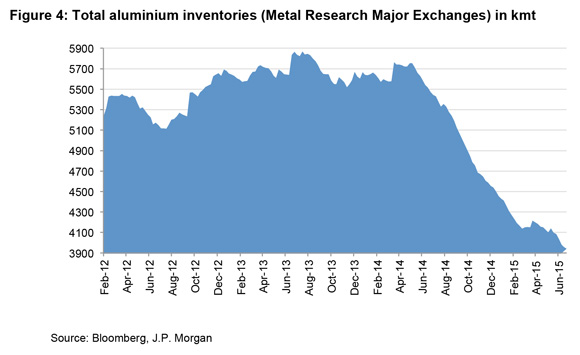
As a result, the alumina price has been under pressure more recently and the outlook appears very tough in the coming months, with weak aluminium earnings at the smelter flowing through to the midstream production of alumina, especially with the weak bauxite prices. The longer-term outlook also looks more challenging for ex-China alumina refining capacity as long as China can find a source of bauxite. Exporting of alumina to China is difficult as they prefer their own source of supply and the tough ex-China aluminium market, due to the significant oversupply of capacity, is likely to keep prices down, despite the more favourable demand outlook.
Copper, the general bellwether of economic growth globally, is also being buffeted due to a lack of demand and ample supply reaching the market. Longer term, the outlook for copper is robust with the growing rise of the Chinese consumer seeing an increasing demand profile, particularly for whitegoods and automobiles. At the same time, there are limited new copper mines coming on stream (and given the weakness in the global consumer versus the pre-GFC highs, copper scrap supply has also fallen) and an increasing decline in copper grades at mature mines. The next significant mine to be completed is MMG’s Las Bambas mine in Chile. While options exist for developing new mines, it has been clear there is great difficulty in developing large scale mines due to political and environmental issues. None more obvious than Rio Tinto’s experience in Mongolia with the Oyu Tolgoi underground development and more recently in the United States, and the push to develop the Resolution copper mine in Arizona. More positive news recently for copper has been the drawdown of copper inventories at the LME and the fall in treatment costs and refining costs at the copper smelters, which is a usual precursor to a tightening market for copper concentrates as it signals refiners need more copper concentrate.
Nickel, another Australian export, is also being impacted by weak Chinese demand. Similar to bauxite, the market had expected that the Indonesian export ban of unprocessed raw materials would lead to a jump in the nickel price. However, supply of nickel ore from the Philippines has been larger and better quality than expected. The question remains, how long can Philippine ore be a substitute for Indonesian ores, given grades are expected to decline? Offsetting this however, has been the substantial rise in LME inventories to the point where warehoused nickel equates to close to 12 months of demand (see figure 5). For the nickel price to rally, inventory levels need to decline. At this stage it is too early to say if the recent inventory decline is indicative of tightening market conditions or another false dawn.

Precious Metals
Gold prices have been remarkably stable over recent months, hovering at around USD 1,200 per ounce. The gold price is reflecting some level of uncertainty surrounding US interest rates and European instability relating to the possibility of Greece exiting the eurozone. Without a significant economic shock or poor economic performance in the US, it is hard to see much support in the gold price from here. The historical relationship has been an inverse one with the US dollar (USD). As the USD rallies, gold has typically sold off. With the lack of global inflation, and the likelihood of US rate rises driving the USD higher, the expectation, therefore is for the gold price to fall.
For Australian gold producers, there may be no significant change to the Australian dollar (AUD) realised gold price on the currency conversion. The AUD gold price has been around AUD 1,500, which for most Australian producers is generating significant cashflow.
Oil and Gas
The oil and gas market has seen significant volatility as the market attempts to digest the significant amount of new supply from the US onshore shale oil boom. At the same time as the US has successfully grown supply, Middle Eastern countries have added to an oversupplied market. As technology in shale oil drilling continues to evolve, it is likely supply will continue to grow from the US and thus put pressure on the price. The oil price is being driven by supply rather than demand, which remains robust. Due to the drop in price, there has been a re-emergence in demand for pick-up trucks and SUVs by US consumers, enhancing the demand side. Demand in the rest of the world is quite weak though.
Looking forward, and assuming no significant political instability in the Middle East (a brave assumption), the significant inventory build is likely to overhang the market, making any significant rebound in the price from USD 60 per barrel difficult to achieve. While rig counts in the US are down, which should reduce supply in time, the production curve for a shale oil well after it is drilled tends to see high production in the first 12 months before a significant decline in production occurs. As a result, these cuts are still four to five months away.
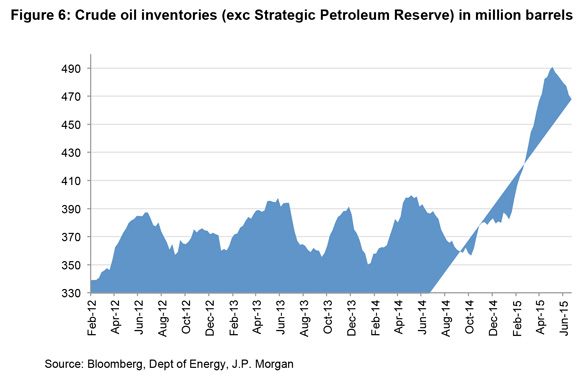
More concerning for the oil market, is the emergence of the carry trade, where traders buy the physical commodity and store it while buying the underlying commodity futures contract. As long as the cost of the futures contract and storage costs are less than the contango (which is the forward price minus spot price) the trade will be profitable. The implication is that there is a growing amount of oil inventory being held by traders which could potentially come out of storage and impact the spot price. This would only be a one-off shock but, given how a similar trade has unwound in the aluminium market and the consequence for realised prices, it could lead to lower oil prices. At this stage, this outcome is not a significant risk but is one that cannot be ignored.
The liquid natural gas market (LNG) is also experiencing oversupply. The Asian LNG price, which is determined by the oil price, has fallen in line with the oil price. There is a significant increase in production from Australia and the US. US production is priced off the Henry Hub gas price. Historically, this has been at a significant discount to oil-linked pricing. It was this discount that underpinned the rapid development of US LNG projects. However, the oil-linked LNG price is now below the Henry Hub-based price which may slow the growth of LNG projects on the US Gulf coast. Irrespective of this weakness, the LNG market is expected to be in oversupply until 2020 due to the number of projects currently under construction and due to start over the next five years.
Conclusion
A number of commodity markets, notably mining and energy are currently suffering from weaker-than-expected global demand, exacerbated by the slowdown in China. At the same time, due to the past high prices and the implementation of a number of new projects, the supply of many commodities has grown. Looking forward, the outlook for many of these commodity prices is heavily reliant on the strength of Chinese demand. Supply of most commodities continues to grow and will likely peak within the next two years. This may put further pressure on commodity prices.
The favoured commodities should be those linked to the growing consumer in China as well as those with declining supply, and copper appears to have the strongest fundamentals. Australia’s agricultural products, including our eighth largest exports, beef (which was Australia’s fastest growing export in 2014, rising 36%, reflecting higher prices and volumes) also stand to benefit from this theme as Chinese consumers increase their protein intake.
Our services exports, particularly education and tourism should also benefit. These sectors are Australia’s fourth and fifth largest exports respectively and are currently experiencing strong growth (rising 14% and 8% respectively in 2014) – benefiting from a weaker Australian dollar and the burgeoning Chinese tourist market and their increasing desire to be better educated. Australia’s total exports of services, led by tourism and education, slightly outpaced iron ore exports in 2014. Services were traditionally more than double the value of iron ore exports prior to the explosive growth in China’s steel industry in 2004. We are thus starting to see a return to normal and we will likely see services rise in importance in Australia’s exports in the years to come.
By James Eginton, Research Analyst, Nikko AM Australia
——–


