

Libby Newman
Lonsec releases Multi-Asset Sector Review
A rapid expansion in the number of multi-asset funds and products is generating a new wave of competition, as fund managers rush to position themselves in the burgeoning multi-asset sector.
According to leading research house Lonsec, the number and variety of multi-asset products have grown immensely over the past two years, with 2015 seeing an influx of new entrants, as well as fund managers seeking to build on existing offerings.
Lonsec’s Multi-Asset Sector Review, released today, includes 34 new additions to Lonsec’s multi-asset fund coverage in 2015, which follows an increase of 31 funds in the year prior. This growth is providing investors and financial decision makers with a growing range of investment products, driven by the recent popularity of the multi-asset approach as well as innovations that allow multi-asset funds to leverage their scale and broaden access for investors.
“We are seeing a lot of development in the multi-asset space at the moment” said Libby Newman, General Manager of Fixed Income and Multi-Asset at Lonsec. “Some of this growth is attributable to more widespread use of ‘white label’ products, which allow advisers to gain access to products and services typically tailored to wholesale and small institutional clients. We are also seeing a resurgence in Investment Bonds, which are popular among investors seeking alternative ways to tax-effectively save.”
According to Ms Newman, the rise in the number of multi-asset products is the natural result of continued growth in funds under management and ever-present competitive pressures.
“With the flow of funds, changing regulatory environment and central bank intervention distorting asset prices, we have seen a proliferation of new investment products,” said Ms Newman. “In the multi-asset space, solid interest in real return strategies has seen global players enter the Australian market in quick succession. Many have established track records in real return investing in the US and UK, and are keen to test their wares against Australian CPI+ benchmarks.”
Overcoming the low-growth problem
Superannuation funds (61–80% growth assets) were the top-performing sub-sector in 2015, with Lonsec’s peer group returning 6.9% on average, supported by allocations to the outperforming property sector. Low-cost funds were the laggards, returning 3.9% on average and impacted by higher allocations to the Australian equity sector, although over a seven-year period they have produced superior returns net of fees (see table below).
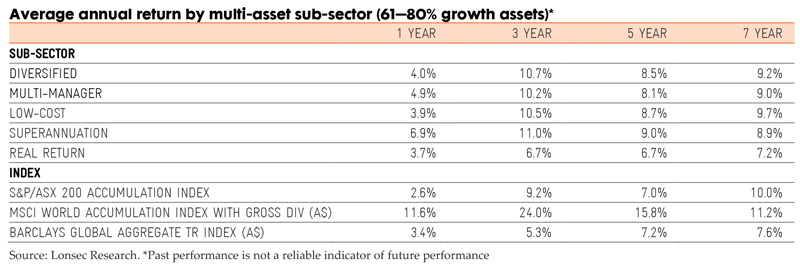
As multi-asset investing heads into an upswing, the dual challenges of low growth and high levels of uncertainty continue to plague markets. Global institutions have continually revised their growth outlook downwards over the past three years, with the IMF in April downgrading its growth estimate for 2016 from 3.4% to 3.2%.
“Investors are still looking for incontrovertible signs that the global economy is improving,” said Ms Newman. “We have not been seeing the sort of growth we expected two or three years ago. The main challenge for multi-asset funds is how they respond to this environment.”
Multi-asset strategies are seen by many investors as an effective way of generating solid risk-adjusted returns, with performance driven predominantly by asset class diversification. However, in periods of systemically low growth, even multi-asset managers may be limited in what they can achieve.
“The shift towards diversification and low correlation has not been the return driver many fund managers had hoped for,” said Ms Newman. “With increased volatility and uncertainty, many managers have tried to diversify away from traditional asset classes and towards alternatives such as hedge funds, which were generally flat in 2015. So while multi-asset investing is certainly effective, it is not immune from the low-growth challenge. Managers are now looking further afield at ways to deliver their objectives. This may include lowering their return targets, expanding the opportunity set, widening asset allocation ranges, or moving up the risk curve.”


