
A laddered corporate strategy can mitigate risks of bond volatility and rising rates
Leading US fund manager, Eaton Vance, comments that moving to a professionally managed, evenly weighted portfolio of corporate bonds is one way investors can become more defensive against rising interest rates.
Thomas H. Luster, Co-Director of Diversified Fixed Income and John H. Croft, Diversified Fixed Income Portfolio Manager at Eaton Vance have the view that although the Federal Reserve held steady last week, questions over the ability of central banks to continue easy monetary policies have caused volatility to pick up in global markets recently.
They added: Still-low yields, rich valuations, uninvested cash and concerns surrounding credit quality all present challenges for bond investors. However, laddered corporate bond portfolios offer a way to potentially mitigate these risks for investors, particularly for those concerned about the impact of rising rates.
Yet, individual investors and their advisors face several challenges when attempting to build laddered corporate bond portfolios on their own, especially ones that are also properly diversified.
For example, limited availability of suitable bonds can make it difficult to maintain an equal weighting over time. The result is that investors often end up with uneven portfolios or portfolios with gaps – a “missing rung” where there is no allocation to a particular target maturity.
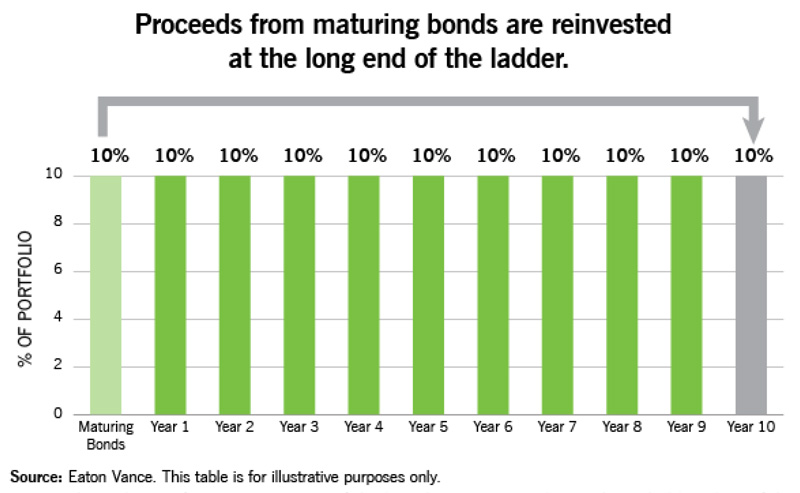
An equal weighting of maturities is one of the key characteristics that makes a laddered portfolio defensive. One of the potential benefits of the equally weighted nature is a consistent income stream and the potential for positive performance in a rising rate scenario.
When the yield curve is upward sloping, proceeds from maturing bonds on the lower rung of the ladder are reinvested at the longer end at higher interest rates. This laddering strategy results in increased yields due to reinvestment in higher-yielding bonds at the long end of the ladder, assuming a positively sloped yield curve.
Should rates rise, the ladder strategy can take advantage by reinvesting at even higher rates, resulting in more income for the investor. The result may be a more attractive total return over the longer term, particularly in a rising rate environment, all else equal.
There are other potential benefits to a professionally managed laddered bond portfolio, including:
- Rigorous credit analysis and ongoing monitoring of holdings.
- Institutional power to buy and sell bonds at advantageous prices.
- Limited capital gains and liquidity risk, assuming that the yield curve is normal and bonds are held to maturity.


