

How are technological advances affecting the valuation of the healthcare sector?
Advances in science and technology are continuously changing and progressing the medical profession and broader healthcare industry.
While this backdrop is surely known to investors, its importance and impact may at times be overlooked, as the focus tends towards the supportive demographic factors that will almost certainly guarantee a growing patient population, underpinning volume growth for the industry.
These factors include aging, the growing incidence of chronic disease, technological developments providing new interventions for untreated conditions and growing wealth in emerging economies.
These demographic factors provide a strong backdrop for the healthcare industry and this is reflected in the valuation of the sector.
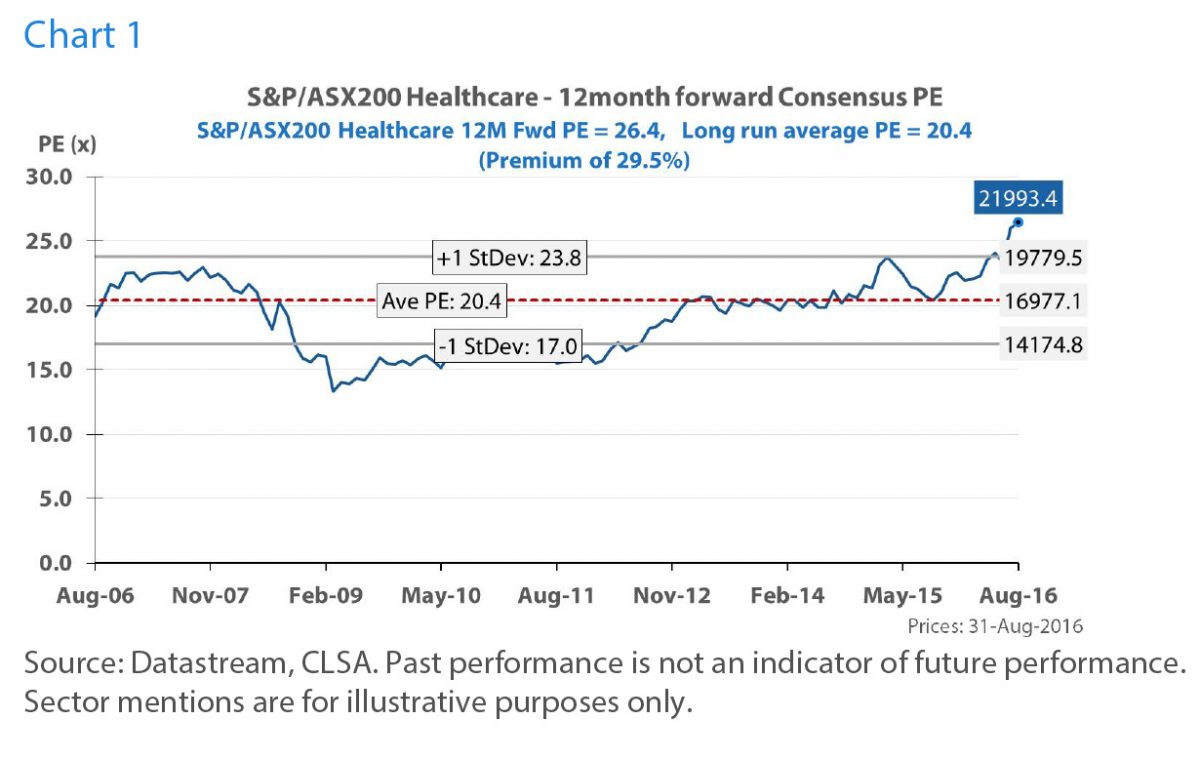
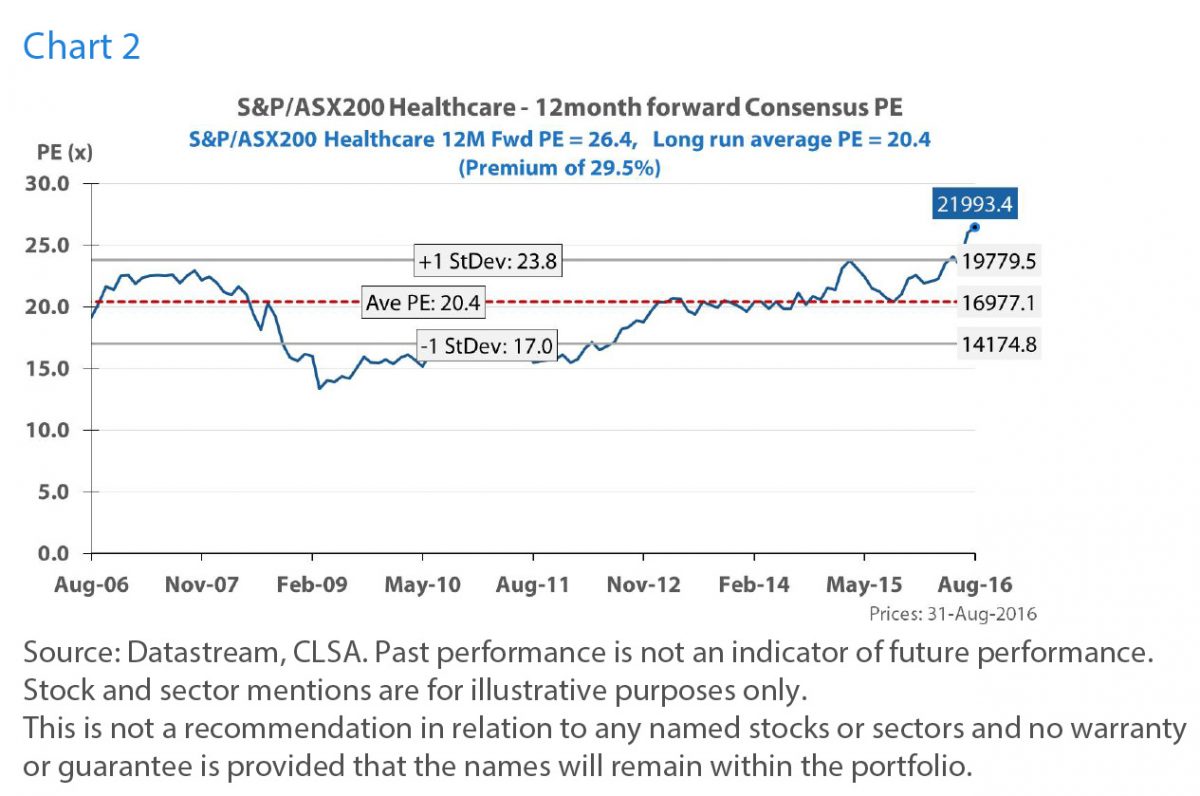
The graph below shows the 12 month forward price-earnings ratio for the S&P/ASX200 Healthcare Sector. It shows that the sector is currently trading on a forward PE of 26.4x – notably this valuation is a 10 year high and at a 30% premium to the 10 year average.
Attention grabbing valuations
There are some standout valuations within the sector that demand attention.
- Cochlear is trading on a forward PE ratio of 34.8x FY17 earnings. This compares to its historic average PE ratio of 24.3x.
- Ramsay Healthcare is trading on a forward PE of 31x, compared to its long term average of 19x.
- Sonic Healthcare is trading on 21.1x, a 33% premium to its ten year average of 15.9x.
The question investors should be asking is whether such multiples are justifiable?
While the industry growth will be strong, not all participants will fare equally. Some will have new products and services that drive future growth; others will be less lucky and will see their products and services displaced by new innovation and players. This is the usual cut and thrust of scientific progress. Cochlear is one company that may face long term threats.
Cochlear – a bet on franchise longevity
Cochlear Limited has had great success. It’s led the development of the cochlear implant industry globally and in doing so, provided hearing to hundreds of thousands of deaf children.
As well as providing this ground breaking treatment, the company has grown its operating profits at 9.2% pa for the past decade.
There’s little doubt that Cochlear’s multiple is currently benefiting from the fact that there’s a lack of growth in many other sectors of the market. But investors should be questioning what this current pricing implies about the growth expectations of this company and equally about the longevity of its franchise.
In our estimation, to justify the current share price, Cochlear would have to continue growing at its historic growth rate (9.2%pa) for another fifteen years and thereafter maintain its super normal profits into perpetuity. To state this in another way, Cochlear’s valuation is implying the business will grow by a factor of 4 over the next 15 years, with no threat to its franchise thereafter.
Ignoring the practical limitations of such a scenario (such as surgical capacity), it’s fair to argue that such a growth outcome is a possible scenario. After all, there’s a large unmet need for Cochlear’s implants for children in the developing world and equally, a growing adult market in developed countries. But for such a scenario to eventuate, a necessary condition is that no competing therapy emerges to threaten Cochlear’s product portfolio.
This is a fair assumption on a five year view, given the lead times involved in bringing new products and therapies to market. But on a 15 year view, this is a significant bet especially when we can see competing therapies being researched with significant success and which, could provide viable treatment options within a 10 year horizon.
An example of a promising competing therapy, which could displace cochlear implants is gene therapy and there has been substantial progress in recent years in this field.
Gene mutations are common causes of congenital deafness. Two different research groups working on two different gene mutations both showed an ability to provide hearing in deaf mice. The hope is that further development of this research will ultimately lead to cures for human congenital deafness and the researchers hope to be in human clinical trials within a 5 to 10 year window.
So while Cochlear today has a compelling competitive advantage, ongoing scientific development will in all likelihood see this eroded at some point in the future. Investors today are essentially paying for a scenario that entirely dismisses this likelihood.
Accelerating change
While technology is the great enabler of change, two other factors are contributing to a likely accelerating pace of change:
- Cost pressures
- A more informed and empowered consumer, which threatens the current information asymmetry which characterises the patient-doctor relationship.
Combined, these three factors will change the way that medicine is practiced and the impact on the industry could be significant. These key factors will shape the future delivery models and business models will evolve to survive only, if they provide one or more of these additional factors:
- Lower cost.
- Greater patient convenience.
- Improved healthcare outcomes.
These aren’t new drivers of success but budget pressure, empowered consumers and coalescing technological developments are introducing additional forces of change into the industry and will accelerate the pace and extent of change.
So what might the future hold? There will likely be more competition in primary care. Care will move to lower cost providers (Nurse Practitioners) and low cost venues (pharmacies, retail clinics).
Patients’ preference for a single GP has been declining and the benefit of such care (longitudinal care) will perhaps be replicated via universal electronic medical records, which enables detailed knowledge of a patient to transfer between providers.
The RAND Institute reported that in the US 18% of visits to GP’s offices were for ten relatively trivial conditions and preventative care: upper respiratory infections, sinusitis, bronchitis, sore throat, immunisations, inner ear infections, swimmer’s ear, conjunctivitis, urinary tract infections, and screening blood tests.
This combined with cost pressures has seen the introduction of lower cost clinics in retail settings, staffed by Nurse Practitioners capable of diagnosing and treating these relatively minor conditions.
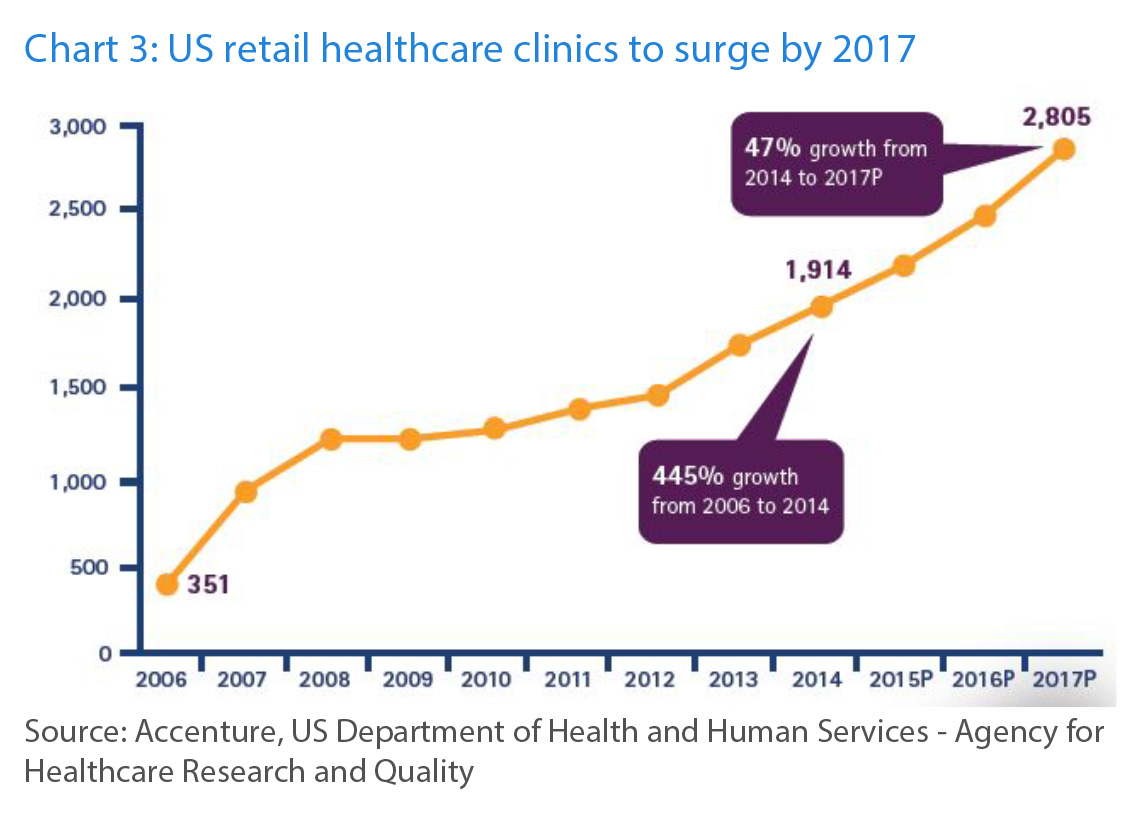
By 2010, there were some 1,300 Retail Care Clinics in the US with 56,000 Nurse Practitioners and 30,000 Physician Assistants. This compares to a total of only 209,000 practising General Practitioners. Retail clinics expanded by approximately 40% between 2010 and 2014 and are forecast by the US Department of Health and Human Services to grow by another 30% by 2017.
Migration of diagnosis and treatment of relatively minor conditions will facilitate increased time for GP’s to devote to more complex conditions. While this is likely a great outcome for patients, it may require some business models to adjust to a lower volume environment.
Diagnosis may move to the point of care
Already, diagnostic accessories that attach to smart phones are capable of diagnosing a wide range of diseases and conditions. An incomplete list includes measles, mumps, HIV, syphilis, herpes, hepatitis B, ear infections, cataracts, astigmatisms, myopia, hyperopia, atrial fibrillation and Ebola. Other accessories can monitor physiological markers, such as blood glucose and heart rate.
More frequent monitoring and feedback is proven to deliver improved patient outcomes and adherence to therapy. Higher frequency and real time access to data relating to chronic disease will no doubt result in improved outcomes for patients. In addition, the ability for physicians to manage patients with chronic disease by exception will provide enormous efficiency gains but equally, will reduce the need for doctor visits.
A further potential consequence of such development is that just as technology facilitated the consolidation of the pathology laboratory industry though scale economics, technology will potentially dismantle these benefits.
While current scale providers may have a role to play in this new environment, the investments made to date are likely to be worth significantly less as the current scale benefits unwind, should point of care or other remote diagnosis become a significant component of the industry.
Increased transparency on price and quality
It’s likely that ‘payers’ will become involved in referral pathways. This involvement of payers in referral pathways is not a new concept in the US, where the health insurance sector has long established networks of providers who are approved to provide treatment to their members.
In Australia and other systems however, such arrangements are not widespread and moreover are viewed with great scepticism, most likely due the widespread belief that anything resembling the US healthcare system should be avoided at all costs.
However, Australian private health insurers have being increasing their involvement in recent years, albeit cautiously and under a consumer-led approach. For example, NIB has developed an application called WhiteCoat. In its early form, WhiteCoat provided contact details and ratings information for dentists and other allied health providers such as Optometrists and Physiotherapists. The application reported very positive feedback from members.
More recently, BUPA and HCF (together representing c47% of the private health insurance industry) have joined WhiteCoat and NIB has flagged it will soon include reviews of both the price and quality of doctors including surgeons. For the first time, the medical profession will be subject to complete transparency in regard to both price and quality.
And as you might expect, the US experience provides some insight as to where this ultimately may lead. In the US, Health insurers are taking high cost events and concentrating them with a narrow group of providers.
For instance, in Walmart’s employee health insurance plan, joint replacement surgery is now conducted in only 6 hospitals in the US. These 6 hospitals were selected based upon outcomes and price. Through extreme specialisation and a highly efficient process, hospital operators can reduce costs and improve quality. Payers are starting to seek out such specialisation in an effort to reduce cost.
For insurers then, this drive for cost efficiency and quality will require an investment in technology. Not only will large amounts of data need to be managed to monitor pricing and provider outcomes, but this data needs to be repackaged and shared with General Practitioners in order to influence referrals in favour of lower cost and higher quality providers.
Note also that this transparency will have implications for provider behaviour. For instance, anecdotal feedback is that some private health insurers have started sharing data on outcomes with hospital groups, essentially identifying practitioners with abnormally poor outcomes.
Upon investigation shortcomings in best practice resulting in sub-optimal outcomes were identified in some instances. Patients obviously have a right to know such information. For hospitals no longer being compensated for controllable adverse events, such information will be critical to maximising profitability.
Electronic medical records can be used for prevention and efficiency
The development of electronic medical records will provide substantial benefits. In the first instance, a widely accessible data set will vastly reduce duplication, as providers will have access to the results of tests ordered by other physicians.
In addition, coupled with predictive analytics, the collection of data will potentially facilitate early intervention before the development of chronic disease. The ability to educate patients as to the ‘trajectory’ of their health should help slow the increasing prevalence of preventable chronic disease such as type 2 diabetes.
Finally, a centralised, consolidated medical history will reduce the impact of the current siloed approach to treatment, where a particular physicians has little or no knowledge of medications etc. being provider by others.
Ultimately, electronic medical records are an absolute imperative for efficient delivery of coordinated care, which is crucial in many chronic diseases where a multi-disciplinary approach is required.
Summary
- The healthcare industry is always evolving and new therapies provide for ongoing growth over and above that coming from aging and chronic disease.
- However, it’s important that investors recognise that the sector’s growth doesn’t necessarily translate equally to growth for each participant.
- New therapies will in some instances displace incumbents. Creative destruction isn’t a new concept.
- Cost, technology and a more informed patient are adding to the more traditional forces in the sector and accelerating the pace of change. The usual hurdles of privacy laws and vested interests will be barriers, but in the long term will not hold back these forces of change. As a result, we will see business models evolving and this will provide for increasing uncertainty for some incumbent operators.
- For investors then, awareness of the threats to each company’s franchise is key. Healthcare is a high growth and long duration sector but this may not be so for the individual participants.
———–


