

Kirby Rappell
Recent market turmoil is a timely reminder to super members not to allow short-term market movements to impact their investment decisions, according to leading research house SuperRatings.
As investors deal with a renewed bout of volatility and growing uncertainty surrounding the economic outlook, recent data show that members are often better off riding the wave rather than switching out of their current investment option in favour of something safer.
After a promising start to the 2020 financial year, markets took a dive through the first half of August, with super funds likely to feel the pinch. According to SuperRatings, the median balanced option return was a promising 1.3% in July, but this has likely been reversed due to August’s fall in share markets. The return for the median growth option, with two thirds of the portfolio allocated to local and international shares, was 1.6% over the year, while the cash option returned 0.1%.
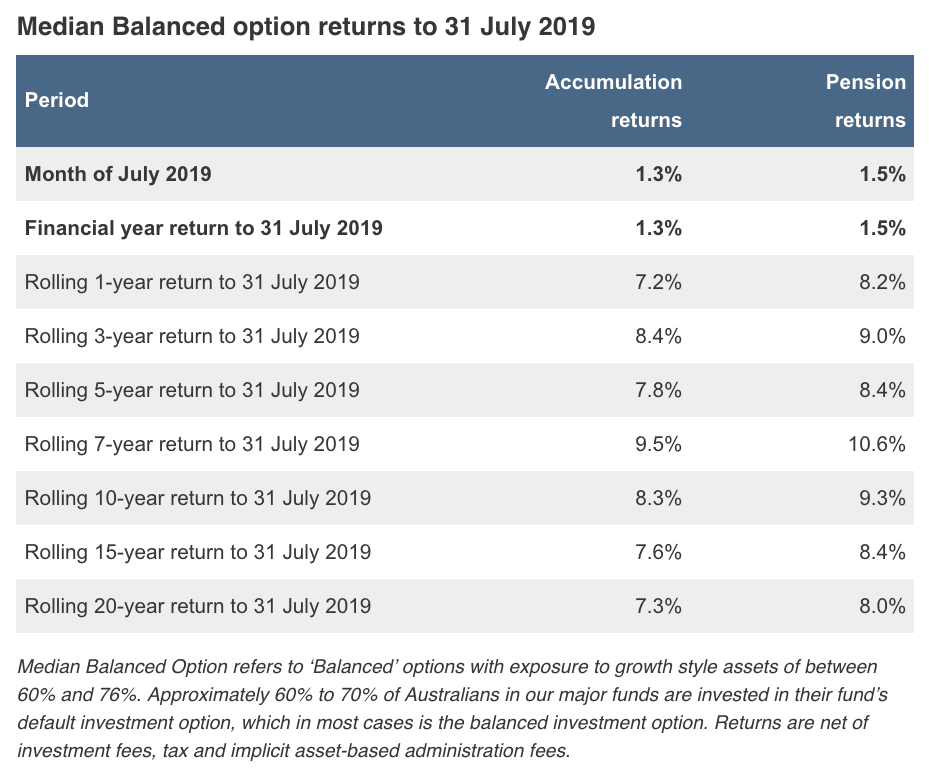
AustralianSuper’s balanced option remains on top of the long-term returns chart, delivering 9.6% p.a. over the 10 years to the end of 31 July 2019, followed closely by Hostplus on 9.5% p.a. and UniSuper on 9.4%.

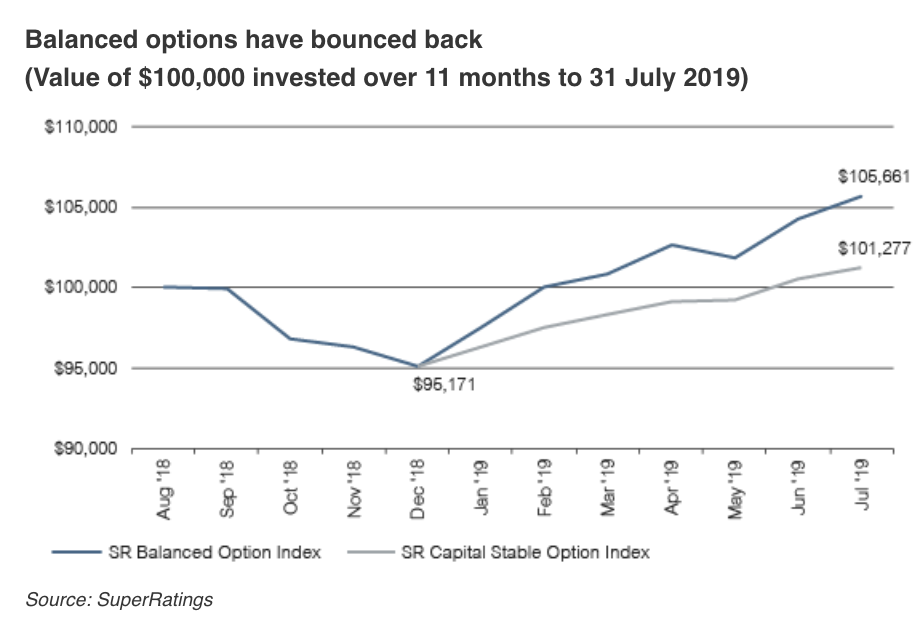
The SR50 Balanced Index took a dive in the December quarter of 2018, only to rebound strongly through to the end of July 2019. Switching to a capital stable option at the end of December would have meant missing out on $4,384 by the end of July (for a starting account balance of $100,000).
“The lesson for investors in the current market environment is that switching in response to short-term market movements is not a good idea,” said SuperRatings Executive Director Kirby Rappell.
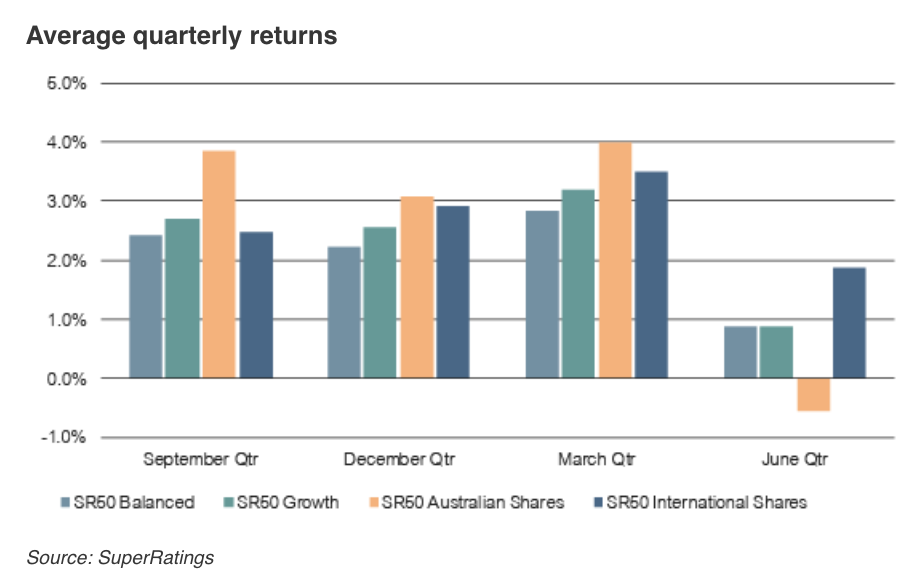
Historically, the June quarter is the most challenging period for super, so members might be breathing a sigh of relief. Whether the worst of recent volatility is over remains to be seen, but members have reason to be optimistic. As the chart below shows, the September quarter has delivered an average return of 2.4% over the past decade, compared to the average June quarter return of 0.9%. For growth options and options focused on Australian or international shares, the results are even more pronounced. Australian share options returns have averaged 3.9% in the September quarter and -0.6% in the June quarter.
“There are certainly some significant challenges facing markets at the moment and investors are forced to deal with a constantly shifting narrative,” said Mr Rappell.
“One of the key challenges facing funds and especially retirees at the moment is record low interest rates in Australia and the continual drop in bond yields. Lower interest rates mean retirees receive less income from annuities while investors start looking for riskier assets to add to their portfolio to generate the desired yield.”


