

The year ahead…
The past year: 2020/21
- With just over a week to go to the end of the financial year, it is opportune to reflect on the past year. Data is up to June 18 for most indicators.
- In 2019/20 Australia experienced its first recession in 28 years – impacted by the COVID-19 coronavirus as well as drought, bushfires and storms. But over 2020/21 the Australian economy has experienced the sharpest recovery since the 1970s due to the relative success in suppressing the COVID-19 virus as well as the speed and size of economic stimulus and support supplied by all levels of government and the Reserve Bank.
- The cash rate is ending 2020/21 at a record low 0.1 per cent; the Aussie dollar is near US75 cents; unemployment stands at 5.1 per cent; annual inflation is 1.1 per cent; the S&P/All Ordinaries has so far lifted 27 per cent on the year; and the S&P/ASX 200 index is up 25 per cent for the year. Total returns on shares (includes dividends) are up by over 30 per cent in 2020/21.
The year ahead: 2021/22
- As we enter 2021/22, it is clear that COVID-19 still dominates the landscape. The bad news is that countries are still experiencing virus break-outs. The good news is that effective vaccines are being distributed across the globe.
- The economic outlook will clearly be dictated by the virus and its variants, and how quickly the vaccines can stem case numbers and allow economies to start repairing.
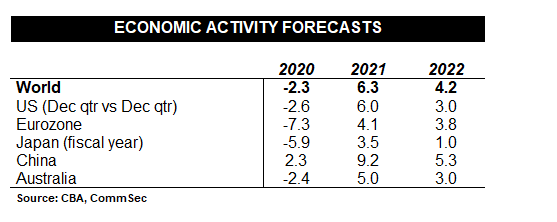
- After contracting an estimated 2.3 per cent in 2020, the global economy is tipped to rebound by 6.3 per cent in 2021. On the same basis, the Australian economy is tipped by Commonwealth Bank (CBA) Group economists to grow by 5.0 per cent in 2021 after contracting 2.4 per cent in calendar 2020.
- The Reserve Bank (RBA) doesn’t expect to start lifting the cash rate until 2024 at the earliest. There are basically three pre-conditions for rates to rise. The Reserve Bank wants to see annual inflation sustainably between 2-3 per cent; it wants to see growth in annual wage lifting to 3 per cent; and the RBA is aiming for full employment – targeting a jobless rate near 4 per cent.
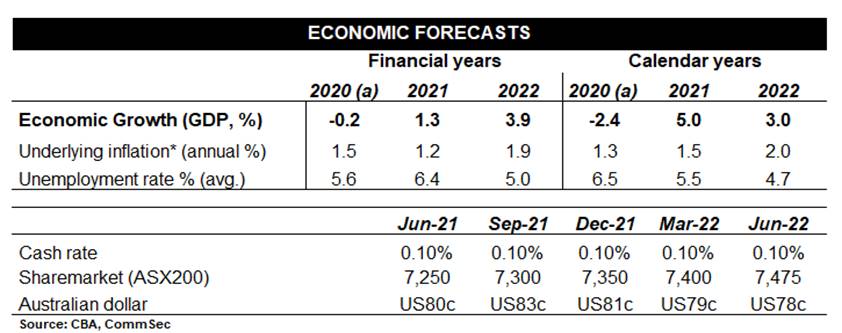
- Unemployment is the focal point of all monetary and fiscal policy actions. CBA Group economists expect that the jobless rate to ease to 5.0 per cent by the end of 2021 and ease further to 4.7 per cent by the end of 2022. Underlying inflation is expected to broadly hold near 1-1.5 per cent over 2021.
Interest rates
- The cash rate has remained at a record low of 0.10 per cent since the RBA last cut the rate by 15 basis points on November 3, 2020.
- On November 3 the RBA announced:
- a reduction in the interest rate on new drawings under the Term Funding Facility to 0.1 per cent.
- a reduction in the interest rate on Exchange Settlement balances to zero.
- and the purchase of $100 billion of government bonds of maturities (also known as Quantitative Easing) of around 5 to 10 years over the next six months.
- On February 2, 2021 the RBA “decided to purchase an additional $100 billion of bonds issued by the Australian Government and states and territories when the current bond purchase program is completed in mid-April. These additional purchases will be at the current rate of $5 billion a week.”
- The market-determined 90-day bank bill rate fell from highs near 0.1056 per cent in July 2020 to record lows of 0.0097 per cent in February and yields are ending 2020/21 near 0.0213 per cent.
- Yields on the long bond – 10-year government bond – held in a range of 0.75 per cent to 1.85 per cent and yields are ending the year at 1.55 per cent. The low yield of 0.75 per cent was set on November 5, 2020.
Exchange rates
- The Aussie dollar has lifted around 10 per cent against the greenback over 2020/21. The Aussie started the year around US69 cents and is ending the year near US75 cents. The Aussie hit 3-year highs of US79.70 cents on February 25, 2021, while the year’s low of US68.95 cents was set on July 1, 2020.
- The Aussie has been supported by solid economic data, rising commodity prices (especially iron ore) and improved risk sentiment on the global economy.
- Over 2020/21 the Aussie has eased against pound sterling (-3.0 per cent); and the Canadian dollar (-0.6 per cent). The Aussie has risen against the Japanese yen (+12.2 per cent); NZ dollar (+0.9 per cent); Chinese yuan (+0.1 per cent); Swiss Franc (+4.9 per cent) and the Euro (+3.6 per cent). On a trade weighted basis the Aussie has lifted by 4.5 per cent.
Sharemarkets
- At the start of July 2020, the Australian All Ordinaries index stood at 6,001.3 with the ASX 200 at 5,897.9. The All Ordinaries is ending 2020/21 near 7,624, up 27 per cent. The ASX 200 ended the year at 7,369, up 25 per cent. The All Ordinaries first regained record highs on April 14, 2021 while the ASX 200 lifted to fresh record highs on May 10.
- Movements of other key markets over the financial year so far: US Dow Jones (+29 per cent); US S&P500 (+34.4 per cent); US Nasdaq (+39.5 per cent); Japan Nikkei (+30 per cent); UK FTSE (+13.7 per cent); German Dax (+25.5 per cent).
- The world index (MSCI) excluding Australia in US dollar terms has risen 34.1 per cent so far in 2020/21. The MSCI Australia index in US dollar terms has risen by 36.7 per cent.
Australia sharemarket sectors and asset returns
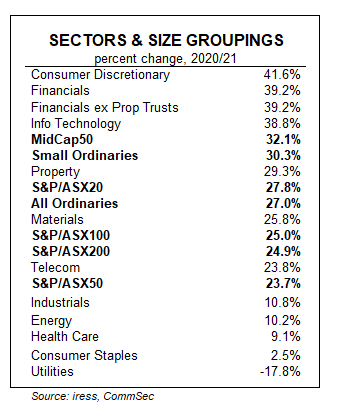
- Australia’s Consumer Discretionary sector has out-performed so far in 2020/21. Consumer Discretionary shares have risen by 41.6 per cent over the year, ahead the Financials sector (+39.2 per cent) and Information Technology (+38.8 per cent).
- At the other end of the scale, the Utilities sector has fallen by 17.8 per cent while Consumer Staples has lifted just 2.5 percent and Health Care has risen by 9.1 per cent.
- Of the size groupings, the MidCap50 has out-performed (+32.1 per cent) from the Small Ordinaries (+30.3 per cent). The S&P/ASX20 has lifted by 27.8 per cent while the S&P/ASX50 has recorded the smallest gain – up 23.7 per cent.
- Total returns on Australian shares (All Ords Accumulation index) have lifted 30.7 per cent so far in 2020/21. The cash rate stands at 0.1 per cent while bond returns (Bloomberg AusBond Govt 0+ Yr index) are down 1.7 per cent. And residential property (CoreLogic Home Value index) returned 14.3 per cent in the year to May.
Commodity prices
- The CommSec daily commodity index has lifted 89 per cent in 2020/21 in US dollar terms. Over the same period the Aussie dollar rose by around 10 per cent.
- The Reserve Bank commodity index in US dollar terms (using spot prices for bulk commodities) was up by 60.3 per cent in the year to May. Bulk commodity spot prices were up 98.3 per cent over the period while rural commodity prices (us dollar terms) were up by 24.5 per cent.
- In contrast, the CRB futures commodity index has risen by 48 per cent so far over 2020/21.
- One of the stand-out gains from an Australian perspective have been natural gas (up 450 per cent), thermal coal (up 139.7 per cent), iron ore (up 115 per cent), crude oil (up 82.4 per cent) and coking coal (up 69.2 per cent).
- At the other end of the scale, rice has fallen by 8.5 per cent, followed by gold (down 1.7 per cent).
Outlook 2021/22
- The Australian economy continues to surprise and much has to do with the strength of the job market. The latest data shows that a stunning 115,200 jobs were created in just the month of May. Employment is back at record highs – recovering all pandemic losses – in fact it is one of only a few economies to have achieved that feat.
- The jobless rate now stands at 5.1 per cent, a 17-month low. In fact the reduction in the jobless rate over the past six months has been a record for any similar period. And monthly data extends back to 1978. The underutilisation rate stands at an 8-year low of 12.5 per cent (lowest since February 2013). The underemployment rate stands at 7.4 per cent – a 7-year low.
- Reduction of the jobless rate is regarded a “national priority”. And there is good scope for unemployment to fall further given that job vacancies stand at 12½-year highs. This is just not important in terms of the spending power of the newly employed, but also the boost to confidence of those people in jobs.
- We had expected the jobless rate to end 2021 at 5 per cent and fall further to 4.7% by end 2022. Those forecasts do appear too conservative now. But the speed of improvement in the job market is likely to slow. Not because of less stimulatory conditions – the Reserve Bank and Federal Government are committed to leave stimulatory conditions in place. But because structural issues will make it harder to chip away at the jobless rate.
- Across a raft of sectors, businesses are finding it harder to find suitable workers. There are likely to more examples of visas being granted to migrants to fill skill shortages.
- Overall we expect the Australian economy to grow by 5 per cent in 2021/22 after contracting by an estimated 1.4 per cent in 2020/21. Risks to the forecasts include virus outbreaks; slow vaccine take up or vaccine shortages; policy mistakes on the removal of support measures; Chinese political tensions and extended delays in the re-opening of foreign borders.
- While the annual rate of headline inflation is expected to spike to 3.0-3.5 per cent in the June quarter, underlying inflation is expected to remain below the Reserve Bank’s (RBA) 2-3 per cent target band. After averaging 1.2 per cent in 2020/21, trimmed mean inflation is expected to average 1.9 per cent in 2021/22.
- The RBA remains committed to leave the cash rate at 0.10 per cent through to 2024. The big question is what happens if unemployment continues to surprise on the downside and wage and price inflation surprises on the upside.
- The RBA wants to see the jobless rate fall to the “full employment” level near 4 per cent. Only when it is near these levels will the hoped-for wage growth of around 3 per cent materialise.
- And only when these conditions hold does the RBA expect inflation to sustainably hold between 2-3 per cent. And the RBA doesn’t expect all this to occur until 2024 at the earliest.
- Turning to the housing market, a record number of homes will be built in 2021. And this increased supply, together with the restraint on demand through the closure of the foreign borders will serve to slow the pace of home prices. That said, CBA Group economists still expect national home prices to lift by a combined 14 per cent in 2020 and 2021.
- The Australian sharemarket has performed strongly over the past few months. Clearly this is explained by the success that fiscal and monetary stimulus has achieved in driving growth and securing improvement in the job market. Stronger global growth has also boosted commodity demand and prices, supporting the mining sector.
- While we expect further gains for the S&P/ASX 200 over the coming year, there will almost certainly be periods of correction and consolidation reflecting inflation and interest rate jitters and any local or global setbacks in reducing Covid-19 base numbers.
- We conservatively forecast the ASX 200 index to be at 7,475 points in June 2022.
- Turning to the Australian dollar, the currency is expected to remain supported by strength of the global economy. The global economy is expected to lift 6.3 per cent in 2021, and 4.2 per cent in 2022.
- More economies are expected to join China in lifting spending on infrastructure, further underpinning demand for metals and ores.
- In June 2022 CBA currency strategists expect the Aussie dollar to be near US78 cents. Upside risks include faster-than-expected re-opening of foreign borders reflecting virus control and vaccine take-up.
- However should the US Federal Reserve reduce stimulus earlier than the Reserve Bank, that could serve to boost the greenback and put downward pressure on the A$/US$ exchange rate.
- Clearly this is an evolving situation – and like most forecasts – reflects the uncertainties related to the once-in-a-century pandemic.


