
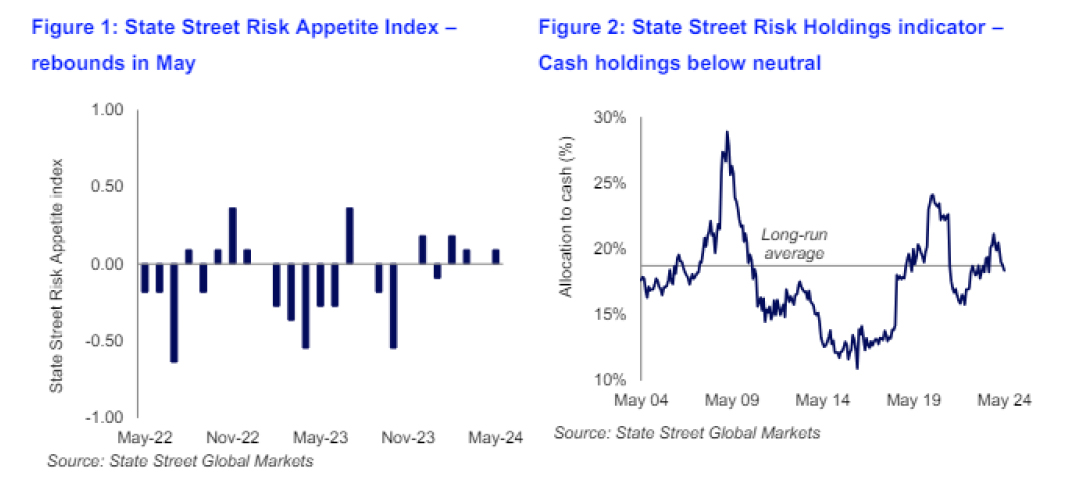
The State Street Risk Appetite Index bounced back to 0.09 in May revealing a modest risk on bias across the month (see Figure 1).
Institutional investors on balance still saw the glass as half full in May. The aggregate allocation to equities at the expense of cash points to a clear desire to maintain risk budgets. Within this moderate risk on environment long-term investors began to reassess their USD overweight once again and rediscovered their appetite for higher yielding FX and fixed income instruments.
“At the same time, however, there is also clear hesitation on cyclically exposed assets both in equities and commodity exposures. There was also significant dispersion in risk preference across emerging markets, where demand for Chinese equities continues to be robust, but investors lightened their holdings of Indian equities ahead of the election,” highlights Michael Metcalfe, Head of Macro Strategy at State Street Global Markets.
The State Street Holdings Indicators showed that long-term investor allocations to equities rose 33bps to 53.7% as cash holdings fell a further 0.4 percentage points to 18.4%. This is the first time in tenth months cash holdings are below their long-term average (see Figure 2 overleaf). This left fixed income holdings largely unchanged after their sharp rise last month.
“The trends in State Street’s holdings indicators were encouraging in May. Despite mixed macro news investors allowed their allocation to equities to drift higher alongside market price movements. The aggregate allocation to equities is now at its highest level since June 2008. This month the move into equities was entirely funded by allowing a further fall in cash allocations, which have slipped to a ten-month low and are now below their long-run average.
“The early indication here is that despite ongoing uncertainties surrounding the outlook, investors are willing to run cash allocations at below average levels to take advantage of the return opportunities in either fixed income or equity markets. As vulnerable as equities look with such a high allocation, the changes in allocations in May were nevertheless encouraging,” added Mr Metcalfe.
About the indicators
The Institutional Investor Indicators (the three i’s) were developed at State Street Associates, State Street Global Markets research and advisory services business. They measure investor confidence or risk appetite quantitatively by analyzing the actual buying and selling patterns of institutional investors derived from State Street’s USD42trn1 in assets under custody and administration (note not investors’ balances held at State Street itself). The Risk Appetite Index is derived from measuring investor flows in twenty-two different dimensions of risk across equities, FX, fixed income, commodity-linked assets, and asset allocation trends. The index captures the proportion of the twenty-two risk elements that saw either risk seeking or risk reducing behavior. A positive reading suggests that on balance investors are adding to their risk exposures, while a negative reading suggests risk reduction. State Street’s holdings indicators capture the share of investor portfolios allocated toward equity, fixed income and cash going back to 1998.
———-


